14 results for "Physics"

The men who stare at goats

Ronson, Jon
In 1979 a secret unit was established by the most gifted minds within the U.S. Army. Defying all known accepted military practice -- and indeed, the laws of physics -- they believed that a soldier could adopt a cloak of invisibility, pass cleanly through walls, and, perhaps most chillingly, kill goats just by staring at them. Entrusted with defending America from all known adversaries, they were the First Earth Battalion. And they really weren't joking. What's more, they're back and fighting the War on Terror. With firsthand access to the leading players in the story, Ronson traces the evolution of these bizarre activities over the past three decades and shows how they are alive today within the U.S. Department of Homeland Security and in postwar Iraq. Why are they blasting Iraqi prisoners of war with the theme tune to Barney the Purple Dinosaur? Why have 100 debleated goats been secretly placed inside the Special Forces Command Center at Fort Bragg, North Carolina? How was the U.S. military associated with the mysterious mass suicide of a strange cult from San Diego? "The Men Who Stare at Goats" answers these and many more questions. Ronson's "Them: Adventures with Extremists," a highly acclaimed international bestseller, examined the paranoia at the fringes of hate-filled extremist movements around the globe. "The Men Who Stare at Goats" reveals extraordinary and very nutty military secrets at the core of George W. Bush's War on Terror.
Simon & Schuster 2006 259 pages

The road to relativity: the history and meaning of Einstein's "The foundation of general relativity" featuring the original manuscript of Einstein's masterpiece

Gutfreund, Hanoch,Renn, Jürgen
This richly annotated facsimile edition of "The Foundation of General Relativity" introduces a new generation of readers to Albert Einstein's theory of gravitation. Written in 1915, this remarkable document is a watershed in the history of physics and an enduring testament to the elegance and precision of Einstein's thought. Presented here is a beautiful facsimile of Einstein's original handwritten manuscript, along with its English translation and an insightful page-by-page commentary that places the work in historical and scientific context. Hanoch Gutfreund and Jürgen Renn's concise introduction traces Einstein's intellectual odyssey from special to general relativity, and their essay "The Charm of a Manuscript" provides a delightful meditation on the varied afterlife of Einstein's text. Featuring a foreword by John Stachel, this handsome edition also includes a biographical glossary of the figures discussed in the book, a comprehensive bibliography, suggestions for further reading, and numerous photos and illustrations throughout.
Princeton University Press 2015 237 pages

The trouble with physics: the rise of string theory, the fall of a science, and what comes next

Smolin, Lee
In this illuminating book, the renowned theoretical physicist Lee Smolin argues that fundamental physics -- the search for the laws of nature -- losing its way. Ambitious ideas about extra dimensions, exotic particles, multiple universes, and strings have captured the public’s imagination -- and the imagination of experts. But these ideas have not been tested experimentally, and some, like string theory, seem to offer no possibility of being tested. Yet these speculations dominate the field, attracting the best talent and much of the funding and creating a climate in which emerging physicists are often penalized for pursuing other avenues. As Smolin points out, the situation threatens to impede the very progress of science. With clarity, passion, and authority, Smolin offers an unblinking assessment of the troubles that face modern physics -- and an encouraging view of where the search for the next big idea may lead.
Houghton Mifflin 2007 392 pages

The Pope of Physics Enrico Fermi and the Birth of the Atomic Age

Gino Segrè,Bettina Hoerlin
A New York Times Book Review Editors’ Choice Named a Best Book of the Year by Bloomberg (Chosen by Philip Tetlock), Booklist ’s Top 10 Science Books of the Year, and Shortlisted for Physics World ’s Book of the Year A Major Biography of the Nobel Prize–Winning Physicist, Enrico Fermi, a Leading Architect of the Atomic Age Enrico Fermi is unquestionably among the greats of the world’s physicists, the most famous Italian scientist since Galileo. Called “the Pope” by his peers, he was regarded as infallible in his instincts and research. His discoveries changed our world; they led to weapons of mass destruction and conversely to life-saving medical interventions. This unassuming man struggled with issues relevant today, such as the threat of nuclear annihilation and the relationship of science to politics. Fleeing Fascism and anti-Semitism, Fermi became a leading figure in America’s most secret project: building the atomic bomb. An examination of the human dramas that touched Fermi’s life as well as a thrilling history of scientific innovation in the twentieth century, this is the comprehensive biography that Fermi deserves.
Picador 2017-10-10 384 pages

The formative years of relativity : $b the history and meaning of Einstein's Princeton lectures : featuring Einstein's classic text The meaning of relativity in its historical context

Gutfreund, Hanoch,Renn, Jürgen
First published in 1922 and based on lectures delivered in May 1921, Albert Einstein's The Meaning of Relativity offered an overview and explanation of the then new and controversial theory of relativity. The work would go on to become a monumental classic, printed in numerous editions and translations worldwide. Now, The Formative Years of Relativity introduces Einstein's masterpiece to new audiences. This beautiful volume contains Einstein's insightful text, accompanied by important historical materials and commentary looking at the origins and development of general relativity. Hanoch Gutfreund and Jürgen Renn provide fresh, original perspectives, placing Einstein's achievements into a broader context for all readers. In this book, Gutfreund and Renn tell the rich story behind the early reception, spread, and consequences of Einstein's ideas during the formative years of general relativity in the late 1910s and 1920s. They show that relativity's meaning changed radically throughout the nascent years of its development, and they describe in detail the transformation of Einstein's work from the esoteric pursuit of one individual communicating with a handful of colleagues into the preoccupation of a growing community of physicists, astronomers, mathematicians, and philosophers. This handsome edition quotes extensively from Einstein's correspondence and reproduces historical documents such as newspaper articles and letters
Princeton University Press 2017-09-26 415 pages

Conversations with Carl Sagan

Sagan, Carl
Though a well-regarded physicist Carl Sagan (1934-1996) is best-known as a writer of popular nonfiction and science fiction and as the host of the PBS series Cosmos . Through his writings and spoken commentary, he worked to popularize interests in astronomy, the universe, and the possibility of extraterrestrial life. From the beginning of his public career, when he co-wrote Intelligent Life in the Universe to the very end as he worked on the 1997 film adaptation of his novel Contact , these subjects absorbed him. This interest in space was rooted in his understanding of the smallness and vulnerability of humanity measured against the immense size and power of the universe. This profound philosophical humility, mixed with personal exuberance, comes through in Conversations with Carl Sagan . In interviews and profiles, Sagan discusses with verve a wide variety of topics--the environment, nuclear disarmament, religion, politics, extraterrestrial life, astronomy, physics, robotics. Whether he is discussing his science fiction or his well-researched nonfiction works, his voice embraces reason and skepticism. This volume shows how Sagan, a lifelong skeptic, refined his views and expressed amazement that Earth, for all his belief in extraterrestrial life, encompasses everything about which he cared. Tom Head of Jackson, Mississippi, is a writer and poet whose work includes Women and Families (Voices from the Civil War) , Possessions and Exorcisms (Fact or Fiction?) , and 1966 (The Turbulent 60s) .
University Press of Mississippi 2006 167 pages

Uranium wars: the scientific rivalry that created the nuclear age

Aczel, Amir D.
Called "one of our best science popularizers" by Publishers Weekly , Amir D. Aczel tackles the cause of one of last century's most destructive events--the scientific discovery of nuclear power. Drawing on his rich storytelling skills, Aczel presents the fascinating and suspenseful story of the scientists who first uncovered the potential of uranium. Uranium Wars takes the reader on a whirlwind tour of 1920s Europe where the scientific elite of the day were embroiled in a fierce rivalry to achieve nuclear fission. Leading us to an understanding of both the processes that take place inside a uranium nucleus and its destructive power are the brilliant men and women at the heart of the race--mammoth figures such as Marie Curie, Enrico Fermi, and Lise Meitner. Enmeshed in the story of scientific intrigue is the complex and ongoing story of uranium itself, which Aczel presents as a dynamic, dual natured force, capable of providing both abundant usable energy and generating unfathomable destructive power. From the nuclear programs in the Middle East to plans for nuclear reactors at home, the element uranium is never far from today's headlines.
Palgrave Macmillan 2010-11-09 256 pages

Philosophy in an age of science: physics, mathematics, and skepticism

Putnam, Hilary
Hilary Putnam's unceasing self-criticism has led to the frequent changes of mind he is famous for, but his thinking is also marked by considerable continuity. A simultaneous interest in science and ethics - unusual in the current climate of contention - has long characterized his thought. In "Philosophy in an Age of Science", Putnam collects his papers for publication - his first volume in almost two decades. Mario De Caro and David Macarthur's introduction identifies central themes to help the reader negotiate between Putnam past and Putnam present: his critique of logical positivism; his enduring aspiration to be realist about rational normativity; his anti-essentialism about a range of central philosophical notions; his reconciliation of the scientific worldview and the humanistic tradition; and his movement from reductive scientific naturalism to liberal naturalism. Putnam returns here to some of his first enthusiasms in philosophy, such as logic, mathematics, and quantum mechanics. The reader is given a glimpse, too, of ideas currently in development on the subject of perception. Putnam's work, contributing to a broad range of philosophical inquiry, has been said to represent a "history of recent philosophy in outline."
Harvard University Press 2012-04-17 659 pages

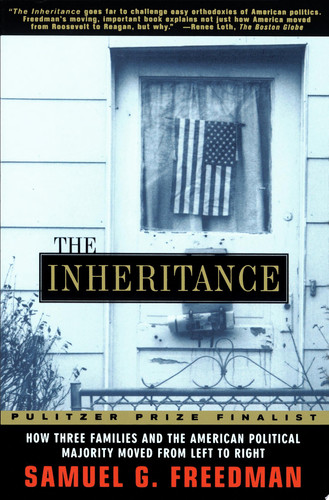
The inheritance: how three families and America moved from Roosevelt to Reagan and beyond

Freedman, Samuel G.
Orphan in the new world (Silvio Burigo) -- Liverpool on the Hudson (Lizzie Sanford Garrett) -- The dreamer and his son (Joseph Obrycki) -- The sewing room (Lizzie Garrett) -- The physics of cynicism (Joseph Obrycki) -- Worth two (Silvio Burigo) -- Voices from downstairs (Richie Garrett) -- Recessive genes (Silvio Burigo/Lorraine and Frank Trotta) -- Address as destiny (Vilma and Jack Maeby) -- Fence and basement (Silvio Burigo/Lorraine and Frank Trotta) -- Senator Clearwater (Richie Garrett) -- Uncle Paulie's Porch (Frank Trotta Jr.) -- The State Street Gang (Leslie Maeby) -- Poor snob (Tim Carey) -- Enchantment and its opposite (Frank Trotta Jr.) -- Incumbent protection (Leslie Maeby) -- Red suspenders (Tim Carey).
Simon & Schuster 1996 464 pages

Fin de siècle and its legacy

Mikulas Teich,Roy Porter
For many years the term fin de siècle has been used to imply a state of decadence which was thought to have pervaded 'civilised' European society in the years around 1900. This volume of essays, which draw on a very wide range of disciplines, argues that the period was in fact one of dramatic change, essentially positive and forward-looking in character. This was the period of the rise of the giant corporation, of mass production and mass consumption, and of the development of the generation and distribution of electrical energy. Novel social features such as mass politics, mass media, and mass sport involved the body of ordinary people and in the arts, complex reactions to contemporary social reality were aroused and expressed. This was also the period which gave birth to the study of quantum mechanics, relativity physics, mental processes and genetics. This volume forms part of a sequence of collections of essays which began with The Enlightenment in National Context (1981) and has continued with Romanticism in National Context (1988). They bring together comparative, national and interdisciplinary approaches to the history of great movements in the development of human thought and actions.
Cambridge University Press 1990-12-13 345 pages

An anxious peace: a Cold War memoir

Mark, Hans
By any measure, Hans Mark was a warrior of the Cold War. Born in Mannheim, Germany, in 1929, he spent his early childhood in Vienna before escaping the Nazi Anschluss in 1938 and eventually emigrating to the United States, settling in New York. He graduated from high school in 1947, went west to attend the University of California, Berkeley, and later earned a PhD in physics from MIT. His work in nuclear engineering soon set him on a path that would be shaped by aeronautics, space exploration, and national defense. It was through advanced technology that Mark believed the United States could win the Cold War. In An Anxious Peace , Mark recounts in detail his life as a twentieth-century “rocket man.” Here is the inside story of one who—in a career spanning more than six decades—was on the technological front line, from long-range bombers to the space shuttle. Along the way, Mark reveals many never-before-told stories from life at NASA and more. Readers will revel in learning the background behind the decision to place a plaque on Pioneer 10 , a space probe that the NASA Ames Research Center designed to fly past the asteroid belt, Jupiter, and Saturn to collect data and images. Mark tells how he, Carl Sagan, and NASA insider John Naugle kept secret the addition of the now iconic 6x9-inch aluminum “message from humanity” until the probe had been launched. To this day Mark is pushing for a manned mission to Mars. One thing is sure: Hans Mark has left a major impact on academic and scientific communities that will be felt for decades to come.
Texas A&M University Press 2019-04-23 676 pages

Sadness and happiness: poems

Pinsky, Robert
From Sadness and Happiness: Poems by Robert Pinsky : CEREMONY FOR ANY BEGINNING Robert Pinsky ? Against weather, and the random Harpies--mood, circumstance, the laws Of biography, chance, physics-- The unseasonable soul holds forth, Eager for form as a renowned Pedant, the emperor's man of worth, Hereditary arbiter of manners. Soul, one's life is one's enemy. As the small children learn, what happens Takes over, and what you were goes away. They learn it in sardonic soft Comments of the weather, when it sharpens The hard surfaces of daylight: light Winds, vague in direction, like blades Lavishing their brilliant strokes All over a wrecked house, The nude wallpaper and the brute Intelligence of the torn pipes. Therefore when you marry or build Pray to be untrue to the plain Dominance of your own weather, how it keeps Going even in the woods when not A soul is there, and how it implies Always that separate, cold Splendidness, uncouth and unkind-- On chilly, unclouded mornings, Torrential sunlight and moist air, Leafage and solid bark breathing the mist.
Princeton University Press 1975-12-21 74 pages