36 results for "Physics"

The road to reality: a complete guide to the laws of the universe

Penrose, Roger
This guide to the universe aims to provide a comprehensive account of our present understanding of the physical universe, and the essentials of its underlying mathematical theory. It attempts to convey an overall understanding--a feeling for the deep beauty and philosophical connotations of the subject, as well as of its intricate logical interconnections. While a work of this nature is challenging, no particular mathematical knowledge is assumed, the early chapters providing the essential background for the physical theories described in the remainder of the book. There is also enough descriptive material to carry the less mathematically inclined reader through, as well as some 450-500 figures. The book counters the common complaint that cutting-edge science is fundamentally inaccessible.
Vintage Books 2007-01-09 1099 pages

My life as a quant: reflections on physics and finance

Derman, Emanuel
In My Life as a Quant, Emanuel Derman relives his exciting journey as one of the first high-energy particle physicists to migrate to Wall Street. Page by page, Derman details his adventures in this field—analyzing the incompatible personas of traders and quants, and discussing the dissimilar nature of knowledge in physics and finance. Throughout this tale, he also reflects on the appropriate way to apply the refined methods of physics to the hurly-burly world of markets.
Wiley 2004 292 pages

Our mathematical universe: my quest for the ultimate nature of reality

Tegmark, Max
"Max Tegmark leads us on an astonishing journey through past, present, and future, and through the physics, astronomy and mathematics that are the foundation of his work, most particularly his hypothesis that our physical reality is a mathematical structure and his theory of the ultimate multiverse. In a dazzling combination of both popular and ground-breaking science, he not only helps us grasp his often mind-boggling theories (his website gives a flavor of how they might boggle the mind), but he also shares with us some of the often surprising triumphs and disappointments that have shaped his life as a scientist. Fascinating from first to last--here is a book for the full science-reading spectrum"--
Alfred A. Knopf 2014 421 pages

A project to find the fundamental theory of physics

Wolfram, Stephen
'In many ways it s the ultimate question in natural science: How does our universe work? Is there a fundamental theory? An incredible amount has been figured out about physics over the past few hundred years. But even with everything that s been done and it's very impressive - we still, after all this time, don t have a truly fundamental theory of physics.' The Wolfram Physics Project is a bold effort to find the fundamental theory of physics. It combines new ideas with the latest research in physics, mathematics and computation in the push to achieve this ultimate goal of science. Written with Stephen Wolfram's characteristic expository flair, this book provides a unique opportunity to learn about a historic initiative in science right as it is happening. A Project to Find the Fundamental Theory of Physics includes: The announcement of the project; A technical introduction; A history section that outlines the backstory which led Wolfram to this point; Background information from computational essays published by the author in 2015 and 2017; Foundational information, including historical notes and an excerpt from Wolfram's; 2002 New York Times Best Seller A New Kind of Science; Hundreds of beautiful full-colour visualisations. Stephen Wolfram is a distinguished scientist and best-selling author, and the creator of some of the world's most respected software systems, including Mathematica, Wolfram|Alpha and Wolfram Language. For more than 30 years he has been the CEO of the global technology company Wolfram Research.
Wolfram Media 2020 778 pages

The Nature of Mathematical Modeling (Cambridge Series on Information and the Natural Sciences)

Gershenfeld, Neil
This book first covers exact and approximate analytical techniques (ordinary differential and difference equations, partial differential equations, variational principles, stochastic processes); numerical methods (finite differences for ODE's and PDE's, finite elements, cellular automata); model inference based on observations (function fitting, data transforms, network architectures, search techniques, density estimation); as well as the special role of time in modeling (filtering and state estimation, hidden Markov processes, linear and nonlinear time series). Each of the topics in the book would be the worthy subject of a dedicated text, but only by presenting the material in this way is it possible to make so much material accessible to so many people. Each chapter presents a concise summary of the core results in an area, providing an orientation to what they can (and cannot) do, enough background to use them to solve typical problems, and pointers to access the literature for particular applications.
Cambridge University Press 2011-09-30

The Cosmic Landscape String Theory and the Illusion of Intelligent Design

Leonard Susskind
The beginning of the 21st century is a watershed in modern science, a time that will forever change our understanding of the universe, Susskind contends. Several decades ago, he introduced the revolutionary concept of string theory to the world of physical science. In doing so, he inspired a generation of physicists who believed that the theory would uniquely predict the properties of our universe. Now, in his first book, Susskind argues that the very idea of such an "elegant theory" no longer suits our understanding of the universe, and that our narrow 20th-century view of a unique universe will have to give way to the much broader concept of a gigantic cosmic landscape--a megaverse, pregnant with new possibilities.--[Résumé de l'éditeur].
Little, Brown 2006-12-01 403 pages

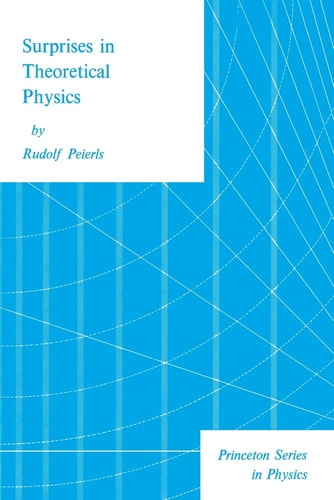
Surprises in theoretical physics

Peierls, Rudolf Ernst Sir
Problems in theoretical physics often lead to paradoxical answers; yet closer reasoning and a more complete analysis invariably lead to the resolution of the paradox and to a deeper understanding of the physics involved. Drawing primarily from his own experience and that of his collaborators, Sir Rudolf Peierls selects examples of such "surprises" from a wide range of physical theory, from quantum mechanical scattering theory to the theory of relativity, from irreversibility in statistical mechanics to the behavior of electrons in solids. By studying such surprises and learning what kind of possibilities to look for, he suggests, scientists may be able to avoid errors in future problems. In some cases the surprise is that the outcome of a calculation is contrary to what physical intuition seems to demand. In other instances an approximation that looks convincing turns out to be unjustified, or one that looks unreasonable turns out to be adequate. Professor Peierls does not suggest, however, that theoretical physics is a hazardous game in which one can never foresee the surprises a detailed calculation might reveal. Rather, he contends, all the surprises discussed have rational explanations, most of which are very simple, at least in principle. This book is based on the author's lectures at the University of Washington in the spring of 1977 and at the Institut de Physique Nucleaire, University de Paris-Sud, Orsay, during the winter of 1977-1978.
Princeton University Press 1979 166 pages

Surprises in theoretical physics

Peierls, Rudolf Ernst Sir
Problems in theoretical physics often lead to paradoxical answers; yet closer reasoning and a more complete analysis invariably lead to the resolution of the paradox and to a deeper understanding of the physics involved. Drawing primarily from his own experience and that of his collaborators, Sir Rudolf Peierls selects examples of such "surprises" from a wide range of physical theory, from quantum mechanical scattering theory to the theory of relativity, from irreversibility in statistical mechanics to the behavior of electrons in solids. By studying such surprises and learning what kind of possibilities to look for, he suggests, scientists may be able to avoid errors in future problems. In some cases the surprise is that the outcome of a calculation is contrary to what physical intuition seems to demand. In other instances an approximation that looks convincing turns out to be unjustified, or one that looks unreasonable turns out to be adequate. Professor Peierls does not suggest, however, that theoretical physics is a hazardous game in which one can never foresee the surprises a detailed calculation might reveal. Rather, he contends, all the surprises discussed have rational explanations, most of which are very simple, at least in principle. This book is based on the author's lectures at the University of Washington in the spring of 1977 and at the Institut de Physique Nucleaire, University de Paris-Sud, Orsay, during the winter of 1977-1978.
Princeton University Press 1979-11-21 166 pages

More surprises in theoretical physics

Peierls, Rudolf E.
Like its predecessor, this book by the renowned physicist Sir Rudolf Peierls draws from many diverse fields of theoretical physics to present problems in which the answer differs from what our intuition had led us to expect. In some cases an apparently convincing approximation turns out to be misleading; in others a seemingly unmanageable problem turns out to have a simple answer. Peierls's intention, however, is not to treat theoretical physics as an unpredictable game in which such surprises happen at random. Instead he shows how in each case careful thought could have prepared us for the outcome. Peierls has chosen mainly problems from his own experience or that of his collaborators, often showing how classic problems can lend themselves to new insights. His book is aimed at both graduate students and their teachers. Praise for Surprises in Theoretical Physics: "A beautiful piece of stimulating scholarship and a delight to read. Physicists of all kinds will learn a great deal from it."--R. J. Blin-Stoyle, Contemporary Physics
Princeton University Press 1991-09 106 pages

Mathematics for the physical sciences.

Schwartz, Laurent
This exploration of the mathematical methods of physics takes a careful look at mathematical entities and explains their elementary properties. Its examples, drawn from the physical sciences, illustrate the application of concepts. The theory of distributions is introduced early and employed throughout the text. Concise rather than comprehensive, this text states only essential results in its proofs. Topics include preliminary results in the integral calculus, elementary theory of distributions, convolution, Fourier series and the Fourier transform, the Laplace transform, wave and heat conduction equations, the gamma function, and Bessel functions. Prerequisites include a familiarity with linear algebra and functions of a complex variable.
Addison-Wesley 1966 358 pages

Quantum Mechanics: Symbolism of Atomic Measurements

Schwinger, Julian
Prologue.- A. Fall Quarter: Quantum Kinematics.- 1 Measurement Algebra.- 2 Continuous q, p Degree of Freedom.- 3 Angular Momentum.- 4 Galilean Invariance.- B. Winter Quarter: Quantum Dynamics.- 5 Quantum Action Principle.- 6 Elementary Applications.- 7 Harmonic Oscillators.- 8 Hydrogenic Atoms.- C. Spring Quarter: Interacting Particles.- 9 Two-Particle Coulomb Problem.- 10 Identical Particles.- 11 Many-Electron Atoms.- 12 Electromagnetic Radiation.
Springer 2014-03-12 500 pages

Approximate methods of higher analysis

Kantorovich, L. V.,Krylov, V. I.
A unique text and reference for pure and applied mathematicians, engineers, physicists, and chemists, this book was a landmark in the literature of computational methods in mathematical physics in the twentieth century. The treatment remains of great interest because of its thoroughness and scope. A valuable historic source for methods and approaches to problems of mathematical physics, this text is enhanced by many detailed, worked-out examples. Topics include methods based on the representation of the solution as an infinite series, the approximate solution of the integral equations of Swedish mathematician Erik Ivar Fredholm, the method of nets, and variational methods. Additional subjects include the conformal transformation of regions, principles of the application of conformal transformation to the solution of the fundamental problems for canonical regions, and Polish mathematician Dr. Hermann Schwarz's method.
Dover Publications, Inc 2018 681 pages

Spinors and space-time

Penrose, Roger
Spinor and Twistor Methods in Space-Time Geometry introduces the theory of twistors, and studies in detail how the theory of twistors and 2-spinors can be applied to the study of space-time. Twistors have, in recent years, attracted increasing attention as a mathematical tool and as a means of gaining new insights into the structure of physical laws. This volume also includes a comprehensive treatment of the conformal approach to space-time infinity with results on general-relativistic mass and angular momentum, a detailed spinorial classification of the full space-time curvature tensor, and an account of the geometry of null geodesics.
CUP 1984 501 pages

Green's functions and boundary value problems

Stakgold, Ivar
"This Third Edition includes basic modern tools of computational mathematics for boundary value problems and also provides the foundational mathematical material necssary to understand and use the tools. Central to the text is a down-to-earth approach that shows readers how to use differential and integral equations when tackling significant problems in the physical sciences, engineering, and applied mathematics, and the book maintains a careful balance between sound mathematics and meaningful applications. A new co-author, Michael J. Holst, has been added to this new edition, and together he and Ivar Stakgold incorporate recent developments that have altered the field of applied mathematics, particularly in the areas of approximation methods and theory including best linear approximation in linear spaces; interpolation of functions in Sobolev Spaces; spectral, finite volume, and finite difference methods; techniques of nonlinear approximation; and Petrov-Galerkin and Galerkin methods for linear equations. Additional topics have been added including weak derivatives and Sobolev Spaces, linear functionals, energy methods and A Priori estimates, fixed-point techniques, and critical and super-critical exponent problems. The authors have revised the complete book to ensure that the notation throughout remained consistent and clear as well as adding new and updated references. Discussions on modeling, Fourier analysis, fixed-point theorems, inverse problems, asymptotics, and nonlinear methods have also been updated"--
Wiley 2011-02-08 855 pages

Cosmic strings and other topological defects

Vilenkin, A.
This book is a comprehensive and coherent introduction to the role of cosmic strings and other topological defects in the universe. After an introduction to standard cosmological theory and the theory of phase transitions in the early universe, the book then describes, in turn, the properties, formation, and cosmological implications of cosmic strings, monopoles, domain walls and textures. It concludes with a chapter considering the role of topological defects in inflationary universe models. Ample introductory material is included to make the book readily accessible. It will be of interest to graduate students and researchers in particle physics, astrophysics and cosmology.
Cambridge University Press 1994 517 pages