52 results for "Physics"

Our mathematical universe: my quest for the ultimate nature of reality

Tegmark, Max
"Max Tegmark leads us on an astonishing journey through past, present, and future, and through the physics, astronomy and mathematics that are the foundation of his work, most particularly his hypothesis that our physical reality is a mathematical structure and his theory of the ultimate multiverse. In a dazzling combination of both popular and ground-breaking science, he not only helps us grasp his often mind-boggling theories (his website gives a flavor of how they might boggle the mind), but he also shares with us some of the often surprising triumphs and disappointments that have shaped his life as a scientist. Fascinating from first to last--here is a book for the full science-reading spectrum"--
Alfred A. Knopf 2014 421 pages

The Nature of Mathematical Modeling (Cambridge Series on Information and the Natural Sciences)

Gershenfeld, Neil
This book first covers exact and approximate analytical techniques (ordinary differential and difference equations, partial differential equations, variational principles, stochastic processes); numerical methods (finite differences for ODE's and PDE's, finite elements, cellular automata); model inference based on observations (function fitting, data transforms, network architectures, search techniques, density estimation); as well as the special role of time in modeling (filtering and state estimation, hidden Markov processes, linear and nonlinear time series). Each of the topics in the book would be the worthy subject of a dedicated text, but only by presenting the material in this way is it possible to make so much material accessible to so many people. Each chapter presents a concise summary of the core results in an area, providing an orientation to what they can (and cannot) do, enough background to use them to solve typical problems, and pointers to access the literature for particular applications.
Cambridge University Press 2011-09-30

Mathematical foundations of quantum mechanics

Von Neumann, John
Mathematical Foundations of Quantum Mechanics was a revolutionary book that caused a sea change in theoretical physics. Here, John von Neumann, one of the leading mathematicians of the twentieth century, shows that great insights in quantum physics can be obtained by exploring the mathematical structure of quantum mechanics. He begins by presenting the theory of Hermitean operators and Hilbert spaces. These provide the framework for transformation theory, which von Neumann regards as the definitive form of quantum mechanics. Using this theory, he attacks with mathematical rigor some of the general problems of quantum theory, such as quantum statistical mechanics as well as measurement processes. Regarded as a tour de force at the time of publication, this book is still indispensable for those interested in the fundamental issues of quantum mechanics.
Princeton University Press 1996 445 pages

Special Relativity and Classical Field Theory The Theoretical Minimum

Leonard Susskind,Art Friedman
A funny, insightful, and self-contained guide to Einstein's relativity theory and classical field theories--including electromagnetism Physicist Leonard Susskind and data engineer Art Friedman are back. This time, they introduce readers to Einstein's special relativity and Maxwell's classical field theory. Using their typical brand of real math, enlightening drawings, and humor, Susskind and Friedman walk us through the complexities of waves, forces, and particles by exploring special relativity and electromagnetism. It's a must-read for both devotees of the series and any armchair physicist who wants to improve their knowledge of physics' deepest truths.
Basic Books 2019-05-07 448 pages

Moral Calculations Game Theory, Logic, and Human Frailty

Laszlo Mero
Are people ever rational? Consider this: You auction off a one-dollar bill to the highest bidder, but you set the rules so that the second highest bidder also has to pay the amount of his last bid, even though he gets nothing. Would people ever enter such an auction? Not only do they, but according to Martin Shubik, the game's inventor, the average winning bid (for a dollar, remember) is $3.40. Many winners report that they bid so high only because their opponent "went completely crazy." This game lies at the intersection of three subjects of eternal fascination: human psychology, morality, and John von Neumann's game theory. Hungarian game-theorist Laszlo Mero introduces us to the basics of game theory, including such concepts as zero-sum games, Prisoner's Dilemma and the origins of altruism; shows how game theory is applicable to fields ranging from physics to politics; and explores the role of rational thinking in the context of many different kinds of thinking. This fascinating, urbane book will interest everyone who wonders what mathematics can tell us about the human condition.
Springer New York 2012-10-17 276 pages

Uncountable: a philosophical history of number and humanity from antiquity to the present

Nirenberg, David,Nirenberg, Ricardo L.
"From the time of Pythagoras, we have been tempted to treat numbers as the ultimate or only truth. This book tells the history of that habit of thought. But more, it argues that the logic of counting sacrifices much of what makes us human, and that we have a responsibility to match the objects of our attention to the forms of knowledge that do them justice. Humans have extended the insights and methods of number and mathematics to more and more aspects of the world, even to their gods and their religions.Today those powers are greater than ever, as computation is applied to virtually every aspect of human activity.But the rules of mathematics do not strictly apply to many things-from elementary particles to people-in the world.By subjecting such things to the laws of logic and mathematics, we gain some kinds of knowledge, but we also lose others. How do our choices about what parts of the world to subject to the logics of mathematics affect how we live and how we die?This question is rarely asked, but it is urgent, because the sciences built upon those laws now govern so much of our knowledge, from physics to psychology.Number and Knowledge sets out to ask it. In chapters proceeding chronologically from Ancient Greek philosophy and the rise of monotheistic religions to the emergence of modern physics and economics, the book traces how ideals, practices, and habits of thought formed over millennia have turned number into the foundation-stone of human claims to knowledge and certainty.But the book is also a philosophical and poetic exhortation to take responsibility for that history, for the knowledge it has produced, and for the many aspects of the world and of humanity that it ignores or endangers.To understand what can be counted and what can't is to embrace the ethics of purposeful knowing"--
University of Chicago Press 2021-10-20 420 pages

Aerodynamics

Theodore Von Karman
Aerodynamics by Theodore Von Karman is a classic textbook that provides a comprehensive introduction to the principles of aerodynamics. The book covers the fundamental concepts of fluid dynamics, including the behavior of gases and liquids, the equations of motion, and the principles of conservation of mass, momentum, and energy. It also explores the physics of aerodynamic forces, such as lift and drag, and the role of viscosity and turbulence in the flow of fluids. The book includes detailed discussions of various aerodynamic phenomena, such as boundary layers, shock waves, and vortices, and their impact on aircraft design and performance. It also covers the design and analysis of airfoils, wings, and other aerodynamic components, as well as the principles of aircraft stability and control. Written by one of the most renowned figures in the field of aerodynamics, this book is an essential resource for students and professionals in the aerospace industry, as well as anyone interested in the science of flight. With its clear explanations, extensive illustrations, and practical examples, Aerodynamics is a valuable reference for anyone seeking a deeper understanding of the principles that govern the behavior of fluids in motion.Selected Topics In The Light Of Their Historical Development.This scarce antiquarian book is a facsimile reprint of the old original and may contain some imperfections such as library marks and notations. Because we believe this work is culturally important, we have made it available as part of our commitment for protecting, preserving, and promoting the world's literature in affordable, high quality, modern editions, that are true to their original work.
Literary Licensing, LLC 2013-10 214 pages

Understanding Understanding Essays on Cybernetics and Cognition

Heinz von Foerster
In these essays Heinz von Foerster discusses some of the fundamental principles that govern how we know the world and how we process the information from which we derive that knowledge. Included are path- breaking articles concerning the principles of computation in neural nets (1967), the definition of self-organizing systems (1960), the nature of cognition (1970), as well as recent expansions on these themes (e.g. "How recursive is communication," 1993). Working with Norbert Wiener, Warren McCullough, and others in the 1960s and 1970s, von Foerster was one of the founders of the science of cybernetics, which has had profound effects both on modern systems theory and on the philosophy of cognition. At the Biological Computer Laboratory at the University of Illinois he produced the first parallel computers and contributed to many other developments in the theory of computation and cognition.
Springer New York 2010-10-15 362 pages

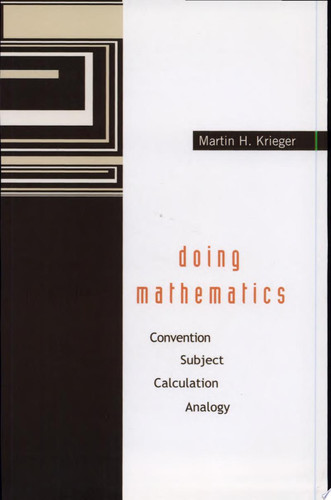
Doing mathematics: convention, subject, calculation, analogy

Krieger, Martin H.
This book discusses some ways of doing mathematical work and the subject matter that is being worked upon and created. It argues that the conventions we adopt, the subject areas we delimit, what we can prove and calculate about the physical world, and the analogies that work for mathematicians--all depend on mathematics, what will work out and what won't. And the mathematics, as it is done, is shaped and supported, or not, by convention, subject matter, calculation, and analogy. The causes studied include the central limit theorem of statistics, the sound of the shape of a drum, the connection between algebra and topology, the stability of matter, the Ising model, and the Langlands Program in number theory and representation theory. Contents: Convention: How Means and Variances are Entrenched as Statistics; Subject: The Fields of Topology; Appendix: The Two-Dimensional Ising Model of a Ferromagner; Calculation: Strategy, Structure, and Tactics in Applying Classical Analysis; Analogy; A Syzygy Between a research Program in Mathematics and a Research Program in Physics, Each of Which is Itself an Analogy; Mathematics in Concreto. Readership: Mathematicians, Physicists, philosophers and historians of science.
World Scientific 2003 454 pages

Quantum theory: concepts and methods

Peres, Asher
This book will be useful to anyone who wants to understand the use of quantum theory for the description of physical processes. It is a graduate level text, ideal for independent study, and includes numerous figures, exercises, bibliographical references, and even some computer programs. The first chapters introduce formal tools: the mathematics are precise, but not excessively abstract. The physical interpretation too is rigorous. It makes no use of the uncertainty principle of other ill-defined notions. The central part of the book is devoted to Bell's theorem and to the Kochen-Specker theorem. It is here that quantum phenomena depart most radically from classical physics. There has recently been considerable progress on these issues, and the latest developments have been included. The final chapters discuss further topics of current research: spacetime symmetries, quantum thermodynamics and information theory, semiclassical methods, irreversibility, quantum chaos, and especially the measuring process. In particular, it is shown how modern techniques allow the extraction of more information from a physical system than traditional measurement methods. For physicists, mathematicians and philosophers of science with an interest in the applications and foundations of quantum theory. The volume is suitable as a supplementary graduate textbook.
Kluwer Academic Publishers 1995-09-30 446 pages

Supersonic Flow and Shock Waves

Richard Courant,K.O. Friedrichs
The Springer edition of this book is an unchanged reprint of Courant and Friedrich's classical treatise which was first published in 1948. The basic research for it took place during World War II, but there are many aspects which still make the book interesting as a text and as a reference. It treats basic aspects of the dynamics of compressible fluids in mathematical form, and attempts to present a systematic theory of nonlinear wave propagation, particularly in relation to gas dynamics. Written in the form of an advanced textbook, it accounts for classical as well as some fairly recent developments. The authors intend their audience to be engineers, physicists and mathematicians alike.
Springer New York 2012-11-17 464 pages

Isoperimetric Inequalities in Mathematical Physics

George Polya,G. Szegö
Pólya and Szegö’s classic treatment of isoperimetric inequalities in mathematical physics from the acclaimed Annals of Mathematics Studies series Princeton University Press is proud to have published the Annals of Mathematics Studies since 1940. One of the oldest and most respected series in science publishing, it has included many of the most important and influential mathematical works of the twentieth century. The series continues this tradition as Princeton University Press publishes the major works of the twenty-first century. To mark the continued success of the series, all books are available in paperback and as ebooks.
Princeton University Press 1951-08-21 279 pages

Philosophical Reflections and Syntheses

Wigner, Eugene Paul
Among the founding fathers of modern quantum physics few have contributed to our basic understanding of its concepts as much as E.P. Wigner. His articles on the epistemology of quantum mechanics and the measurement problem, and the basic role of symmetries were of fundamental importance for all subsequent work. He was also the first to discuss the concept of consciousness from the point of view of modern physics. G.G. Emch edited most of those papers and wrote a very helpful introduction into Wigner's contributions to Natural Philosophy. The book should be a gem for all those interested in the history and philosophy of science.
Springer 2012-02-12 650 pages

Orthogonal polynomials

Szegő, Gábor
The general theory of orthogonal polynomials was developed in the late 19th century from a study of continued fractions by P. L. Chebyshev, even though special cases were introduced earlier by Legendre, Hermite, Jacobi, Laguerre, and Chebyshev himself. It was further developed by A. A. Markov, T. J. Stieltjes, and many other mathematicians. The book by Szego, originally published in 1939, is the first monograph devoted to the theory of orthogonal polynomials and its applications in many areas, including analysis, differential equations, probability and mathematical physics. Even after all the years that have passed since the book first appeared, and with many other books on the subject published since then, this classic monograph by Szego remains an indispensable resource both as a textbook and as a reference book. It can be recommended to anyone who wants to be acquainted with this central topic of mathematical analysis.
American Mathematical Society 1939-12-31 432 pages

Irreducible Tensorial Sets

Fano, U.
Irreducible Tensorial Sets discusses mathematical methods originating from the theory of coupling and recoupling of angular momenta in atomic physics that constitute an extension of vector and tensor algebra. The book presents a unified treatment with a compact system of notations from different approaches, such as group theory, algebra, and quantum mechanical transformation theory. It discusses irreducible tensorial sets that cover different sets of quantities such as tensor components and states of atomic systems. It also explains quantum mechanical applications, coupling and recoupling of atomic and nuclear states, the Wigner-Eckart theorem, and the products of tensorial sets of operators. The text shows how to calculate the interaction energy between atomic systems couple with one another with a constant total angular momentum. The book also explains the correlations which are functions of the Euler angles between the frame of reference in which a radiation is observed and a frame of reference attached to the orienting radiation or field. It then cites sample problems related to the angular distribution of radiations. The book will prove useful for physicists, for mathematicians, or for readers with some knowledge in theoretical physics, particularly on theory of groups and quantum mechanics.
Academic Press 2016 180 pages

Concepts of mass in contemporary physics and philosophy

Jammer, Max
The concept of mass is one of the most fundamental notions in physics, comparable in importance only to those of space and time. But in contrast to the latter, which are the subject of innumerable physical and philosophical studies, the concept of mass has been but rarely investigated. Here Max Jammer, a leading philosopher and historian of physics, provides a concise but comprehensive, coherent, and self-contained study of the concept of mass as it is defined, interpreted, and applied in contemporary physics and as it is critically examined in the modern philosophy of science. With its focus on theories proposed after the mid-1950s, the book is the first of its kind, covering the most recent experimental and theoretical investigations into the nature of mass and its role in modern physics, from the realm of elementary particles to the cosmology of galaxies. The book begins with an analysis of the persistent difficulties of defining inertial mass in a noncircular manner and discusses the related question of whether mass is an observational or a theoretical concept. It then studies the notion of mass in special relativity and the delicate problem of whether the relativistic rest mass is the only legitimate notion of mass and whether it is identical with the classical (Newtonian) mass. This is followed by a critical analysis of the different derivations of the famous mass-energy relationship E = mc2 and its conflicting interpretations. Jammer then devotes a chapter to the distinction between inertial and gravitational mass and to the various versions of the so-called equivalence principle with which Newton initiated his Principia but which also became the starting point of Einstein's general relativity, which supersedes Newtonian physics. The book concludes with a presentation of recently proposed global and local dynamical theories of the origin and nature of mass. Destined to become a much-consulted reference for philosophers and physicists, this book is also written for the nonprofessional general reader interested in the foundations of physics.
Princeton Univ. Press 2000 180 pages

Real Algebraic Geometry

Vladimir I. Arnold
This book is concerned with one of the most fundamental questions of mathematics: the relationship between algebraic formulas and geometric images. At one of the first international mathematical congresses (in Paris in 1900), Hilbert stated a special case of this question in the form of his 16th problem (from his list of 23 problems left over from the nineteenth century as a legacy for the twentieth century). In spite of the simplicity and importance of this problem (including its numerous applications), it remains unsolved to this day (although, as you will now see, many remarkable results have been discovered).
Springer 2013-04-18 120 pages

A passion for discovery

Freund, Peter G. O.
This book assembles human stories about physicists and mathematicians. Remarkably, these stories cluster around some general themes having to do with the interaction between scientists, and with the impact of historic events such as the advent of fascism and communism in the twentieth century - on scientists' behavior. Briefly, but lucidly, some of the beautiful science that brought these scientists together in the first place is explained
World Scientific 2007 221 pages