242 results for "Physics"

"Surely you're joking, Mr. Feynman!”: adventures of a curious character

Feynman, Richard P.
Winner of the Nobel Prize for Physics in 1965, Richard Feynman was one of the world's greatest theoretical physicists, but he was also a man who fell, often jumped, into adventure. An artist, safecracker, practical joker and storyteller, Feynman's life was a series of combustible combinations made possible by his unique mixture of high intelligence, unquenchable curiosity and eternal skepticism. Over a period of years, Feynman's conversations with his friend Ralph Leighton were first taped and then set down as they appear here, little changed from their spoken form, giving a wise, funny, passionate and totally honest self-portrait of one of the greatest men of our age.
Norton 1985 350 pages

Relativity The Special and the General Theory

Albert Einstein
Relativity: The Special and the General Theory is a groundbreaking scientific work written by Albert Einstein, one of the most renowned physicists of all time. Published in 1915, the book revolutionized our understanding of space, time, and gravity. Relativity remains a cornerstone of modern physics and a testament to Einstein's intellectual brilliance. Journey through the fabric of space, time, and thought. Provides a comprehensive exploration of both the special theory of relativity and the general theory of relativity. Concepts are explained in a logical and concise manner, enhancing the reader's comprehension. Offers readers a fresh perspective on the fundamental principles that govern our reality. Delve into the mind of Einstein and understand the ideas that reshaped our understanding of the universe. Allows readers to engage with the timeless concepts that underpin our current scientific understanding.
Prakash Book Depot 2023-12-06 176 pages

A Briefer History of Time

Stephen Hawking,Leonard Mlodinow
Stephen Hawking’s worldwide bestseller, A Brief History of Time , has been a landmark volume in scientific writing. Its author’s engaging voice is one reason, and the compelling subjects he addresses is another: the nature of space and time, the role of God in creation, the history and future of the universe. But it is also true that in the years since its publication, readers have repeatedly told Professor Hawking of their great difficulty in understanding some of the book’s most important concepts. This is the origin of and the reason for A Briefer History of Time : its author’s wish to make its content more accessible to readers—as well as to bring it up-to-date with the latest scientific observations and findings. Although this book is literally somewhat “briefer,” it actually expands on the great subjects of the original. Purely technical concepts, such as the mathematics of chaotic boundary conditions, are gone. Conversely, subjects of wide interest that were difficult to follow because they were interspersed throughout the book have now been given entire chapters of their own, including relativity, curved space, and quantum theory. This reorganization has allowed the authors to expand areas of special interest and recent progress, from the latest developments in string theory to exciting developments in the search for a complete unified theory of all the forces of physics. Like prior editions of the book—but even more so— A Briefer History of Time will guide nonscientists everywhere in the ongoing search for the tantalizing secrets at the heart of time and space.
Random House Large Print 2005 260 pages

Extraterrestrial The First Sign of Intelligent Life Beyond Earth

Avi Loeb
New York Times Bestseller | Wall Street Journal Bestseller | Publishers Weekly Bestseller | Publishers Marketplace 2020 Buzz Book | Amazon Best Book of the Year | Longlisted for the 2022 PEN/E.O. Wilson Literary Science Writing Award Harvard's top astronomer lays out his controversial theory that our solar system was recently visited by advanced alien technology from a distant star. "Provocative and thrilling ... Loeb asks us to think big and to expect the unexpected."--Alan Lightman, New York Times bestselling author of Einstein's Dreams and Searching for Stars on an Island in Maine In late 2017, scientists at a Hawaiian observatory glimpsed an object soaring through our inner solar system, moving so quickly that it could only have come from another star. Avi Loeb, Harvard's top astronomer, showed it was not an asteroid; it was moving too fast along a strange orbit, and left no trail of gas or debris in its wake. There was only one conceivable explanation: the object was a piece of advanced technology created by a distant alien civilization. In Extraterrestrial, Loeb takes readers inside the thrilling story of the first interstellar visitor to be spotted in our solar system. He outlines his controversial theory and its profound implications: for science, for religion, and for the future of our species and our planet. A mind-bending journey through the furthest reaches of science, space-time, and the human imagination, Extraterrestrial challenges readers to aim for the stars--and to think critically about what's out there, no matter how strange it seems.
HarperCollins Publishers 2022-02-22 240 pages

Interstellar The Search for Extraterrestrial Life and Our Future in the Stars

Avi Loeb
"The world's leading alien hunter" -- New York Times Magazine From acclaimed Harvard astrophysicist and bestselling author of Extraterrestrial comes a mind-expanding new book explaining why becoming an interstellar species is imperative for humanity's survival and detailing a game plan for how we can settle among the stars. In the New York Times bestseller Extraterrestrial, Avi Loeb, the longest serving Chair of Harvard's Astronomy Department, presented a theory that shook the scientific community: our solar system, Loeb claimed, had likely been visited by a piece of advanced alien technology from a distant star. This provocative and persuasive argument opened millions of minds internationally to the vast possibilities of our universe and the existence of intelligent life beyond Earth. But a crucial question remained: now that we are aware of the existence of extraterrestrial life, what do we do next? How do we prepare ourselves for interaction with interstellar extraterrestrial civilization? How can our species become interstellar? Now Loeb tackles these questions in a revelatory, powerful call to arms that reimagines the idea of contact with extraterrestrial civilizations. Dismantling our science-fiction fueled visions of a human and alien life encounter, Interstellar provides a realistic and practical blueprint for how such an interaction might actually occur, resetting our cultural understanding and expectation of what it means to identify an extraterrestrial object. From awe-inspiring searches for extraterrestrial technology, to the heated debate of the existence of Unidentified Aerial Phenomena, Loeb provides a thrilling, front-row view of the monumental progress in science and technology currently preparing us for contact. He also lays out the profound implications of becoming--or not becoming--interstellar; in an urgent, eloquent appeal for more proactive engagement with the world beyond ours, he powerfully contends why we must seek out other life forms, and in the process, choose who and what we are within the universe. Combining cutting edge science, physics, and philosophy, Interstellar revolutionizes the approach to our search for extraterrestrial life and our preparation for its discovery. In this eye-opening, necessary look at our future, Avi Loeb artfully and expertly raises some of the most important questions facing us as humans, and proves, once again, that scientific curiosity is the key to our survival.
HarperCollins Publishers 2024-08-20 256 pages

Einstein lived here

Pais, Abraham
Abraham Pais's 'Subtle is the Lord...' is the definitive biography of Albert Einstein. Timothy Ferris, in The New York Times Book Review, called it "the biography of Einstein he himself would have liked best," adding that "it is a work against which future scientific biographies will be measured." As a respected physicist himself, Pais was the first biographer to give Einstein's thinking its full due, and as a close friend and associate of Einstein, he could provide an intimate, first-hand account of the life of this great scientist. The result was a national bestseller. Indeed, it was one of The New York Times's Best Books of the Year, and the winner of the 1983 American Book Award for Science. Now, Pais turns his attention to the great physicist's life outside of science, with an informal, almost kalaidoscopic portrait of Einstein--his personal life and his public persona ("my mythical namesake who has made my life so burdensome"), his scientific contributions, and his thoughts on religion, philosophy, and politics, on Israel and Zionism, on the rise of Nazism and McCarthyism, and on much more. Pais offers a candid look at Einstein's troubled personal life--his two failed marriages, his first child Lieserl, who was born out of wedlock (and of whom all trace has vanished), his estranged son Hans Albert, also a scientist, who felt his father had abandoned the family, and his son Eduard, who gradually descended into madness. Of course, any book on Einstein must touch upon science, and Pais includes several illuminating chapters, one of which offers general readers an accessible explanation of relativity, and another traces the long road to Einstein's Nobel Prize (after being nominated almost every year from 1909 to 1920, he finally won in 1921--not for relativity, but for his work on the photoelectric effect). On the lighter side, Pais includes samples from Einstein's "curiosity file," in which he kept crank letters, marriage proposals, hate mail (one began "You are the prince of idiocy, the count of imbecility, the duke of cretinism, the baron of morons"), and the like. But the heart of the book is the final section, where Pais traces Einstein's life as seen through the media. Here we not only meet Einstein the living legend--receiving the keys to New York City from flamboyant Mayor Jimmy Walker, attending the Hollywood premier of City Lights with Charlie Chaplin--but also witness his extensive involvement in the issues of his day. Much of his commentary is amazingly prescient. In 1933, he said of Nazism: "I cannot understand the passive response of the whole civilized world to this modern barbarism. Does the world not see that Hitler is aiming for war?"
Clarendon Press 1994 282 pages

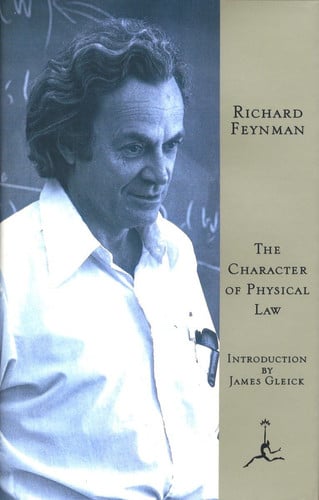
The character of physical law

Feynman, Richard P.
Like any set of oral reflections, The Character of Physical Law has special value as a demonstration of the mind in action. The reader is particularly lucky in Richard Feynman - one of the most eminent and imaginative modern physicists. In these Messenger Lectures, originally delivered at Cornell University and recorded for television by the BBC, Richard Feynman offers an overview of selected physical laws and gathers their common features into one broad principle of invariance. He maintains at the outset that the importance of a physical law is not ''how clever we are to have found it out - but . . . how clever nature is to pay attention to it'' and steers his discussions toward a final exposition of the elegance and simplicity of all scientific laws. Rather than an essay on the most significant achievements in modern science, The Character of Physical Law is a statement of what is most remarkable in nature. Feynman's enlightened approach, his wit, and his enthusiasm make this a memorable exposition of the scientist's craft. The law of gravitation is the author's principal example. Relating the details of its discovery and stressing its mathematical character, he uses it to demonstrate the essential interaction of mathematics and physics. He views mathematics as the key to any system of scientific laws, suggesting that if it were possible to fill out the structure of scientific theory completely, the result would be an integrated set of mathematical axioms. The principles of conservation, symmetry, and time irreversibility are then considered in relation to developments in classical and modern physics, and in his final lecture, Feynman develops his own analysis of the process and future of scientific discovery.
Modern Library 1994-11-08 167 pages

The Upright Thinkers

Mlodinow, Leonard
How did a near-extinct species, eking out a meager existence with stone axes, become the dominant power on earth, able to harness a knowledge of nature ranging from tiny atoms to the vast structures of the universe? Leonard Mlodinow takes us on an enthralling tour of the history of human progress, from our time on the African savannah through the invention of written language, all the way to modern quantum physics. Along the way, he explores the colorful personalities of the great philosophers, scientists, and thinkers, and traces the cultural conditions—and the elements of chance—that influenced scientific discovery. Deeply informed, accessible, and infused with the author’s trademark humor and insight, The Upright Thinkers is a stunning tribute to humanity’s intellectual curiosity and an important book for any reader with an interest in the scientific issues of our day.
Random House US 2016-04-19 352 pages

Customized Complete Statistical Physics

Frederick Reif
This last volume of the Berkeley Physics Course is devoted to the study of large-scale systems consisting of many atoms or molecules: thus it provides an introduction to the subjects of statistical mechanics, kinetic theory, thermo- dynamics, and heat. The approach is not patterned upon the historical development of these subjects and does not pro- ceed along conventional lines. The aim has been to adopt a modern point of view and to show, in as systematic and simple way as possible, how the basic notions of atomic theory lead to a conceptual framework capable of describing and predicting the properties of macroscopic systems.
McGraw-Hill/Primis Custom Publishing 1998-03 420 pages

Six Not-So-Easy Pieces-Book/CD Package

Richard P. Feynman
No twentieth-century American scientist is better known to a wider spectrum of people than Richard P. Feynman (1918–1988)—physicist, teacher, author, and cultural icon. His autobiographies and biographies have been read and enjoyed by millions of readers around the world, while his wit and eccentricities have made him the subject of TV specials and even a theatrical film.The spectacular reception of the book and audio versions of Feynman's Six Easy Pieces (published in 1995) resulted in a worldwide clamor for “More Feynman! More Feynman!” The outcome is these six additional lectures, drawn from the celebrated three-volume Lectures on Physics. Though slightly more challenging than the first six, these lectures are more focused, delving into the most revolutionary discovery in twentieth-century physics: Einstein's Theory of Relativity.No single breakthrough in twentieth-century physics (with the possible exception of quantum mechanics) changed our view of the world more than that of Einstein's discovery of relativity. The notions that the flow of time is not a constant, that the mass of an object depends on its velocity, and that the speed of light is a constant no matter what the motion of the observer, at first seemed shocking to scientists and laymen alike. But, as Feynman shows so clearly and so entertainingly in the lectures chosen for this volume, these crazy notions are no mere dry principles of physics, but are things of beauty and elegance. No one—not even Einstein himself—explained these difficult, anti-intuitive concepts more clearly, or with more verve and gusto, than Richard Feynman.
Basic Books 1997-03-09 184 pages

The Evolution Of Physics

Albert Elnstein,Leopold Infeld
This work has been selected by scholars as being culturally important, and is part of the knowledge base of civilization as we know it. This work is in the "public domain in the United States of America, and possibly other nations. Within the United States, you may freely copy and distribute this work, as no entity (individual or corporate) has a copyright on the body of the work. Scholars believe, and we concur, that this work is important enough to be preserved, reproduced, and made generally available to the public. We appreciate your support of the preservation process, and thank you for being an important part of keeping this knowledge alive and relevant.
Creative Media Partners, LLC 2022-10-26 342 pages

Wholeness and the implicate order

Bohm, David
David Bohm was one of the foremost scientific thinkers and philosophers of our time. Although deeply influenced by Einstein, he was also, more unusually for a scientist, inspired by mysticism. Indeed, in the 1970s and 1980s he made contact with both J. Krishnamurti and the Dalai Lama whose teachings helped shape his work. In both science and philosophy, Bohm's main concern was with understanding the nature of reality in general and of consciousness in particular. In this classic work he develops a theory of quantum physics which treats the totality of existence as an unbroken whole. Writing clearly and without technical jargon, he makes complex ideas accessible to anyone interested in the nature of reality.
Routledge 2002 284 pages