48 results for "Physics"

Relativity The Special and the General Theory

Albert Einstein
Relativity: The Special and the General Theory is a groundbreaking scientific work written by Albert Einstein, one of the most renowned physicists of all time. Published in 1915, the book revolutionized our understanding of space, time, and gravity. Relativity remains a cornerstone of modern physics and a testament to Einstein's intellectual brilliance. Journey through the fabric of space, time, and thought. Provides a comprehensive exploration of both the special theory of relativity and the general theory of relativity. Concepts are explained in a logical and concise manner, enhancing the reader's comprehension. Offers readers a fresh perspective on the fundamental principles that govern our reality. Delve into the mind of Einstein and understand the ideas that reshaped our understanding of the universe. Allows readers to engage with the timeless concepts that underpin our current scientific understanding.
Prakash Book Depot 2023-12-06 176 pages

Extraterrestrial The First Sign of Intelligent Life Beyond Earth

Avi Loeb
New York Times Bestseller | Wall Street Journal Bestseller | Publishers Weekly Bestseller | Publishers Marketplace 2020 Buzz Book | Amazon Best Book of the Year | Longlisted for the 2022 PEN/E.O. Wilson Literary Science Writing Award Harvard's top astronomer lays out his controversial theory that our solar system was recently visited by advanced alien technology from a distant star. "Provocative and thrilling ... Loeb asks us to think big and to expect the unexpected."--Alan Lightman, New York Times bestselling author of Einstein's Dreams and Searching for Stars on an Island in Maine In late 2017, scientists at a Hawaiian observatory glimpsed an object soaring through our inner solar system, moving so quickly that it could only have come from another star. Avi Loeb, Harvard's top astronomer, showed it was not an asteroid; it was moving too fast along a strange orbit, and left no trail of gas or debris in its wake. There was only one conceivable explanation: the object was a piece of advanced technology created by a distant alien civilization. In Extraterrestrial, Loeb takes readers inside the thrilling story of the first interstellar visitor to be spotted in our solar system. He outlines his controversial theory and its profound implications: for science, for religion, and for the future of our species and our planet. A mind-bending journey through the furthest reaches of science, space-time, and the human imagination, Extraterrestrial challenges readers to aim for the stars--and to think critically about what's out there, no matter how strange it seems.
HarperCollins Publishers 2022-02-22 240 pages

The structure of scientific revolutions

Kuhn, Thomas S.
"When it was first published in 1962, The Structure of Scientific Revolutions was a landmark event in the history and philosophy of science. Fifty years later, it still has many lessons to teach. With The Structure of Scientific Revolutions, Thomas S. Kuhn challenge long-standing linear notions of scientific progress, arguing that transformative ideas do not arise from the day-to-day, gradual process of experimentation and data accumulation, but that the revolutions in science, those breakthrough moments that disrupt accepted thinking and offer unanticipated ideas, occur outside of "normal science," as he called it. Though Kuhn was writing when physics ruled the sciences, his ideas on how scientific revolutions bring order to the anomalies that amass over time in research experiments are still instructive in our biotech age. This new edition of Kuhn's essential work in the history of science includes an insightful introduction by Ian Hacking, which clarifies terms popularized by Kuhn, including paradigm and incommensurability, and applies Kuhn's ideas to the science of today." --
The University of Chicago Press 2012 217 pages

THE EMPEROR'S NEW MIND: Concerning Computers, Minds, and the Laws of Physics

Penrose, Roger
For decades, proponents of artificial intelligence have argued that computers will soon be doing everything that a human mind can do. Admittedly, computers now play chess at the grandmaster level, but do they understand the game as we do? Can a computer eventually do everything a human mind can do? In this absorbing and frequently contentious book, Roger Penrose--eminent physicist and winner, with Stephen Hawking, of the prestigious Wolf prize--puts forward his view that there are some facets of human thinking that can never be emulated by a machine. Penrose examines what physics and mathematics can tell us about how the mind works, what they can't, and what we need to know to understand the physical processes of consciousness. He is among a growing number of physicists who think Einstein wasn't being stubborn when he said his "little finger" told him that quantum mechanics is incomplete, and he concludes that laws even deeper than quantum mechanics are essential for the operation of a mind. To support this contention, Penrose takes the reader on a dazzling tour that covers such topics as complex numbers, Turing machines, complexity theory, quantum mechanics, formal systems, Godel undecidability, phase spaces, Hilbert spaces, black holes, white holes, Hawking radiation, entropy, quasicrystals, the structure of the brain, and scores of other subjects. The Emperor's New Mind will appeal to anyone with a serious interest in modern physics and its relation to philosophical issues, as well as to physicists, mathematicians, philosophers and those on either side of the AI debate.
Oxford University Press 1990 466 pages

The Logic of Scientific Discovery

Karl R. Popper
2024 Hardcover Reprint of Original 1959 Edition. Exact facsimile of the original edition, not reproduced with Optical Recognition Software. This book by one of the world's foremost philosophers of science presented a striking new picture of the logical character of scientific discovery--a picture which does full justice to the liberating effect of the Einsteinian revolution in physics and its immense impact upon scientific thought in general. For this new English edition Dr. Popper did his own translation and has written 150 pages of entirely new text. Ernest Nagel considered this work "a first rate contribution to the logic of scientific method. The book contains a very interesting chapter on quantum mechanics, which performs one of the few sensible analyses of the Indeterminacy Principle which I have seen in print... The book is highly stimulating and contains much that is bed-rock for future work."--From the Dusk Jacket.
Martino Fine Books 2024-03-07 482 pages

A project to find the fundamental theory of physics

Wolfram, Stephen
'In many ways it s the ultimate question in natural science: How does our universe work? Is there a fundamental theory? An incredible amount has been figured out about physics over the past few hundred years. But even with everything that s been done and it's very impressive - we still, after all this time, don t have a truly fundamental theory of physics.' The Wolfram Physics Project is a bold effort to find the fundamental theory of physics. It combines new ideas with the latest research in physics, mathematics and computation in the push to achieve this ultimate goal of science. Written with Stephen Wolfram's characteristic expository flair, this book provides a unique opportunity to learn about a historic initiative in science right as it is happening. A Project to Find the Fundamental Theory of Physics includes: The announcement of the project; A technical introduction; A history section that outlines the backstory which led Wolfram to this point; Background information from computational essays published by the author in 2015 and 2017; Foundational information, including historical notes and an excerpt from Wolfram's; 2002 New York Times Best Seller A New Kind of Science; Hundreds of beautiful full-colour visualisations. Stephen Wolfram is a distinguished scientist and best-selling author, and the creator of some of the world's most respected software systems, including Mathematica, Wolfram|Alpha and Wolfram Language. For more than 30 years he has been the CEO of the global technology company Wolfram Research.
Wolfram Media 2020 778 pages

Fashion, faith, and fantasy in the new physics of the universe

Penrose, Roger
"What can fashionable ideas, blind faith, or pure fantasy possibly have to do with the scientific quest to understand the universe? Surely, theoretical physicists are immune to mere trends, dogmatic beliefs, or flights of fancy? In fact, acclaimed physicist and best-selling author Roger Penrose argues that researchers working at the extreme frontiers of physics are just as susceptible to these forces as anyone else. In this provocative book, he argues that fashion, faith, and fantasy, while sometimes productive and even essential in physics, may be leading today's researchers astray in three of the field's most important areas--string theory, quantum mechanics, and cosmology ... The result is an important critique of some of the most significant developments in physics today from one of its most eminent figures."--Jacket.
Princeton University Press 2016 501 pages

The large, the small and the human mind

Penrose, Roger
Roger Penrose's original and provocative ideas about the large-scale physics of the Universe, the small-scale world of quantum physics and the physics of the mind have been the subject of controversy and discussion. These ideas were proposed in his best-selling books The Emperor's New Mind and Shadows of the Mind. In this book, he summarises and updates his current thinking in these complex areas to present a masterful summary of those areas of physics in which he feels there are major unresolved problems. Through this, he introduces radically new concepts which he believes will be fruitful in understanding the workings of the brain and the nature of the human mind. These ideas are challenged by three distinguished experts from different backgrounds: Abner Shimony and Nancy Cartwright as philosophers of science and Stephen Hawking as a theoretical physicist and cosmologist. Roger Penrose concludes with a response to their thought-provoking criticisms.
Cambridge University Press 2000-04-28 201 pages

Doing physics: how physicists take hold of the world

Krieger, Martin H.
Doing Physics makes concepts of physics easier to grasp by relating them to everyday knowledge. Addressing some of the models and metaphors that physicists use to explain the physical world, Martin H. Krieger describes the conceptual world of physics by means of analogies to economics, anthropology, theater, carpentry, mechanisms such as clockworks, and machine tool design. The interaction of elementary particles or chemical species, for example, can be related to the theory of kinship—who can marry whom is like what can interact with what. Likewise, the description of physical situations in terms of interdependent particles and fields is analogous to the design of a factory with its division of labor among specialists. For the new edition, Krieger has revised the text and added a chapter on the role of mathematics and formal models in physics. Doing Physics will be of special interest to economists, political theorists, anthropologists, and sociologists as well as philosophers of science.
Indiana University Press 2012-11-19 218 pages

Black-body theory and the quantum discontinuity, 1894-1912

Kuhn, Thomas S.
"A masterly assessment of the way the idea of quanta of radiation became part of 20th-century physics. . . . The book not only deals with a topic of importance and interest to all scientists, but is also a polished literary work, described (accurately) by one of its original reviewers as a scientific detective story."—John Gribbin, New Scientist "Every scientist should have this book."—Paul Davies, New Scientist
University of Chicago Press 1987-01-15 378 pages

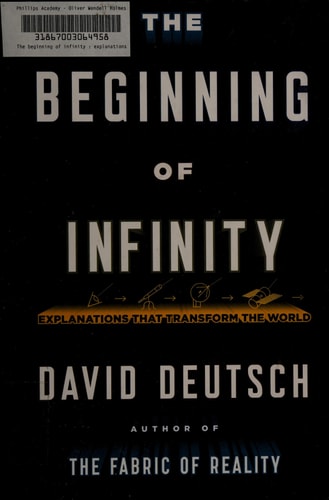
The beginning of infinity: explanations that transform the world

Deutsch, David
"A bold and all-embracing exploration of the nature and progress of knowledge from one of today's great thinkers. Throughout history, mankind has struggled to understand life's mysteries, from the mundane to the seemingly miraculous. In this important new book, David Deutsch, an award-winning pioneer in the field of quantum computation, argues that explanations have a fundamental place in the universe. They have unlimited scope and power to cause change, and the quest to improve them is the basic regulating principle not only of science but of all successful human endeavor. This stream of ever improving explanations has infinite reach, according to Deutsch: we are subject only to the laws of physics, and they impose no upper boundary to what we can eventually understand, control, and achieve. In his previous book, The Fabric of Reality, Deutsch describe the four deepest strands of existing knowledge-the theories of evolution, quantum physics, knowledge, and computation-arguing jointly they reveal a unified fabric of reality. In this new book, he applies that worldview to a wide range of issues and unsolved problems, from creativity and free will to the origin and future of the human species. Filled with startling new conclusions about human choice, optimism, scientific explanation, and the evolution of culture, The Beginning of Infinity is a groundbreaking book that will become a classic of its kind"--
Viking 2011 487 pages

Science And Human Values

Jacob Bronowski
Science and Human Values is a thought-provoking book by Jacob Bronowski that explores the relationship between science and human values. The author argues that science is not just a collection of facts and theories, but a way of thinking that shapes our understanding of the world and our place in it. He contends that science and human values are intimately connected, and that science has the power to transform our understanding of ourselves and the world around us.The book is divided into five chapters, each of which explores a different aspect of the relationship between science and human values. The first chapter discusses the nature of scientific inquiry and the role of imagination in scientific discovery. The second chapter examines the relationship between science and art, arguing that both are essential to our understanding of the world. The third chapter explores the ethical implications of scientific research, particularly in the areas of genetics and nuclear physics.The fourth chapter examines the role of science in shaping our understanding of human nature, while the final chapter discusses the implications of scientific progress for our future as a species. Throughout the book, Bronowski emphasizes the importance of human values in shaping scientific research and the need for scientists to be mindful of the ethical implications of their work.Overall, Science and Human Values is a thought-provoking and insightful book that challenges readers to think deeply about the relationship between science and human values. It is a must-read for anyone interested in the role of science in our lives and the ethical implications of scientific research.The Impact Of Science On Ethics And Human Values.This scarce antiquarian book is a facsimile reprint of the old original and may contain some imperfections such as library marks and notations. Because we believe this work is culturally important, we have made it available as part of our commitment for protecting, preserving, and promoting the world's literature in affordable, high quality, modern editions, that are true to their original work.
Literary Licensing, LLC 2011-09 98 pages

Atom and void: essays on science and community

Oppenheimer, J. Robert
J. Robert Oppenheimer was one of the outstanding physicists of his generation. He was also an immensely gifted writer and speaker, who thought deeply about the way that scientific discoveries have changed the way people live and think. Displaying his subtlety of thought and expression as do few other documents, this book of his lectures discusses the moral and cultural implications of developments in modern physics. Originally published in 1989. The Princeton Legacy Library uses the latest print-on-demand technology to again make available previously out-of-print books from the distinguished backlist of Princeton University Press. These editions preserve the original texts of these important books while presenting them in durable paperback and hardcover editions. The goal of the Princeton Legacy Library is to vastly increase access to the rich scholarly heritage found in the thousands of books published by Princeton University Press since its founding in 1905.
Princeton University Press 1989 155 pages

The Interpretation of Nature and the Psyche

Carl Gustav Jung,Wolfgang Ernst Pauli
Carl Gustav Jung (1875-1961) and Wolfgang Ernst Pauli (1900 - 1958) were two of the greatest thinkers of modern times. Jung is the founder of Analytical Psychology and is one of the best known researchers in the field of Dream Interpretation and Symbolization. Pauli was one of the pioneers of Quantum Physics. In 1945, Pauli received the Nobel Prize in Physics after being nominated by Albert Einstein for his "decisive contribution through his discovery of a new law of Nature, the exclusion principle" involving spin theory underpinning the structure of matter and the whole of chemistry. Together they collaborated on this book that was First published in 1952 in German as Naturerklarung und Psyche. C. G. Jung: Synchronizitat als ein Prinzip akausaler Zusammenhange. W. Pauli: Der Einfluss archetypischer Vorstellungen auf die Bildung naturwissenschaftlicher Theorien bei Kepler. However, our reviewer, himself an eminent professor of mathematics, concludes, "After thoroughly studying their writings for many months now, I have come to see clearly that they are both utterly mad.""
Ishi Press International 2012-02 280 pages

The human test: how predictability, creativity, and the quantum mind will redefine life in the age of AI

Folman, Ron
"As data harvesting continues its exponential growth and computing power increases beyond what we can even imagine, AI and Big Data will be able to predict what we want for breakfast, what shoes we will buy, which political party we will vote for, and who we will fancy in a bar. Indeed, these deep-learning machines will know us better than we know ourselves. The day awaits when academia and big business will be able to quantify just how predictable each of us are. If indeed we are predictable like machines, to what extent are we alive, and under what definition? In The Human Test, quantum physicist Ron Folman unites findings from cognitive science, quantum physics, philosophy, and technology to offer a prescient look into this startling new era of human existence. If we are indeed found to be predictable, it will change everything we thought we knew about human nature. The Human Test strives for a new paradigm, and this new paradigm is found in human predictability. Existing monitors of general brain activity measure only very rudimentary aspects of the human experience, or what may be called human life; could the advent of a disruptive new technology bring about a much more insightful measure of who we are? While The Human Test describes a new and profound near-future impact of AI, it is rooted in a topic of paramount importance to humans: the enigma of consciousness and how it defines human life-or, what differentiates humans from all other life forms. Ultimately, The Human Test addresses some of the most fundamental questions about our species, starting with the most crucial: do we have free will, or are we merely machines? Fortunately, there is an antidote to predictability: creativity, that wondrous state of being original and inherently not predictable. Ultimately, Folman argues that if we can understand predictability, we can learn how to distance ourselves from it, and transcend to a purer idea of what human life should look like"-- Provided by publisher.
Prometheus 2025-03-25 267 pages