7 results for "Physics"

The Logic of Scientific Discovery

Karl R. Popper
2024 Hardcover Reprint of Original 1959 Edition. Exact facsimile of the original edition, not reproduced with Optical Recognition Software. This book by one of the world's foremost philosophers of science presented a striking new picture of the logical character of scientific discovery--a picture which does full justice to the liberating effect of the Einsteinian revolution in physics and its immense impact upon scientific thought in general. For this new English edition Dr. Popper did his own translation and has written 150 pages of entirely new text. Ernest Nagel considered this work "a first rate contribution to the logic of scientific method. The book contains a very interesting chapter on quantum mechanics, which performs one of the few sensible analyses of the Indeterminacy Principle which I have seen in print... The book is highly stimulating and contains much that is bed-rock for future work."--From the Dusk Jacket.
Martino Fine Books 2024-03-07 482 pages

Uranium wars: the scientific rivalry that created the nuclear age

Aczel, Amir D.
Called "one of our best science popularizers" by Publishers Weekly , Amir D. Aczel tackles the cause of one of last century's most destructive events--the scientific discovery of nuclear power. Drawing on his rich storytelling skills, Aczel presents the fascinating and suspenseful story of the scientists who first uncovered the potential of uranium. Uranium Wars takes the reader on a whirlwind tour of 1920s Europe where the scientific elite of the day were embroiled in a fierce rivalry to achieve nuclear fission. Leading us to an understanding of both the processes that take place inside a uranium nucleus and its destructive power are the brilliant men and women at the heart of the race--mammoth figures such as Marie Curie, Enrico Fermi, and Lise Meitner. Enmeshed in the story of scientific intrigue is the complex and ongoing story of uranium itself, which Aczel presents as a dynamic, dual natured force, capable of providing both abundant usable energy and generating unfathomable destructive power. From the nuclear programs in the Middle East to plans for nuclear reactors at home, the element uranium is never far from today's headlines.
Palgrave Macmillan 2010-11-09 256 pages

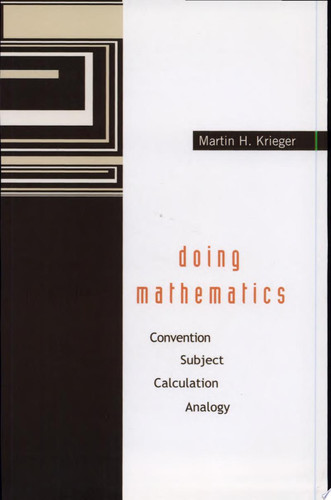
Doing mathematics: convention, subject, calculation, analogy

Krieger, Martin H.
This book discusses some ways of doing mathematical work and the subject matter that is being worked upon and created. It argues that the conventions we adopt, the subject areas we delimit, what we can prove and calculate about the physical world, and the analogies that work for mathematicians--all depend on mathematics, what will work out and what won't. And the mathematics, as it is done, is shaped and supported, or not, by convention, subject matter, calculation, and analogy. The causes studied include the central limit theorem of statistics, the sound of the shape of a drum, the connection between algebra and topology, the stability of matter, the Ising model, and the Langlands Program in number theory and representation theory. Contents: Convention: How Means and Variances are Entrenched as Statistics; Subject: The Fields of Topology; Appendix: The Two-Dimensional Ising Model of a Ferromagner; Calculation: Strategy, Structure, and Tactics in Applying Classical Analysis; Analogy; A Syzygy Between a research Program in Mathematics and a Research Program in Physics, Each of Which is Itself an Analogy; Mathematics in Concreto. Readership: Mathematicians, Physicists, philosophers and historians of science.
World Scientific 2003 454 pages

The universe within: from quantum to cosmos

Turok, Neil
Turok explores the transformative scientific discovers of the past three centuries, from classical mechanics to the nature of light and the evolution of the cosmos, and shows how they created shifts in the organization of society. He argues that we are on the cusp of another major transformation: the coming quantum revolution that will supplant our current digital age.
House of Anansi Press 2012 292 pages

The Quantum Theory

James Zimmerhoff,Fritz Reiche
THE old saying that small causes give rise to great effects has been confirmed more than once in the history of physics. For, very frequently, inconspicuous differences be- tween theory and experiment (which did not, however, escape the vigilant eye of the investigator) have become starting- points of new and important researches. Out of the well-known Michelson-Morley experiment, which, in spite of the application of the most powerful methods of exact optical measurement, failed to show an influence of the earth's movement on the propagation of light as was predicted by classical theory, there arose the great structure of Einstein's Theory of Eelativity. In the same way the trifling difference between the measured and calculated values of black-body radiation gave rise to the Quantum Theory which, formulated by Max Planck, was destined to revolutionise in the course of time almost all departments of physics. The quantum theory is yet comparatively young. It is therefore not surprising that we are confronted with an unfinished theory still in process of development which, changing constantly in many directions, must often destroy what it has built up a short time before. But under such circumstances as these, in which the theory is continually deriving new nourishment from a fresh stream of ideas and suggestions, there is a peculiar fascination in attempting to review the life-history of the quantum theory to the present time and in disclosing the kernel which will certainly out- last changes of form, 1 CHAPTER I The Origin of the Quantum Hypothesis § I. Black-Body Radiation and its Realisation in Practice THE Quantum Theory &st saw light in 1900. When, in the years immediately preceding (1897-1899), Lummer and Pringsheim made their fundamental measurements ' of black-body radiation at the Beichsanstalt, they could ba.ve had no premonition that their careful experiments would become the starting-point of a revolution such as has seldom occurred in physics. In the field of heat radiation chief interest at that time was centred in the radiation of a black body (briefly called " black- body " radiation), that is, of a body which absorbs completely all radiation which falls on it and which thus reflects, trans- mits, and scatters 2 none. We may shortly call to mind the following facts. It is known that any body at a given temperature sends out energy in the form of radiation into the surrounding space. This radiation is not energy in a single simple form but is made up of a number of single radiations of different colours, i.e. of different wave-lengths X or of different frequencies s v. In other words, it forms in general a spectrum in which radiations of all frequencies between v = and v = oo are represented. Further, these radiations are present in varying " intensities." We define this term thus. Consider the radiation emitted from unit surface of the body per second in a certain direction ; break it up spectrally and cut out of the spectrum a small frequency interval dv such that it contains all frequencies between v and V + dv. The energy of radiation E^ thus sliced out (namely, the emissivity of the body for the frequency v)
Independently Published 2017-09-16 185 pages