23 results for "Physics"

"Surely you're joking, Mr. Feynman!”: adventures of a curious character

Feynman, Richard P.
Winner of the Nobel Prize for Physics in 1965, Richard Feynman was one of the world's greatest theoretical physicists, but he was also a man who fell, often jumped, into adventure. An artist, safecracker, practical joker and storyteller, Feynman's life was a series of combustible combinations made possible by his unique mixture of high intelligence, unquenchable curiosity and eternal skepticism. Over a period of years, Feynman's conversations with his friend Ralph Leighton were first taped and then set down as they appear here, little changed from their spoken form, giving a wise, funny, passionate and totally honest self-portrait of one of the greatest men of our age.
Norton 1985 350 pages

The men who stare at goats

Ronson, Jon
In 1979 a secret unit was established by the most gifted minds within the U.S. Army. Defying all known accepted military practice -- and indeed, the laws of physics -- they believed that a soldier could adopt a cloak of invisibility, pass cleanly through walls, and, perhaps most chillingly, kill goats just by staring at them. Entrusted with defending America from all known adversaries, they were the First Earth Battalion. And they really weren't joking. What's more, they're back and fighting the War on Terror. With firsthand access to the leading players in the story, Ronson traces the evolution of these bizarre activities over the past three decades and shows how they are alive today within the U.S. Department of Homeland Security and in postwar Iraq. Why are they blasting Iraqi prisoners of war with the theme tune to Barney the Purple Dinosaur? Why have 100 debleated goats been secretly placed inside the Special Forces Command Center at Fort Bragg, North Carolina? How was the U.S. military associated with the mysterious mass suicide of a strange cult from San Diego? "The Men Who Stare at Goats" answers these and many more questions. Ronson's "Them: Adventures with Extremists," a highly acclaimed international bestseller, examined the paranoia at the fringes of hate-filled extremist movements around the globe. "The Men Who Stare at Goats" reveals extraordinary and very nutty military secrets at the core of George W. Bush's War on Terror.
Simon & Schuster 2006 259 pages

A serious man

Coen, Ethan
It is 1967 and Larry Gopnik, a physics professor at a quiet Midwestern university, has just been informed by his wife Judith that she is leaving him since she has fallen in love with one of his more pompous colleagues. His domestic woes accumulate: his unemployable brother Larry is sleeping on the couch, his son Danny is playing hooky from Hebrew school, and his daughter is sneaking money from his wallet in order to save up for a nose job. Also, a graduate student seems to be trying to bribe him for a passing grade while at the same time threatening to sue him for defamation, thus putting in jeopardy Larry's chances for tenure at the university. As if all this wasn't enough, he is tormented by the sight of his beautiful next door neighbor sunbathing nude. Larry's search for some kind of equilibrium is conveyed with the kind of humor, imagination, and verbal wit that have made the work of Ethan and Joel Coen so distinctive.
Faber and Faber 2009-10-13 126 pages

Feynman's rainbow: a search for beauty in physics and in life

Mlodinow, Leonard
In the early 1980's, Leonard Mlodinow came to the California Institute of Technology to begin a postdoctoral fellowship. Mlodinow had written a groundbreaking Ph.D. thesis, but he was afraid he was simply not smart enough to be at Caltech. In danger of losing himself watching hours of Rockford Files reruns while waiting for one good idea, Mlodinow took his doubts and insecurities to Caltech's intimidating resident genius and iconoclast, Richard Feynman. So began a pivotal year in a young man's life and a year of awakening. In the funny, inspiring, and revelatory book, Leonard Mlodinow looks back at the time he shared with Feynman: the ideas they explored, the views of life and physics they exchanged, and what Mlodinow learned from a mentor who had not only helped shape the landscape of physics, but whose mind was drawn to all aspects of human experience. In a series of fascinating, sprawling exchanges, Feynman delved into the nature of science, creativity, love, mathematics, happiness, God, art, pleasures and ambition. And as the relationship between the older scientist and Mlodinow deepened - at one point the two crashed a wedding buffet together - their conversations took on a sense of urgency. For while Mlodinow was floundering, Feynman was battling cancer - and confronting his own mortality.
Warner Books 2003 171 pages

The Los Alamos Primer

Robert Serber
Unabridged declassified value reproduction of The Los Alamos Primer by Robert Serber, in full color with all censor markings. This is the booklet given to new workers at Los Alamos during World War II, to catch them up on how to build a practical fission bomb. The Primer was driven by Robert Oppenheimer asking his protégé Robert Serber to summarize all knowledge and possible solutions known as of April 1943 in a series of lectures. Serber did such an excellent job that the notes from the series was turned into The Los Alamos Primer. Serber was known as an expert that bridged theory and reality, and so was also chosen to be one of the first Americans to enter Hiroshima and Nagasaki to assess the atomic damage in 1945. Touch a piece of history in this slim volume with the full text at an affordable price.
Chump Change 1943-04 32 pages

The Pope of Physics Enrico Fermi and the Birth of the Atomic Age

Gino Segrè,Bettina Hoerlin
A New York Times Book Review Editors’ Choice Named a Best Book of the Year by Bloomberg (Chosen by Philip Tetlock), Booklist ’s Top 10 Science Books of the Year, and Shortlisted for Physics World ’s Book of the Year A Major Biography of the Nobel Prize–Winning Physicist, Enrico Fermi, a Leading Architect of the Atomic Age Enrico Fermi is unquestionably among the greats of the world’s physicists, the most famous Italian scientist since Galileo. Called “the Pope” by his peers, he was regarded as infallible in his instincts and research. His discoveries changed our world; they led to weapons of mass destruction and conversely to life-saving medical interventions. This unassuming man struggled with issues relevant today, such as the threat of nuclear annihilation and the relationship of science to politics. Fleeing Fascism and anti-Semitism, Fermi became a leading figure in America’s most secret project: building the atomic bomb. An examination of the human dramas that touched Fermi’s life as well as a thrilling history of scientific innovation in the twentieth century, this is the comprehensive biography that Fermi deserves.
Picador 2017-10-10 384 pages

Adventures of a computational explorer

Wolfram, Stephen
Through his pioneering work in science, technology and language design, Stephen Wolfram has developed his own signature way of thinking about an impressive range of subjects. From science consulting for a Hollywood movie, solving problems of AI ethics, hunting for the source of an unusual polyhedron, communicating with extraterrestrials, to finding the fundamental theory of physics and exploring the digits of pi, Adventures of a Computational Explorer captures the infectious energy and curiosity of one of the great pioneers of the computational world.
Stephen Wolfram, LLC 2019 421 pages

The only woman in the room: why science is still a boys' club

Pollack, Eileen
"Eileen Pollack had grown up in the 1960s and 70s dreaming of a career as a theoretical astrophysicist. Denied the chance to take advanced courses in science and math, she nonetheless made her way to Yale, where, despite finding herself far behind the men in her classes, she went on to graduate, summa cum laude, with honors, as one of the university's first two women to earn a Bachelor of Science degree in physics. And yet, isolated, lacking in confidence, starved for encouragement, she abandoned her ambition to become a physicist. Years later, Pollack revisited her reasons for walking away from the career she once had coveted. She spent six years interviewing her former teachers and classmates and dozens of other women who had dropped out before completing their degrees in science. In addition, Pollack talked to experts in the field of gender studies and reviewed the most up-to-date research that seeks to document why women and minorities underperform in STEM fields. Girls who study science and math are still belittled and teased by their male peers and teachers, even by other girls. They are led to think that any interest or achievement in science or math will diminish their popularity. They are still being steered away from advanced courses in technical fields, while deeply entrenched stereotypes lead them to see themselves as less talented than their male classmates, a condition that causes them to fulfill such expectations and perform more poorly than the boys sitting beside them. "--
Beacon Press 2015 266 pages

"What do you care what other people think?”

Feynman, Richard P.
"Here is the story of how two people most influenced Feynman's early years-his father, who taught him to think, and his first wife Arlene who taught him to love, even as she lay dying in an Albuquerque hospital while Feynman worked nearby, on the atomic bomb at Los Alamos. And here are lighter moments, some told through letters, as Feynman reports from Geneva, Trinidad, Greece, and Japan on the effects this curious character has had on the locals. The second half of the book...is Feynman's behind-the-scenes account of the investigation that followed the space shuttle Challenger's explosion in January 1986"--Jacket.
Norton 1988 255 pages

Quantum man: Richard Feynman's life in science

Krauss, Lawrence Maxwell
Perhaps the greatest physicist of the second half of the twentieth century, Richard Feynman changed the way we think about quantum mechanics, the most perplexing of all physical theories. Here the author, himself a theoretical physicist, offers a scientific biography: a narrative coupled with clear and novel expositions of science at the limits. An immensely colorful persona in and out of the office, Feynman revolutionized our understanding of nature amid a turbulent life. The author presents that life, from the death of Feynman's childhood sweetheart during the Manhattan Project to his reluctant rise as a scientific icon, seen through the science, providing a new understanding of the legacy of a man who has fascinated millions. A reflection on the issues that drive physics today, this work captures the story of a man who was willing to break all the rules to tame a theory that broke all the rules.
W.W. Norton 2011 350 pages

A matter of choices: memoirs of a female physicist

Ajzenberg-Selove, Fay
When Fay Ajzenberg-Selove became a nuclear physicist, the number of women in the field could be counted on one hand. In this engaging memoir, Fay Ajzenberg-Selove writes candidly about her difficult journey to international recognition in physics. She is frank about the ways being a woman has made a difference in her opportunities and choices as a scientist--and how, by being a woman, she has made a difference in the world of physics. Ajzenberg-Selove came to America at the age of 15 after narrowly escaping the Nazi takeover of France. She had planned to become an engineer like her father, but switched to physics after she was told the only engineering jobs open to women were in drafting: Marie Curie's example proved to her that women could do physics. Her first attempt at graduate work at Columbia University was a disaster, but she was sturck with the intellectual beauty of the field. After taking a Ph.D. in physics at University of Wisconsin, she did post-doctoral work with Thomas Lauritsen at the California Institute of Technology, where she began writing the first of a series of major review papers on the nuclear spectroscopy of the light nuclei, a subject of fundamental importance to nuclear physics, astrophysics, and applied physics. She continued this work and experimental research for thirty-eight years while teaching at Boston University, Haverford College, and the University of Pennsylvania. During her early career, Ajzenberg-Selove was shielded by her male mentors from experiencing much of the discrimination directed against women in science. Her simultaneous battles to become a tenured professor and to overcome breast cancer opened her eyes and confirmed her as a feminist. The lay reader and the scientist alike will be fascinated by Ajzenberg-Selove's clear portrayal of her interlinked lives as physicist, teacher, wife of particle physicist, Walter Selove, and a woman who relishes both competition and friendship in a male-dominated field. An invaluable book for anyone contemplating a career in science.
Rutgers University Press 1994 234 pages

The recollections of Eugene P. Wigner as told to Andrew Szanton

Wigner, Eugene Paul
Eugene P. Wigner, indisputedly one of the world's greatest physicists of the twentieth century, recounts the breathtaking story of his singular life. Dr. Wigner's wining of the Nobel Prize crowned a lifetime of achievements in physics - achievements that profoundly affect our understanding of science today. His enormous contributions to the Manhattan Project and his insights into quantum physics stand as hallmarks of his incomparable talent. But equally important are his musings on his long and uniquely fascinating life. This memoir, a fruitful collaboration between Eugene Wigner and writer Andrew Szanton, reveals a story by turns endearing, painful, and ultimately triumphant. A witness to many of the changes of the twentieth century, Wigner grew up amid the political turmoil of Hungary. He later experienced the Berlin of the early 1930s as Hitler rose to power. During World War II, he took an active role in the Manhattan Project, the building of the world's first atomic bomb. In his recollections, he conveys the exultation of observing the first successfully controlled nuclear chain reaction. Eugene Wigner's friends and acquaintances comprise a Who's Who of twentieth-century scientists, and the book is replete with their vivid, candid, and amusing portrayals. Having enjoyed many years working with Albert Einstein, he paints an engaging portrait of that most famous of geniuses. He also sketches distinctive pictures of the trio of his fellow Hungarians: Leo Szilard, one of the first men to dream seriously about the atom bomb; Johnny von Neumann, perhaps the greatest mathematician of the century; and Edward Teller, the prime architect of the hydrogen bomb. This is the first major bookever written about Eugene P. Wigner. It makes a significant contribution to the history of the Manhattan Project and to the history of nuclear physics. But in a much larger sense, physics is only its backdrop. The real story is that of an extraordinary man and his unforgettable life.
Plenum 1992-01-01 335 pages

The Age of Wire and String

Marcus, Ben
In The Age of Wire and String, hailed by Robert Coover as "the most audacious literary debut in decades," Ben Marcus weilds together a new reality from the scrapheap of the past. Dogs, birds, horses, automobiles, and the weather are some of the recycled elements in Marcus's first collection—part fiction, part handbook—as familiar objects take on markedly unfamiliar meanings. Gradually, this makeshift world, in its defiance of the laws of physics and language, finds a foundation in its own implausibility, as Marcus produces new feelings and sensations—both comic and disturbing—in the definitive guide to an unpredictable yet exhilarating plane of existence.
Dalkey Archive Press 2024-10-22 152 pages

Making sense of my life in science: a memoir

Keller, Evelyn Fox
"Evelyn Fox Keller trained as a theoretical physicist at a time when women didn't "do physics." Unable to find a supportive advisor, she moved into the new field of molecular biology just getting off the ground. After receiving her doctorate, she returned to physics but then took another swerve, joining a small interdisciplinary effort to develop mathematical models of biological systems. This work led to her appointment to a special position as Professor of Mathematics and Humanities at Northeastern University. When second-wave feminism arrived in the 1960s, it changed the lives of everyone in its path. It certainly changed Keller's, leading her beyond the borders of science altogether. Eventually she began to think of herself as a dual citizen of the proverbial two cultures―science and humanities. The trajectory was hardly straightforward, nor was it conducive to building a conventional career, or even getting a job. Now in hindsight, after an illustrious career and having published fourteen books, Keller reflects on her life, influences, successes and struggles along her trailblazing path as a scientist and feminist." -- From publisher's website
Modern Memoirs, Inc 2023-03-29 206 pages

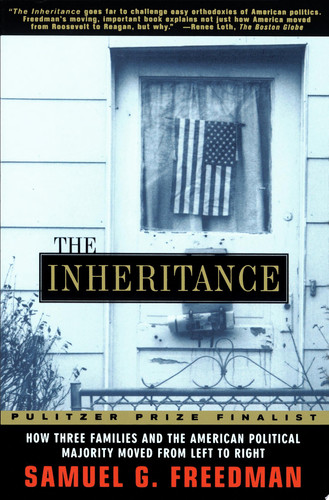
The inheritance: how three families and America moved from Roosevelt to Reagan and beyond

Freedman, Samuel G.
Orphan in the new world (Silvio Burigo) -- Liverpool on the Hudson (Lizzie Sanford Garrett) -- The dreamer and his son (Joseph Obrycki) -- The sewing room (Lizzie Garrett) -- The physics of cynicism (Joseph Obrycki) -- Worth two (Silvio Burigo) -- Voices from downstairs (Richie Garrett) -- Recessive genes (Silvio Burigo/Lorraine and Frank Trotta) -- Address as destiny (Vilma and Jack Maeby) -- Fence and basement (Silvio Burigo/Lorraine and Frank Trotta) -- Senator Clearwater (Richie Garrett) -- Uncle Paulie's Porch (Frank Trotta Jr.) -- The State Street Gang (Leslie Maeby) -- Poor snob (Tim Carey) -- Enchantment and its opposite (Frank Trotta Jr.) -- Incumbent protection (Leslie Maeby) -- Red suspenders (Tim Carey).
Simon & Schuster 1996 464 pages

Eye of the hurricane: an autobiography

Bellman, Richard
This is a very frank and detailed account by a leading and very active mathematician of the past decades whose contributions have had an important impact in those fields where mathematics is now an integral part. It starts from his early childhood just after the First World War to his present-day positions as professor of mathematics, electrical engineering and medicine at the USC, which in itself reflects on the diversity of interests and experiences gained through the turbulent years when American mathematics and sciences established themselves on the forefront. The story traces the tortuous path Bellman followed from Brooklyn College; the University of Wisconsin to Princeton during the war years; more than a decade with the RAND Corporation; with frequent views of more than just the academic circles, including his experiences at Los Alamos on the A-bomb project.Bellman gives highly personalised views of key personalities in mathematics, physics and other areas, and his motivations and the forces that helped shape dynamic programming and other new areas which emerged as consequences of fruitful applications of mathematics.
World Scientific 1984 344 pages