34 results for "Poetry"

The Truth Will Set You Free, But First It Will Piss You Off! Thoughts on Life, Love and Rebellion

Gloria Steinem
For decades -- and especially now in these times of crisis -- people around the world have found guidance, humor, and unity in Gloria Steinem's gift for creating quotes that inspire action and create hope. From her early days as a journalist and feminist activist, up to today, Steinem's words have helped generations to empower themselves and work together. Gloria sees quotes as 'the poetry of everyday life,' so she also has included a few favorites from friends, including bell hooks, Flo Kennedy, Michelle Obama, and more, in this anthology of quotes that will make you want to laugh, march, and create some of your own. At the end of the book, there is a special space for each reader to add their own quotes and others they've found. Covering topics from relationships ('Many are looking for the right person. Too few are looking to be the right person.') to patriarchy ('Men are liked better when they win. Women are liked better when they lose. This is how patriarchy is enforced every day.') and activism ('Change, like a tree, grows from the bottom up.'), plus an introduction and essays by Steinem, this is the definitive collection of her words on many of the topics that matter most today. The Truth Will Set You Free, But First It Will Piss You Off! is both timeless and timely. It is a gift of hope from Gloria to readers, that they will want to share with friends.
Murdoch Books Pty Limited 2019 192 pages

Various Positions A Life of Leonard Cohen

Ira B. Nadel
Reissued with a new afterword Leonard Cohen is back! With a #1 bestselling poetry collection, The Book of Longing , flying off bookshelves; Lian Lunson’s acclaimed documentary, Leonard Cohen: I’m Your Man , in theatres this summer (the DVD will release this fall); and the superb soundtrack in music stores everywhere, Leonard Cohen proves he is Canada’s most enduring icon. Now, in the newly reissued Various Positions , Ira Nadel peels back the many layers to reveal the man and explain the fascinating relationship between Leonard Cohen’s life and his art. This book is a remarkable and rare look at Leonard Cohen, up close and personal. For nearly forty years, Leonard Cohen has endured the ups and downs of an international career that has alternately identified him as the "Prince of Bummers" and Canada's most respected poet and performer. Now, author Ira Nadel brings us closer to understanding these conflicting descriptions and allows us to enter Cohen's private world. He peels back the many layers to reveal the man and explain the fascinating relationship between Cohen's life and his art. This is a remarkable and rare look at Leonard Cohen, up close and personal.
Vintage Canada 1997 325 pages

The Genius Under the Table Growing Up Behind the Iron Curtain

Eugene Yelchin
"Yelchin delivers a darkly humorous slice-of-life account of growing up in the Soviet Union. . . . Humorous, heartbreaking, and ultimately hopeful." -- Kirkus Reviews (starred review) Drama, family secrets, and a KGB spy in his own kitchen! How will Yevgeny ever fulfill his parents' dream that he become a national hero when he doesn't even have his own room? He's not a star athlete or a legendary ballet dancer. In the tiny apartment he shares with his Baryshnikov-obsessed mother, poetry-loving father, continually outraged grandmother, and safely talented brother, all Yevgeny has is his little pencil, the underside of a massive table, and the doodles that could change everything. With equal amounts charm and solemnity, award-winning author and artist Eugene Yelchin recounts in hilarious detail his childhood in Cold War Russia as a young boy desperate to understand his place in his family.
Candlewick Press 2024-05-21 208 pages

I Dreamed I Was a Very Clean Tramp An Autobiography

Richard Hell
From an early age, Richard Hell dreamed of running away. He arrived penniless in New York City at seventeen; ten years later he was a pivotal voice of the age of punk, cofounding such seminal bands as Television, The Heartbreakers, and Richard Hell and the Voidoids—whose song "Blank Generation" remains the defining anthem of the era, an era that would forever alter popular culture in all its forms. How this legendary downtown artist went from a bucolic childhood in the idyllic Kentucky foothills to igniting a movement that would take over New York and London's restless youth culture—cementing CBGB as the ground zero of punk and spawning the careers of not only Hell himself, but a cohort of friends such as Tom Verlaine, Patti Smith, the Ramones, and Debby Harry—is a mesmerizing chronicle of self-invention, and of Hell's yearning for redemption through poetry, music, and art. An acutely rendered, unforgettable coming-of-age story, I Dreamed I Was a Very Clean Tramp evokes with feeling, lyricism, and piercing intelligence both the world that shaped him and the world he shaped.
HarperCollins 2014-02-18 304 pages

Journey from the Land of No -L

Roya Hakakian
From the Hardcover "We stormed every classroom, inscribed our slogans on the blackboard . . . Never had mayhem brought more peace. All our lives we had been taught the virtues of behaving, and now we were discovering the importance of misbehaving. Too much fear had tainted our days. Too many afternoons had passed in silence, listening to a fanatic's diatribes. We were rebelling because we were not evil, we had not sinned, and we knew nothing of the apocalypse. . . . This was 1979, the year that showed us we could make our own destinies. We were rebelling because rebelling was all we could do to quell the rage in our teenage veins. Together as girls we found the courage we had been told was not in us." In Journey from the Land of No Roya Hakakian recalls her childhood and adolescence in prerevolutionary Iran with candor and verve. The result is a beautifully written coming-of-age story about one deeply intelligent and perceptive girl's attempt to i¬?nd an authentic voice of her own at a time of cultural closing and repression. Remarkably, she manages to re-create a time and place dominated by religious fanaticism, violence, and fear with an open heart and often with great humor. Hakakian was twelve years old in 1979 when the revolution swept through Tehran. The daughter of an esteemed poet, she grew up in a household that hummed with intellectual life. Family gatherings were punctuated by witty, satirical exchanges and spontaneous recitations of poetry. But the Hakakians were also part of the very small Jewish population in Iran who witnessed the iron fist of the Islamic fundamentalists increasingly tightening its grip. It is with the innocent confusion of youth that Royadescribes her discovery of a swastika--"a plus sign gone awry, a dark reptile with four hungry claws"--painted on the wall near her home. As a schoolgirl she watched as friends accused of reading blasphemous books were escorted from class by Islamic Society guards, never to return. Only much later did Roya learn that she was spared a similar fate because her teacher admired her writing. Hakakian relates in the most poignant, and at times painful, ways what life was like for women after the country fell into the hands of Islamic fundamentalists who had declared an insidious war against them, but we see it all through the eyes of a strong, youthful optimist who somehow came up in the world believing that she was different, knowing she was special. At her loneliest, Roya discovers the consolations of writing while sitting on the rooftop of her house late at night. There, "pen in hand, I led my own chorus of words, with a melody of my own making." And she discovers the craft that would ultimately enable her to find her own voice and become her own person. A wonderfully evocative story, Journey from the Land of No reveals an Iran most readers have not encountered and marks the debut of a stunning new talent.
Tandem Library 2005-06

Alexander and the Wonderful, Marvelous, Excellent, Terrific Ninety Days An Almost Completely Honest Account of What Happened to Our Family When Our Youngest Son, His Wife, Their Baby, Their Toddler, and Their Five-Year-Old Came to Live with Us for Three Months

Judith Viorst
Judith Viorst is known and loved by readers of all ages, for children’s books such as Alexander and the Terrible, Horrible, No Good, Very Bad Day; nonfiction titles, including the bestseller Necessary Losses; and her collections of humorous poetry, which make perfect gifts for birthdays, Mother’s Day, graduation, Christmas, Chanukah, or at any time of year. Whatever became of Alexander after that famously bad day? And did you know that Judith Viorst is his mother? And what happens to her passion for household neatness and orderliness, her deep devotion to schedules, her compulsive yearning to offer helpful advice when Alexander— now grown up, married, and the father of three—moves his family into his parents’ house? What happens is controlled, and sometimes not so controlled, chaos, as lives and routines are turned upside down and the house is overrun with scattered toys, pacifiers, baby bottles, sippy cups, pink-sequined flip-flops, jigsaw puzzles, and fishy crackers. With her characteristic sparkle and wit, Viorst relates her efforts to (graciously) share space, to become (if only a little bit) more flexible, to (sort of) keep her opinions to herself, and even to eventually figure out how to unlock the safety locks of the baby's (expletives deleted) bouncy seat. She describes how she and her husband, while sometimes longing for the former peace and tranquility of unravished rooms and quiet dinners for two unaccompanied by cries of “Oh, yuck!” survived and relished the extended visit of the Alexander Five. She also opens our eyes to the joys of multigenerational family living and to the unexpected opportunities to grow that life presents—even under the most unlikely circumstances. Several generations of readers surely will relate to this funny and loving book, enhanced throughout by Laura Gibson’s delightful two-color drawings.
Simon & Schuster 2011-07-02 128 pages

Leonard Cohen A Life in Art

Ira Bruce Nadel
Profiling Canada's leading poet-singer, this concise biography surveys the remarkable 40-year career of Leonard Cohen that has produced 11 books and 11 records. Focusing on the evolution of Cohen's international reputation, the book begins with a review of the Montreal years. The popularity of works like The Spice Box of Earth and Beautiful Losers is examined in detail. Cohen's musical career receives special attention, from his first studio session to his latest record. The biography concludes with a discussion of Stranger Music .
ECW Press 1994 190 pages

Learning to drive: and other life stories

Pollitt, Katha
Learning to Drive • Now a major motion picture starring Patricia Clarkson and Ben Kingsley Celebrated for her award-winning political columns, criticism, and poetry, Katha Pollitt now shows us another side of her talent. Learning to Drive is a surprising, revealing, and entertaining collection of essays drawn from the author’s own life. With deep feeling and sharp insight, Pollitt writes about the death of her father; the sad but noble final days of a leftist study group of which she was a member; and the betrayal and heartbreak inflicted by a man who seriously deceived her. (Her infinitely patient, gentle driving instructor points out her weakness—“Observation, Katha, observation!”) She also offers a candid view of her preoccupation with her ex-lover’s haunting presence on the Internet, and her search there for a secret link that might provide a revelation about him that will Explain Everything. Other topics include the differences between women and men—“More than half the male members of the Donner party died of cold and starvation, but three quarters of the females survived, saved by that extra layer of fat we spend our lives trying to get rid of”—and the practical implications of political theory: “What if socialism—all that warmhearted folderol about community and solidarity and sharing was just an elaborate con job, a way for men to avoid supporting their kids?” Learning to Drive demonstrates that while Katha Pollitt is undeniably one of our era’s most profound observers of culture, society, and politics, she is just as impressively a wise, graceful, and honest observer of her own and others’ human nature. Praise for Learning to Drive “The kind of book you want to look up from at points so you can read aloud certain passages to a friend or lover.” — Chicago Tribune “A powerful personal narrative . . . full of insight and charm . . . Pollitt is her own Jane Austen character . . . haughty and modest, moral and irresponsible, sensible and, happily for us, lost in sensibility.” — The New York Review of Books “With . . . bracing self-honesty, Pollitt takes us through the maddening swirl of contradictions at the heart of being fifty-something: the sense of slowing down, of urgency, of wisdom, of ignorance, of strength, of helplessness, of breakdown, of renewal.” — The Seattle Times “Essays of breathtaking candor and razor-sharp humor . . . [Pollitt] has outdone herself. . . . [Her] observations are acute and her confessions tonic. Forget face-lifts; Pollitt’s essays elevate the spirit.” — Booklist (starred review)
Random House Trade Paperbacks 2008-09-09 207 pages

Undiscovered

Debra Winger
Celebrated for her indelible, Oscar-caliber performances in some of the most memorable films of the 1980s and 1990s, Debra Winger, in Undiscovered , her first book, demonstrates that her creative range extends from screen to page. Here is an intimate glimpse of an artist marvelously wide-ranging in her gifts. In fact, as this beguiling book reveals, Winger is that rare star who dared to resist the all-consuming industry that is Hollywood becoming her entire reason for being. "I love the work," she states, "and don't much care for the business." Yet she cares deeply for the people who have inspired her. We meet them (most famously, James Bridges, Bernardo Bertolucci; most dearly, her mother, husband, and sons) here, as Winger passionately makes her case for forging a life beyond acting -- and shows how she has done just that. Winger's screen performances have long been celebrated for their breathtaking emotional range, a quality that shines through in these pages. "When I was little," she writes, "someone told me that when you age, you turn into the person you were all your life." In this intriguing mix of reminiscence, poetry, storytelling, and insightful observation, a portrait of a life well-lived is strikingly rendered.
Simon & Schuster 2012-04-06 208 pages

I Remember

Perec, Georges
'Perec is serious fun' The Guardian Both an affectionate portrait of mid-century Paris and a daring memoir, Georges Perec's I Remember is now available in English to UK readers for the first time, with an introduction by David Bellos. In 480 numbered statements, all beginning identically with 'I remember', Perec records a stream of individual memories of a childhood in post-war France, while posing wider questions about memory and nostalgia. As playful and puzzling as the best of his novels, I Remember is an ode to life: the ordinary, the extraordinary, and the sometimes trivial, as seen through the eyes of the irreplaceable Georges Perec.
Gallic Books 2020 131 pages

May I Kiss You On The Lips, Miss Sandra?

Sandra Bernhard
Fragile, raw, daring, brilliant...Sandra Bernhard rocks. The actress, philospher, comedian, and cult goddess is definitely back -- and feeling fabulous -- with a labor of love that'll knock her followers off their feet and draw new ones to her like a magnet. Stage, film, music, television -- in every performance, Bernhard has shocked and amused, titillated and broken every rule. With her first two books, Confessions of a Pretty Lady and Love, Love, and Love Bernhard's electrifying talent took to the page and burned it up with flashes of true brillance -- the kind of writing that separates the powerful from the good. And now, in this new book, Sandra returns with a deeply personal collection of spicy tales, fiercely witty riffs, and sweet doses of wisdom. Here is Sandy as we know and love her -- and as we've never quite seen her before: heartrenderingly honest, with the mouth of a diva, the soul of a fighter, and the insight of a girl who has lived life big. Like a whisper in your ear, Sandy opens up her world: from her friendship with her loyal housepainter to her imagined history as as one of Jack Kennedy's lovers; from the sensual streets of Mogador to the comfort of her pristine L.A. bungalow; from her own poetry of romantic yearning and reflective prayer to dead-on truths brought to light in the heartbreaking and hilarious glow of fashion, celebrity, rock and spirituality. There is nothing Sandra Bernhard offers that doesn't deliver a pungent snap of truth and the surprise of unexpected emotion in this, her most revealing and entertaining book yet.
HarperCollins 1999-11-09 224 pages

Prison Memoirs of an Anarchist

Alexander Berkman
Prison Memoirs of an Anarchist is Alexander Berkman's account of his experience in prison in Western Penitentiary of Pennsylvania, in Pittsburgh, from 1892 to 1906. First published in 1912 by Emma Goldman's Mother Earth press, it has become a classic in autobiographical literature. Odin's Library Classics is dedicated to bringing the world the best of humankind's literature from throughout the ages. Carefully selected, each work is unabridged from classic works of fiction, nonfiction, poetry, or drama.
CreateSpace Independent Publishing Platform 2017-09-12 228 pages

Matthew Arnold

Lionel Trilling
Matthew Arnold BY LIONEL TRILLING NEW YORK COLUMBIA UNIVERSITY PRESS LONDON GEORGE ALLEN and UNWIN, LTD. Copyright 1939, 1949, by Lionel Trilling FIRST PRINTING 1939 BY W. W. NORTON COMPANY, INC. REISSUED WITH ADDITIONAL MATERIAL 1949 BY COLUMBIA UNIVERSITY PRESS AND GEORGE ALLEN AND UNWIN, LTD. REPRINTED 1958 MANUFACTURED IN THE UNITED STATES OF AMERICA TO DIANA CITY MO. PUBLIC PREFACE TO THE SECOND EDITION BOOK was first published ten years ago. The demand I for it during this time, although certainly not large, has been --steady enough to have exhausted the last printing of the original publisher this is naturally a satisfaction to me, and no less gratifying is the action of the Press of my own University in making the book again available. Because of technical considerations a re vision of the text was not possible. I have been able to correct certain literal inaccuracies, although probably not all. But I have not been able to let my pencil follow its strong, irritable impulse to alter phrases, sentences, and paragraphs, or to modify and make juster the state ments that now cause me uneasiness. For this I am very glad. One s sense of style does, I think, improve with the years and one is likely to acquire stricter notions of how prose should sound and of what is due one s readers and possibly one even does also acquire more precise notions of the way things are, of what the object really is. But were I able to undertake incidental revisions I should certainly be led on to fundamental ones, and I am relieved that circumstance pro tects me from this temptation. Leaving aside the question of whether or not it is proper to impose a present self on a former self, I know that ten yearsago I had the advantage of a much more intimate con nection with Matthew Arnold than I have now, and, of much more knowledge of certain aspects of 19th-century thought. When the book was done, I quite intentionally turned away from the subject, know ing that my absorption in it had inevitably had its effect on my mind, one that on the whole I thought beneficial, but having no wish to be, Preface to the Second Edition as one says in the academic profession, quot an Arnold man. quot Were I now to undertake any fundamental revision, I should be tampering with the work of a writer who, whatever the lapses of his knowledge, knew more about certain matters than I do now and, whatever the failures of his judgment, had the considerable advantage of a deep involve ment with his subject. I may, however, without encroachment, mention two faults of the book of which I became aware soon after its publication. Mr. Ed mund Wilson remarked in a review that in my narrative of Arnold s youthful stress the figure of Arthur Hugh Clough is not sufficiently clear and solid I think that this is so, and it is indeed a fault, and an opportunity missed. Then I am in agreement with the reviewers who said that I did not pay enough attention to the aesthetics of Arnold s poetry. I speak in particular of these two insufficiencies because they are of a kind which the reader can supply if once he has been put in mind of them. The ten years have of course seen a continuing production of scholarly and critical work on Arnold. I could certainly have derived benefit from this work had it been available to me as I was writing but, so far as I know, nothing has as yet appeared which would lead me to change in any essentialway my account of Arnold s thought. The two most considerable publications of the decade are The Poetry of Matthew Arnold A Commentary, by Chauncey Brewster Tinker and Howard Foster Lowry Oxford University Press, 1940, which is mentioned in my original preface as not yet published, and Matthew Arnold, Pohe Essai de biographic psychologique, by Professor Louis Bonnerot Paris, Didier, 1947, The new edition of Arnold s poems by Professor Tinker and President Lowry is on the point of publication and Dr...
Read Books 2008-11 476 pages

Quarterly Essay 52: Found in Translation In Praise of a Plural World

Linda Jaivin
Whether we're aware of it or not, we spend much of our time in this globalised world in the act of translation. Language is a big part of it, of course, as anyone who has fumbled with a phrasebook in a foreign country will know, but behind language is something far more challenging to translate: culture. As a traveller, a mistranslation might land you a bowl of who - knows - what when you think you asked for noodles, and mistranslations in international politics can be a few steps from serious trouble. But translation is also a way of entering new and exciting worlds, and forging links that never before existed. Linda Jaivin has been translating from Chinese for more than thirty years. While her specialty is subtitles, she has also translated song lyrics, poetry and fiction, and interpreted for ABC film crews, Chinese artists and even the English singer Billy Bragg as he gave his take on socialism to some Beijing rockers. In Found in Translation she reveals the work of the translator and considers whether different worldviews can be bridged. She pays special attention to China and the English - speaking West, Australia in particular, but also discusses French, Japanese and even the odd phrase of Maori. This is a free - ranging essay, personal and informed, about translation in its narrowest and broadest senses, and the prism - occasionally prison - of culture.
ReadHowYouWant.com, Limited 2016-04-29 188 pages

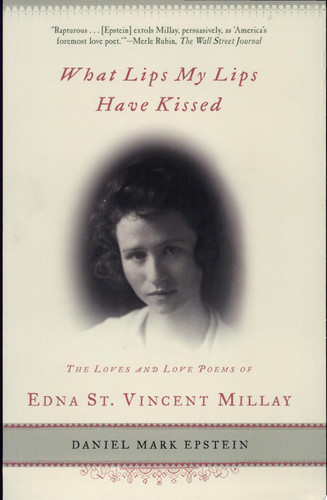
What Lips My Lips Have Kissed The Loves and Love Poems of Edna St. Vincent Millay

Daniel Mark Epstein
This is the story of a rare sort of American genius, who grew up in grinding poverty in Camden, Maine. Nothing could save the sensitive child but her talent for words, music, and drama, and an inexorable desire to be loved. When she was twenty, her poetry would make her famous; at thirty she would be loved by readers the world over. Edna St. Vincent Millay was widely considered to be the most seductive woman of her age. Few men could resist her, and many women also fell under her spell. From the publication of her first poems until the scandal over Fatal Interview twenty years later, gossip about the poet's liberated lifestyle prompted speculation about who might be the real subject of her verses. Using letters, diaries, and journals of the poet and her lovers that have only recently become available, Daniel Mark Epstein tells the astonishing story of the life, dedicated to art and love, that inspired the sublime lyrics of Edna St. Vincent Millay.
Macmillan 2002-09 300 pages

Heredity and Other Inventions

Sharona Muir
"Sharona Muir's Heredity and Other Inventions radiate like elements discovered late at night after years of searching ... a rocket in a museum in another country is both public knowledge and family secret; a daughter's umbilical cord in her father's lab sparks questions about the uses of love; the body of an airplane holds the imagined gestures of humans in their fi nal moments of life ... Muir renders the physical world so unfl inchingly that the metaphysical blows back, in equal and opposite reaction ... these poems are an act of postmortem collaboration: daughter as witness to history, using language to weld and spark familial bonds and to summon up their mysteries." --Rebecca Klaver, author of Empire Wasted "... Muir has a gift for conjuring beauty in the least expected places, dazzling audiences with rich imagery ... While the speaker's narrative is particular to her unique experience, in many ways this chapbook's poems transcend place and time, and resonate with all who have looked to the past for a way of understanding the present." --Mary Biddinger, author of Small Enterprise
C&R Press 2017-09 44 pages

How I Accidentally Started the Sixties

Howard Bloom
"Every page, every paragraph, every sentence sparkles with captivating metaphors, delightful verbal concoctions, alchemical insights, philosophic whimsy, absurd illogicals, scientific comedy routines, relentless, non-stop waves of hilarity. The comparisons to James Joyce are undeniable. Wow! Whew! Wild! Wonderful!"" Timothy Leary The strangest memoir you will ever read. You or your parents lived it. I helped start it. And it was an accident. It was the era of myth, legend, sex, and extreme adventure called The Sixties. "I blasted through Howard Bloom's How I Accidentally Started The Sixties like the wildfire swallowing up my mountain in California. I loved it. The molecular amusement ride, the sexual Disneyland, the Chevy 350 Impala blasting down the freeway at 120 mph. The universal essence is its brilliant simplicity.....Reality is really a mind field seen through Bloom's neurotic Buddha-like mind resplendent with every major family issue mortal humans will ever come across in a life time: identity, parents, meaning, self, non-self, food, habitation, education, goals, marriage, family, children, God, sex, more sex----DRUGS. It slithers like a rattlesnake across the page, the way a story should. What I love most is the off the wall comedy. Howard Bloom as Harpo Marx riding a freight train like Buddha carrying his life in a sleeping bag. I mean it's priceless. Bloom's psychedelic journey across the American landscape, is deciphered through the irresistible minds of murderers, crackpots, Nobel Prize Playboy bunnies, scholars, waiters, hobo gurus, cops, professors, French majors, psychiatrists, cock suckers, recreational drug users, Mormons, Jews, nut jobs, laundry mat owners, demonic children, lizards...........Aldous Huxley with a pinch of Timothy Leary.............and every molecule in the universe. It separates Bloom from any scientist/global mind who ever lived. Richard Feynman, Albert Einstein, and Aldous Huxley would be proud. Each man strived to marry science, art, and poetry but never managed to pull it off. How I Accidentally Started the Sixties does. I salute Howard Bloom. His doctrine sparkles every page with his Promethean fire; distilled in Shakespeare's immortal words, 'From women's eyes this doctrine I derive'.....[women] are the books, the arts, the academies, that show, contain and nourish the world.' Love's Labour Lost, only in Bloom's case, found, lost, and then found again. God only knows what else this mastermind is hiding from the rest of us." Mark Lamonica, winner of the Southern California Booksellers Association Nonfiction Award, author of Junk Yard Dogs And William Shakespeare and Renaissance Porn Star: The Saga of Pietro Aretino, The World's Greatest Hustler
CreateSpace Independent Publishing Platform 2014-09-23 220 pages

Lawrence and the Women The Intimate Life of D.H. Lawrence

Elaine Feinstein
D. H. Lawrence is recognized as one of the greatest novelists of this century. His work is taught in schools and universities all over the world. Yet, more than thirty years after the failure to ban Lady Chatterley's Lover in England fundamentally changed the moral climate of that country and of America, Lawrence remains a controversial figure. Regarded by many women during his lifetime as a sexual prophet, in recent years his supposed misogyny has drawn fierce condemnation from feminist critics. In this new biography of Lawrence, Elaine Feinstein explores his relationships with the women in his own life, many of whom have their counterparts in his novels. She traces the obsessive nature of his love for his mother, Lydia; his difficult relationship with his first sweetheart, Jessie Chambers; his pursuit of the bisexual Helen Corke; and the failure of his youthful engagement to Louisa Burrows. She gives a fascinating account of his long, battling marriage to Frieda von Richthofen; his friendships with women writers like Katherine Mansfield and Catherine Carswell; and the attachment to Lawrence of patronesses such as Lady Ottoline Morrell, Lady Cynthia Asquith and Mabel Dodge Luhan. Lawrence and the Women investigates the paradoxes of Lawrence's personality. He was considered to have a rare understanding of women's sexuality, yet his own sexual relationships were unusually difficult. He put all his faith in the energies of the body, yet his own was frail and sickly. He argued that women needed to submit to men, but he never succeeded in dominating his own wife, Frieda. With a novelist's eye for detail and uncanny intuition about character, Elaine Feinstein probes the sources of Lawrence's attitudes toward women with candor and compassion. Always responsive to the poetry and power of his writing, she offers a fresh and surprising portrait of one of the most misunderstood literary figures of our time.
HarperCollins Publishers 1994-03-30 275 pages