
2 results for "Poetry"

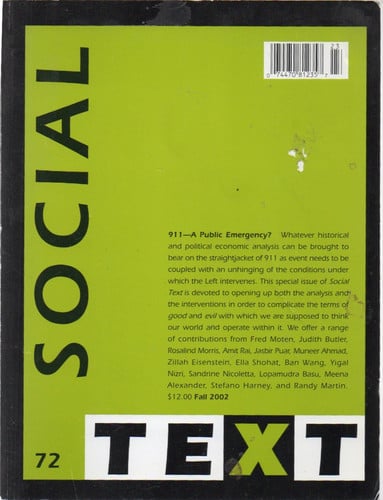
911 a Public Emergency?

Brent Hayes Edwards,Stefano Harney,Randy Martin,Ella Shohat,Timothy Mitchell,Fred Moten
Since September 11, public discourse has often been framed in terms of absolutes: an age of innocence gives way to a present under siege, while the United States and its allies face off against the Axis of Evil. This special issue of Social Text aims to move beyond these binaries toward thoughtful analysis. The editors argue that the challenge for the Left is to develop an antiterrorism stance that acknowledges the legacy of U.S. trade and foreign policy as well as the diversity of the Muslim faith and the dangers presented by fundamentalism of all kinds. Examining the strengths and shortcomings of area, race, and gender studies in the search for understanding, this issue considers cross-cultural feminism as a means of combating terrorism; racial profiling of Muslims in the context of other racist logics; and the homogenization of dissent. The issue includes poetry, photographic work, and an article by Judith Butler on the discursive space surrounding the attacks of September 11. This impressive range of contributions questions the meaning and implications of the events of September 11 and their aftermath. Contributors . Muneer Ahmad, Meena Alexander, Lopamudra Basu, Judith Butler, Zillah Eisenstein, Stefano Harney, Randy Martin, Rosalind C. Morris, Fred Moten, Sandrine Nicoletta, Yigal Nizri, Jasbir K. Puar, Amit S. Rai, Ella Shohat, Ban Wang
Duke University Press 2002-09-20 208 pages

The Naked God The Writer and the Communist Party

Howard Fast
2020 Reprint of the 1957 Edition. Full facsimile of the original edition and not reproduced with Optical Recognition Software. Howard Fast (1914-2003) was one of the most prolific American writers of the twentieth century. He was a bestselling author of more than eighty works of fiction, nonfiction, poetry, and screenplays. The son of immigrants, Fast grew up in New York City and published his first novel upon finishing high school in 1933. In 1950, his refusal to provide the United States Congress with a list of possible Communist associates earned him a three-month prison sentence. During his incarceration, Fast wrote one of his best-known novels, Spartacus (1951). Throughout his long career, Fast matched his commitment to championing social justice in his writing with a deft, lively storytelling style. In The Naked God the well-known author tells of his disillusionment with Communism and his subsequent break with the Party. The book is Howard Fast's public repudiation of the Communist Party, of which he was a devoted member for thirteen years until reading about the full scope of atrocities committed by the Soviet Union under Stalin. As the bestselling author of Spartacus and Citizen Tom Paine, Howard Fast lent his writing talents and celebrity to the communist cause as a steadfast advocate and public figure. However, he felt increasingly ill at ease with the superior manner Party leaders took with rank-and-file members and with rumors of Soviet anti-Semitism. In The Naked God, his first book after officially leaving the Party in 1956, Howard Fast explores the reasons he joined and his long inner struggle with a political movement in which he never felt he truly belonged.
Martino Fine Books 2020-11-03 206 pages