16 results for "Poetry"

Various Positions A Life of Leonard Cohen

Ira B. Nadel
Reissued with a new afterword Leonard Cohen is back! With a #1 bestselling poetry collection, The Book of Longing , flying off bookshelves; Lian Lunson’s acclaimed documentary, Leonard Cohen: I’m Your Man , in theatres this summer (the DVD will release this fall); and the superb soundtrack in music stores everywhere, Leonard Cohen proves he is Canada’s most enduring icon. Now, in the newly reissued Various Positions , Ira Nadel peels back the many layers to reveal the man and explain the fascinating relationship between Leonard Cohen’s life and his art. This book is a remarkable and rare look at Leonard Cohen, up close and personal. For nearly forty years, Leonard Cohen has endured the ups and downs of an international career that has alternately identified him as the "Prince of Bummers" and Canada's most respected poet and performer. Now, author Ira Nadel brings us closer to understanding these conflicting descriptions and allows us to enter Cohen's private world. He peels back the many layers to reveal the man and explain the fascinating relationship between Cohen's life and his art. This is a remarkable and rare look at Leonard Cohen, up close and personal.
Vintage Canada 1997 325 pages

Leonard Cohen A Life in Art

Ira Bruce Nadel
Profiling Canada's leading poet-singer, this concise biography surveys the remarkable 40-year career of Leonard Cohen that has produced 11 books and 11 records. Focusing on the evolution of Cohen's international reputation, the book begins with a review of the Montreal years. The popularity of works like The Spice Box of Earth and Beautiful Losers is examined in detail. Cohen's musical career receives special attention, from his first studio session to his latest record. The biography concludes with a discussion of Stranger Music .
ECW Press 1994 190 pages

I Remember

Perec, Georges
'Perec is serious fun' The Guardian Both an affectionate portrait of mid-century Paris and a daring memoir, Georges Perec's I Remember is now available in English to UK readers for the first time, with an introduction by David Bellos. In 480 numbered statements, all beginning identically with 'I remember', Perec records a stream of individual memories of a childhood in post-war France, while posing wider questions about memory and nostalgia. As playful and puzzling as the best of his novels, I Remember is an ode to life: the ordinary, the extraordinary, and the sometimes trivial, as seen through the eyes of the irreplaceable Georges Perec.
Gallic Books 2020 131 pages

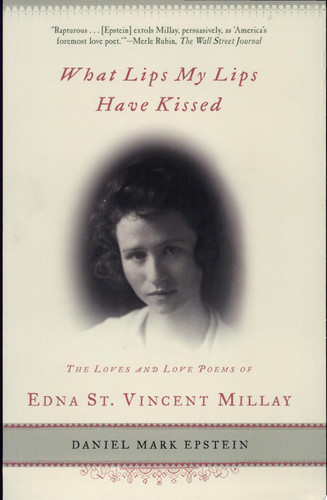
What Lips My Lips Have Kissed The Loves and Love Poems of Edna St. Vincent Millay

Daniel Mark Epstein
This is the story of a rare sort of American genius, who grew up in grinding poverty in Camden, Maine. Nothing could save the sensitive child but her talent for words, music, and drama, and an inexorable desire to be loved. When she was twenty, her poetry would make her famous; at thirty she would be loved by readers the world over. Edna St. Vincent Millay was widely considered to be the most seductive woman of her age. Few men could resist her, and many women also fell under her spell. From the publication of her first poems until the scandal over Fatal Interview twenty years later, gossip about the poet's liberated lifestyle prompted speculation about who might be the real subject of her verses. Using letters, diaries, and journals of the poet and her lovers that have only recently become available, Daniel Mark Epstein tells the astonishing story of the life, dedicated to art and love, that inspired the sublime lyrics of Edna St. Vincent Millay.
Macmillan 2002-09 300 pages

Lawrence and the Women The Intimate Life of D.H. Lawrence

Elaine Feinstein
D. H. Lawrence is recognized as one of the greatest novelists of this century. His work is taught in schools and universities all over the world. Yet, more than thirty years after the failure to ban Lady Chatterley's Lover in England fundamentally changed the moral climate of that country and of America, Lawrence remains a controversial figure. Regarded by many women during his lifetime as a sexual prophet, in recent years his supposed misogyny has drawn fierce condemnation from feminist critics. In this new biography of Lawrence, Elaine Feinstein explores his relationships with the women in his own life, many of whom have their counterparts in his novels. She traces the obsessive nature of his love for his mother, Lydia; his difficult relationship with his first sweetheart, Jessie Chambers; his pursuit of the bisexual Helen Corke; and the failure of his youthful engagement to Louisa Burrows. She gives a fascinating account of his long, battling marriage to Frieda von Richthofen; his friendships with women writers like Katherine Mansfield and Catherine Carswell; and the attachment to Lawrence of patronesses such as Lady Ottoline Morrell, Lady Cynthia Asquith and Mabel Dodge Luhan. Lawrence and the Women investigates the paradoxes of Lawrence's personality. He was considered to have a rare understanding of women's sexuality, yet his own sexual relationships were unusually difficult. He put all his faith in the energies of the body, yet his own was frail and sickly. He argued that women needed to submit to men, but he never succeeded in dominating his own wife, Frieda. With a novelist's eye for detail and uncanny intuition about character, Elaine Feinstein probes the sources of Lawrence's attitudes toward women with candor and compassion. Always responsive to the poetry and power of his writing, she offers a fresh and surprising portrait of one of the most misunderstood literary figures of our time.
HarperCollins Publishers 1994-03-30 275 pages

Her

Ferlinghetti, Lawrence
"To all those who have for several years sought to discredit the new American literature, Lawrence Ferlinghetti has just dealt a most powerful blow," wrote French critic Pierre Lepape in 1961 when Her was published in France as La Quatrième Personne du Singulier. Calling it "a masterpiece of the young American novel," Lepape declared it was "the confirmation of a great American writer who, in the hall of American literary glories, takes the place left vacant by the death of Hemingway." Lepape went on to speak of the "incredible verbal virtuosity" by which the reader is led through this "laby-rêve," and it is this image of the "labyrinth-dream" which relates Her to the anti-novels of the young French school of Robbe-Grillet and Butor. Being thus very far from the kind of novels produced by Ferlinghetti's immediate contemporaries (whether Beat or academic) this book has met with little but bafflement among American critics. With well over 50,000 now in print Her nevertheless continues to make its own way.
New directions publ 1988 156 pages

Irving Howe

Gerald Sorin
A New York Times “Books for Summer Reading” selection Winner of the 2003 National Jewish Book Award for History By the time he died in 1993 at the age of 73, Irving Howe was one of the twentieth century’s most important public thinkers. Deeply passionate, committed to social reform and secular Jewishness, ardently devoted to fiction and poetry, in love with baseball, music, and ballet, Howe wrote with such eloquence and lived with such conviction that his extraordinary work is now part of the canon of American social thought. In the first comprehensive biography of Howe’s life, historian Gerald Sorin brings us close to this man who rose from Jewish immigrant poverty in the 1930s to become one of the most provocative intellectuals of our time. Known most widely for his award-winning book World of Our Fathers, a rich portrayal of the East European Jewish experience in New York, Howe also won acclaim for his prodigious output of illuminating essays on American culture and as an indefatigable promoter of democratic socialism as can be seen in the pages of Dissent, the journal he edited for nearly forty years. Deeply devoted to the ideal of democratic radicalism and true equality, Howe was constantly engaged in a struggle for decency and basic fairness in the face of social injustice. In the century of Auschwitz, the Gulag, and global inter-ethnic mass murder, it was difficult to sustain political certainties and take pride in one's humanity. To have lived a life of conviction and engagement in that era was a notable achievement. Irving Howe lived such a life and Gerald Sorin has done a masterful job of guiding us through it in all its passion and complexity.
New York University Press 2002 386 pages

The Education of a Young Poet

David Biespiel
"Biespiel’s supple memoir of becoming a poet will surely inspire other writers to embrace the bodily character of writing and feel the power and, sometimes, the emptiness of the act of writing poetry." — Publishers Weekly (starred review) The Education of a Young Poet is David Biespiel’s moving account of his awakening to writing and the language that can shape a life. Exploring the original source of his creative impulse—a great–grandfather who traveled alone from Ukraine to America in 1910, eventually settling as a rag peddler in the tiny town of Elma, Iowa—through the generations that followed, Biespiel tracks his childhood in Texas and his university days in the northeast, led along by the ""pattern and random bursts that make up a life." His book offers an intimate recollection of how one person forges a life as a writer during extraordinary times. From the Jewish quarter of Houston in the 1970s to bohemian Boston in the 1980s, from Russia’s Pale of Settlement to a farming village in Vermont, Biespiel remains alert to the magic of possibilities—ancestral journeys, hash parties, political rallies, family connections, uncertain loves, the thrill of sex, and lasting friendships. Woven throughout are reflections on the writer’s craft coupled with a classic coming–of–age tale that does for Boston in the 1980s what Hemingway’s A Moveable Feast did for Paris in the 1920s and Broyard’s Kafka Was the Rage did for Greenwich Village in the 1950s. Restless with curiosity and enthusiasm, The Education of a Young Poet is a singular and universal bildungsroman that movingly demonstrates, "in telling the story of one’s coming into consciousness, all languages are more or less the same."
Catapult 2018-10-09 192 pages

Edward Thomas The Last Four Years

Eleanor Farjeon
Eleanor Farjeon first met Edward Thomas in the late autumn of 1912, when her brother invited him to tea. It was the beginning of a deep friendship between the painfully shy 31-year-old woman and the reserved writer known for his prose works and literary criticism. Though he died at the Battle of Arras in April 1917, it was a friendship which for Eleanor did not end with his death, but lived beyond it in his letters, and his poems, many of which Edward had sent to her from the trenches of the First World War for her comments. This double memoir uses Edward's letters and Eleanor's diaries and linking commentary to provide an extraordinarily candid account of their developing friendship, and of the enthusiasms they shared - both loved walking, and it was during this period that Edward first found his way into poetry. Edward was often deeply depressed, a man who found in nature something fundamental and ideal, a soldier-poet who wrote about the war in a new way, but Eleanor also shows us another side to his character, capturing moments of joy and humour. She also offers a unique account of Thomas's development as a poet, including the momentous meeting in 1913 with the American poet Robert Frost, whose encouragement led to Thomas's first poems. Thomas describes for her his family, his friendships with other writers, D H Lawrence among them, and also provides an exceptionally detailed account of his experiences in the First World War with the Artists' Rifles. Edward Thomas: The Last Four Years, was widely acclaimed on its first publication in 1958 - this second edition, published on the 80th anniversary of Thomas's death, has an introduction by Anne Harvey, a selection of Eleanor's sonnets 'To E.T.', and 'Walking Tom', a hitherto little-known poem about Edward written by Clifford Bax and Herbert Farjeon. Also included are eight pages of black and white photographs.
Faber & Faber Limited 2010-05 330 pages

Robert Burns

David Daiches
'In the later twentieth century Robert Burns was sorely in need of commentators to provide fuller analysis of a figure whose cultural reputation too often overshadowed his literary achievement. The brilliance of David Daiches as a literary critic filled much of the gap. His readings are a cornerstone of modern Burns studies.' Gerry Carruthers, Director, Centre for Robert Burns Studies, University of Glasgow An Edinburgh graduate in the 1930s, the early part of David Daiches' long and distinguished academic career was spent in the United States. However, after spells at Chicago and Cornell Universities, in 1951 he returned to Cambridge as a Lecturer in English. Ten years later he chose to leave Cambridge for the new University of Sussex where he was the first Professor and Dean in the School of English Studies. Retiring in 1977, he returned to Edinburgh where he continued to play an exceptionally active role in Scotland's intellectual and cultural life until his death in 2005. A polymath of English letters, Daiches' scholarly interests ranged extremely widely, but in no field is his influence more creative and enduring than in that of Scottish Literature. Our understanding of Scotland's literary culture in the eighteenth century, of Burns, of Scott, of Stevenson and McDiarmid, was transformed by his work. Originally published in 1951, his Robert Burns is a brilliant example of his ground-breaking scholarship and criticism at its most illuminating.
Humming Earth 2009 336 pages

Spontaneous Mind Selected Interviews 1958-1996

Allen Ginsberg
From his conversation with the conservative William F. Buckley on PBS to his testimony at the Chicago Seven trial to his passionate riffs on Cezanne, Blake, Whitman, and Pound, the interviews collected in Spontaneous Mind , chronologically arranged and in some cases previously unpublished, were conducted throughout Allen Ginsberg's long career. From the late 1950s to the mid-1990s, Ginsberg speaks frankly about his life, his work, and major events, allowing us to hear once again the impassioned voice of one of the most influential literary and cultural figures of our time.
HarperCollins 2002-03-26 624 pages

Waiting For The Messiah: A Memoir

Layton, Irving (with David ORourke)
Enigmatic and explosive, Irving Layton was indisputably one of this country's most controversial literary figures. His flamboyant style and outspokenness won him friends and enemies. His visceral and lyrical poetry earned him reverence and international acclaim. In Waiting for the Messiah, first published in 1985, Layton writes openly about his life and the discordant impulses that shaped him into the provocative poet and personality that he became. With the vitality, passion, and intimacy that characterizes his verse, his memoir -- covering the years between 1912 and 1946 -- sheds welcome light on Irving Layton's public persona, and gives further substance to one of the most impressive bodies of work in Canadian poetry. His self-portrait teems with insight and energy, and paints a picture of a colourful life, from its beginnings in Montreal's Jewish ghetto. As a high-spirited, life-loving, and sensual boy, he reacted against anti-Semitism and poverty that surrounded him, rejecting his parents' values and orthodox beliefs. He battled his way through an educational system that provided no outlet for his imagination. Layton's "crazy need for experience" drove him to embrace or challenge all that he encountered, and he recounts his first experiences with sex and death, his associations with literary friends and rivals, his relationships with women. Equally compelling is his description of Montreal in the forties as a city crackling with literary and political energies. It was in the ferment of this milieu that Layton ripened as a poet In Waiting for the Messiah, Layton unleashes his sparkling prose style. He is bold and revealing, scathing and witty. The result is a rich and entertaining memoir of a life which as "commuted daily between heaven and hell" and produced poems which have made a lasting contribution to Canadian literature.
Totem Press 1986 255 pages

Notebooks Selections from the A.M. Klein Papers (Collected Works of A.M. Klein)

A.M. Klein
Much of A.M. Klein's finest prose is to be found in the mass of uncompleted work that he abandoned at the time of his breakdown, and that became accessible only when his papers were deposited in the National Archives. Notebooks offers a generous selection of this work, revealing previously unsuspected facets of Klein's character and artistry. The fiction, criticism, and memoirs collected here focus on Klein's exploration of the role of the artist. The works illuminate crucial periods of his career, especially the early 1940s, when he was transforming himself into a modernist, and the early 1950s, when he was struggling to overcome the misgivings about his art that were to lead to his final breakdown. The semi-autobiographical text which Klein referred to as 'Raw Material' and the unfinished novel of prison life entitled 'Stranger and Afraid' cast a new light on Klein's often frustrating relationship with the Montreal Jewish community. In 'Marginalia' he discusses poetic form and technique and makes observations on the nature of poetry, thereby providing insights into his own concerns as a writer. In 'The Golem,' a profoundly ambiguous treatment of the act of creation, a self-portrait emerges of a storyteller who has lost faith in the power and value of his story. The volume includes a critical introduction, that places the material in the context of Klein's other works, as well as textual and explanatory notes.
University of Toronto Press 1995-12-15 290 pages

The Street

Aram Saroyan
Aram Saroyan's The Street: An Autobiographical Novel tells what it was like to come of age in New York City in the turbulent period of Vietnam and L.S.D., of racial unrest and rock-and-roll. Saroyan's free-wheeling, poignant and funny autobiographical novel deals with near stardom in Hollywood (Mike Nichols wanted him for the title role in "The Graduate"), his father, William Saroyan, his step-father, Walter Matthau, and a fascinating cast of characters from the world famous to the drop-outs of the psychedelic revolution. A screen adaptation of The Street, written and directed by Noam J. Christopher, can be viewed at ubu.com/film/saroyan.html. "Here is a novel that pins down an era." -Bookpeople Aram Saroyan's Complete Minimal Poems received the William Carlos Williams Award from the Poetry Society of America. His many prose books include Genesis Angels: The Saga of Lew Welch and the Beat Generation, Artists in Trouble: New Stories, and Door to the River: Essays and Reviews from the 1960s into the Digital Age. "A writer who looks deeply into himself and his own experience, confronts what he finds there with real courage and reports what he has experienced with a measure of candor that is both breathtaking and, at moments, heartbreaking." -Jonathan Kirsch, Los Angeles Times
Wilder Publications, Incorporated 2014 124 pages