8 results for "Poetry"

Democracy in One Book Or Less How It Works, Why It Doesn't, and Why Fixing It Is Easier Than You Think

David Litt
Bill Bryson meets Thomas Frank in this deeply insightful, unexpectedly hilarious story of how politicians hijacked American democracy and how we can take it back The democracy you live in today is different--completely different--from the democracy you were born into. You probably don't realize just how radically your republic has been altered during your lifetime. Yet more than any policy issue, political trend, or even Donald Trump himself, our redesigned system of government is responsible for the peril America faces today. What explains the gap between what We, the People want and what our elected leaders do? How can we fix our politics before it's too late? And how can we truly understand the state of our democracy without wanting to crawl under a rock? That's what former Obama speechwriter David Litt set out to answer. Poking into forgotten corners of history, translating political science into plain English, and traveling the country to meet experts and activists, Litt explains how the world's greatest experiment in democracy went awry. (He also tries to crash a party at Mitch McConnell's former frat house. It goes poorly.) The result of Litt's journey is something you might not have thought possible: a page-turner about the political process. You'll meet the Supreme Court justice charged with murder, learn how James Madison's college roommate broke the Senate, encounter a citrus thief who embodies what's wrong with our elections, and join Belle the bill as she tries to become a law (a quest far more harrowing than the one in Schoolhouse Rock!). Yet despite his clear-eyed assessment of the dangers we face, Litt remains audaciously optimistic. He offers a to-do list of bold yet achievable changes--a blueprint for restoring the balance of power in America before it's too late.
HarperCollins Publishers 2020-06-16 592 pages

Irving Howe

Gerald Sorin
A New York Times “Books for Summer Reading” selection Winner of the 2003 National Jewish Book Award for History By the time he died in 1993 at the age of 73, Irving Howe was one of the twentieth century’s most important public thinkers. Deeply passionate, committed to social reform and secular Jewishness, ardently devoted to fiction and poetry, in love with baseball, music, and ballet, Howe wrote with such eloquence and lived with such conviction that his extraordinary work is now part of the canon of American social thought. In the first comprehensive biography of Howe’s life, historian Gerald Sorin brings us close to this man who rose from Jewish immigrant poverty in the 1930s to become one of the most provocative intellectuals of our time. Known most widely for his award-winning book World of Our Fathers, a rich portrayal of the East European Jewish experience in New York, Howe also won acclaim for his prodigious output of illuminating essays on American culture and as an indefatigable promoter of democratic socialism as can be seen in the pages of Dissent, the journal he edited for nearly forty years. Deeply devoted to the ideal of democratic radicalism and true equality, Howe was constantly engaged in a struggle for decency and basic fairness in the face of social injustice. In the century of Auschwitz, the Gulag, and global inter-ethnic mass murder, it was difficult to sustain political certainties and take pride in one's humanity. To have lived a life of conviction and engagement in that era was a notable achievement. Irving Howe lived such a life and Gerald Sorin has done a masterful job of guiding us through it in all its passion and complexity.
New York University Press 2002 386 pages

The Paul Goodman reader

Goodman, Paul
A one-man think-tank for the New Left, Paul Goodman wrote over thirty books, most of them before his decade of fame as a social critic in the Sixties. A Paul Goodman Reader that does him justice must be a compendious volume, with excerpts not only from best-sellers like Growing Up Absurd, but also from his landmark books on education, community planning, anarchism, psychotherapy, language theory, and poetics. Samples as well from The Empire City, a comic novel reviewers compared to Don Quixote, prize-winning short stories, and scores of poems that led America's most respected poetry reviewer, Hayden Carruth, to exclaim, "Not one dull page. It's almost unbelievable." Goodman called himself as an old-fashioned man of letters, which meant that all these various disciplines and occasions added up to a single abiding concern for the human plight in perilous times, and for human promise and achieved grandeur, love and hope.
PM 2010 479 pages

Liberating Society from the State And Other Writings, a Political Reader

Erich Muhsam
Erich Mühsam (187S-1934), poet, bohemian, revolutionary, remains one of Germany's most renowned and influential anarchists. Born into a middle-class Jewish family, he challenged the conventions of bourgeois society at the turn of the century, engaged in heated debates on the rights of women and homosexuals, and traveled Europe in search of radical communes and artist colonies. He was a primary instigator of the ill-fated Bavarian Council Republic in 1919, and held the libertarian banner high during a Weimar Republic that came under increasing threat by right-wing forces. In 1933, four weeks after HitlerÆs ascension to power, Mühsam was arrested in his Berlin home. He spent the last sixteen months of his life in detention and died in the Oranienburg Concentration Camp in July 1934. Mühsam wrote poetry, plays, essays, articles, and diaries. His work unites a burning desire for individual liberation with anarcho-communist convictions, and bohemian strains with syndicalist tendencies. The body of his writings is immense, yet hardly any English translations have existed. This collection presents not only Liberating Society from the State: What is Communist Anarchism? MühsamÆs main political pamphlet and one of the key texts in the history of German anarchism, but also letters, unbending defenses of political prisoners, passionate calls for solidarity with the lumpenproletariat, recollections of the utopian community of Monte Verita, debates on the rights of homosexuals and women, excerpts from his journals, and essays contemplating German politics and anarchist theory as well as Jewish identity and the role of intellectuals in the class struggle. An appendix documents the fate of Zenzl Mühsam, who, after her husband's death, escaped to the Soviet Union where she spent twenty years in Gulag camps. Book jacket.
Merlin Press Limited 2011-06 304 pages

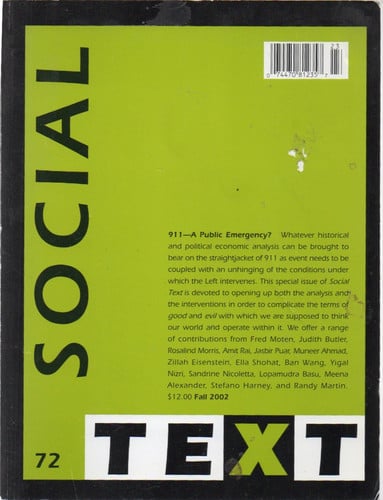
911 a Public Emergency?

Brent Hayes Edwards,Stefano Harney,Randy Martin,Ella Shohat,Timothy Mitchell,Fred Moten
Since September 11, public discourse has often been framed in terms of absolutes: an age of innocence gives way to a present under siege, while the United States and its allies face off against the Axis of Evil. This special issue of Social Text aims to move beyond these binaries toward thoughtful analysis. The editors argue that the challenge for the Left is to develop an antiterrorism stance that acknowledges the legacy of U.S. trade and foreign policy as well as the diversity of the Muslim faith and the dangers presented by fundamentalism of all kinds. Examining the strengths and shortcomings of area, race, and gender studies in the search for understanding, this issue considers cross-cultural feminism as a means of combating terrorism; racial profiling of Muslims in the context of other racist logics; and the homogenization of dissent. The issue includes poetry, photographic work, and an article by Judith Butler on the discursive space surrounding the attacks of September 11. This impressive range of contributions questions the meaning and implications of the events of September 11 and their aftermath. Contributors . Muneer Ahmad, Meena Alexander, Lopamudra Basu, Judith Butler, Zillah Eisenstein, Stefano Harney, Randy Martin, Rosalind C. Morris, Fred Moten, Sandrine Nicoletta, Yigal Nizri, Jasbir K. Puar, Amit S. Rai, Ella Shohat, Ban Wang
Duke University Press 2002-09-20 208 pages

The Naked God The Writer and the Communist Party

Howard Fast
2020 Reprint of the 1957 Edition. Full facsimile of the original edition and not reproduced with Optical Recognition Software. Howard Fast (1914-2003) was one of the most prolific American writers of the twentieth century. He was a bestselling author of more than eighty works of fiction, nonfiction, poetry, and screenplays. The son of immigrants, Fast grew up in New York City and published his first novel upon finishing high school in 1933. In 1950, his refusal to provide the United States Congress with a list of possible Communist associates earned him a three-month prison sentence. During his incarceration, Fast wrote one of his best-known novels, Spartacus (1951). Throughout his long career, Fast matched his commitment to championing social justice in his writing with a deft, lively storytelling style. In The Naked God the well-known author tells of his disillusionment with Communism and his subsequent break with the Party. The book is Howard Fast's public repudiation of the Communist Party, of which he was a devoted member for thirteen years until reading about the full scope of atrocities committed by the Soviet Union under Stalin. As the bestselling author of Spartacus and Citizen Tom Paine, Howard Fast lent his writing talents and celebrity to the communist cause as a steadfast advocate and public figure. However, he felt increasingly ill at ease with the superior manner Party leaders took with rank-and-file members and with rumors of Soviet anti-Semitism. In The Naked God, his first book after officially leaving the Party in 1956, Howard Fast explores the reasons he joined and his long inner struggle with a political movement in which he never felt he truly belonged.
Martino Fine Books 2020-11-03 206 pages