52 results for "Poetry"

No Matter the Wreckage

Sarah Kay
In No Matter the Wreckage , Sarah Kay takes you on a profound journey through her self-discovery in New York. Following her breakout poem "B," this debut poetry collection showcases her accessible brilliance. With each verse, Kay transports readers to a world of love, nostalgia, and life's wonders. Her elegant words celebrate family bonds, young love, travel, and the echoes of history shaping our present. What sets No Matter the Wreckage apart is Kay's ability to find magic in the ordinary, painting intimate portraits of unlikely love affairs between objects and exploring whimsical topics. This collection's transformative helps readers to find a sanctuary of words that uplift your spirit and ignite imagination. No Matter the Wreckage is a must-have for poetry lovers, an unforgettable journey.
Write Bloody Publishing 2021 150 pages

A change of world

Rich, Adrienne
"This reissue of Adrienne Rich's first poetry collection reaffirms the author's place as one of our most important American poets. A Change of World was selected by W. H. Auden for the Yale Series of Younger Poets Award. Out of print for decades, this initial collection launched the career of a poet whose work has been crucial to discussions of gender, race, and class, pushing formal boundaries and consistently examining both self and society" -- From the publisher.
W. W. Norton & Company 2016 52 pages

Essential essays: culture, politics, and the art of poetry

Rich, Adrienne
"Demonstrating the lasting brilliance of her voice and her prophetic vision, 'Essential Essays' showcases Adrienne Rich's singular ability to unite the political, personal, and poetical. The essays selected here by feminist scholar Sandra M. Gilbert range from the 1960s to 2006, emphasizing Rich's lifelong intellectual engagement and fearless prose exploration of feminism, social justice, poetry, race, homosexuality, and identity." - Umschlagrückseite
W.W. Norton & Company 2019-08-20 411 pages

Averno Poems

Louise Glück
WINNER OF THE NOBEL PRIZE IN LITERATURE Averno is a small crater lake in southern Italy, regarded by the ancient Romans as the entrance to the underworld. That place gives its name to Louise Glück's tenth collection: in a landscape turned irretrievably to winter, it is a gate or passageway that invites traffic between worlds while at the same time resisting their reconciliation. Averno is an extended lamentation, its long, restless poems no less spellbinding for being without conventional resoltution or consolation, no less ravishing for being savage, grief-stricken. What Averno provides is not a map to a point of arrival or departure, but a diagram of where we are, the harrowing, enduring present. Averno is a 2006 National Book Award Finalist for Poetry.
Farrar, Straus and Giroux 2021-03-09 96 pages

When Did I Stop Being Twenty And Other Injustices

Judith Viorst
Judith Viorst is known and loved by readers of all ages, for children’s books such as Alexander and the Terrible, Horrible, No Good, Very Bad Day ; nonfiction titles, including the bestseller Necessary Losses ; and her collections of humorous poetry, which make perfect gifts for birthdays, Mother’s Day, graduation, Christmas, Chanukah, or at any time of year. When Did I Stop Being Twenty and Other Injustices brings together the best of Judith Viorst's witty, insightful poetry, including many favorites from out-of-print collections. Whether she's finding herself or finding a sitter, or contemplating her sex life as she rubs the hormone night cream on her face, Viorst explores the true and funny ironies all women encounter growing up in the modern world. Here is a young single girl from Irvington, NJ, leaving her parents' home for life in the big city ("No I do not believe in free love/And yes I will be home for Sunday dinners," she promises). Here is the aspiring bohemian with an expensive liberal arts education, getting coffee and taking dictation, "Hoping that someday someone will be impressed/With all I know." Here is that married woman, coping with motherhood ("The tricycles are cluttering my foyer/The Pop Tart crumbs are sprinkled on my soul") and fantasy affairs ("I could imagine cryptic conversations, clandestine martinis...and me explaining that long kisses clog my sinuses") and all-too-real family reunions ("Four aunts in pain taking pills/One cousin in analysis taking notes"). And here she is at mid-life, wondering whether a woman who used to wear a "Ban the Bomb" button can find happiness being a person with a set of fondue forks, a fish poacher, and a wok. Every step of the way, Viorst transforms the familiar events of daily life into poems that make you laugh with recognition. When Did I Stop Being Twenty and Other Injustices demonstrates once and for all that no one understands American women coming of age like Judith Viorst.
Simon & Schuster 2011-01-01 112 pages

Enough Rope

Dorothy Parker
One of America's Greatest Wits! Published in 1926 Enough Rope was Parker's first collection of poetry. The collection sold very well and garnered impressive reviews. The Nation described it as "caked with a salty humor rough with splinters of disillusion and tarred with a bright black authenticity." The New York Times referred to it as "flapper verse " Enough Rope affirm Parker's reputation for sparkling wit
National Book Network 2024-04-23 58 pages

My lover is a woman: contemporary lesbian love poems

Lesléa Newman
Editor Lesléa Newman has collected the work of both well-known and emerging poets to create an anthology of some of the finest writers of any gender or sexual orientation writing poetry today. The probing fierceness of Adrienne Rich's "Love Poem," the stirring sensual incantation of Ellen Bass's "Praise," the intensely felt tenderness of Dorothy Allison's "Reason Enough to Love You," are just a few examples of the rich talent displayed in this volume. These poets have written daring confessions of love, sorrow, anger, and joy. Each poem is an elaborate confirmation of the resilience of the human spirit, and the ability to transform experience--including the struggle against the societal taboo of same-sex love--into brilliant poetry.
Ballantine 1999-06-01 336 pages

Tender Buttons

Gertrude Stein
One evening in the winter, some years ago, my brother came to my rooms in the city of Chicago bringing with him a book by Gertrude Stein. The book was called Tender Buttons and, just at that time, there was a good deal of fuss and fun being made over it in American newspapers. I had already read a book of Miss Stein's called Three Lives and had thought it contained some of the best writing ever done by an American. I was curious about this new book. My brother had been at some sort of a gathering of literary people on the evening before and someone had read aloud from Miss Stein's new book. The party had been a success. After a few lines the reader stopped and was greeted by loud shouts of laughter. It was generally agreed that the author had done a thing we Americans call "putting something across"-the meaning being that she had, by a strange freakish performance, managed to attract attention to herself, get herself discussed in the newspapers, become for a time a figure in our hurried, harried lives. My brother, as it turned out, had not been satisfied with the explanation of Miss Stein's work then current in America, and so he bought Tender Buttons and brought it to me, and we sat for a time reading the strange sentences. "It gives words an oddly new intimate flavor and at the same time makes familiar words seem almost like strangers, doesn't it," he said. What my brother did, you see, was to set my mind going on the book, and then, leaving it on the table, he went away. - Sherwood Anderson about "Tender Buttons" written by Gertrude Stein
Independently Published 2019-09-14 106 pages

Writing like a woman

Ostriker, Alicia
"'If we have the habit of freedom and the courage to write exactly as we think, ' as Woolf puts it in A Room of One's Own , writing like a woman simply means writing like what one actually is, in sickness and health, richer and poorer, belly and bowels, the consonants and the vowels too. We may have a general sense that women poets are more likely than men, at the present time, to write in detail about their bodies; to take power relationships as a theme; to want to speak with a strong rather than a subdued voice; are less likely to seek distance, more likely to seek intimacy, in poetic tone. But generalization would be foolish here. 'Woman poet, ' like 'American poet' or 'French poet' or 'Russian poet, ' allows--even insists on--diversity, while implying something valuable in common, some shared language and life, of tremendous importance to the poet and the poet's readers." --Alicia Ostriker
Michigan U.P. 1983 147 pages

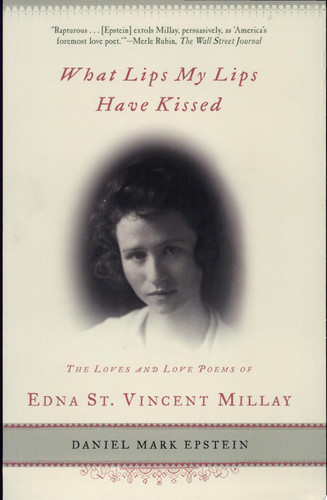
What Lips My Lips Have Kissed The Loves and Love Poems of Edna St. Vincent Millay

Daniel Mark Epstein
This is the story of a rare sort of American genius, who grew up in grinding poverty in Camden, Maine. Nothing could save the sensitive child but her talent for words, music, and drama, and an inexorable desire to be loved. When she was twenty, her poetry would make her famous; at thirty she would be loved by readers the world over. Edna St. Vincent Millay was widely considered to be the most seductive woman of her age. Few men could resist her, and many women also fell under her spell. From the publication of her first poems until the scandal over Fatal Interview twenty years later, gossip about the poet's liberated lifestyle prompted speculation about who might be the real subject of her verses. Using letters, diaries, and journals of the poet and her lovers that have only recently become available, Daniel Mark Epstein tells the astonishing story of the life, dedicated to art and love, that inspired the sublime lyrics of Edna St. Vincent Millay.
Macmillan 2002-09 300 pages

Heredity and Other Inventions

Sharona Muir
"Sharona Muir's Heredity and Other Inventions radiate like elements discovered late at night after years of searching ... a rocket in a museum in another country is both public knowledge and family secret; a daughter's umbilical cord in her father's lab sparks questions about the uses of love; the body of an airplane holds the imagined gestures of humans in their fi nal moments of life ... Muir renders the physical world so unfl inchingly that the metaphysical blows back, in equal and opposite reaction ... these poems are an act of postmortem collaboration: daughter as witness to history, using language to weld and spark familial bonds and to summon up their mysteries." --Rebecca Klaver, author of Empire Wasted "... Muir has a gift for conjuring beauty in the least expected places, dazzling audiences with rich imagery ... While the speaker's narrative is particular to her unique experience, in many ways this chapbook's poems transcend place and time, and resonate with all who have looked to the past for a way of understanding the present." --Mary Biddinger, author of Small Enterprise
C&R Press 2017-09 44 pages

Calligraphies Poems

Marilyn Hacker
A formally brilliant and powerful volume from "one of the most extraordinary innovative poets writing today" (Carol Muske-Dukes, Los Angeles Times ). Moving from Paris to Beirut and back, Calligraphies is a tribute to exiles and refugees, the known and unknown, dead and living, from the American poet Marie Ponsot to the Syrian pasionaria Fadwa Suleiman. Award-winning poet Marilyn Hacker finds resistance, wit, potential, and gleaming connection in everyday moments--a lunch of "standing near the fridge with / labneh, two verbs, and a spoon"--as a counterweight to the precarity of existence. With signature passion and agility, Hacker draws from French, Arabic, and English to probe the role of language in identity and revolution. Amid conversations in smoky cafes, personal mourning, and political turmoil, she traces the lines between exiles and expats, immigrants and refugees. A series of "Montpeyroux Sonnets" bookends the volume, cataloguing months in 2021 and 2022 in which the poet observes a village "in pandemic mode" and reflects on her own aging. In a variety of tones and formal registers, from vivid crowns of sonnets to insistent ghazals to elegiac pantoums and riffs on the renga, Calligraphies explores a world opened up by language.
W. W. Norton, Incorporated 2024-10-08 144 pages

Getting home alive

Levins Morales, Aurora
A mother and daughter of Puerto Rican and Jewish ancestry, the Moraleses express their radical and feminist views in diary-like poetry and prose that echo the rhetoric of the '60s. Yet the mixed origins of this pair lend an international, even universal feeling to the sentiments. They seem to speak for many women of many places and times. Titles of their pieces include "Concepts of Pollution," "Distress Signals," "Getting Out Alive," "Class Poem" and "I Am the Reasonable One." Both authors are literary, serious, socially concerned and passionate, and their anger is about injustices that plague them and other people. There is much vivid imagery and heartfelt emotion, and the reader may well long for causes that stir them as these women are stirred. Copyright 1986 Reed Business Information, Inc.
Firebrand Books 1986-10-01 213 pages

Bunny

Moscovitch, Hannah
Sorrel grew up with professor parents, where carob was dessert, reading passages of Canadian poetry aloud was entertainment, and canoeing was the only sport encouraged. No one really noticed the studious Sorrel until she turned seventeen, when late puberty suddenly transformed her into a hot dork. Boys wanted her and girls loathed her, and all at once Sorrel discovered the joys of sexuality and the pain of social rejection. Sorrel enters college as a self-proclaimed loser with no female friends, but then she meets Maggie. Maggie's unwavering friendship helps her shed her inhibitions and become more truly herself. The two women grow older, but when Maggie is diagnosed with cancer, Sorrel must choose between raw feeling and devotion.
Playwrights Canada Press 2019-03 108 pages

The Last Innocence The Lost Adventures

Alejandra Pizarnik
Poetry. Latinx Studies. LGBTQIA Studies. Women's Studies. Translated from the Spanish by Cecilia Rossi. THE LAST INNOCENCE and THE LOST ADVENTURES are Alejandra Pizarnik's second and third collections of poetry. Published in Buenos Aires shortly after The Most Foreign Country, her first book of poetry (which she would later disavow), these early poems blend the real and the imaginary, demonstrating the inner torment, deep solitude and acute vulnerability that would plague Pizarnik throughout her short life. This edition includes new English-language translations of both books along with an introduction by poet, translator, and Pizarnik scholar Ana Becciu. "Pizarnik's haunting words have garnered a 40-year following, earning her a reputation as perhaps Argentina's most important female poet."--The Argentina Independent
Ugly Duckling Presse 2019 63 pages