9 results for "Psychology"

The ecology of human development: experiments by nature and design

Bronfenbrenner, Urie
Here is a book that challenges the very basis of the way psychologists have studied child development. According to Urie Bronfenbrenner, one of the world’s foremost developmental psychologists, laboratory studies of the child’s behavior sacrifice too much in order to gain experimental control and analytic rigor. Laboratory observations, he argues, too often lead to “the science of the strange behavior of children in strange situations with strange adults for the briefest possible periods of time.” To understand the way children actually develop, Bronfenbrenner believes that it will be necessary to observe their behavior in natural settings, while they are interacting with familiar adults over prolonged periods of time. This book offers an important blueprint for constructing such a new and ecologically valid psychology of development. The blueprint includes a complete conceptual framework for analysing the layers of the environment that have a formative influence on the child. This framework is applied to a variety of settings in which children commonly develop, ranging from the pediatric ward to daycare, school, and various family configurations. The result is a rich set of hypotheses about the developmental consequences of various types of environments. Where current research bears on these hypotheses, Bronfenbrenner marshals the data to show how an ecological theory can be tested. Where no relevant data exist, he suggests new and interesting ecological experiments that might be undertaken to resolve current unknowns. Bronfenbrenner’s groundbreaking program for reform in developmental psychology is certain to be controversial. His argument flies in the face of standard psychological procedures and challenges psychology to become more relevant to the ways in which children actually develop. It is a challenge psychology can ill-afford to ignore.
Harvard University Press 1981 330 pages

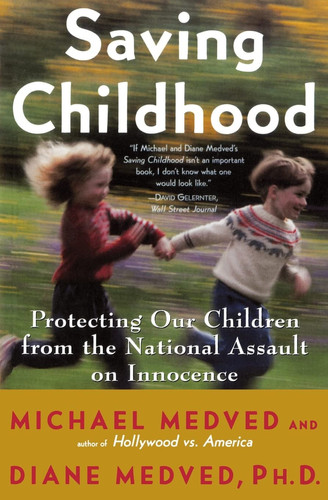
Saving childhood: how to protect your children from the national assault on innocence

Medved, Michael
Saving Childhood offers parents and grandparents practical strategies to cope with a society that seems perversely determined to frighten and corrupt its young. Cultural critic and popular radio host Michael Medved and his wife, psychologist Diane Medved, argue that in a mistaken effort to curb problems plaguing its youth, our culture has changed from protecting childhood as a precious time of growth to hammering even the smallest youngsters with a grim, harsh, and menacing view of the world. The Medveds systematically present unassailable scientific evidence, moving anecdotes, and personal experiences of raising their three young children to explain the attack from four primary directions--media, schools, peers, and even well-intentioned parents themselves. In a unique analysis the Medveds define innocence not as ignorance but as the result of three components--security, a sense of wonder and optimism. They empower parents and all who care about childhood with concrete, easily accomplished means to fend off the assault, as well as advice for handling hurdles such as the Internet, television, peer pressure, and the plague of pessimism. Saving Childhood enables us to restore and maintain for our children imagination, confidence, and hope for the future.
HarperCollinsPublishers 1998 324 pages

Understanding other minds: perspectives from autism

Simon Baron-Cohen,Donald J. Cohen,Helen Tager-Flusberg
This book focuses on a recent, important psychological theory of autism, the 'theory of mind' hypothesis. This claims that children with autism fail to develop the ability to think about mental states in the normal way, and thus fail to understand behavior in terms of mental states. In current terminology, they are impaired in the development of a 'theory of mind'. This psychological deficit is held to underlie some of the key feature of the syndrome: the abnormalities in social and communication development. The editors have collected together both the evidence and the controversies surrounding the theory, and present these as a valuable debate about the nature of what is widely recognized as the most severe childhood psychiatric disorder. The chapters are written by scholars from a variety of disciplines (developmental psychology, neuropsychology, philosophy, psycholinguistics, primatology, child psychiatry, and psychoanalysis). The book stands as an illustration of the mutual influence of studies of the mind from the prespectives of normality and pathology.
Oxford University Press 1993 515 pages

Playing the future: what we can learn from digital kids

Rushkoff, Douglas
Do "The Simpsons" represent a leap forward in media consciousness? Do Sega video games andchannel-surfing offer new strategies for coping in a world fraught with unpredictability? Canraves, snowboarding, or online chatting teach us something about adapting to cultural change?Douglas Rushkoff, "one of the great thinkers and writers of our time" (Timothy Leary) says yes, yes, and yes.
Riverhead Books 1999 278 pages

Children in jeopardy: can we break the cycle of poverty?

Harris, Irving B.
In this compassionate and controversial book Irving Harris argues that the key to breaking the cycle of poverty, hopelessness, and violence is very early intervention: we must provide adequate caregiving to children from birth to age three and - to stop the cycle even sooner - we must discourage pregnancy among adolescents. Harris, a successful businessman, has devoted himself to children's causes for the past forty years and has initiated and funded numerous programs geared to children and families. He presents data from research in pediatrics, social work, nursing, psychology, and education showing that children who receive early nurturing and stimulation are far more likely to have success in school and in life. He urges that the government build more day-care centers and train more caregivers and public-health nurses for babies and small children; that schools offer instruction and counseling in prenatal care; and that there be easier access to contraceptives and abortions in order to reduced unwanted pregnancies.
Yale University Press 1996-01-01 236 pages