16 results for "Psychology"

Think Like a Freak The Authors of Freakonomics Offer to Retrain Your Brain

Steven D. Levitt,Stephen J. Dubner
Now in Paperback—the New York Times bestseller—and follow up to the revolutionary bestsellers Freakonomics and SuperFreakonomics—with a new author Q&A. With their trademark blend of captivating storytelling and unconventional analysis, Steven D. Levitt and Stephen J. Dubner take us inside their thought process and teach us all how to think a bit more productively, more creatively, more rationally. In Think Like A Freak, they offer a blueprint for an entirely new way to solve problems, whether your interest lies in minor lifehacks or major global reforms. The topics range from business to philanthropy to sports to politics, all with the goal of retraining your brain. Along the way, you’ll learn the secrets of a Japanese hot-dog-eating champion, the reason an Australian doctor swallowed a batch of dangerous bacteria, and why Nigerian e-mail scammers make a point of saying they’re from Nigeria. Levitt and Dubner plainly see the world like no one else. Now you can too. Never before have such iconoclastic thinkers been so revealing—and so much fun to read.
HarperCollins 2015-07-07 304 pages

Turning Pro Tap Your Inner Power and Create Your Life's Work

Steven Pressfield
The follow-up to his bestseller The War of Art, Turning Pro navigates the passage from the amateur life to a professional practice. "You don't need to take a course or buy a product. All you have to do is change your mind."--Steven PressfieldTURNING PRO IS FREE, BUT IT'S NOT EASY.When we turn pro, we give up a life that we may have become extremely comfortable with. We give up a self that we have come to identify with and to call our own.TURNING PRO IS FREE, BUT IT DEMANDS SACRIFICE.The passage from amateur to professional is often achieved via an interior odyssey whose trials are survived only at great cost, emotionally, psychologically and spiritually. We pass through a membrane when we turn pro. It's messy and it's scary. We tread in blood when we turn pro.WHAT WE GET WHEN WE TURN PRO.What we get when we turn pro is we find our power. We find our will and our voice and we find our self-respect. We become who we always were but had, until then, been afraid to embrace and live out.
Repro India Limited 2023-06-06 160 pages

Imagine How Creativity Works

Jonah Lehrer
"Did you know that the most creative companies have centralized bathrooms? That brainstorming meetings are a terrible idea? That the color blue can help you double your creative output? From the best-selling author of How We Decide comes a sparkling and revelatory look at the new science of creativity. Shattering the myth of muses, higher powers, even creative 'types, ' Jonah Lehrer demonstrates that creativity is not a single gift possessed by the lucky few. It's a variety of distinct thought processes that we can all learn to use more effectively. Lehrer reveals the importance of embracing the rut, thinking like a child, daydreaming productively, and adopting an outsider's perspective (travel helps). He unveils the optimal mix of old an new partners in any creative collaboration and explains why criticism is essential to the process. Then he zooms out to show how we can make our neighborhoods more vibrant, our companies more productive, and our schools more effective. You'll learn about Bob Dylan's writing habits and the drug addictions of poets. You'll meet a Manhattan bartender who thinks like a chemist, and an autistic surfer who invented an entirely new surfing move. You'll see why Elizabethan England experienced a creative explosion, and how Pixar's office space is designed to spark the next big leap in animation. Collapsing the layers separating the neuron from the finished symphony, Imagine reveals the deep inventiveness of the human mind and its essential role in our increasingly complex world."--
Penguin Books, Limited 2012-03-20 304 pages

The Artist's Journey The Wake of the Hero's Journey and the Lifelong Pursuit of Meaning

Steven Pressfield
"No one's insights about the craft and journey of being an artist have guided me in the day-to-day struggle of this profession more than Steven Pressfield. Wherever you are, whatever you've been called to make, you need to read this book...and everything else he has written." - Ryan Holiday, Bestselling Author of Ego Is the Enemy and The Obstacle Is the Way YOU ARE AN ARTIST ... AND YOU HAVE AN ARTIST'S JOURNEY I have a theory about the Hero's Journey. We all have one. We have many, in fact. But our primary hero's journey is the passage we live out, in real life, before we find our calling. The hero's journey ends when, like Odysseus, we return home to Ithaca, to the place from which we started. What then? The passage that comes next is The Artist's Journey . On our artist's journey, we move past Resistance and past self-sabotage. We discover our true selves and our authentic calling, and we produce the works we were born to create. You are an artist too-whether you realize it or not, whether you like it or not-and you have an artist's journey. Will you live it out? Will you follow your Muse and do the work you were born to do? Ready or not, you are called.
Black Irish Entertainment LLC 2018 192 pages

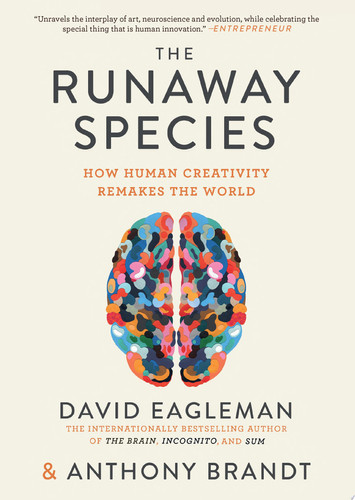
The Runaway Species How Human Creativity Remakes the World

David Eagleman,Anthony Brandt
This enlightening examination of creativity looks “at art and science together to examine how innovations . . . build on what already exists and rely on three brain operations: bending, breaking and blending” ( The Wall Street Journal ) The Runaway Species is a deep dive into the creative mind, a celebration of the human spirit, and a vision of how we can improve our future by understanding and embracing our ability to innovate. David Eagleman and Anthony Brandt seek to answer the question: what lies at the heart of humanity’s ability—and drive—to create? Our ability to remake our world is unique among all living things. But where does our creativity come from, how does it work, and how can we harness it to improve our lives, schools, businesses, and institutions? Eagleman and Brandt examine hundreds of examples of human creativity through dramatic storytelling and stunning images in this beautiful, full–color volume. By drawing out what creative acts have in common and viewing them through the lens of cutting–edge neuroscience, they uncover the essential elements of this critical human ability, and encourage a more creative future for all of us. “ The Runaway Species approach[es] creativity scientifically but sensitively, feeling its roots without pulling them out.” — The Economist
Catapult 2018-06-19 304 pages

The Real Work On the Mystery of Mastery

Adam Gopnik
For decades now, Adam Gopnik has been one of our most beloved writers, a brilliantly perceptive critic of art, food, France, and more. But recently, he became obsessed by a more fundamental matter, one he had often meditated on in The New Yorker: How do masters learn their miraculous skill, whether it was drawing a museum-ready nude or baking a perfect sourdough loaf? How could anyone become so good at anything? There seemed to be a fundamental mystery to mastery. Was it possible to unravel it? In The Real Work--the term magicians use for the accumulated craft that makes for a great trick--Gopnik becomes a dedicated student of several masters of their craft: a classical painter, a boxer, a dancing instructor, a driving instructor, and others. Rejecting self-help bromides and bullet points, he nevertheless shows that the top people in any field share a set of common qualities and methods. For one, their mastery is always a process of breaking down and building up--of identifying and perfecting the small constituent parts of a skill and the combining them for an overall effect greater than the sum of those parts. For another, mastery almost always involves intentional imperfection--as in music, where vibrato, a way of not quite landing on the right note, carries maximum expressiveness. Gopnik's simplest and most invigorating lesson, however, is that we are surrounded by mastery. Far from rare, mastery is commonplace, if we only know where to look: from the parent who can whip up a professional strudel to the social worker who--in one of the most personally revealing passages Gopnik has ever written--helps him master his own demons. Spirited and profound, The Real Work will help you understand how mastery can happen in your own life--and, significantly, why each of us relentlessly seeks to better ourselves in the first place.
Liveright Publishing Corporation 2024-04-02 256 pages

The Creative Mind

Henri. Bergson
The Creative Mind is a philosophical work written by the French philosopher Henri Bergson. Originally published in 1934, the book explores the nature of creativity and the creative process. Bergson argues that creativity is not simply a matter of individual genius, but is a fundamental aspect of life itself. He suggests that creativity arises from a tension between the past and the present, and that it is the result of a continual process of invention and adaptation.Bergson draws on a wide range of examples, from the arts to the sciences, to illustrate his ideas about creativity. He discusses the role of intuition and imagination in the creative process, and explores the relationship between creativity and the unconscious mind. He also considers the social and cultural factors that can either encourage or inhibit creativity.Throughout the book, Bergson emphasizes the importance of living in the present moment, and of being open to new experiences and ideas. He argues that creativity is not something that can be taught or learned, but is instead a natural expression of the human spirit.Overall, The Creative Mind is a thought-provoking and insightful exploration of one of the most fundamental aspects of human experience. It is a must-read for anyone interested in the nature of creativity, and in the ways in which we can cultivate it in ourselves and others.This is a new release of the original 1946 edition.This scarce antiquarian book is a facsimile reprint of the old original and may contain some imperfections such as library marks and notations. Because we believe this work is culturally important, we have made it available as part of our commitment for protecting, preserving, and promoting the world's literature in affordable, high quality, modern editions, that are true to their original work.
Literary Licensing, LLC 2013-10 306 pages

An Absorbing Errand How Artists and Craftsmen Make Their Way to Mastery

Janna Malamud Smith
An Absorbing Errand uses stories of artists' lives, personal anecdotes, and insights from the author's work as a psychotherapist to examine the psychological obstacles that prevent people from staying with, and relishing, the process of art–making. Each chapter is devoted to a problem intrinsic to the creative process and illustrates how these very obstacles, once understood, can become prime sources of the energy that actually fuels the mastery of art–making. Ultimately, An Absorbing Errand provides a philosophical, historical, and analytical look at the creative impulse and how certain artists from a wide field mastered their craft. From Julia Child to Charlie Chaplin, Lady Gaga to Michael Jackson, famous painters to established writers, Smith shows us how each overcame the obstacles they faced in the pursuit of their creative visions. Many people carry within their hearts an aching sense that they have something they want to express through art; or that they will not feel complete until they've brought out some hidden part of themselves. Yet they cannot begin to do the work of bringing their creative idea into the world. Or, maybe they've begun over and over, but they can't stay with their labor long enough to finish it. An Absorbing Errand is a supportive companion, an enlightened and compassionate ballast, a guide for anyone who has ever picked up a pencil to write, or a paint brush to paint, or any tool —from chisel to loom— to pursue any serious craft, and then put it down again frustrated, discouraged, and unable to continue. An Absorbing Errand is unlike any book about creating art of any kind, and aspiring and working artists alike will find it both original and invaluable.
Catapult 2013-08-06 272 pages

Wisdom, intelligence, and creativity synthesized

Sternberg, Robert J.
For thirty years, Robert J. Sternberg has been among the most vocal critics of narrow conceptions of intelligence. In Wisdom, Intelligence, and Creativity Synthesized Sternberg critically reviews and summarizes the best research available on human intelligence. He argues that any serious understanding of intelligence must go beyond the standard paper and pencil tests currently in use. In addition to analytical and quantitative abilities, a theory of intelligence must take account of peoples' creative abilities - their ability to go beyond given information and imagine new and exciting ways of reformulating old problems. It must also take into account peoples' ability to weigh options carefully and act prudently. Understanding one's own intellectual shortcomings and learning how to overcome, Sternberg argues, is just as important as developing one's strengths. As he weaves his way through decades of important research on these questions, Sternberg develops a vision of human intelligence that is far more nuanced and accurate than anything previously offered. Wisdom, Intelligence, and Creativity Synthesized is essential reading for psychologists, cognitive scientists, educators, and organizational researchers. Robert J. Sternberg is Dean of the School of Arts and Sciences and Professor of Psychology at Tufts University. Prior to being at Tufts, he was IBM Professor of Psychology and Education, Professor of Management in the School of Management, and Director of the Center for the Psychology of Abilities, Competencies, and Expertise at Yale University. This center, now relocated to Tufts, is dedicated to the advancement of theory, research, practice, and policy advancing the notion of intelligence as developing expertise, as a construct that is modifiable and capable, to some extent, of development throughout the lifespan. Author of over 1,100 articles, chapters, and books, Sternberg's research focuses on intelligence, creativity, and wisdom, and he has studied love and close relationships as well as hate.
Cambridge University Press 2003 227 pages

The creativity conundrum: a propulsion model of kinds of creative contributions

Sternberg, Robert J.
People tend to think of creativity as a trait-a single attribute with which we are born that is relatively fixed in quantity. Many people also think of creativity as something that only very gifted people possess. This book challenges all of these notions. The basic idea is that there are multiple kinds of creativity, and that everyone can develop at least some of these kinds of creativity. The book considers the various kinds of creativity as they apply in domains such as science, literature, the arts, government, business, and sports. The most common kind of creativity may be conceptual replication, whereby someone produces a minor variant of work that has been produced before. This kind of creativity represents a "limiting case" of creative thought. Most successful inventions and scientific discoveries represent "forward incrementations," which basically take existing ideas and move them to the next step in the direction the field is already going. Often more radical are redirections, which take a field in a new direction, and reinitiations, which represent essentially a "starting over" of how people think about a given problem. The book discusses 8 kinds of creativity, and how they are similar to and different from each other. It is illustrated with many examples, and describes why it is necessary to distinguish among the kinds of creativity. --From publisher's description.
Psychology Press 2002 141 pages

Creativity/Anthropology

Smadar Lavie,Kirin Narayan,Renato Rosaldo
Creativity and play erupt in the most solemn of everyday worlds as individuals reshape traditional forms in the light of changing historical circumstances. In this lively volume, fourteen distinguished anthropologists explore the life of creativity in social life across the globe and within the study of ethnography itself. Contributors include Barbara A. Babcock, Edward M. Bruner, James W. Fernandez, Don Handelman, Smadar Lavie, José E. Limon, Barbara Myerhoff, Kirin Narayan, Renato Rosaldo, Richard Schechner, Edward L. Schieffelin, Marjorie Shostak, Anna Lowenhaupt Tsing, and Edith Turner.
Cornell University Press 2018-08-15 368 pages

The Treehouse Eccentric Wisdom from My Father on How to Live, Love, and See

Naomi Wolf
Leonard Wolf, a retired professor now in his early eighties, is the kind of person who likes to use a medieval astrolabe, dress in Basque shepherd's clothing, and convince otherwise sensible people to quit their jobs and follow their passions. Leonard believes that inside everyone is an artist, and that happiness in life depends on valuing and acting upon one's creative impulse. In The Treehouse, her most personal book yet, Naomi Wolf outlines her father's lessons in creating lasting success and happiness, and offers inspiration for the artist in all of us. Drawn from Leonard's lecture notes, the chapters of The Treehouse remind us to "Be Still and Listen," "Use Your Imagination," and "Do Nothing Without Passion," and that "Your Only Wage Will Be Joy" and "Mistakes Are Part of the Draft." This is a journey of self-discovery in which the creative endeavor is paramount. The Treehouse is a stirring personal history, a meditation on fathers and daughters, an argument for honoring the creative impulse, and a unique instruction in the art of personal happiness.
Simon and Schuster 2006-05-03 288 pages

Cognition, creativity, and behavior: selected essays

Epstein, Robert
This diverse set of essays traces Epstein's experimental and theoretical work over a 15-year period. Four of the essays were coauthored by the eminent psychologist B.F. Skinner. The book demonstrates how the scientific study of the behavior can increase our understanding and effectiveness in many domains: creativity and innovation, parenting, artificial intelligence, self-improvement, and even world peace. Reviewers have praised the volume as an impressive effort by one of America's most notable psychologists.
Praeger 1996 360 pages