5 results for "Psychology"

Focus: The Hidden Driver of Excellence

Goleman, Daniel
In Focus, psychologist and journalist Daniel Goleman delves into the science of attention in all its varieties, presenting a long-overdue discussion of this little-noticed and underrated mental asset that matters enormously for how we navigate life. Attention works much like a muscle: use it poorly and it can wither; work it well and it grows. In an era of unstoppable distractions, Goleman persuasively argues that now more than ever we must learn to sharpen focus if we are to contend with, let alone thrive in, a complex world. Goleman analyzes attention research as a threesome: inner, other, and outer focus. He shows why high-performers need all three kinds of focus, as demonstrated by rich case studies from fields as diverse as competitive sports, education, the arts, and business. Those who excel rely on what Goleman calls smart practice that helps them improve habits, add new skills, and sustain excellence. Combining cutting-edge research with practical findings, Focus reveals what distinguishes experts from amateurs and stars from average performers.
HARPER PAPERBACKS 2015-05-05 320 pages

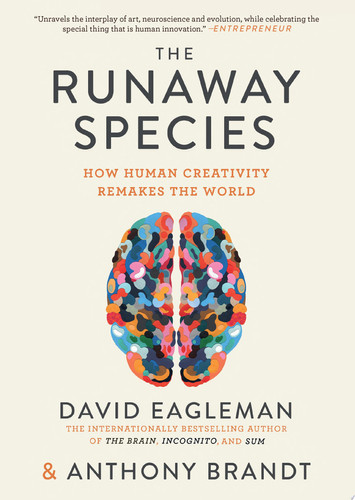
The Runaway Species How Human Creativity Remakes the World

David Eagleman,Anthony Brandt
This enlightening examination of creativity looks “at art and science together to examine how innovations . . . build on what already exists and rely on three brain operations: bending, breaking and blending” ( The Wall Street Journal ) The Runaway Species is a deep dive into the creative mind, a celebration of the human spirit, and a vision of how we can improve our future by understanding and embracing our ability to innovate. David Eagleman and Anthony Brandt seek to answer the question: what lies at the heart of humanity’s ability—and drive—to create? Our ability to remake our world is unique among all living things. But where does our creativity come from, how does it work, and how can we harness it to improve our lives, schools, businesses, and institutions? Eagleman and Brandt examine hundreds of examples of human creativity through dramatic storytelling and stunning images in this beautiful, full–color volume. By drawing out what creative acts have in common and viewing them through the lens of cutting–edge neuroscience, they uncover the essential elements of this critical human ability, and encourage a more creative future for all of us. “ The Runaway Species approach[es] creativity scientifically but sensitively, feeling its roots without pulling them out.” — The Economist
Catapult 2018-06-19 304 pages

Moral Calculations Game Theory, Logic, and Human Frailty

Laszlo Mero
Are people ever rational? Consider this: You auction off a one-dollar bill to the highest bidder, but you set the rules so that the second highest bidder also has to pay the amount of his last bid, even though he gets nothing. Would people ever enter such an auction? Not only do they, but according to Martin Shubik, the game's inventor, the average winning bid (for a dollar, remember) is $3.40. Many winners report that they bid so high only because their opponent "went completely crazy." This game lies at the intersection of three subjects of eternal fascination: human psychology, morality, and John von Neumann's game theory. Hungarian game-theorist Laszlo Mero introduces us to the basics of game theory, including such concepts as zero-sum games, Prisoner's Dilemma and the origins of altruism; shows how game theory is applicable to fields ranging from physics to politics; and explores the role of rational thinking in the context of many different kinds of thinking. This fascinating, urbane book will interest everyone who wonders what mathematics can tell us about the human condition.
Springer New York 2012-10-17 276 pages

Decision Theory and Decision Behaviour

A. Rapoport
The book treats two approaches to decision theory: (1) the normative, purporting to determine how a 'perfectly rational' actor ought to choose among available alternatives; (2) the descriptive, based on observations of how people actually choose in real life and in laboratory experiments. The mathematical tools used in the normative approach range from elementary algebra to matrix and differential equations. Sections on different levels can be studied independently. Special emphasis is made on 'offshoots' of both theories to cognitive psychology, theoretical biology, and philosophy.
Palgrave Macmillan UK 1998-01-28 469 pages

DECISION TIME! Better Decisions for a Better Life

Richard Davidson
Where you are in life today is the result of all of the past decisions which you have made or which have been made for you in response to the various situations and events, both expected and unexpected, that have impacted your life. The decisions that you will make from this point forward will determine the degree to which your future will be positive or negative. "Decision Time!" describes the subjective and multi-variable nature of real life decisions and demonstrates techniques for making complex decisions with ease and insight. "Decision Time!" provides guidance for many different decision-making situations with both personal and business aspects. Topics with examples from life include games, negotiation, the challenge of financing a college education, starting a small business, purchasing/shopping, family relationships, getting the government to listen to you, investments, and many more. "Decision Time!" gives you insight into the decision-making process as applied to both small and large choices you will face. It includes dynamic aspects, cultural effects, and morality as applied to decision-making for individuals, teams, and societies. "Decision Time!" prepares you to face the continuous impact of decision situations confidently and without hesitation.
Richard Davidson 2007-08 176 pages