16 results for "Psychology"

Making Sense Conversations on Consciousness, Morality, and the Future of Humanity

Sam Harris
A New York Times New and Noteworthy Book From the bestselling author of Waking Up and The End of Faith, an adaptation of his wildly popular, often controversial podcast "Civilization rests on a series of successful conversations." --Sam Harris Sam Harris--neuroscientist, philosopher, and bestselling author--has been exploring some of the most important questions about the human mind, society, and current events on his podcast, Making Sense. With over one million downloads per episode, these discussions have clearly hit a nerve, frequently walking a tightrope where either host or guest--and sometimes both--lose their footing, but always in search of a greater understanding of the world in which we live. For Harris, honest conversation, no matter how difficult or controversial, represents the only path to moral and intellectual progress. This book includes a dozen of the best conversations from Making Sense, including talks with Daniel Kahneman, Timothy Snyder, Nick Bostrom, and Glenn Loury, on topics that range from the nature of consciousness and free will, to politics and extremism, to living ethically. Together they shine a light on what it means to "make sense" in the modern world.
HarperCollins Publishers 2021-08-17 464 pages

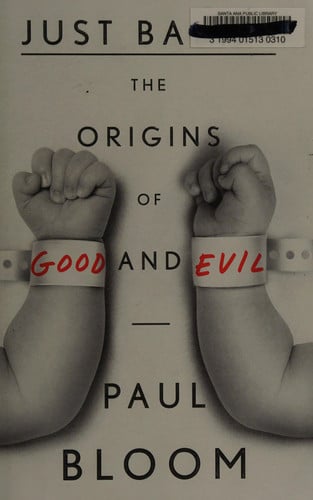
Just babies: the origins of good and evil

Bloom, Paul
"A leading cognitive scientist argues that a deep sense of good and evil is bred in the bone. From Sigmund Freud to Lawrence Kohlberg, psychologists have long believed that we begin life as amoral animals. After all, isn't it the parents' role to turn babies into civilized beings who can experience empathy and shame, and override selfish impulses? In Just Babies, Paul Bloom argues that humans are in fact hardwired with a sense of morality. Drawing upon years of original research at his Yale lab, he shows that babies and toddlers can judge the goodness and badness of others' actions; that they act to soothe those in distress; and that they feel guilt, shame, pride, and righteous anger. Yet this innate morality is tragically limited. Our natural strong moral feelings toward those in our own group--same family, same race--are offset by ingrained dislike, even hatred, of those in different groups. Put more simply, we are natural-born bigots. Vivid and intellectually probing, Just Babies argues that through intelligence and creativity we can transcend the primitive sense of morality we are born with. This erudite yet accessible book will captivate readers of Steven Pinker, Philip Zimbardo, and Robert Wright"--
Crown Publishers 2013 273 pages

Love & life

Schlessinger, Laura
Dr. Laura dives into the controversial topics and thorniest problems that face today's parents and grandparents, husbands and wives, men and women, and everyone seeking love, fulfillment, success -- or simply anyone who wants to be a decent and productive human being. With her trademark provocative, firm, but always thought-provoking and values-centered advice, Dr. Laura provides guidance that will inspire readers to be the very best they can be. Based on the tough-love advice from the calls and letters Dr. Laura receives.
Humanix Books 2020 223 pages

The hard problem

Stoppard, Tom
"Hilary, a young psychology researcher at the Krohl Institute for Brain Science, is nursing a private sorrow and a troubling question. She and other researchers at the institute are grappling with what science calls the 'hard problem'--if there is nothing but matter, what is consciousness? What Hilary discovers puts her fundamentally at odds with her colleagues, who include her first mentor and onetime lover, Spike; her boss, Leo; and the billionaire founder of the institute, Jerry. Hilary needs a miracle, and she is prepared to pray for one."--Back cover.
Grove Press 2015 76 pages

Spinoza's Ethics: an introduction

Nadler, Steven M.
Spinoza's Ethics is one of the most remarkable, important, and difficult books in the history of philosophy: a treatise simultaneously on metaphysics, knowledge, philosophical psychology, moral philosophy, and political philosophy. It presents, in Spinoza's famous 'geometric method', his radical views on God, Nature, the human being, and happiness. In this wide-ranging 2006 introduction to the work, Steven Nadler explains the doctrines and arguments of the Ethics, and shows why Spinoza's endlessly fascinating ideas may have been so troubling to his contemporaries, as well as why they are still highly relevant today. He also examines the philosophical background to Spinoza's thought and the dialogues in which Spinoza was engaged - with his contemporaries (including Descartes and Hobbes), with ancient thinkers (especially the Stoics), and with his Jewish rationalist forebears. His book is written for the student reader but will also be of interest to specialists in early modern philosophy.
Cambridge University Press 2006-05-25 281 pages

Aspiration: the agency of becoming

Callard, Agnes
Becoming someone is a learning process; and what we learn is the new values around which, if we succeed, our lives will come to turn. Agents transform themselves in the process of, for example, becoming parents, embarking on careers, or acquiring a passion for music or politics. How can such activity be rational, if the reason for engaging in the relevant pursuit is only available to the person one will become? How is it psychologically possible to feel the attraction of a form of concern that is not yet one's own? How can the work done to arrive at the finish line be ascribed to one who doesn't (really) know what one is doing, or why one is doing it? In Aspiration, Agnes Callard asserts that these questions belong to the theory of aspiration. Aspirants are motivated by proleptic reasons, acknowledged defective versions of the reasons they expect to eventually grasp. The psychology of such a transformation is marked by intrinsic conflict between their old point of view on value and the one they are trying to acquire. They cannot adjudicate this conflict by deliberating or choosing or deciding-rather, they resolve it by working to see the world in a new way. This work has a teleological structure: by modeling oneself on the person he or she is trying to be, the aspirant brings that person into being. Because it is open to us to engage in an activity of self-creation, we are responsible for having become the kinds of people we are. --
Oxford University Press 2018 287 pages

The pathology of normalcy

Fromm, Erich
A brilliant meditation on mental health in the modern world; alienation and mental health; ways to overcome 'the insane society'; a comprehensive analysis of prevailing concepts of mental health against Fromm’s views on overcoming destructive narcissism and social determinants of mental health; and a look at humankind’s alleged passivity in relation to dreams, child development and psychology.[Bokinfo]
American Mental Health Foundation Books 2010 152 pages

Analytic philosophy and human life

Nagel, Thomas
"This book collects Thomas Nagel's recent philosophical reflections on topics of fundamental interest: ethics, moral psychology, science and religion, death and the holocaust, and the metaphysics of mind. Among the figures discussed are Peter Singer, Alvin Plantinga, Christine Korsgaard, Elizabeth Anscombe, Philippa Foot, Iris Murdoch, T. M. Scanlon, Ronald Dworkin, Samuel Scheffler, Daniel Kahneman, Jonathan Haidt, Joshua Greene, and Daniel Dennett. Nagel consistently defends a realist interpretation of moral truth and resists reductive attempts to subsume ethics to psychology and evolutionary theory. He also defends a pluralistic conception of the content of morality against utilitarianism, including deontological elements such as rights and special responsibilities. A realist outlook also informs his discussions of metaphysical and epistemological questions. The book closes with tributes to a number of people Nagel has known over the course of his career. The essays are all addressed to a general audience, and should appeal not only to philosophers but to anyone interested in current attempts to understand human life, human values, and how we fit into the world"--
Oxford University Press 2023 291 pages

A very bad wizard: morality behind the curtain

Sommers, Tamler
In the first edition of A Very Bad Wizard: Morality behind the Curtain - Nine conversations, philosopher Tamler Sommers talked with an interdisciplary group of the world's leading researchers -- from the fields of social psychology, moral philosophy, cognitive science, and primatology - all working on the same issue: the origins and workings of morality. Together, these nine interviews pulled back some of the curtain, not only on our moral lives but - through Sommers' probing, entertaining, and well informed questions - on the way morality traditionally has been studied. This Second Edition increases the subject matter, adding eight additional interviews and offering features that will make A Very Bad Wizard more useful in undergraduate classrooms. These features include structuring all chapters around sections and themes familiar in a course in ethics or moral psychology; providing follow-up podcasts for some of the interviews, which will delve into certain issues from the conversations in a more informal manner; including an expanded and annotated reading list with relevant primary sources at the end of each interview; presenting instructor and student resources online in a companion website. (www.routledge.com/cw/sommers) The resulting new publication promises to synthesize and make accessible the latest interdisciplinary research to offer a brand new way to teach philosophical ethics and moral psychology. -- from back cover
Routledge 2016 322 pages

Relative justice: cultural diversity, free will, and moral responsibility

Sommers, Tamler
When can we be morally responsible for our behavior? Is it fair to blame people for actions that are determined by heredity and environment? Can we be responsible for the actions of relatives or members of our community? In this provocative book, Tamler Sommers concludes that there are no objectively correct answers to these questions. Drawing on research in anthropology, psychology, and a host of other disciplines, Sommers argues that cross-cultural variation raises serious problems for theories that propose universally applicable conditions for moral responsibility. He then develops a new way of thinking about responsibility that takes cultural diversity into account. Relative Justice is a novel and accessible contribution to the ancient debate over free will and moral responsibility. Sommers provides a thorough examination of the methodology employed by contemporary philosophers in the debate and a challenge to Western assumptions about individual autonomy and its connection to moral desert.
Princeton University Press 2012-01-08 230 pages

Mind and morals: essays on cognitive science and ethics

Larry May,Marilyn Friedman,Andy Clark
The essays in this anthology deal with the growing interconnections between moral philosophy and research that draws upon neuroscience, developmental psychology, and evolutionary biology. The essays in this anthology deal with the growing interconnections between moral philosophy and research that draws upon neuroscience, developmental psychology, and evolutionary biology. This cross-disciplinary interchange coincides, not accidentally, with the renewed interest in ethical naturalism. In order to understand the nature and limits of moral reasoning, many new ethical naturalists look to cognitive science for an account of how people actually reason. At the same time, many cognitive scientists have become increasingly interested in moral reasoning as a complex form of human cognition that challenges their theoretical models. The result of this collaborative, and often critical, interchange is an exciting intellectual ferment at the frontiers of research into human mentality. Sections and Contributors Ethics Naturalized, Owen Flanagan, Mark L. Johnson, Virginia Held - Moral Judgments, Representations, and Prototypes, Paul M. Churchland, Andy Clark, Peggy DesAutels, Ruth Garrett Millikan - Moral Emotions, Robert M. Gordon, Alvin I. Goldman, John Deigh, Naomi Scheman - Agency and Responsibility James P. Sterba, Susan Khin-Zaw, Helen E. Longino, Michael E. Bratman A Bradford Book
MIT Press 1996 315 pages

Judgments of responsibility: a foundation for a theory of social conduct

Weiner, Bernard
This intriguing new work provides a careful examination of how judgments of ourselves and others relate to problems and, in so doing, yields valuable insight into human interactions and motivational processes. Laying out a general theory of social motivation, the author incorporates a number of well-researched areas in social psychology and motivation to elucidate basic principles that guide human conduct across culture and time. Chapters reveal how responsibility inferences are reached, the manner in which such judgments affect emotions, and the role that "cold" judgments of responsibility versus "hot" feelings, such as anger, play in producing both positive and negative behaviors. The author demonstrates that the ways others are perceived influence the behaviors directed toward them, showing how attributions of personal causality are followed by judgments of responsibility. These inferences then give rise to other-directed emotions such as anger and sympathy which, in turn, generate antisocial and prosocial actions. Providing a conceptual system that permits readers a deeper understanding of motivational processes and suggests guidelines for more effective interventions, this book is insightful reading for a wide range of scholars.
Guilford Press 1995-04-14 301 pages