
5 results for "Psychology"

Just babies: the origins of good and evil

Bloom, Paul
"A leading cognitive scientist argues that a deep sense of good and evil is bred in the bone. From Sigmund Freud to Lawrence Kohlberg, psychologists have long believed that we begin life as amoral animals. After all, isn't it the parents' role to turn babies into civilized beings who can experience empathy and shame, and override selfish impulses? In Just Babies, Paul Bloom argues that humans are in fact hardwired with a sense of morality. Drawing upon years of original research at his Yale lab, he shows that babies and toddlers can judge the goodness and badness of others' actions; that they act to soothe those in distress; and that they feel guilt, shame, pride, and righteous anger. Yet this innate morality is tragically limited. Our natural strong moral feelings toward those in our own group--same family, same race--are offset by ingrained dislike, even hatred, of those in different groups. Put more simply, we are natural-born bigots. Vivid and intellectually probing, Just Babies argues that through intelligence and creativity we can transcend the primitive sense of morality we are born with. This erudite yet accessible book will captivate readers of Steven Pinker, Philip Zimbardo, and Robert Wright"--
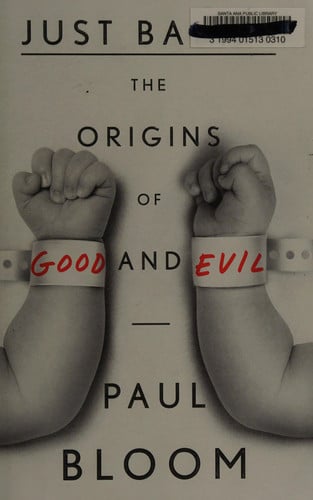
Crown Publishers 2013 273 pages

Radical evil: a philosophical interrogation

Bernstein, Richard J.
"At present, there is an enormous gulf between the visibility of evil and the paucity of our intellectual resources for coming to grips with it. We have been flooded with images of death camps, terrorist attacks and horrendous human suffering. Yet when we ask what we mean by radical evil and how we are to account for it, we seem to be at a loss for proper responses." ; "Bernstein seeks to discover what we can learn about the meaning of evil and human responsibility. He turns to philosophers such as Kant, who coined the expression 'radical evil', as well as to Hegel and Schelling. He also examines more recent explorations of evil, namely the thinking of Freud and Nietzsche on the moral psychology of evil. Finally, he looks at the way in which three post-Holocaust thinkers - Emmanuel Levinas, Hans Jonas, and Hannah Arendt - have sought to come to grips with evil "after Auschwitz."" "Radical Evil will be essential reading for students and scholars of philosophy, social and political theory and religious studies."--Jacket
Polity Press 2002-08-02 289 pages

The pathology of normalcy

Fromm, Erich
A brilliant meditation on mental health in the modern world; alienation and mental health; ways to overcome 'the insane society'; a comprehensive analysis of prevailing concepts of mental health against Fromm’s views on overcoming destructive narcissism and social determinants of mental health; and a look at humankind’s alleged passivity in relation to dreams, child development and psychology.[Bokinfo]
American Mental Health Foundation Books 2010 152 pages

Depth psychology and a new ethic

Neumann, Erich
The modern world has witnessed a dramatic breakthrough of the dark, negative forces of human nature. The "old ethic," which pursued an illusory perfection by repressing the dark side, has lost its power to deal with contemporary problems. Erich Neumann was convinced that the deadliest peril now confronting humanity lay in the "scapegoat" psychology associated with the old ethic. We are in the grip of this psychology when we project our own dark shadow onto an individual or group identified as our "enemy," failing to see it in ourselves. The only effective alternative to this dangerous shadow projection is shadow recognition, acknowledgement, and integration into the totality of the self. Wholeness, not perfection, is the goal of the new ethic.
Shambhala 1990-06-10 158 pages

The reality of the devil: evil in man

Anshen, Ruth Nanda
Anshen's book displays an extensive phenomenology of evil with dispassion, insight & irony. The Devil is seen as no mere medieval curiosity. He's equal to God in power, but not in substance, & a compulsive force in humans & the universe. Dr Ansen reviews the fall of Lucifer & of humanity with an analytical ingenuity that casts Satan, Eve & Cain in roles formidable & provocative for the history & psychology of humankind. Lucifer, before his fall, the author contends, was not evil. Nor was his act of rebellion against God an act of satanic hatred. It was the act of an individualist who rebelled against the fact of being created by one beyond & above himself.
Harper & Row 1972 142 pages