13 results for "Psychology"

The madwoman in the attic: the woman writer and the nineteenth-century literary imagination

Gilbert, Sandra M.,Gubar, Susan
A pathbreaking book of literary criticism is now reissued with a new introduction by Lisa Appignanesi that speaks to how The Madwoman in the Attic set the groundwork for subsequent generations of scholars writing about women writers, and why the book still feels fresh some four decades later.
Yale University Press 2020-03-17 719 pages

Uncle Tungsten

Sacks, Oliver
In this memoir, Oliver Sacks evokes, with warmth and wit, his upbringing in wartime England, telling of the large science-steeped family who fostered his early fascination with chemistry. There follow his years at boarding school where, though unhappy, he developed the intellectual curiosity that would shape his later life. And we hear of his return to London, an emotionally bereft 10-year-old who found solace in his passion for learning. 'Uncle Tungsten' radiates all the delight and wonder of a boy's adventures, and provides an unforgettable portrait of an extraordinary young mind.
Picador 2016-02-25 337 pages

Ghost hunters

Blum, Deborah
In Victorian Britain, a group of eminent scientists got together to found a society expressly to prove the existence of ghosts. The age of Darwin represented the greatest scientific advances known to man. The tension between science and religion was exposed by Darwin's On the Origin of the Species in 1859, which challenged the basic tenets of belief. Yet many of those in the forefront of the scientific revolution could not give up the idea of a higher reality. Life after death was the unknown frontier. Victorian society was full of mediums claiming they could communicate with the spirits of the dead. Baffling psychic phenomena occurred every day at seances- mysterious rappings were heard, furniture moved, ghostly forms appeared, the mediums spoke in the altered voices of the dead with information only their nearest could possibly know. Pyschometry involving locks of hair and watches and children's toys; telepathy; ouija boards; apparitions; astral projection- all were commonplace. In 1882 the Society of Psychical Research was founded in London to investigate all these phenomena- it was a group led by some of the greatest scientists of the age but its membership also included Alfred, Lord Tennyson, Leslie Stephen, Virginia Woolf's father, John Ruskin, the Reverend Charles Dodgson (Lewis Carroll) and Samuel Clemens (Mark Twain). Six months later William James, Professor of Psychology at Harvard, and the brother of Henry James visited London and went on to set up American branch. Their experiments went on for years. Many mediums, like the notorious Madame Blavatsky, were exposed as charlatans yet there were some mediums who continued to communicate directly with another world, who despite every rigorous scientific test seemed to prove that souls survived death. This is the story of this group of forward thinkers- many of whom were driven to the spirit world by personal tragedy, some whose feeling of loss lead to their own suicides. It is the story of the greatest ghost hunt of any age.
Arrow 2007 370 pages

Ada: a life and a legacy

Stein, Dorothy
Augusta Ada Byron, Countess of Lovelace, was the daughter of Lord Byron and a close friend to many of the leading figures of the Victorian era; based on her report on Charles Babbage's Analytical Engine she is also generally known as the inventor of the science of computer programming. In this engrossing biography, Dorothy Stein strips away the many layers of myth to reveal a story far more dramatic and fascinating than previous accounts have indicated. Dorothy Stein is a psychologist with a special interest in thought and language and a background in physics and computer programming. She has taught courses in nineteenth-century women's history and in the biology and psychology of sex differences, and is particularly concerned with the use of myth in science.
The MIT Press 1985 321 pages

My Judy Garland life

Boyt, Susie
Fascinating and extraordinary, thrilling and poignant, My Judy Garland Life will speak to anyone who has ever nursed an obsession or held a candle to a star. Judy Garland has been an important figure in Susie Boyt's life since she was three years old, comforting, inspiring and at times disturbing her. In this unique book, Boyt travels deep into the underworld of hero worship, reviewing through the prism of Judy our understanding of rescue, consolation, love, grief and fame. What does it mean to adore someone you don't know? What is the proper husbandry of a twenty-first century obsession? Boyt's journey takes in a duetting breakfast with Mickey Rooney, a Munchkin luncheon, tea with the largest collector of Garlandia, an illicit late-night spree at the Minnesota Judy Garland Museum and a breathless, semi-sacred encounter with Miss Liza Minnelli . . .
Virago 2019-09-19 309 pages

The Medical Man And The Witch During The Renaissance

Gregory Zilboorg
""The Medical Man and the Witch During the Renaissance"" by Gregory Zilboorg is a historical account of the relationship between medicine and witchcraft during the Renaissance period. The book explores how medical professionals, such as physicians and surgeons, interacted with individuals accused of practicing witchcraft and the role they played in the persecution of witches. Zilboorg delves into the cultural and social context of the time, examining the beliefs and superstitions that shaped the attitudes towards witches and the methods used to diagnose and treat supposed witchcraft. The book also examines the impact of the witch trials on the medical profession and the development of medical knowledge during this period. Overall, ""The Medical Man and the Witch During the Renaissance"" provides a fascinating insight into the intersection of medicine and witchcraft during a tumultuous period in European history.Publications Of Institute Of The History Of Medicine, The Johns Hopkins University, Third Series, V2.This scarce antiquarian book is a facsimile reprint of the old original and may contain some imperfections such as library marks and notations. Because we believe this work is culturally important, we have made it available as part of our commitment for protecting, preserving, and promoting the world's literature in affordable, high quality, modern editions, that are true to their original work.
Literary Licensing, LLC 2011-07 234 pages

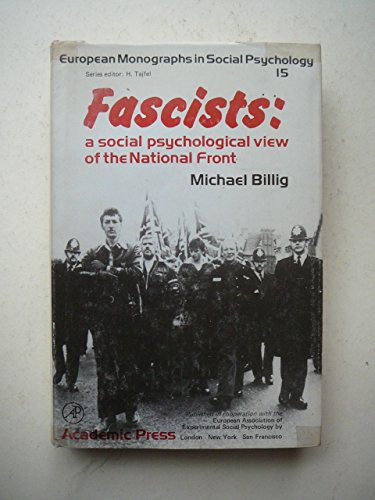
Fascists: a social psychological view of the National Front

Billig, Michael
The growth of the National Front into a political party has shown that fascism is alive and kicking in Britain, and no longer confined to a tiny lunatic fringe.This book examines in detail the official propaganda of the National Front and this, together with an analysis of its basic ideology and interviews with ordinary members, demonstrates a clear historical continuity with Nazism and the survival of the anti-Semitic belief in a world Jewish conspiracy.The idea of a Nazi revival here in Britain is of frightening importance and this book should be read by all those with an interest in the threat posed by contemporary fascism.
Academic Press in co-operation with European Association of Experimental Social Psychology 1978 393 pages

Music and psychology: from Vienna to London, 1939-52

Keller, Hans
For three or four decades after the Second World War, musical thinking in Britain was dominated by psychology. Among the earliest of the musical Freudians was Hans Keller (1919-85), an émigré from Vienna. For his case studies Keller drew on composers, performers, listeners and critics; and for his general topics he turned to opera, film music, creative character, genius, aesthetics and the issues of everyday musical life. The writing is impressive for its novelty, its insights, and the communicative clarity of its prose. The book includes a large number of aphorisms, two stories and a one-act play on British anti-Semitism. Most of the writings appear here in print for the first time and are drawn from papers held in the Hans Keller Archive at the University Library in Cambridge.
Plumbago Books 2003 267 pages

Double talk: the erotics of male literary collaboration

Koestenbaum, Wayne
Sigmund Freud and Josef Breuer on hysteria, J.A. Symonds and Havelock Ellis on sexuality, a novel by Ford Madox Ford and Joseph Conrad, The Waste Land of T.S. Eliot (and Ezra Pound), even the Lyrical Ballads of Wordsworth and Coleridge: men making books together. Wayne Koestenbaum's startling interpretation of literary collaboration focuses on homosexual desire: men write together, he argues, in order either to express or to evade homosexual feelings. Their writing becomes a textual intercourse, the book at once a female body they can share and the child of their partnership. These man-made texts steal a generative power that women's bodies seem to represent. Seen as the site of a struggle between homosexual and homophobic energies, the texts Koestenbaum explores - works of psychoanalysis, sexology, fiction, and poetry - emerge as more complex, more revealing. They crystallize and refract the anxiety of male sexuality at the end of the last century, and open up a deeper understanding of connections today between the erotic and the literary. Drawing upon the work of feminist critics, Koestenbaum connects male collaboration and the exchange of women within patriarchy: he peers into both medical texts and imaginative literature, disturbing our ready acceptance of the co-authored work. This strong and unsettling book transforms our understanding of the creative process, providing a new sense of what both collaborative and solitary artistry mean.
Routledge 1989 214 pages

The British: character, psychology and destiny

Stein, Walter Johannes
‘This book is a tribute to [Stein’s] appreciation of the land of his adoption and, to those who knew him, it is a monument to his penetrative powers of spiritual perception.’ – A.P. Shepherd At a time when British identity is being reassessed and questioned, W.J. Stein’s classic and timeless study, with its penetrative analysis of the character, psychology and destiny of the British people, takes on new relevance. Stein, a political refugee from Austria, spent the last 24 years of his life in Britain. As an outsider, he was able to view British custom and culture with objectivity. As a student of Rudolf Steiner, he brought years of spiritual study and wisdom to the writing of this book, enabling profound insights. In this concise and aphoristic study, Stein writes on everything from geography, history, politics and economics to the arts (in particular painting and music) and religion. He also reflects on the British concept of freedom, as well as Great Britain’s somewhat mysterious propensity to extend itself – and its language and culture – across the world. ‘Amidst the international turmoils of today the Delphic word can be heard to resound from all sides, in its metamorphosed form: “Know yourselves as folk-souls!” Stein’s little book is an invaluable contribution to such a super-individual self-knowledge.’ – T.H. Meyer
Temple Lodge 1990 55 pages