35 results for "Psychology"

Doppelganger: a trip into the mirror world

Klein, Naomi
"What if you woke up one morning and found you'd acquired another self--a double who was almost you and yet not you at all? What if that double shared many of your preoccupations but, in a twisted, upside-down way, furthered the very causes you'd devoted your life to fighting against? Not long ago, the celebrated activist and public intellectual Naomi Klein had just such an experience--she was confronted with a doppelganger whose views she found abhorrent but whose name and public persona were sufficiently similar to her own that many people got confused about who was who. Destabilized, she lost her bearings, until she began to understand the experience as one manifestation of a strangeness many of us have come to know but struggle to define: AI-generated text is blurring the line between genuine and spurious communication; New Age wellness entrepreneurs turned anti-vaxxers are scrambling familiar political allegiances of left and right; and liberal democracies are teetering on the edge of absurdist authoritarianism, even as the oceans rise. Under such conditions, reality itself seems to have become unmoored. Is there a cure for our moment of collective vertigo? Naomi Klein is one of our most trenchant and influential social critics, an essential analyst of what branding, austerity, and climate profiteering have done to our societies and souls. Here she turns her gaze inward to our psychic landscapes, and outward to the possibilities for building hope amid intersecting economic, medical, and political crises. With the assistance of Sigmund Freud, Jordan Peele, Alfred Hitchcock, and bell hooks, among other accomplices, Klein uses wry humor and a keen sense of the ridiculous to face the strange doubles that haunt us--and that have come to feel as intimate and proximate as a warped reflection in the mirror. Combining comic memoir with chilling reportage and cobweb-clearing analysis, Klein seeks to smash that mirror and chart a path beyond despair. Doppelganger asks: What do we neglect as we polish and perfect our digital reflections? Is it possible to dispose of our doubles and overcome the pathologies of a culture of multiplication? Can we create a politics of collective care and undertake a true reckoning with historical crimes? The result is a revelatory treatment of the way many of us think and feel now--and an intellectual adventure story for our times"--
Farrar, Straus and Giroux 2023-09-12 399 pages

Young Jane Young: a novel

Zevin, Gabrielle
"Aviva Grossman [is] an ambitious congressional intern in Florida who makes the life-changing mistake of having an affair with her boss, who is beloved, admired, successful, and very married--and blogging about it. When the affair comes to light, the congressman doesn't take the fall, but Aviva does, and her life is over before it hardly begins. She becomes a late night talk show punchline; she is slut-shamed, labeled as fat and ugly, and considered a blight on politics in general. How does one go on after this? In Aviva's case, she sees no way out but to change her name and move to a remote town in Maine"--
Algonquin Books of Chapel Hill 2018-05-01 306 pages

The age of American unreason

Jacoby, Susan
From the Publisher: A cultural history of the last forty years, The Age of American Unreason focuses on the convergence of social forces-usually treated as separate entities-that has created a perfect storm of anti-rationalism. These include the upsurge of religious fundamentalism, with more political power today than ever before; the failure of public education to create an informed citizenry; and the triumph of video over print culture. Sparing neither the right nor the left, Jacoby asserts that Americans today have embraced a universe of "junk thought" that makes almost no effort to separate fact from opinion
Pantheon Books 2008 356 pages

The authority gap: why women are still taken less seriously than men, and what we can do about it

Sieghart, Mary Ann
"An incisive, intersectional look at the mother of all gender biases: a resistance to women's authority and power. Every woman has a story of being underestimated, ignored, challenged, or patronized in the workplace. Maybe she tried to speak up in a meeting, only to be talked over by male colleagues. Or a client addressed her male subordinate instead of her. Despite the progress we've made toward equality, we still fail, more often than we might realize, to take women as seriously as men. In The Authority Gap, journalist Mary Ann Sieghart examines the wide-ranging implications of this critical gender bias. She explores its intersections with race and class biases and the measures we can take to bridge the gap. With precision and insight, she marshals a wealth of data from a variety of disciplines-including psychology, sociology, politics, and business-and interviews pioneering women like Booker Prize winner Bernardine Evaristo and Janet Yellen. The Authority Gap offers a "a credible roadmap that is capable of taking women from the margins to the center" (Mary McAleese, former president of Ireland)"--
W. W. Norton & Company 2022 375 pages

Joining the resistance

Gilligan, Carol
Since the publication of her landmark book In a Different Voice, Carol Gilligan has transformed the way we think about women and men and the relations between them. It was ‘the little book that started a revolution’, and with more than 800,000 copies in print it has become one of the most widely read and influential books ever written on gender and human development. In her new book Joining the Resistance Carol Gilligan reflects on the evolution of her thinking and shows how her key ideas were interwoven with her own life experiences. Her work began with the question of voice: who is speaking to whom, in what body, telling what stories about which relationships? By listening carefully she heard a voice that had been held in silence, and in the process realized the extent to which we – both women and men – had been telling false stories about ourselves. In her subsequent work Gilligan found that adolescent girls resisted pressures to disengage themselves from their honest voices, and by joining their resistance she opened the way for the development of a more humane way of thinking about personal and political relationships. For the central conviction of her work today – and the central thesis of this book – is that the requisites for love and the requisites for citizenship in a democratic society are one and the same. Both voice and the desire to live in relationships inherent in our human nature, together with the capacity to resist false authority. Combining autobiographical reflection with an analysis of key questions about gender and human development, this timely and highly readable book by one of America’s greatest contemporary thinkers will appeal to a wide readership.
Polity 2013-05-13 180 pages

Mind change: how digital technologies are leaving their mark on our brains

Greenfield, Susan
"Google. Facebook. Twitter. Repeat. We live in a world unimaginable even a few decades ago, one like no other in human history. It's a parallel world where we can be on the move in the real world, yet always hooked into an alternative time and place. And although it's a two-dimensional world of sight and sound, it offers instant information, connected identities, and constant novelty. In this world, our screen technologies are increasingly where we work, where we unwind, where we relieve our boredom and where we learn. The subsequent transformation in how we live and think is a vitally important issue, perhaps even the most important issue of our time. When toddlers are given iPads, and adults spend ten hours a day staring at a screen, can we afford to assume that our brave new screen technologies are harmless tools? Blending a wide range of scientific studies, news events, and cultural criticism with brio and verve, Mind Change presents an incisive snapshot of the global 'now.' Greenfield examines how the dawn of the Digital Age has already altered our cultural landscape, fueled an epidemic of oversharing, and transformed how we learn, remember and spread information -- and how these innovations are changing our physical brains. A warning cry, a shot across the bow, and a call to action, Mind Change explores the social, cultural and physiological ramifications of our new digital lifestyle"--
Random House 2015-02-10 348 pages

Microtrends: the small forces behind tomorrow's big changes

Penn, Mark J.
Pollster Mark Penn argues that the biggest trends in America are microtrends, the smaller trends that go unnoticed or ignored. One million people can create new market for a business, spark a social movement, or effect political change. In 1996, a microtrend identified by Penn ("soccer moms") helped re-elect Clinton. Now, Penn identifies the new microtrends sweeping the world, from Extreme Commuters and Working Retired to Old New Dads, from Bourgeois And Bankrupt to Uptown Tattooed. Highlighting everything from religion to politics, from leisure pursuits to relationships, this book will take the reader deep into the worlds of polling, targeting, and psychographic analysis.--From publisher description.
Twelve 2009 454 pages

The McDonaldization of society

Ritzer, George
One of the most popular Sociology books of all time has been thoroughly updated to examine how McDonaldization has roared into the 21st century. The McDonaldization of Society, Revised New Century Edition discusses how McDonaldization and the broader process of globalization (in a new Chapter 8), are spreading more widely and more deeply into various social institutions such as education, medicine, the criminal justice system, and more. This Revised New Century Edition provides many new, relevant examples from recent events and contemporary popular culture, including the ever-increasing global proliferation of McDonald′s and other fast food franchises, shopping malls, and similar commercial entities. Their impact is examined in the post-September 11, 2001 era.
Pine Forge Press 2004-01-21 309 pages

Beasts: what animals can teach us about the origins of good and evil

Masson, J. Moussaieff
"There are two supreme predators on the planet with the most complex brains in nature: humans and orcas. In the twentieth century alone, one of these animals killed 200 million members of its own species, the other has killed none. Jeffrey Masson's fascinating new book begins here: There is something different about us. In his previous bestsellers, Masson has showed that animals can teach us much about our own emotions--love (dogs), contentment (cats), grief (elephants), among others. But animals have much to teach us about negative emotions such as anger and aggression as well, and in unexpected ways. In Beasts he demonstrates that the violence we perceive in the "wild" is mostly a matter of projection. We link the basest human behavior to animals, to "beasts" ("he behaved no better than a beast"), and claim the high ground for our species. We are least human, we think, when we succumb to our primitive, animal ancestry. Nothing could be further from the truth. Animals, at least predators, kill to survive, but there is nothing in the annals of animal aggression remotely equivalent to the violence of mankind. Our burden is that humans, and in particular humans in our modern industrialized world, are the most violent animals to our own kind in existence, or possibly ever in existence on earth. We lack what all other animals have: a check on the aggression that would destroy the species rather than serve it. It is here, Masson says, that animals have something to teach us about our own history. In Beasts, he strips away our misconceptions of the creatures we fear, offering a powerful and compelling look at our uniquely human propensity toward aggression"--
Bloomsbury 2014 213 pages

Ceremonial violence: a psychological explanation of school shootings

Fast, Jonathan
Ceremonial Violence analyzes the Columbine high school shooting and four other cases and explains for the first time why teenagers commit school rampage shootings. With his grasp of the elements of abnormal psychology, developmental psychology, sociology, and neurology that contribute to the homicidal mindset, Fast offers us a means of understanding and coming to terms with these tragedies.--From publisher description.
Overlook Press 2008-09-04 333 pages

Saving the modern soul: therapy, emotions, and the culture of self-help

Illouz, Eva
The language of psychology is all-pervasive in American culture―from The Sopranos to Oprah, from the abundance of self-help books to the private consulting room, and from the support group to the magazine advice column. Saving the Modern Soul examines the profound impact of therapeutic discourse on our lives and on our contemporary notions of identity. Eva Illouz plumbs today's particular cultural moment to understand how and why psychology has secured its place at the core of modern identity. She examines a wide range of sources to show how self-help culture has transformed contemporary emotional life and how therapy complicates individuals' lives even as it claims to dissect their emotional experiences and heal trauma.
University of California Press 2008 294 pages

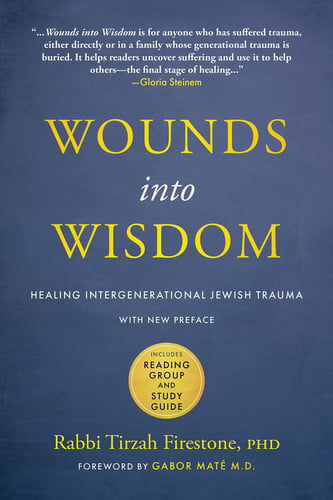
Wounds into wisdom: healing intergenerational Jewish trauma

Firestone, Tirzah
"Our past does not simply disappear. The painful history of our ancestors and their rich cultural wisdom intertwine within us to create the patterns of our future. Even when past trauma remains unspoken or has long been forgotten, it becomes part of us and our children-a legacy of both strength and woundedness that shapes our lives. In this book, Tirzah Firestone brings to life the profound impact of protracted historical trauma through the compelling narratives of those whose lives were marred by racial persecution and displacement. The tragic story of Firestone's own family lays the groundwork for these revealing testimonies of recovery, forgiveness, and moral leadership. Throughout, Firestone interweaves their voices with neuroscientific and psychological findings, as well as relevant and inspiring Jewish teachings. Seven principles emerge from these wise narratives-powerful prescriptive tools that speak to anyone dealing with the effects of past traumatic injury. At the broadest level, these principles are directives for staying morally awake in a world rife with terror"--
Monkfish Book Publishing Company 2022 258 pages

I want to kill the dog

Cohen, Richard M.
A hilarious book by Richard M. Cohen, the New York Times bestselling author of Blindsided and Strong at the Broken Places , about living with his wife, Meredith Vieira, and her band of difficult dogs. “Has a couple ever gone to war or a spouse moved to another country because a pet came between them? Have two people other than my wife and me ever had such opposing feelings when it comes to domestic animals?” So wonders Richard M. Cohen, who has endured the beasts his wife, Meredith Vieira, has brought into the house to enrich their lives. Despite her unshakable affection for these furry creatures, the various animals have destroyed the serenity of a once calm household. Friends watch in stunned silence as the family frantically struggles to keep peace in this lawless land. Delivery people have fled in fear. Guests have cowered or simply laughed at the hideous shrieks, the current mutt’s stab at intimidation. Then there are the cats that think they are ferocious jungle creatures. Weary of having animals run the show, Richard is fed up. These animals are destroying a home, and the life of one simple soul who seeks only peace and quiet. The King has been overthrown. The Queen and her court have taken over. That would be Meredith and her minions. I Want to Kill the Dog is more than a countercultural ode to those weary of the pet pedestal. It is a portrait of a marriage and of the redemptive power of humor and family when banishing the beast is not an option.
Blue Rider Press, a member of Penguin Group (USA) Inc 2012 125 pages

Ask and tell: self-advocacy and disclosure for people on the autism spectrum

Stephen M. Shore
Edited by Stephen Shore, author of Beyond the Wall: Personal Experiences with Autism and Asperger Syndrome, Ask and Tell: Self-Advocacy and Disclosure for People on the Autism Spectrum aims to help people with autism effectively self-advocate in their pursuit of independent, productive, and fulfilling lives. Ask and Tell is unique by being the first book to speak to the twin issues of self-advocacy and disclosure for people with autism and by consisting exclusively including the cover art and the preface by Temple Grandin of contributions by those on the autism spectrum for persons on the spectrum.
Autism Asperger Publishing, Co 2004-01-01 196 pages

A house of cards: baseball card collecting and popular culture

Bloom, John
Baseball card collecting carries with it images of idealized boyhoods in the sprawling American suburbs of the postwar era. Yet since the mid-1970s, it has grown from a pastime for children to a big money pursuit taken seriously by adults. This work employs interviews with collectors, dealers, and hobbyists to ask what this hobby tells us about nostalgia, work, play, masculinity, and race and gender relations among collectors. These interviews reveal the hobby's alienating, lonely and unfulfilling aspects, and demonstrate the nostalgia experienced among collectors for the ideal childhood world many middle class white males experienced in the postwar years, when baseball card collecting was a form of play, not a money-making enterprise. The work links this nostalgia to anxieties about de-industrialization and the rise of the civil rights, feminist, and gay rights movements. It examines the gendered nature of swap meets as well as the views of masculinity expressed by the collectors: is the purpose of baseball card collecting to form a community of adults to reminisce or to inculcate young men with traditional masculine values? Is it to establish "connectedness" or to make money? Are collectors striving to reinforce the dominant culture or question it through their attempts to create their own meaning out of what are, in fact, mass-produced commercial artifacts?
University of Minnesota Press 1997 142 pages

Speaking treason fluently: anti-racist reflections from an angry white male spea[k]ing

Wise, Tim J.
In this highly anticipated follow-up to White Like Me: Reflections on Race from a Privileged Son , activist Tim Wise examines the way in which institutional racism continues to shape the contours of daily life in the United States, and the ways in which white Americans reap enormous privileges from it. The essays included in this collection span the last ten years of Wise’s writing and cover all the hottest racial topics of the past decade: affirmative action, Hurricane Katrina, racial tension in the wake of the Duke lacrosse scandal, white school shootings, racial profiling, phony racial unity in the wake of 9/11, and the political rise of Barack Obama. Wise’s commentaries make forceful yet accessible arguments that serve to counter both white denial and complacency—two of the main obstacles to creating a more racially equitable and just society. Speaking Treason Fluently is a superbly crafted collection of Wise’s best work, which reveals the ongoing salience of race in America today and demonstrates that racial privilege is not only a real and persistent problem, but one that ultimately threatens the health and well-being of the entire society.
Soft Skull 2008-09-01 359 pages

States of denial: knowing about atrocities and suffering

Cohen, Stanley
Blocking out, turning a blind eye, shutting off, not wanting to know, wearing blinkers, seeing what we want to see ... these are all expressions of 'denial'. Alcoholics who refuse to recognize their condition, people who brush aside suspicions of their partner's infidelity, the wife who doesn't notice that her husband is abusing their daughter, are supposedly 'in denial'. Governments deny their responsibility for atrocities, and plan them to achieve 'maximum deniability'. Truth Commissions try to overcome the suppression and denial of past horrors. Bystander nations deny their responsibility to intervene, whether in Bosnia or Rwanda. Do these phenomena have anything in common? When we deny, are we aware of what we are doing or is this an unconscious defence mechanism to protect us from unwelcome truths? Can there be cultures of denial? How do organizations like Amnesty and Oxfam try to overcome the public's apparent indifference to distant suffering and cruelty? Is denial always so bad--or do we need positive illusions to retain our sanity? States of denial is the first comprehensive study of both the personal and political ways in which uncomfortable realitites are avoided and evaded. It ranges from clinical studies of depression, to media images of suffering, to explanations of the 'passive bystander' and 'compassion fatigue'. The book shows how organized atrocities--the Holocaust and other genocides, torture, and political massacres--are denied by perpetrators and by bystanders, those who stand by and do nothing.
Polity 2001 344 pages

'I know who caused COVID-19': pandemics and xenophobia

Zhou, Xun,Gilman, Sander L.
Fear has consequences, for individuals and for communities. And in times of stress, such as during epidemics, prejudices and primeval fear, always beneath the surface, can resurge to haunt us. In this book Zhou Xun and Sander L. Gilman examine how four groups have been blamed for causing or spreading the COVID-19 virus: the residents of Wuhan and Black African communities in China; Ultra-Orthodox Jewish communities in the USA, Britain and Israel; African Americans and the UK's BAME communities; and White right-wing groups in America and Europe. 'I Know Who Caused COVID-19' explores stereotyping and the false attribution of blame, as well as what happens when a collective is actually at fault, and how the community deals with these conflicting issues. This is an incisive, cogent examination of blame and xenophobia in the time of COVID-19. -- Provided by publisher.
Reaktion Books 2021-09-14 254 pages

The elephant in the room: silence and denial in everyday life

Zerubavel, Eviatar
The fable of the Emperor's New Clothes is a classic example of a conspiracy of silence, a situation where everyone refuses to acknowledge an obvious truth. But the denial of social realities -- whether incest, alcoholism, corruption, or even genocide -- is no fairy tale. In this book, the author sheds new light on the social and political underpinnings of silence and denial -- the keeping of "open secrets." The author shows that conspiracies of silence exist at every level of society, ranging from small groups to large corporations, from personal friendships to politics. Drawing on examples from newspapers and comedy shows to novels, children's stories, and film, the book travels back and forth across different levels of social life, and from everyday moments to large-scale historical events. At its core, the book helps us understand why we ignore truths that are known to all of us. The author shows how such conspiracies evolve, illuminating the social pressures that cause people to deny what is right before their eyes. We see how each conspirator's denial is symbiotically complemented by the others, and we learn that silence is usually more intense when there are more people conspiring -- and especially when there are significant power differences among them. He concludes by showing that the longer we ignore "elephants," the larger they loom in our minds, as each avoidance triggers an even greater spiral of denial. Social life in families, organizations, communities and even entire nations is full of situations where the emperor has no clothes. The book illuminates the dynamics behind these situations, revealing why we ignore obvious and alarming realities.
Oxford University Press 2008 162 pages