9 results for "Public Policy"

Franklin D. Roosevelt A Political Life

Robert Dallek
Named a Best Book of the Year by The Washington Post and NPR “We come to see in FDR the magisterial, central figure in the greatest and richest political tapestry of our nation’s entire history” —Nigel Hamilton, Boston Globe “Meticulously researched and authoritative” —Douglas Brinkley, The Washington Post “A workmanlike addition to the literature on Roosevelt.” —David Nasaw, The New York Times “Dallek offers an FDR relevant to our sharply divided nation” —Michael Kazin “Will rank among the standard biographies of its subject” — Publishers Weekly A one-volume biography of Roosevelt by the #1 New York Times bestselling biographer of JFK, focusing on his career as an incomparable politician, uniter, and deal maker In an era of such great national divisiveness, there could be no more timely biography of one of our greatest presidents than one that focuses on his unparalleled political ability as a uniter and consensus maker. Robert Dallek’s Franklin D. Roosevelt: A Political Life takes a fresh look at the many compelling questions that have attracted all his biographers: how did a man who came from so privileged a background become the greatest presidential champion of the country’s needy? How did someone who never won recognition for his intellect foster revolutionary changes in the country’s economic and social institutions? How did Roosevelt work such a profound change in the country’s foreign relations? For FDR, politics was a far more interesting and fulfilling pursuit than the management of family fortunes or the indulgence of personal pleasure, and by the time he became president, he had commanded the love and affection of millions of people. While all Roosevelt’s biographers agree that the onset of polio at the age of thirty-nine endowed him with a much greater sense of humanity, Dallek sees the affliction as an insufficient explanation for his transformation into a masterful politician who would win an unprecedented four presidential terms, initiate landmark reforms that changed the American industrial system, and transform an isolationist country into an international superpower. Dallek attributes FDR’s success to two remarkable political insights. First, unlike any other president, he understood that effectiveness in the American political system depended on building a national consensus and commanding stable long-term popular support. Second, he made the presidency the central, most influential institution in modern America’s political system. In addressing the country’s international and domestic problems, Roosevelt recognized the vital importance of remaining closely attentive to the full range of public sentiment around policy-making decisions—perhaps FDR’s most enduring lesson in effective leadership.
Penguin 2018-11-06 720 pages

Great Society A New History

Amity Shlaes
The New York Times bestselling author of The Forgotten Man and Coolidge offers a stunning revision of our last great period of idealism, the 1960s, with burning relevance for our contemporary challenges. "Great Society is accurate history that reads like a novel, covering the high hopes and catastrophic missteps of our well-meaning leaders." --Alan Greenspan Today, a battle rages in our country. Many Americans are attracted to socialism and economic redistribution while opponents of those ideas argue for purer capitalism. In the 1960s, Americans sought the same goals many seek now: an end to poverty, higher standards of living for the middle class, a better environment and more access to health care and education. Then, too, we debated socialism and capitalism, public sector reform versus private sector advancement. Time and again, whether under John F. Kennedy, Lyndon Johnson, or Richard Nixon, the country chose the public sector. Yet the targets of our idealism proved elusive. What's more, Johnson's and Nixon's programs shackled millions of families in permanent government dependence. Ironically, Shlaes argues, the costs of entitlement commitments made a half century ago preclude the very reforms that Americans will need in coming decades. In Great Society, Shlaes offers a powerful companion to her legendary history of the 1930s, The Forgotten Man, and shows that in fact there was scant difference between two presidents we consider opposites: Johnson and Nixon. Just as technocratic military planning by "the Best and the Brightest" made failure in Vietnam inevitable, so planning by a team of the domestic best and brightest guaranteed fiasco at home. At once history and biography, Great Society sketches moving portraits of the characters in this transformative period, from U.S. Presidents to the visionary UAW leader Walter Reuther, the founders of Intel, and Federal Reserve chairmen William McChesney Martin and Arthur Burns. Great Society casts new light on other figures too, from Ronald Reagan, then governor of California, to the socialist Michael Harrington and the protest movement leader Tom Hayden. Drawing on her classic economic expertise and deep historical knowledge, Shlaes upends the traditional narrative of the era, providing a damning indictment of the consequences of thoughtless idealism with striking relevance for today. Great Society captures a dramatic contest with lessons both dark and bright for our own time.
HarperCollins Publishers 2020-11-24 528 pages

Dangerous Offenders The Elusive Target of Justice

Hauser Professor of Nonprofit Organizations Mark H Moore,Mark H. Moore,Susan R. Estrich,Robert Kingsley Professor of Law and Political Science Susan R Estrich,Daniel McGillis,William Spelman
Americans rank crime among the most urgent of social concerns. Overflowing prisons and public outcry have led many to propose that the criminal justice system could control crime more effectively by focusing on dangerous offenders. Recent social studies have suggested that serious criminality is highly concentrated and that high-rate offenders can be distinguished from others on the basis of prior criminal conduct, drug abuse, and employment record. Such studies urge judges to shift from rehabilitative sentencing to selective incapacitation, with longer prison sentences for convicted criminals who are deemed unusually dangerous. In response to these recommendations, some prosecutors' offices have established career criminal units designed to assure that repeat offenders will be prosecuted to the full measure of the law. Some police departments are experimenting with "perpetrator-oriented patrols" targeted on suspected high-rate offenders. The authors of this major book in criminal jurisprudence describe and analyze the intellectual and social challenge posed to public officials by this new thrust in criminal justice policy. They develop a framework for evaluating policies that focus on dangerous offenders. They first examine the general issues that arise as society considers the benefits and risks of concentrating on a particular category of criminals. They then outline how that approach might work at each stage of the criminal justice system--sentencing, pretrial detention, prosecution, and investigation. This cogently argued book provides much needed guidance on the crucial questions of whether sharpened attention to dangerous offenders is just, whether such a policy can be effective in managing the problem of crime, which applications seem particularly valuable, what the long-term risks to social institutions are, and what uncertainties must be monitored and resolved as the policy evolves.
Harvard University Press 2013-10 258 pages

Language, Nation and State Identity Politics in a Multilingual Age

T. Judt,D. Lacorne
This edited collection examines the role that language has played in forming modern European nations. With language an omnipresent issue within the European Union, the importance languages have played within the histories and present situations of member nations is a crucial topic. Drawing on an international cast of contributors, the book explores the issues of monolingualism vs. plurilingualism within individual nations, the revival of languages in nations such as former soviet republics, and concludes with a look at language in the electronic age.
Palgrave Macmillan US 2004-12-16 249 pages

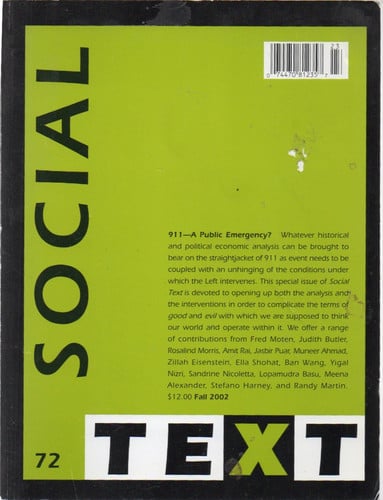
911 a Public Emergency?

Brent Hayes Edwards,Stefano Harney,Randy Martin,Ella Shohat,Timothy Mitchell,Fred Moten
Since September 11, public discourse has often been framed in terms of absolutes: an age of innocence gives way to a present under siege, while the United States and its allies face off against the Axis of Evil. This special issue of Social Text aims to move beyond these binaries toward thoughtful analysis. The editors argue that the challenge for the Left is to develop an antiterrorism stance that acknowledges the legacy of U.S. trade and foreign policy as well as the diversity of the Muslim faith and the dangers presented by fundamentalism of all kinds. Examining the strengths and shortcomings of area, race, and gender studies in the search for understanding, this issue considers cross-cultural feminism as a means of combating terrorism; racial profiling of Muslims in the context of other racist logics; and the homogenization of dissent. The issue includes poetry, photographic work, and an article by Judith Butler on the discursive space surrounding the attacks of September 11. This impressive range of contributions questions the meaning and implications of the events of September 11 and their aftermath. Contributors . Muneer Ahmad, Meena Alexander, Lopamudra Basu, Judith Butler, Zillah Eisenstein, Stefano Harney, Randy Martin, Rosalind C. Morris, Fred Moten, Sandrine Nicoletta, Yigal Nizri, Jasbir K. Puar, Amit S. Rai, Ella Shohat, Ban Wang
Duke University Press 2002-09-20 208 pages

Paradoxes of power: reflections on the Thatcher interlude

Sherman, Alfred.
Thumb through the index of almost any study of the Thatcher years -- biographical, scholarly or journalistic -- and you will come across the name of Sir Alfred Sherman. In her memoirs Lady Thatcher herself pays tribute to Sherman's 'brilliance', the 'force and clarity of his mind', his 'breadth of reading and his skills as a ruthless polemicist'. She credits him with a central role in her achievements, especially as Leader of the Opposition but also after she became Prime Minister. Born in 1919 in London's East End, until 1948 Sherman was a Communist and fought in the Spanish Civil War. But he ended up an indefatigable free-market crusader. The book describes his early relationship with Sir Keith Joseph and his own role in the formation of the Centre for Policy Studies in 1974. Sherman examines the origins and development of 'Thatcherism', but concludes that the Conservative administrations of the 1980s were, for the most part, an 'interlude' and that the post-war consensus remains largely unscathed -- 'we are back to where we started'.
Imprint Academic 2005 200 pages