10 results for "Public Policy"

The deadliest lies: the Israel lobby and the myth of Jewish control

Foxman, Abraham H.
While the special relationship of all ethnic and religious minorities in the USA with their old countries and the existence of their pressure groups is regarded as normal, the support given by U.S. Jews to Israel and the pro-Israeli lobby causes some Americans to view the Jews as disloyal to the USA. Examines the "paper" by John J. Mearsheimer and Stephen M. Walt, "The Israeli Lobby and U.S. Foreign Policy" (first published in 2006 on the Internet and then in the "London Review of Books"; an expanded book appeared later, in 2007). The authors contend that U.S. support of Israel is harmful to American interests, and is due to pressure exerted by a mighty Israel Lobby which acts to the detriment of the state. They argue that the Israel Lobby had a crucial part in the decision to attack Iraq in 2003. Notes that despite the academic style of their paper, Mearsheimer and Walt have revived the myths of a Jewish conspiracy, of Jewish control of the mass media, and of a Jewish secret power. Dwells, also, on the Tony Judt affair. In 2006 Judt, who supported Mearsheimer and Walt, was to deliver a lecture on a binational alternative for Israel. His lecture was cancelled, which he ascribed to pressure by the Anti-Defamation League. Supporters of Mearsheimer and Walt used it as a demonstration of the Israel Lobby's intervention. Criticizes Jimmy Carter's book "Palestine: Peace Not Apartheid" (2006) for its clear anti-Israel bias.
Palgrave Macmillan 2007-09-04 256 pages

Quest for inclusion: Jews and liberalism in modern American

Dollinger, Marc
For over sixty years, Jews have ranked as the most liberal white ethnic group in American politics, figuring prominently in social reform campaigns ranging from the New Deal to the civil rights movement. Today many continue to defy stereotypes that link voting patterns to wealth. What explains this political behavior? Historians have attributed it mainly to religious beliefs, but Marc Dollinger discovered that this explanation fails to account for the entire American Jewish political experience. In this, the first synthetic treatment of Jewish liberalism and U.S. public policy from the 1930s to the mid-1970s, Dollinger identifies the drive for a more tolerant, pluralistic, and egalitarian nation with Jewish desires for inclusion in the larger non-Jewish society. The politics of acculturation, the process by which Jews championed unpopular social causes to ease their adaptation to American life, established them as the guardians of liberal America. But, according to Dollinger, it also erected barriers to Jewish liberal success. Faced with a conflict between liberal politics and their own acculturation, Jews almost always chose the latter. Few Jewish leaders, for example, condemned the wartime internment of Japanese Americans, and most southern Jews refused to join their northern co-religionists in public civil rights protests. When liberals advocated race-based affirmative action programs and busing to desegregate public schools, most Jews dissented. In chronicling the successes, limits, and failures of Jewish liberalism, Dollinger offers a nuanced yet wide-ranging political history, one intended for liberal activists, conservatives curious about the creation of neo-conservatism, and anyone interested in Jewish communal life.
Princeton University Press 2000-07-23 296 pages

The 7 deadly myths: antisemitism from the time of Christ to Kanye West

Ryvchin, Alex
"The 7 Deadly Myths traces antisemitism from its earliest origins to the present day and uncovers the dangerous conspiracy theories that have corrupted reasoning and led people and nations to diabolical acts. Exploring some of the most significant events in history and uncovering little-known villains, this book answers the questions of how antisemitism takes hold, how it is transmitted and how it inspires violence to the present day. Written in a clear and compelling style, The 7 Deadly Myths is essential to understanding why this ancient hatred continues to plague society, inspiring pop stars, athletes and demagogues alike. It is a crucial resource for policy makers, students and the reading public seeking to understand racism and how it can be stopped"--
Cherry Orchard Books 2023 111 pages

With all your possessions: Jewish ethics and economic life

Tamari, Meir
Despite age-old slanders about Jewish economic and business activity, a highly ethical system of laws and customs has always been central to Jewish life. Noted economist and rabbinical scholar Meir Tamari explains that the moral and religious tenets of Judaism have, in fact, created a unique economic framework within which Jews have worked successfully for thousands of years, combining free market practices with social welfare, competition with compassion.
Jason Aronson Inc 1998 340 pages

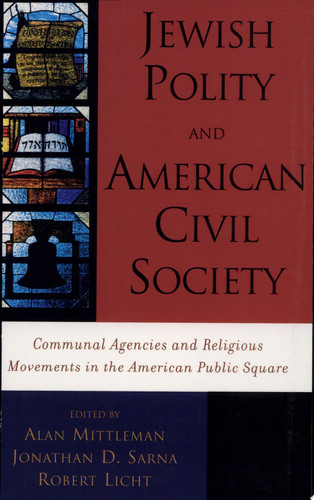
Jewish polity and American civil society: communal agencies and religious movements in the American public sphere

Alan Mittleman,Robert Licht,Jonathan D. Sarna
Jewish Polity and American Civil Society is a study of the civic and political engagements of American Jews as mediated by their communal and denominational institutions. The book explores how the various branches of the organized Jewish community seek to influence public affairs. Over the course of the last century, Jewish agencies and religious movements have tried to shape public debate and public policy on such issues as civil rights, church-state relations, and American foreign policy. The book sets the history of Jewish engagement in these areas into historical context; analyzes the motives, strategies, and tactics of various Jewish groups, and evaluates their successes and failures. The book also explores the underlying idea-the public philosophy-that informs American Jews' understanding of civic and political engagement.
Rowman & Littlefield 2002-07-23 420 pages

Jews and genes: the genetic future in contemporary Jewish thought

Elliot N. Dorff,Laurie Zoloth
Well aware of Jews having once been the victims of Nazi eugenics policies, many Jews today have an ambivalent attitude toward new genetics and are understandably wary of genetic forms of identity and intervention. At the same time, the Jewish tradition is strongly committed to medical research designed to prevent or cure diseases. Jews and Genes explores this tension against the backdrop of various important developments in genetics and bioethics—new advances in stem cell research; genetic mapping, identity, testing, and intervention; and the role of religion and ethics in shaping public policy. Jews and Genes brings together leaders in their fields, from all walks of Judaism, to explore these most timely and intriguing topics—the intricacies of the genetic code and the wonders of life, along with cutting-edge science and the ethical issues it raises.
Jewish Publication Society 2015-03-01 458 pages

Imperial Russia's Jewish question, 1855-1881

Klier, John Doyle
The reform era in Russia (1855-1881) witnessed the emancipation of the serfs, economic and social change, the reform of all imperial institutions, and the growth of national identity among Russians and the Empire's expanding Jewish population. Consequently, the 'Jewish Question' became one of most hotly debated topics in Russia. Attitudes toward the Jews which evolved during this period persisted up to the Revolution and beyond. This book, based on exhaustive archival research of materials published during the period, studies the interplay of public opinion and official policy. The author examines the attitudes of all sectors of Russian educated society towards the Jews. He also explores how a new group, the Russian Jewish intelligentsia, sought to define a modern Jewish identity in the midst of a multi-ethnic Empire.
Cambridge University Press 1995 534 pages

Eternal guilt? forty years of German-Jewish-Israeli relations

Wolffsohn, Michael
Should the Germans of today continue to atone for the sins of their forebears? "Eternal Guilt" argues persuasively that Germans, Israelis and American Jews cling to their historical legacy in order to manipulate contemporary political ends. In their social interactions since 1950, Germans, Jews, and Israelis have largely abandoned the "us versus them" worldview fostered by the Holocaust. At the personal level, members of these groups increasingly deal with one another as individuals living in the present. Germans and Israelis are increasingly willing to visit each other's countries; Diaspora Jews are reluctant to settle in Israel; intermarriage is prevalent among Jews and majority populations everywhere. Nonetheless, at the official level images and memories of the past prevail; the past remains important not as intrinsically instructive but as pragmatically useful in manipulating political aims. Wolffsohn demonstrates that this gap between "routine policy" among individuals and "historical policy" among nations results in continuing misunderstandings and ongoing disputes. Wolffsohn argues that if the continuing spiral of inflammatory rhetoric and political manoeuvering is ever to end, official positions must catch up to popular behaviour. His epilogue analyzes the implications of reunification for the relations among these groups. --
Columbia University Press 1993 225 pages

The Jewish divide over Israel: accusers and defenders

Edward Alexander,Paul Bogdanor
Before 1967, Israel had the overwhelming support of world opinion. So long as Israel's existence was in harmony with politically correct assumptions, it was supported, or at least accepted, by the majority of "progressive" Jews, especially in the wake of the Holocaust. This is no longer the case. The Jewish Divide Over Israel explains the role played by prominent Jews in turning Israel into an isolated pariah nation. After their catastrophic defeat in 1967, Arabs overcame inferiority on the battlefield with superiority in the war of ideas. Their propaganda stopped trumpeting their desire to eradicate Israel. Instead, in a calculated appeal to liberals and radicals, they redefined their war of aggression against the Jews as a struggle for the liberation of Palestinian Arabs. The tenacity of Arabs' rejection of Israel and their relentless campaign--in schools, universities, churches, professional organizations, and, above all, the news media--to destroy Israel's moral image had the desired impact. Many Jewish liberals became desperate to escape from the shadow of Israel's alleged misdeeds and found a way to do so by joining other members of the left in blaming Israeli sins for Arab violence. Today, Jewish liberals rationalize violence against the innocent as resistance to the oppressor, excuse Arab extremism as the frustration of a wronged party, and redefine eliminationist rhetoric and physical assaults on Jews as "criticism of Israeli policy." Israel's Jewish accusers have played a crucial and disproportionate role in the current upsurge of antisemitism precisely because they speak as Jews. The essays in this book seek to understand and throw back the assault on Israel led by such Jewish liberals and radicals as Tony Judt, Noam Chomsky, George Steiner, Daniel Boyarin, Marc Ellis, Israel Shahak, and many others. Its writers demonstrate that the foundation of the state of Israel, far from being the primal sin alleged by its accusers, was one of the few redeeming events in a century of blood and shame.
Transaction Publishers 2008 283 pages