24 results for "Public Policy"

Trumped up

Dershowitz, Alan M.
"In our current age of hyper-partisan politics, nearly everyone takes sides. This is especially true with regard to the Trump presidency. It has become difficult to have a reasonable discussion about the most controversial president in our recent history. For Trump zealots, their president has not only committed no crimes, he has done nothing wrong. For anti-Trump zealots, nothing Trump has done--even in foreign policy--is good. Everything he has done is wrong, and since it is wrong, it must necessarily be criminal. This deeply undemocratic fallacy--that political sins must be investigated and prosecuted as criminal--is an exceedingly dangerous trend. Hardening positions on both sides has been manifested by increasing demands to criminalize political differences. Both sides scream "lock 'em up" instead of making substantive criticisms of opposing views ... The vibrant center is weakening, with traditional liberalism and conservatism becoming further apart, not just in approach, but in their respect for Constitutional norms that have served us well for more than two centuries. While Donald Trump is not the only cause of this profound division, his election drew it to the surface and made it the dominant paradigm of political debate. Unless we as a nation begin to focus again on what unites us rather than on what divides us, America might not survive the next decade."--Publisher description.
Bombardier Books, an imprint of Post Hill Press 2017 193 pages

The Holocaust industry: reflections on the exploitation of Jewish suffering

Finkelstein, Norman G.
"Controversial indictment of those who exploit the tragedy of the Holocaust for personal and political gain In his iconoclastic and controversial study, Norman G. Finkelstein moves from an interrogation of the place the Holocaust has come to occupy in global culture to a disturbing examination of Holocaust compensation settlements. It was not until the Arab-Israeli War of 1967, when Israel's evident strength brought it into line with US foreign policy, that memory of the Holocaust began to acquire the exceptional prominence it has today. Recalling Holocaust fraudsters such as Jerzy Kosinski and Binjamin Wilkomirski, as well as the demagogic constructions of writers like Daniel Goldhagen, Finkelstein contends that the main danger posed to the memory of Nazism's victims comes from some of the very people who profess most passionately to defend it. Drawing on a wealth of untapped sources, he exposes the double shakedown of European countries and legitimate Jewish claimants, and concludes that the Holocaust industry has become an outright extortion racket."--
Verso 2024 286 pages

The savage wars of peace: small wars and the rise of American power

Boot, Max
"While the major conflicts in American history have become all too familiar, America's "small wars" have played an essential but little-appreciated role in the country's growth as a world power. First published in 2002, The Savage Wars of Peace quickly became a key volume in the case for a new policy of interventionism. Max Boot shows how America's smaller actions--such as the recent conflicts in Bosnia, Somalia, Haiti, Kosovo, and Afghanistan--have made up the vast majority of our military engagements, and yet our armed forces do little to prepare for these "low intensity conflicts." A compellingly readable history of the forgotten wars that helped promote America's rise in the last two centuries, The Savage Wars of Peace is now updated with new material on the repercussions of America's far-flung imperial actions and the impact of these ventures in American international affairs"--Amazon.com, viewed April 3, 2014.
Basic Books 2014 454 pages

Pro: reclaiming abortion rights

Pollitt, Katha
A POWERFUL ARGUMENT FOR ABORTION AS A MORAL RIGHT AND SOCIAL GOOD BY A NOTED FEMINIST AND LONGTIME COLUMNIST FOR THE NATION Forty years after the landmark Roe v. Wade ruling, "abortion" is still a word that is said with outright hostility by many, despite the fact that one in three American women will have terminated at least one pregnancy by menopause. Even those who support a woman's right to an abortion often qualify their support by saying abortion is a "bad thing," an "agonizing decision," making the medical procedure so remote and radioactive that it takes it out of the world of the everyday, turning an act that is normal and necessary into something shameful and secretive. Meanwhile, with each passing day, the rights upheld by the Supreme Court are being systematically eroded by state laws designed to end abortion outright. In this urgent, controversial book, Katha Pollitt reframes abortion as a common part of a woman's reproductive life, one that should be accepted as a moral right with positive social implications. In Pro , Pollitt takes on the personhood argument, reaffirms the priority of a woman's life and health, and discusses why terminating a pregnancy can be a force for good for women, families, and society. It is time, Pollitt argues, that we reclaim the lives and the rights of women and mothers.
Picador 2014-10-14 258 pages

"They take our jobs!": and 20 other myths about immigration

Chomsky, Aviva
"Revised and expanded edition of the groundbreaking book which demystifies twenty-one of the most widespread myths and beliefs about immigrants and immigrations. In "They Take Our Jobs!" Aviva Chomsky challenges the underlying assumptions that fuel misinformed claims about immigrants, radically altering our notions of citizenship, discrimination, and U.S. history. Since it was first published, many of the same myths about immigration such as "immigrants take American jobs," " immigrants don't pay taxes," and "immigrants increase crime" continue to be perpetuated and used to promote aggressive anti-immigration policies. In a new introduction, Chomsky reflects on the events of the past ten years. She analyzes declining Mexican immigration patterns, illuminates Mexico's little-known Southern Border Program, and assesses Obama's complicated legacy as "deporter-in-chief" which, Chomsky argues, inadvertently laid the groundwork for Trump's anti-immigrant racism"--
Beacon Press 2018-04-24 243 pages

Occupy

Chomsky, Noam
PRAISE FOR NOAM CHOMSKY'S OCCUPY AND ZUCCOTTI PARK PRESS: "Having spent so much time thinking about and engaging with social movements, Chomsky is both optimistic about the energy of Occupy and realistic about the challenges it faces. He appreciates the "just do it" ethos and embraces its radical approach to participatory democracy...What makes Chomsky's perspective so interesting, aside from the wealth of his political experience, is the range of his interests. He draws from examples around the world to demonstrate his points. ...It's a big agenda that Occupy has identified, nothing less than a complete renewal of U.S. society and the U.S. role in the world. Chomsky sees not only the radical agenda but also the radical practice of the Occupiers. "Part of what functioning, free communities like the Occupy communities can be working for and spreading to others is just a different way of living, which is not based on maximizing consumer goods, but on maximizing values that are important for life," he concludes in this valuable set of remarks and interviews." --John Feffer, Foreign Policy in Focus, Pick Review "For decades, Chomsky has been marginalized for his insightful, levelheaded, and accurate observations about how our society functions. In Occupy , Chomsky... sets the record straight. And he's got an answer for everything. "It's necessary," Chomsky warns, "to get out into the country and get people to understand what this is about, and what they can do about it, and what the consequences are of not doing anything about it." Occupy begins with a powerful editor's note from Greg Ruggiero, who comments on 'the heartlessness and inhumanity of the system, ' where 'people's stolen homes are sold off to the highest bidder.' And if it isn't obvious to those who are still asking what the demands of Occupy Wall Street are, Ruggiero puts it plainly: 'Occupy embodies a vision of democracy that is fundamentally antagonistic to the management of society as a corporate-controlled space that funds a political system to serve the wealthy, ignore the poor.' One can only cringe at the thought of what will happen if we continue to ignore the wisdom of Noam Chomsky. He gives a clue in Occupy ...." --The Coffin Factory, The Magazine for People who Love Books Occupy is another vital contribution from Chomsky to the literature of defiance and protest, and a red-hot rallying call to forge a better, more egalitarian future. --Alternet Chomsky advocates intelligent activism by those who see the divorce between public policy and public opinion. He is both optimistic and realistic towards this "first major public response to 30 years of class war." --IRISH TIMES, PICK REVIEW " Occupy , is at once a vivid portrait of the now-global movement and a practical guide to intelligent activism, infused with Chomsky's signature meditations on everything from how the wealthiest 1% came to steer society to what a healthy democracy would look like to how we can separate money from politics. Alongside Chomsky's words are some of the most moving and provocative photographs from the Occupy movement. ... [One of] 10 essential books on protest." --Maria Popova, Brain Pickings In Occupy , Chomsky discusses the cornerstone issues, questions and demands that have been driving ordinary Americans to critique the influence of the 1%. The book begins and ends with Chomsky celebrating the life and work of his longtime friend and colleague, Howard Zinn, author of A People's History of the United States. As a call to action, Chomsky encourages people to continue organizing, to continue struggling, and to continue defending citizenship and community-driven democracy from predation from the relentless encroachments of wealth and corporate power.
Zuccotti Park Press 2012 125 pages

Safe food: the politics of food safety

Nestle, Marion
Food safety is a matter of intense public concern, and for good reason. Millions of annual cases of food "poisonings" raise alarm not only about the food served in restaurants and fast-food outlets but also about foods bought in supermarkets. The introduction of genetically modified foods—immediately dubbed "Frankenfoods"—only adds to the general sense of unease. Finally, the events of September 11, 2001, heightened fears by exposing the vulnerability of food and water supplies to attacks by bioterrorists. How concerned should we be about such problems? Who is responsible for preventing them? Who benefits from ignoring them? Who decides? Marion Nestle, author of the critically acclaimed Food Politics, argues that ensuring safe food involves more than washing hands or cooking food to higher temperatures. It involves politics. When it comes to food safety, billions of dollars are at stake, and industry, government, and consumers collide over issues of values, economics, and political power—and not always in the public interest. Although the debates may appear to be about science, Nestle maintains that they really are about control: Who decides when a food is safe? She demonstrates how powerful food industries oppose safety regulations, deny accountability, and blame consumers when something goes wrong, and how century-old laws for ensuring food safety no longer protect our food supply. Accessible, informed, and even-handed, Safe Food is for anyone who cares how food is produced and wants to know more about the real issues underlying today's headlines.
University of California Press 2010-06-15 379 pages

The deadliest lies: the Israel lobby and the myth of Jewish control

Foxman, Abraham H.
While the special relationship of all ethnic and religious minorities in the USA with their old countries and the existence of their pressure groups is regarded as normal, the support given by U.S. Jews to Israel and the pro-Israeli lobby causes some Americans to view the Jews as disloyal to the USA. Examines the "paper" by John J. Mearsheimer and Stephen M. Walt, "The Israeli Lobby and U.S. Foreign Policy" (first published in 2006 on the Internet and then in the "London Review of Books"; an expanded book appeared later, in 2007). The authors contend that U.S. support of Israel is harmful to American interests, and is due to pressure exerted by a mighty Israel Lobby which acts to the detriment of the state. They argue that the Israel Lobby had a crucial part in the decision to attack Iraq in 2003. Notes that despite the academic style of their paper, Mearsheimer and Walt have revived the myths of a Jewish conspiracy, of Jewish control of the mass media, and of a Jewish secret power. Dwells, also, on the Tony Judt affair. In 2006 Judt, who supported Mearsheimer and Walt, was to deliver a lecture on a binational alternative for Israel. His lecture was cancelled, which he ascribed to pressure by the Anti-Defamation League. Supporters of Mearsheimer and Walt used it as a demonstration of the Israel Lobby's intervention. Criticizes Jimmy Carter's book "Palestine: Peace Not Apartheid" (2006) for its clear anti-Israel bias.
Palgrave Macmillan 2007-09-04 256 pages

Who speaks for America? why democracy matters in foreign policy

Alterman, Eric
A book in current affairs by a columnist for The Nation whose first book sold some 30,000 copies. The new book continues the work the author began in Sound and Fury: The Washington Punditocracy and the Collapse of American Politics (Harper-Collins, 1992). Alterman says that elites dominate U.S. foreign policy at every turn, and that the gap between the views of the public and those of the policy-making elites has increased to the extent that the United States has become an empire.Journalist and historian Eric Alterman argues that the vast majority of Americans have virtually no voice in the conduct of U.S. foreign policy. With policymakers answerable only to a small coterie of self-appointed experts, corporate lobbyists, self-interested parties, and the elite media, the U.S. foreign policy operates not as the instrument of a democracy, but of a "pseudo-democracy": a political system with the trappings of democratic checks and balances but with little of their content. This failure of American democracy is all the more troubling, Alterman charges, now that the Cold War is over and the era of global capital has replaced it. Americans' stake in so-called foreign policy issues from trade to global warming is greater than ever. Yet the current system serves to mute their voices and ignore their concerns. Experts have long insisted that the public is too ignorant to contribute to the creation of successful foreign policy. But over the course of two hundred years, as Alterman makes clear, the American people have shown an impressive consistency in their ideals and values. The problem for any elite, the author explains, is that Americans often define their interests quite differently than those who would speak in their name. The American public's values are, ironically, much closer to the "liberal republican" philosophy of our founders than to those of our most powerful elites. Alterman concludes with a series of challenging proposals for reforms designed to create a truly democratic U.S. foreign policy.
Cornell University Press 1998-01 244 pages

Shades of Hiawatha: staging Indians, making Americans: 1880-1930

Trachtenberg, Alan
Winner of the 2005 Francis Parkman Prize A century ago, U.S. policy aimed to sever the tribal allegiances of Native Americans, limit their ancient liberties, and coercively prepare them for citizenship. At the same time millions of arriving immigrants sought their freedom by means of that same citizenship. In this subtle, eye-opening new work, Alan Trachtenberg argues that the two developments were, inevitably, juxtaposed: Indians and immigrants together preoccupied the public imagination, and together changed the idea of what it meant to be American. To begin with, programs of "Americanization" were organized for both groups, yet Indians were at the same time celebrated as noble "First Americans" and role models. Trachtenberg traces the peculiar effect of this implicit contradiction, with Indians themselves staging "The Song of Hiawatha" (which was also translated into Yiddish); Edward Curtis's poignant photographs memorializing vanishing heroism; and the Wanamaker department store making a fortune from commercialized versions of their once reviled cultures. By 1925 the national narrative had been rewritten, and citizenship was granted to Indians as a birthright, while the National Origins Act began to close the door on immigrants. "In Shades of Hiawatha," Trachtenberg eloquently suggests that we must re-create America's tribal creation story in new ways if we are to reaffirm its beckoning promise of universal liberty.
Hill and Wang 2004 369 pages

Living with the dragon: how the American public views the rise of China

Page, Benjamin I.
It is widely believed that most Americans not only distrust but also despise China. Considering the country's violent political history, unprecedented economic rise, and growing military capabilities, China has become America's strongest market competitor and arguably the most challenging global threat to the United States.Nevertheless, a full consideration of American opinion proves the opposite to be true. Carefully analyzing all available polls and surveys, Benjamin I. Page and Tao Xie find most Americans favor peaceful engagement with China. The public view has been surprisingly coherent and consistent, changing only in response to major events and new information.While a majority of Americans are not happy that China's economy is projected to become as large as that of the United States, they are prepared to live with it. "Unfair" Chinese trade practices and their impact on American jobs and wages are a concern, along with the quality and safety of Chinese-made goods. However, Americans favor free trade with China, provided it is tempered with environmental and workplace protections. They also believe that the United States should "balance" Chinese power through alliances with neighboring countries, such as Japan. Yet they oppose military action to defend Taiwan. Page and Xie examine these opinions in relation to facts about China and in light of current U.S. debates on diplomacy and policy
Columbia University Press 2010 212 pages

Britain and the Jews of Europe, 1939-1945

Wasserstein, Bernard
Examines British policy towards the "Jewish problem" during World War II. Based on archival sources, the book explores the reasons for the near-total ban on Jewish refugee immigration into Britain, the restrictive immigration policy in Palestine, the failure to aid Jewish resistance in Europe and the rejection of the scheme for the Allied bombing of Auschwitz. The author presents a story of bureaucratic complacency, inhumanity and blindness to the Jewish catastrophe in Europe. This revised edition takes into account papers opened since the first edition, including intelligence materials, and subsequent scholarship.
Leicester University Press 1999 352 pages

The rational public: fifty years of trends in Americans' policy preferences

Page, Benjamin I.
This monumental study is a comprehensive critical survey of the policy preferences of the American public, and will be the definitive work on American public opinion for some time to come. Drawing on an enormous body of public opinion data, Benjamin I. Page and Robert Y. Shapiro provide the richest available portrait of the political views of Americans, from the 1930's to 1990. They not only cover all types of domestic and foreign policy issues, but also consider how opinions vary by age, gender, race, region, and the like. The authors unequivocally demonstrate that, notwithstanding fluctuations in the opinions of individuals, collective public opinion is remarkably coherent: it reflects a stable system of values shared by the majority of Americans and it responds sensitively to new events, arguments, and information reported in the mass media. While documenting some alarming case of manipulation, Page and Shapiro solidly establish the soundness and value of collective political opinion. The Rational Public provides a wealth of information about what we as a nation have wanted from government, how we have changed our minds over the years, and why. For anyone interested in the short- and long-term trends in Americans' policy preferences, or eager to learn what Americans have thought about issues ranging from racial equality to the MX missile, welfare to abortion, this book offers by far the most sophisticated and detailed treatment available.
University of Chicago Press 1992 489 pages

The battle of ideas in the war on terror: essays on U.S. public diplomacy in the Middle East

Satloff, Robert
In this collection of essays -- including several written expressly for this volume -- Robert Satloff takes aim at the conventional wisdom concerning the post-9/11 "battle of ideas" and offers a bold, hopeful, and unapologetic vision for U.S. public diplomacy in the Middle East. The essays take a closer look at U.S. government efforts to reach out to Arabs and Muslims and recommends how--and how not--to wage a campaign for their "hearts and minds."
The Washington Institute for Near East Policy 2004 106 pages

Strangers at our door

Bauman, Zygmunt
Refugees from the violence of wars and the brutality of famished lives have knocked on other people's doors since the beginning of time. As our TV screens and newspapers are filled with accounts of a 'migration crisis' a feeling of fear spreads that some evil threatens the well-being of society. Bauman analyses the origins, contours and impact of this moral panic, and shows how politicians have exploited fears and anxieties that have become widespread. He argues that the policy of mutual separation, of building walls rather than bridges, is misguided.
Polity 2016 125 pages

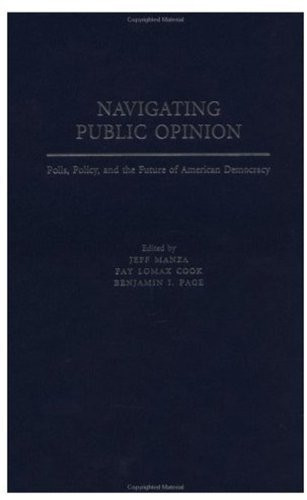
Navigating public opinion: polls, policy, and the future of American democracy

Professor of Sociology Jeff Manza,Jeff Manza,Fay Lomax Cook,Professor of Human Development and Social Policy in the School of Education and Social Policy Fay Lomax Cook,Benjamin I. Page,Gordon Scott Fulcher Professor of Decision Making in the Department of Political Science Benjamin I Page
Do politicians listen to the public? How often and when? Or are the views of the public manipulated or used strategically by political and economic elites? Navigating Public Opinion brings together leading scholars of American politics to assess and debate these questions. It describes how the relationship between opinion and policy has changed over time; how key political actors use public opinion to formulate domestic and foreign policy; and how new measurement techniques might improve our understanding of public opinion in contemporary polling and survey research. The distinguished contributors shed new light on several long-standing controversies over policy responsiveness to public opinion. Featuring a new analysis by Robert Erikson, Michael MacKuen, and James Stimson that builds from their pathbreaking work on how public mood moves policy in a macro-model of policymaking, the volume also includes several critiques of this model by Lawrence Jacobs and Robert Shapiro, another critique by G. William Domhoff, and a rejoinder by Erikson and his coauthors. Other highlights include discussions of how political elites, including state-level policymakers, presidents, and makers of foreign policy, use (or shape) public opinion; and analyses of new methods for measuring public opinion such as survey-based experiments, probabilistic polling methods, non-survey-based measures of public opinion, and the potential and limitations of Internet polls and surveys. Introductory and concluding essays provide useful background context and offer an authoritative summary of what is known about how public opinion influences public policy. A must-have for all students of American politics, public opinion, and polling, this state-of-the-art collection addresses issues that lie at the heart of democratic governance today.
Oxford University Press 2002 376 pages

Enraged citizens, European peace and democratic deficits: or, Why the democracy given to us must become one we fight for

Menasse, Robert
"In 2010, Robert Menasse journeyed to Brussels to begin work on a novel centered on the European Union. His extended stay resulted in a completely different book - Enraged Citizens, European Peace and Democratic Deficits, a work of nonfiction examining the history of the European project and the evolving politics of nation-states. Spanning from the beginning of the transnational idea with 1951's Montanunion - the European Coal and Steel Community - to the current financial crisis, Menasse focuses on the institutional structures and forces both advancing and obstructing the European project. Given the internal tensions among the European Commission, Parliament, and Council, Menasse argues that current problems that are frequently misunderstood as resulting from the financial crisis are, in fact, political. Along the way, he makes the bold claim that either the Europe of nation-states will perish - or the project of transcending the nation-states will ... [this work] analyzes the financial and bureaucratic structures of the European Union and sheds light on the state of the debt crisis. Menasse unravels the real state of the Union, along the way weaving a tale of one continent's efforts to become a truly postnational democracy."--Provided by publisher.
Seagull Books 2016 134 pages