8 results for "Public Policy"

Worst-case scenarios

Sunstein, Cass R.
Nuclear bombs in suitcases, anthrax bacilli in ventilators, tsunamis and meteors, avian flu, scorchingly hot temperatures: nightmares that were once the plot of Hollywood movies are now frighteningly real possibilities. How can we steer a path between willful inaction and reckless overreaction? Cass Sunstein explores these and other worst-case scenarios and how we might best prevent them in this vivid, illuminating, and highly original analysis. Singling out the problems of terrorism and climate change, Sunstein explores our susceptibility to two opposite and unhelpful reactions: panic and utter neglect. He shows how private individuals and public officials might best respond to low-probability risks of disaster—emphasizing the need to know what we will lose from precautions as well as from inaction. Finally, he offers an understanding of the uses and limits of cost–benefit analysis, especially when current generations are imposing risks on future generations. Throughout, Sunstein uses climate change as a defining case, because it dramatically illustrates the underlying principles. But he also discusses terrorism, depletion of the ozone layer, genetic modification of food, hurricanes, and worst-case scenarios faced in our ordinary lives. Sunstein concludes that if we can avoid the twin dangers of overreaction and apathy, we will be able to ameliorate if not avoid future catastrophes, retaining our sanity as well as scarce resources that can be devoted to more constructive ends.
Harvard University Press 2009-05-15 340 pages

Combating terrorism: strategies of ten countries

Yonah Alexander
The tragic events of September 11, 2001, and the consequent "war on terrorism" have made the question of effective counterterrorism policy a growing public concern. The original essays in Combating Terrorism offer a unique overview and evaluation of the counterterrorism policies of ten countries: the United States, Argentina, Peru, Colombia, the United Kingdom, Spain, Israel, Turkey, India, and Japan. Postscripts for each of the country chapters provide post-September 11 assessments of current counterterrorism practices. Most of the contributors to this volume have served in official governmental capacities and many continue to serve as consultants to governmental policy and decision makers. All of the essays address the same set of questions to allow for cross-national comparison of strategies and an assessment of counterterrorism practices: What is the governmental and public perception of the sources of terrorism? How successful have the policies of governments been in combating both domestic and international terrorism? What factors influence a government's willingness and ability to cooperate with other countries in combating terrorism? To what degree are the terrorist realities and the concerns of governments interconnected with global terrorism? To what degree are certain countries "natural hosts" of either terrorist groups or propensities that target Western or closely allied interests? To what degree are terrorist organizations mainly concerned about winning political participation in their target countries? Which counterterrorism strategies work, and which do not? What are the lessons of past experiences for future counterterrorism responses at the national, regional, and global levels? The conclusion to the volume summarizes the lessons that may be learned from the experiences of the ten countries and discusses a list of best practices in counterterrorism. This book will be of interest to policymakers, scholars, and other individuals with professional responsibilities in the area of terrorism and security studies. Written in clear, accessible prose, this book will also appeal to the general reader who is interested in gaining insight into the array of issues facing governments that endeavor to combat terrorism, and into the possible solutions to one of the foremost threats to world peace in our time. Yonah Alexander is Professor and Director, Inter-University Center for Terrorism Studies; Senior Fellow and Director, International Center for Terrorism Studies, Potomac Institute for Policy Studies; and Co-Director, Inter-University Center for Legal Studies, International Law Institute.
University of Michigan Press 2002 436 pages

The new normal: finding a balance between individual rights and the common good

Etzioni, Amitai
Amitai Etzioni argues that societies must find a way to balance individual rights and the common good. This point of balance may change as new technologies develop, the natural and international environments change, and new social forces arise. Some believe the United States may be unduly short-changing individual rights that need to be better protected. Specifically, should the press be granted more protection? Or should its ability to publish state secrets be limited? Should surveillance of Americans and others be curtailed? Should American terrorists be treated differently from others? How one answers these questions, Etzioni shows, invites a larger fundamental question: Where is the proper point of balance between rights and security? Etzioni implements the social philosophy, "liberal communitarianism." Its key assumptions are that neither individual rights nor the common good should be privileged, that both are core values, and that a balance is necessary between them. Etzioni argues that we need to find a new balance between our desire for more goods, services, and affluence, particularly because economic growth may continue to be slow and jobs anemic. The key question is what makes a good life, especially for those whose basic needs are sated.
Transaction Publishers 2015 386 pages

From empire to community: a new approach to international relations

Etzioni, Amitai
Whether one favors the U.S. global projection of force or is horrified by it, the question stands - where do we go from here? What ought to be the new global architecture? Amitai Etzioni follows a third way, drawing on both neoconservative and liberal ideas, in this bold new look at international relations. He argues that a "clash of civilizations" can be avoided and that the new world order need not look like America. Eastern values, including spirituality and moderate Islam, have a legitimate place in the evolving global public philosophy.Nation-states, Etzioni argues, can no longer attend to rising transnational problems, from SARS to trade in sex slaves to cybercrime. Global civil society does help, but without some kind of global authority, transnational problems will overwhelm us. The building blocks of this new order can be found in the war against terrorism, multilateral attempts at deproliferation, humanitarian interventions and new supranational institutions (e.g., the governance of the Internet). Basic safety, human rights, and global social issues, such as environmental protection, are best solved cooperatively, and Etzioni explores ways of creating global authorities robust enough to handle these issues as he outlines the journey from "empire to community."
Palgrave Macmillan 2004-05-14 258 pages

Is democracy possible here? principles for a new political debate

Dworkin, Ronald
Politics in America are polarized and trivialized, perhaps as never before. In Congress, the media, and academic debate, opponents from right and left, the Red and the Blue, struggle against one another as if politics were contact sports played to the shouts of cheerleaders. The result, Ronald Dworkin writes, is a deeply depressing political culture, as ill equipped for the perennial challenge of achieving social justice as for the emerging threats of terrorism. Can the hope for change be realized? Dworkin, one the world's leading legal and political philosophers, identifies and defends core principles of personal and political morality that all citizens can share. He shows that recognizing such shared principles can make substantial political argument possible and help replace contempt with mutual respect. Only then can the full promise of democracy be realized in America and elsewhere. Dworkin lays out two core principles that citizens should share: first, that each human life is intrinsically and equally valuable and, second, that each person has an inalienable personal responsibility for identifying and realizing value in his or her own life. He then shows what fidelity to these principles would mean for human rights, the place of religion in public life, economic justice, and the character and value of democracy. Dworkin argues that liberal conclusions flow most naturally from these principles. Properly understood, they collide with the ambitions of religious conservatives, contemporary American tax and social policy, and much of the War on Terror. But his more basic aim is to convince Americans of all political stripes--as well as citizens of other nations with similar cultures--that they can and must defend their own convictions through their own interpretations of these shared values.
Princeton University Press 2006 177 pages

A just response: the Nation on terrorism, democracy, and September 11, 2001

Katrina vanden Heuvel
On Tuesday morning, a piece was torn out of our world. A patch of blue sky that should not have been there opened up in the New York skyline…. Our city was changed forever. Our country was changed forever. Our world was changed forever. So wrote Jonathan Schell in the first issue of The Nation magazine following September 11, 2001. In A Just Response, some of the most respected figures on the progressive left analyze the causes and consequences of this new American wound in a series of thoughtful, informed, and provocative essays. Selected from The Nation and other sources, these articles counter the bombast and jingoism of so much of the media coverage since September 11—while providing informed analysis, provocative commentary, and reasoned debates. The writers in these pages speak out against "Fascism with an Islamic face," jingoism, and the undermining of civil rights, address the confusion between dissent and treason, and articulate a vision of a just response to terrorism. Others reflect on an interview with Osama bin Laden, the concept of "Blowback"—modern technological society turned unwittingly against itself—and the American right wing's exploitation of a national emergency to further its political agenda. Also included are dispatches from other countries around the world, brief background histories of bin Laden's origins, the roots of fundamentalism, asymmetrical warfare, and a heated exchange between Noam Chomsky and Christopher Hitchens.
Thunder's Mouth Press/Nation Books 2002-03-18 349 pages

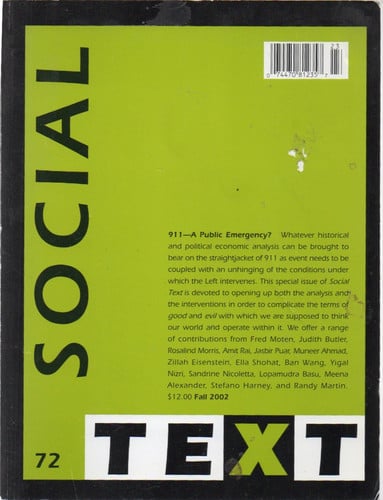
911 a Public Emergency?

Brent Hayes Edwards,Stefano Harney,Randy Martin,Ella Shohat,Timothy Mitchell,Fred Moten
Since September 11, public discourse has often been framed in terms of absolutes: an age of innocence gives way to a present under siege, while the United States and its allies face off against the Axis of Evil. This special issue of Social Text aims to move beyond these binaries toward thoughtful analysis. The editors argue that the challenge for the Left is to develop an antiterrorism stance that acknowledges the legacy of U.S. trade and foreign policy as well as the diversity of the Muslim faith and the dangers presented by fundamentalism of all kinds. Examining the strengths and shortcomings of area, race, and gender studies in the search for understanding, this issue considers cross-cultural feminism as a means of combating terrorism; racial profiling of Muslims in the context of other racist logics; and the homogenization of dissent. The issue includes poetry, photographic work, and an article by Judith Butler on the discursive space surrounding the attacks of September 11. This impressive range of contributions questions the meaning and implications of the events of September 11 and their aftermath. Contributors . Muneer Ahmad, Meena Alexander, Lopamudra Basu, Judith Butler, Zillah Eisenstein, Stefano Harney, Randy Martin, Rosalind C. Morris, Fred Moten, Sandrine Nicoletta, Yigal Nizri, Jasbir K. Puar, Amit S. Rai, Ella Shohat, Ban Wang
Duke University Press 2002-09-20 208 pages