15 results for "Relationships"

Emotional Freedom Liberate Yourself from Negative Emotions and Transform Your Life

Judith Orloff, M.D.
A New York Times bestseller, Emotional Freedom is a road map for those who are stressed out, discouraged, or overwhelmed as well as for those who are in a good emotional place but want to feel even better. Picture yourself trapped in a traffic jam feeling utterly calm. Imagine being unflappable and relaxed when your supervisor loses her temper. What if you were peaceful instead of anxious? What if your life were filled with nurturing relationships and a warm sense of belonging? This is what it feels like when you’ve achieved emotional freedom. Bestselling author Dr. Judith Orloff invites you to take a remarkable journey, one that leads to happiness and serenity, and a place where you can gain mastery over the negativity that pervades daily life. No matter how stressed you currently feel, the time for positive change is now. You possess the ability to liberate yourself from depression, anger, and fear. Synthesizing neuroscience, intuitive medicine, psychology, and subtle energy techniques, Dr. Orloff maps the elegant relationships between our minds, bodies, spirits, and environments. With humor and compassion, she shows you how to identify the most powerful negative emotions and how to transform them into hope, kindness, and courage. Compelling patient case studies and stories from her online community, her workshop participants, and her own private life illustrate the simple, easy-to-follow action steps that you can take to cope with emotional vampires, disappointments, and rejection. As Dr. Orloff shows, each day presents opportunities for us to be heroes in our own lives: to turn away from negativity, react constructively, and seize command of any situation. Complete emotional freedom is within your grasp.
Harmony/Rodale/Convergent 2010-12-28 416 pages

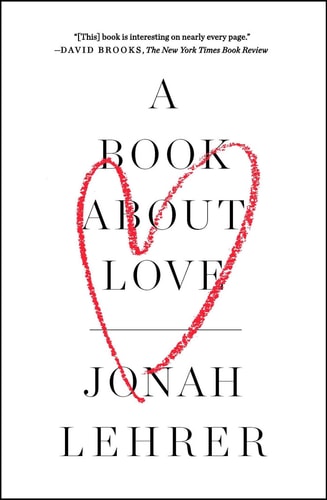
A Book About Love

Jonah Lehrer
Number one bestselling science writer Jonah Lehrer explores the “only happiness that lasts”—love—in a book that “is interesting on nearly every page” (David Brooks, The New York Times Book Review ). Weaving together scientific studies from clinical psychologists, longitudinal studies of health and happiness, historical accounts and literary depictions, child-rearing manuals, and the language of online dating sites, Jonah Lehrer’s A Book About Love plumbs the most mysterious, most formative, most important impulse governing our lives. Love confuses and compels us—and it can destroy and define us. It has inspired our greatest poetry, defined our societies and our beliefs, and governs our biology. From the way infants attach to their parents, to the way we fall in love with another person, to the way some find a love for God or their pets, to the way we remember and mourn love after it expires, this book focuses on research that attempts, even in glancing ways, to deal with the long-term and the everyday. The most dangerous myth of love is that it’s easy, that we fall into the feeling and then the feeling takes care of itself. While we can easily measure the dopamine that causes the initial feelings of “falling” in love, the partnerships and devotions that last decades or longer remain a mystery. “Lehrer uses scores of detailed vignettes to traverse a complicated intellectual landscape, eventually arriving at modern theories of love…He is a talent” ( USA TODAY ), and A Book About Love decodes the set of skills necessary to cultivate a lifetime of love. Love, Lehrer argues, is not built solely on overwhelming passion, but, fascinatingly, on a set of skills to be cultivated over a lifetime.
Simon and Schuster 2017-07-25 304 pages

The Sweet Spot The Pleasures of Suffering and the Search for Meaning

Paul Bloom
"This book will challenge you to rethink your vision of a good life. With sharp insights and lucid prose, Paul Bloom makes a captivating case that pain and suffering are essential to happiness. It's an exhilarating antidote to toxic positivity." --Adam Grant, #1 New York Times bestselling author of Think Again and host of the TED podcast WorkLife One of Behavioral Scientist's "Notable Books of 2021" From the author of Against Empathy, a different kind of happiness book, one that shows us how suffering is an essential source of both pleasure and meaning in our lives Why do we so often seek out physical pain and emotional turmoil? We go to movies that make us cry, or scream, or gag. We poke at sores, eat spicy foods, immerse ourselves in hot baths, run marathons. Some of us even seek out pain and humiliation in sexual role-play. Where do these seemingly perverse appetites come from? Drawing on groundbreaking findings from psychology and brain science, The Sweet Spot shows how the right kind of suffering sets the stage for enhanced pleasure. Pain can distract us from our anxieties and help us transcend the self. Choosing to suffer can serve social goals; it can display how tough we are or, conversely, can function as a cry for help. Feelings of fear and sadness are part of the pleasure of immersing ourselves in play and fantasy and can provide certain moral satisfactions. And effort, struggle, and difficulty can, in the right contexts, lead to the joys of mastery and flow. But suffering plays a deeper role as well. We are not natural hedonists--a good life involves more than pleasure. People seek lives of meaning and significance; we aspire to rich relationships and satisfying pursuits, and this requires some amount of struggle, anxiety, and loss. Brilliantly argued, witty, and humane, Paul Bloom shows how a life without chosen suffering would be empty--and worse than that, boring.
HarperCollins Publishers 2021-11-02 304 pages

Imperfect Control Our Lifelong Struggles With Power and Surrender

Judith Viorst
In her remarkable national bestseller, Necessary Losses, Judith Viorst explored how we are shaped by the various losses we experience throughout our lives. Now, in her wise and perceptive new book, Imperfect Control, she shows us how our sense of self and all our important relationships are colored by our struggles over control: over wanting it and taking it, loving it and fearing it, and figuring out when the time has come to surrender it. Writing with compassion, acute psychological insight, and a touch of her trademark humor, Viorst invites us to contemplate the limits and possibilities of our control. She shows us how our lives can be shaped by our actions and our choices. She reminds us, too, that we sometimes should choose to let go. And she encourages us to find our own best balance between power and surrender.
Simon and Schuster 1999-03 448 pages

Enchanted Love

Williamson, Marianne
'Marianne Williamson reveals, with elegant simplicity, that love is not a mere sentiment of emotion, but the ultimate truth at the heart of creation' Deepak Chopra For millians of Westerners, the quest for material gain has led to increasing frustration and unhappiness. Now, says spiritual philosopher Marianne Williamson, our hunger for worldly gain has been transformed, for many of us, into hunger for spiritual renewal. What we deeply long for most is the experience of paradise. In this inspiring new work, Williamson explores different aspects of the power of that vision - the possibility of the highest love made manifest on Earth - in a series of reflective essays accompanied by prayers and meditations. Topics include the power of faith, innocence, being seen, forgiveness, blamelessness, healing, surrender, serenity, beauty and unity. For people seeking to enhance their lives, Williamson's insights lay the groundwork for spiritual evolution and fulfillment. Her practical advice will guide readers towards a place where passion, creativity and freedom - most important, the freedom to express and infinite love - are recognised not only as the soul's most potent desire, but also as the ultimate destiny of the human race.
Rider & Co 2014-03-24 288 pages

Cold intimacies: the making of emotional capitalism

Illouz, Eva
It is commonly assumed that capitalism has created an a-emotional world dominated by bureaucratic rationality; that economic behavior conflicts with intimate, authentic relationships; that the public and private spheres are irremediably opposed to each other; and that true love is opposed to calculation and self-interest. Eva Illouz rejects these conventional ideas and argues that the culture of capitalism has fostered an intensely emotional culture in the workplace, in the family, and in our own relationship to ourselves. She argues that economic relations have become deeply emotional, while close, intimate relationships have become increasingly defined by economic and political models of bargaining, exchange, and equity. This dual process by which emotional and economic relationships come to define and shape each other is called emotional capitalism. Illouz finds evidence of this process of emotional capitalism in various social sites: self-help literature, women's magazines, talk shows, support groups, and the Internet dating sites. How did this happen? What are the social consequences of the current preoccupation with emotions? How did the public sphere become saturated with the exposure of private life? Why does suffering occupy a central place in contemporary identity? How has emotional capitalism transformed our romantic choices and experiences? Building on and revising the intellectual legacy of critical theory, this book addresses these questions and offers a new interpretation of the reasons why the public and the private, the economic and the emotional spheres have become inextricably intertwined.
Polity Press 2007-02-12 134 pages

The Emotional Revolution Harnessing the Power of Your Emotions for a More Positive Life

Norman E. Rosenthal
Feel Better. . .Live Better Scientific discoveries are unlocking the mysteries of our emotional lives. Every week brings us new information on the environmental, hormonal, genetic, and chemical factors that affect our feelings, and an ever-expanding repertoire of methods to manage specific emotional conditions. But how can we apply this cutting-edge research to our own lives? In The Emotional Revolution, Norman E. Rosenthal, psychiatrist, researcher, and specialist in the fields of psychopharmacology and psychobiology, offers a comprehensive guide to these exciting breakthroughs. He explores the latest findings about the body mechanisms that create emotions--and why our feelings can sometimes go out of control. He also offers simple self-help strategies and evaluates dozens of the newest treatments--both traditional and alternative--that can help with everything from depression and addiction to anxiety and excessive anger. Here is fascinating, up-to-the-minute information you won't find in any other single resource, including: * Clues to the biological basis of monogamy * A new link between depression and heart disease, and what this means for the treatment of both conditions * How simple patterns of eye movements can help alleviate painful memories * How taking a commonly-used blood pressure medication can help you cope with trauma * How lying in the dark releases a hormone that can alleviate anxiety and craving * The surprising health benefits of friendship and religion * The deadly dangers of anger * The health-promoting powers of love The first book to combine scientific research with prescriptive guidelines for the general reader, The Emotional Revolution is your guide to understanding the complexities of human feelings--and improving your life. "A well-researched, clearly-written, and absorbing book. Highly recommended for anyone who's ever seen a psychiatrist--or who hasn't!" --Dean Hamer, Ph.D., author of The Science of Desire Norman E. Rosenthal, M.D., is Clinical Professor of Psychiatry at Georgetown University. A practicing psychiatrist, Dr. Rosenthal has been listed in The Best Doctors in the U.S. For twenty years, he was a senior researcher in psychiatry and psychobiology at the National Institute of Mental Health. He has appeared on 20/20, CNN, National Public Radio, The Today Show, CBS Morning News, and Good Morning, America . Dr. Rosenthal lives and practices in Rockville, Maryland. Visit his Web site at www.normanrosenthal.com.
Citadel Press 2003 491 pages

Achieving emotional literacy: a personal program to increase your emotional intelligence

Steiner, Claude
Emotional literacy is the ability to understand one's own feelings and to empathize with those of others in a way which enhances living - it is now recognized as an important factor in leading a happy and balanced existence. in Achieving Emotional Literacy Dr. Claude Steiner has written an authoritative guide to increasing emotional intelligence and ultimately achieving a stable, emotionally-based approach to life. Dr. Steiner has created an easy-to-follow three-stage training programme- firstly he shows how to open the heart with specific techniques directed at breaking down the barriers which separate us from our feelings. Next, you learn how to recognize your feelings and express them productively, and how to listen with empathy as others express their emotions. Finally he shows us how to take responsibility - by means of defining any problems in relationships, admitting our role in these problems and making meaningful changes. These training methods are based on Steiner's research and 20 years of experience in emotional literacy - real-life examples reinforcing the theories appear throughout the book.
Bloomsbury 1999 256 pages

A theory of feelings

Heller, Agnes
"A theory of feelings examines the problem of human feelings, widely understood, from phenomenological, analytic, and historical perspectives. It begins with an analysis of drives and affects, and pursues the nature of "feeling" itself, in all of its variability, through a close study of the distinctive categories of emotions, emotional dispositions, orientive feelings, and the passions. As such, the starting point of the analysis entails an examination of the characteristics of human involvement, or our ways of being in the world. Building upon this assessment of the conditions of human involvement, the philosophical history and emotional economy characteristic of modern relationships is treated, and the nature of expression, social division, suffering, and responsibility is evaluated in light of the theory of feeling presented here."--BOOK JACKET
Lexington 2009-01-01 224 pages

What's really going on here?

Orbach, Susie
Here are fascinating articles on sex, jealousy, anger, intimacy, loss, food problems, parent/child relationships, sibling rivalry and much more...from Susie Orbach, truly innovative therapist and a highly accessible writer. Together they result in a coherent and profoundly perceptive exploration of our emotional lives. 'We have no shared language for emotional life...What continues to engage me is the desire to increase our understanding of the intersection of the very private, intimate world and the structures of the wider public sphere' - Susie Orbach
Virago 1994 239 pages

Research companion to emotion in organizations

Neal M. Ashkanasy,Cary L. Cooper
The study of emotions and their effects in the workplace has become one of the 21st century's most exciting and burgeoning fields of organizational research. This unique work confirms that it has become increasingly clear that emotions are an essential element of our understanding of organizational life.This Companion brings together many leading scholars to address a wide range of topics in 38 chapters, across five levels of organizational analysis - including within-person, between-person (individual differences), relationships, groups, and the organization as a whole. Chapters tackle structure and measurement of emotion, antecedents and consequences of positive and negative emotions, including effects on work satisfaction and performance. The expression, recognition, and regulation of emotion and the propagation of mood and emotion in groups are also dealt with. The Companion explores contemporary issues including leadership, organizational climate and culture, as well as organizational change.With cutting edge research and comprehensive coverage of emotion in organizations this Companion will be of invaluable interest to postgraduate students and scholars in the fields of organizational behavior, organizational science, and industrial and organizational psychology.
Edward Elgar 2010-01-27 641 pages

Happiness - Facts and Myths

MICHAEL W. EYSENCK
First published in 1990, Happiness is based fairly and squarely on scientific evidence and provides realistic insights into the following questions: What is happiness? How can you tell if you are happy? How important are love, sex, money, and family relationships? Can happiness last? Is there a blueprint for happiness? Is unhappiness a terminal illness? Is there a 'happiness gone'? This book will be of interest to students of psychology and other mental health experts.
Taylor & Francis 2026-01-19 144 pages

Personal Reconstruction A Psychological, Spiritual, Financial and Legal Course in the Art of Preventing Personal Crises, and Recovering from Them

Peter Tarlow,Nathaniel Tarlow,Thomas Marrs
A guide for dealing with personal crises, either for self-help or as an accompanying book for a course, teaching methods for averting personal crises and for recovering from the ones experienced. It covers the four main areas of life that are the foundation for happiness: mental health, spiritual balance, personal finances, and lawful-ethical behavior. Although this book's audience can include anyone, it is focused on common issues for four main categories of people: adolescents, those afoul of the law, midlifers, and the elderly. Each lesson in the book includes exercises and worksheets to help the reader in several ways: Identify personal risks that can turn into crises, Assess the likely causes of an existing crisis, Formulate strategies for avoiding and managing crises, and Create an action plan for recovering from an ongoing crisis. These are imparted by four accomplished experts in their fields who give you actionable insights for achieving happiness: Dr. Peter Tarlow, a world-renowned speaker and columnist writing about philosophy and religion, discusses spirituality; Dr. Tom Marrs, a licensed psychologist and behaviorist, shows you what you can do to attain and maintain good mental health; Dr. Eduardo Leite, a management and finances expert, helps you establish essential personal finances; and Nathaniel Tarlow, a successful civil and criminal defense attorney, explains how society and laws affect you before and after a personal crisis. By the end of Personal Reconstruction, the reader have a good understanding of the psychological, spiritual, financial and legal factors that affect happiness. The reader will also know which actions to take before suffering a crisis, and will have tools and strategies for recovery that can be applied after experiencing a personal crisis that is not averted .
Quest Publishing 2018-01-25 198 pages

Love A Somatic View

Stanley Keleman
El amor tal como se trata en este libro va más allá de atracciones sexuales, imágenes o ideas. Tiene que ver con la biología, con la sangre. Keleman habla del amor desde un punto de vista evolutivo, psicobiológico, somático. El amor es ante todo una verdad del cuerpo, una realidad somática. La intimidad se basa en compartir la excitación vital interna. El deseo y el altruismo están profundamente enraizados en la vida celular. Aprendemos o ignoramos qué es el amor en nuestro entorno familiar. Aprendemos a amar de niñ amamos como nos amaron y como nos enseñaron a hacerlo. Una respuesta de amor escasa, excesiva o equivocada durante las cuatro etapas básicas de la crianza, el cuidado infantil, el compartir adolescente y la cooperación juvenil, puede alterar la experiencia somática de la personalidad en cuanto a la forma de ser amado y originar en la etapa adulta un carácter rígido, denso, hinchado o colapsado. Estas alteraciones características de la forma natural de amar y ser amado, se reflejan de forma muy precisa en la relación de pareja y en todo caso pueden ser trabajadas en el recinto seguro de la psicoterapia corporal. Stanley Keleman (Brooklyn, Nueva York, 1931) es un psicoterapeuta estadounidense, pionero del estudio del cuerpo y su conexión con los aspectos emocionales, psicológicos, sexuales e imaginativos de la experiencia humana. Ha estado desarrollando la psicología somática desde los años 60. Vive en Berkeley, California, donde trabaja individualmente y con grupos en el Center for Energetic Studies, del cual es director. A través de sus escritos y de la práctica, impartiendo numerosos cursos también cada año en Europa, ha desarrollado una metodología y un marco de referencia conceptual para la vida del cuerpo.
Center Press 1994 90 pages

The Foundations of Personality

MYERSON. MYERSON,Myerson Abraham
Unlike some other reproductions of classic texts (1) We have not used OCR(Optical Character Recognition), as this leads to bad quality books with introduced typos. (2) In books where there are images such as portraits, maps, sketches etc We have endeavoured to keep the quality of these images, so they represent accurately the original artefact. Although occasionally there may be certain imperfections with these old texts, we feel they deserve to be made available for future generations to enjoy.
HARDPRESS Limited 2016-06-21 370 pages