3 results for "Resilience"

How free is free? the long death of Jim Crow

Litwack, Leon F.
In 1985, a black veteran of the civil rights movement offered a bleak vision of a long and troubled struggle. For more than a century, black southerners learned to live with betrayed expectations, diminishing prospects, and devastated aspirations. Their odyssey includes some of the most appalling examples of terrorism, violence, and dehumanization in the history of this nation. But, as Leon Litwack graphically demonstrates, it is at the same time an odyssey of resilience and resistance defined by day-to-day acts of protest: the fight for justice poignantly recorded in the stories, songs, images, and movements of a people trying to be heard. For black men and women, the question is: how free is free? Despite two major efforts to reconstruct race relations, injustices remain. From the height of Jim Crow to the early twenty-first century, struggles over racism persist despite court decisions and legislation. Few indignities were more pronounced than the World War II denial of basic rights and privileges to those responding to the call to make the world safe for democratic values—values that they themselves did not enjoy. And even the civil rights movement promise to redeem America was frustrated by change that was often more symbolic than real. Although a painful history to confront, Litwack’s book inspires as it probes the enduring story of racial inequality and the ongoing fight for freedom in black America with power and grace.
Harvard University Press 2009-02-27 187 pages

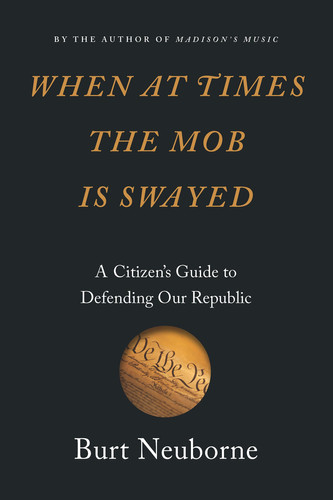
When at times the mob is swayed: a citizen's guide to defending our republic

Neuborne, Burt
From a leading constitutional lawyer who has sued every president since LBJ, a masterful explication of the true "pillars of our democracy" On November 9, 2016--and again on January 6, 2021--many Americans feared that our democracy was on the verge of collapse. But is it? In an erudite and brilliant evaluation of the current state of our government, noted constitutional scholar Burt Neuborne administers a stress test to democracy and concludes that our unprecedented sets of constitutional protections, all endorsed by both major parties, stand between us and an authoritarian federal regime: namely the division of powers between the three branches, the rights reserved to the states, and the Bill of Rights. Neuborne parses the genius of our constitutional system and the ways its built-in resilience will ultimately survive current attempts to dismantle it. While many important issue areas--women's right to choose, LGBTQ rights, separation of church and state--risk erosion, Neuborne argues that the Constitution's inherent defense mechanisms can buy us time. But only an active citizenry will enable us to defend our cherished rights and protections, fulfilling Ben Franklin's charge to keep our republic.
New Press 2019 246 pages

Impossible exodus: Iraqi Jews in Israel

Bashkin, Orit
Between 1949 and 1951, 123,000 Iraqi Jews immigrated to the newly established Israeli state. Lacking the resources to absorb them all, the Israeli government resettled them in maabarot , or transit camps, relegating them to poverty. In the tents and shacks of the camps, their living conditions were squalid and unsanitary. Basic necessities like water were in short supply, when they were available at all. Rather than returning to a homeland as native sons, Iraqi Jews were newcomers in a foreign place. Impossible Exodus tells the story of these Iraqi Jews' first decades in Israel. Faced with ill treatment and discrimination from state officials, Iraqi Jews resisted: they joined Israeli political parties, demonstrated in the streets, and fought for the education of their children, leading a civil rights struggle whose legacy continues to influence contemporary debates in Israel. Orit Bashkin sheds light on their everyday lives and their determination in a new country, uncovering their long, painful transformation from Iraqi to Israeli. In doing so, she shares the resilience and humanity of a community whose story has yet to be told.
Stanford University Press 2017 305 pages