6 results for "Resilience"

The way to the spring: life and death in Palestine

Ehrenreich, Ben
A brave and necessary immersion into the lives and struggles of a group of everyday Palestinians. In cities and small villages alike, men and women, young and old, a group of unforgettable characters share their lives with Ehrenreich and make their own case for resistance and resilience in the face of life under occupation. Ruled by the Israeli military, set upon and harassed constantly by Israeli settlers who admit unapologetically to wanting to drive them from the land, forced to negotiate an ever more elaborate and more suffocating series of fences, checkpoints and barriers that have sundered home from field, home from home, they are a population whose living conditions are unique, and indeed hard to imagine.
Penguin Press 2016 428 pages

Rumsfeld

Decter, Midge
US Defense Secretary Donald Rumsfeld has become the leading spokesman for the Bush administration on all matters related to the military and its prosecution of the war on terror. Midge Decter, an accomplished political journalist who has enjoyed over two decades of friendship with Rumsfeld, will answer the question of why and how he has come to play such a critical role. Partly biographical and partly analytical, the book focuses on Rumsfeld's past and current activities as well as what he represents: an ethos of sturdiness, frankness, and resilience that has clearly resonated with the American public. Decter gained Rumsfeld's full cooperation, and she trailed him through the Pentagon and beyond as he prosecuted the war on terror and the military campaign against Saddam Hussein. The daily stresses of advising the president, handling the media, crafting military policy, and dealing with issues of life and death are examined from the inside – as they happened. This book offers a dynamic, intimate, behind–the–scenes look at the biggest political star (apart from the President himself) of the Bush administration.
HarperCollins 2004-10-12 240 pages

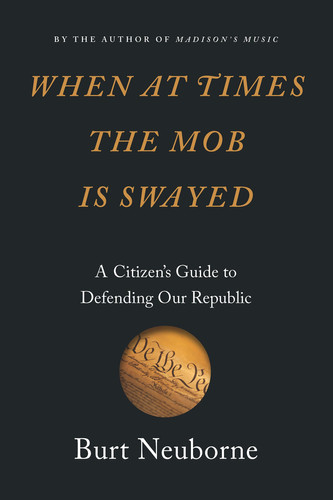
When at times the mob is swayed: a citizen's guide to defending our republic

Neuborne, Burt
From a leading constitutional lawyer who has sued every president since LBJ, a masterful explication of the true "pillars of our democracy" On November 9, 2016--and again on January 6, 2021--many Americans feared that our democracy was on the verge of collapse. But is it? In an erudite and brilliant evaluation of the current state of our government, noted constitutional scholar Burt Neuborne administers a stress test to democracy and concludes that our unprecedented sets of constitutional protections, all endorsed by both major parties, stand between us and an authoritarian federal regime: namely the division of powers between the three branches, the rights reserved to the states, and the Bill of Rights. Neuborne parses the genius of our constitutional system and the ways its built-in resilience will ultimately survive current attempts to dismantle it. While many important issue areas--women's right to choose, LGBTQ rights, separation of church and state--risk erosion, Neuborne argues that the Constitution's inherent defense mechanisms can buy us time. But only an active citizenry will enable us to defend our cherished rights and protections, fulfilling Ben Franklin's charge to keep our republic.
New Press 2019 246 pages

Judah Benjamin: counselor to the confederacy

Traub, James
Judah P. Benjamin (1811-1884) was a brilliant and successful lawyer in New Orleans, and one of the first Jewish members of the U.S. Senate. He then served in the Confederacy as secretary of war and secretary of state, becoming the confidant and alter ego of Jefferson Davis. In this new biography, author James Traub grapples with the difficult truth that Benjamin, who was considered one of the greatest legal minds in the United States, was a slave owner who deployed his oratorical skills in defense of slavery. How could a man as gifted as Benjamin, knowing that virtually all serious thinkers outside the American South regarded slavery as the most abhorrent of practices, not see that he was complicit with evil? This biography makes a serious moral argument both about Jews who assimilated to Southern society by embracing slave culture and about Benjamin himself, a man of great resourcefulness and resilience who would not, or could not, question the practice on which his own success, and that of the South, was founded.
Yale University Press 2021 185 pages

51st state?

Altman, Dennis
Australian prime ministers since Harold Holt have all fostered close relationships with the United States, but John Howard has initiated economic and military policies that have bound the two countries even tighter. As a result, many Australians now believe that not only our sovereignty but also our very identity as a nation is under threat, and that we are fast becoming America's 51st state. If this view is correct, it should be reflected not only in our foreign policy but also in our domestic policies. Indeed, the weakening of social safety nets, the privatisation of areas long seen as government responsibilities, and the signing of the Free Trade Agreement all point to the triumph of US-style neo-liberalism. Yet, as Dennis Altman shows, the story is not so simple. Even as official rhetoric immerses us ever deeper into the US worldview, the resilience of the Australian social contract is imposing real limits on the application of neo-liberal principles. And, despite his enthusiastic membership of the coalition of the willing, Howard has assiduously cultivated economic and political ties within our region which, as the global balance of power shifts, will become increasingly relevant. In this elegant and sophisticated meditation on Australian identity, Altman suggests that the tendency to attribute malign American influence to everything we dislike about the contemporary world is the flipside of seeing the US as the only model worthy of emulation, and serves to conceal the deeper questions we face namely, how does Australia imagine its future?
Scribe Short Books 2006 136 pages

Life is a funny business: a very personal story

Shatter, Alan Joseph
In Life is a Funny Business Alan Shatter revisits his early life experiences and explores how he was shaped and influenced by them. For the first time he describes the tragedy and comedy in his family history and background, depicted through the lens of an Irish Jewish boy growing up in 1950s and 60s Dublin, and his insights as a member of Ireland's small Jewish community. His story travels through the Ireland of the 1950s, 60s and 70s, and his early years of social and political activism and experiences as a lawyer. It ends shortly after Christmas 1981, just over six months following his first election to Dáil Éireann at the age of thirty. It also touches on some more recent events of social, political and historical significance linked to his past. His surprising and perceptive narrative uniquely depicts an Ireland of decades partially forgotten, profound changes that have taken place, incidents and events he has not previously publicly discussed and how he coped with childhood adversity. Alan's deeply moving and thoughtful story reveals the real person behind the public figure and what shaped his values, beliefs, character and self-deprecating sense of humour. It is a story of love, laughter, tears and resilience.
Poolbeg Press Ltd 2017 266 pages