3 results for "Romance"

Write your own fairy tale: the new rules for dating, relationships, and finding love on your terms

Flicker, Siggy
"Smart and sassy relationship expert Siggy Flicker is your new fairy godmother. Having matched more than a thousand couples and embraced her own second chance at love, she knows finding a prince is no picnic. Now she's sharing the keys to building a fairy-tale romance, beginning with a honest assessment of what you really want to be happy. To help readers create the healthy, lasting relationships they deserve, Siggy is sharing her honest, empowering advice, including: Define the relationship you want. Set an intention and true love will follow. Forget what looks good "on paper." Sure he's Mr. Right, but is he right for you? Take a break from your dating rut with a Dating Detox. Step back and reevaluate your dating behavior. Learn how to make the most of the first five minutes. First impressions are important, so learn to send the right signals. Happily ever after means forever. Continue to work hard to keep your relationship strong and passionate. In Write Your Own Fairy Tale, readers will get a tried-and-true comprehensive guide to the first six months of dating and Siggy's exclusive plan to get over heartbreak ensuring you'll get from agony to over it in just six simple steps. Featuring practical exercises, real-life success stories, and lessons Siggy learned the hard way, Write Your Own Fairy Tale is a wake-up call for everyone looking for love--and a guide for making sure you get the happiness you truly deserve"--
New American Library 2015-09-29 226 pages

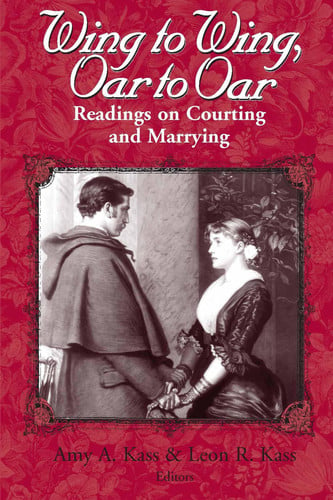
Wing to wing, oar to oar: readings on courting and marrying

Kass, Amy A.,Kass, Leon R.
Despite current concerns for “family values” and the dissolution of marriages, Amy A. and Leon R. Kass see very little attention being paid to what makes for marital success. They argue there are no longer socially prescribed forms of conduct that help guide young men and women in the direction of matrimony; the very concepts of “wooing” and “courting” seem archaic. Yet they see major discontent with the present situation and detect among their students certain longings―for friendship, for wholeness, for a life that is serious and deep, and for associations that are trustworthy and lasting―longings they do not realize could be largely satisfied by marrying well. Wing to Wing, Oar to Oar: Courting and Marrying is an anthology of source readings offered as a response to the contemporary cultural silence surrounding love that leads to marriage. It addresses important questions that emerge not from theory, but from practice: Why marry? Is this love? How can I find and win the right one to marry? What about sex? Why a wedding and the promises of marriage? What can married life be like? Using readings taken mainly from classic texts of Homer, Herodotus, Plato, Aquinas, Erasmus, Shakespeare, Rousseau, Austen, Tolstoy, C.S. Lewis, Miss Manners, and many others, this collection challenges our unexamined opinions, expands our sympathies, elevates our gaze. It offers a higher kind of sex education, one that prepares hearts and minds for romance leading to lasting marriage, and introduces us to possibilities open to human beings in everyday life that may be undreamt of in our current philosophizing. This unapologetically pro-marriage anthology is intended to help young people of marriageable age and their parents think about the meaning, purpose, and virtues of marriage and, especially, about finding the right person with whom to make a life.
University of Notre Dame Press 2000-02-22 636 pages

The village

Laski, Marghanita
The Village, first published in 1952, begins on the very day the war ended. Two women, who have been firm friends during the war, go as usual to the Red Cross Post. Here they spend the night as they always had done, chatting over a cup of tea. As dawn breaks they lock the door 'but still they lingered, unwilling finally to end this night and the years behind it. '"There's a lot of us will miss it," Edith said. "We've all of us felt at times, you know, how nice it was, like you and me being able to be together and friendly, just as if we were the same sort, if you know what I mean." "I'll miss it a lot too," Wendy said. There was no point in her saying that it could go on now, the friendliness and the companionship and the simple human liking of one woman for another. Both knew that this breaking down of social barriers was just one of the things you got out of the war, but it couldn't go on.' The main theme of The Village is that Wendy's attempt to cling on to her old way of life was already under pressure by 1939 and had become even more out-of-date by 1945. It is Edith who is the New Britain, with her prosperous son and her commonsense and indeed kindness. Wendy, with her snobbery and her refusal to change and her uncompromising attitude to her daugher, is the Old. When Labour swept to a landslide victory in 1945 'Attlee's government promised a fairer future for all and no going back to the inequalities of the pre-war world,' writes Juliet Gardiner in her Afterword to this Persephone edition of The Village. When Wendy goes back up the road to Wood View on Priory Hill 'where the gentry lived' and Edith goes downhill on the other side, 'down Station Road among the working classes', they both assume that the values and habits of pre-war Britain will continue. But Britain has already changed a great deal, a change symbolised by Edith's son Roy, a printer with excellent prospects, falling in love with the penniless Margaret, Wendy's daughter. 'The story of the romance between the two of them forms the central narrative of the novel,' Juliet Gardiner continues, 'and the attitude of the other villagers when the news gets out illuminates their understanding - or rejection - of the village's elaborately calibrated social stratification. This is a finely-observed novel about the losses and gains of the Second World War, how hopeless and how isolating it would be to hold onto the past, how illusory was the notion that the war had broken down class barriers, or had managed to save "deep England" from the future and how peace, too, would produce its own list of casualties. It is also about the futility of 'keeping up appearances', the boredom of middle-class women with nothing to do, even the realisation that cooking and housework had to be streamlined if theose women were to take their place in society. But above all The Village is an extremely enjoyable and well-written novel evoking an entire community (there is a long cast of characters at the beginning) and a whole way of life, and has one of the most ancient plots in the world - a young couple who fall in love but are forbidden to marry.
Persephone Books 2004 302 pages