32 results for "Science"

Just a Dream

Chris Van Allsburg
In this picture book classic, travel with young Walter on a fantastical adventure as he journeys--by way of his bed--into a polluted dreamscape world that wakes him up to our collective and individual environmental responsibility. Walter does not appreciate the beauty of nature, or understand his role in keeping the planet healthy . . . until a fantastic journey shows him the tragic fate that could befall Earth if humans like him are not more careful. Chris Van Allsburg (The Polar Express) pairs pitch-perfect narrative with his full-color pastel illustrations, rendering this picture book a story that has stood the test of time. "Two-time Caldecott Medalist Van Allsburg reaches a new pinnacle of excellence in both illustration and storytelling in his latest work." --Publishers Weekly This anniversary edition includes a stunning new jacket!
Houghton Mifflin Harcourt 1990 48 pages

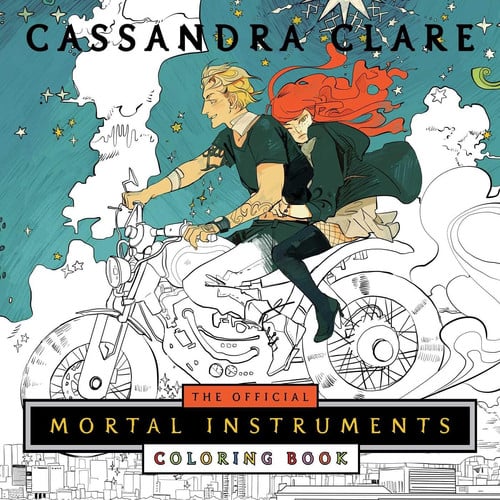
The Official Mortal Instruments Coloring Book

Cassandra Clare
Experience Cassandra Clare’s internationally bestselling world of the Shadowhunters like never before with this intricate adult coloring book featuring forty-five all-new illustrations! From the hallowed halls of the New York Institute to the glimmering glass buildings of Alicante, from the depths of the city of bones to the forests of faerie, the world of Cassandra Clare’s Mortal Instruments series comes to life like never before in this stunning coloring book. The forty-five illustrations face text excerpts, highlighting never-before-illustrated scenes from The Mortal Instruments. With gorgeous original black-and-white drawings by Cassandra Jean, illustrator of The Bane Chronicles and Tales from the Shadowhunter Academy , The Mortal Instruments Coloring Book is a must-have gift book for every Cassandra Clare fan in your life.
Simon and Schuster 2017-04-25 96 pages

Unfathomable city, a New Orleans atlas

Solnit, Rebecca,Snedeker, Rebecca
"Like the bestselling Infinite City: A San Francisco Atlas, this book is a brilliant reinvention of the traditional atlas, one that provides a vivid, complex look at the multi-faceted nature of New Orleans, a city replete with contradictions. More than twenty essays assemble a chorus of vibrant voices, including geographers, scholars of sugar and bananas, the city's remarkable musicians, prison activists, environmentalists, Arab and Native voices, and local experts, as well as the coauthors' compelling contributions. Featuring 22 full-color two-page-spread maps, Unfathomable City plumbs the depths of this major tourist destination, pivotal scene of American history and culture and, most recently, site of monumental disasters such as Hurricane Katrina and the BP oil spill. The innovative maps' precision and specificity shift our notions of the Mississippi, the Caribbean, Mardi Gras, jazz, soils and trees, generational roots, and many other subjects, and expand our ideas of how any city is imagined and experienced. Together with the inspired texts, they show New Orleans as both an imperiled city-by erosion, crime, corruption, and sea level rise-and an ageless city that lives in music as a form of cultural resistance. Compact, lively, and completely original, Unfathomable City takes readers on a tour that will forever change the way they think about place. "--
University of California Press 2013 166 pages

Beetlejuice: The Official Coloring Book

Alan Robert
The creator of the best-selling coloring book series The Beauty of Horror , Alan Robert, intricately illustrates the most recognizable and beloved scenes of the ghost with the most from Tim Burton’s renowned 1988 film in Beetlejuice: The Official Coloring Book! The mischievous world of Beetlejuice™ comes to life in Beetlejuice: The Official Coloring Book , ready to be colored! Alan Robert, renowned illustrator of The Beauty of Horror coloring book series, hand-draws rich, detailed illustrations that evoke the haunting spirit of the infamous bio-exorcist as he tempts the Maitlands, terrorizes Lydia Deetz and her family, counters Otho’s over-the-top hijinks, and highlights all the frights and sights revealed in the afterlife. With more than 60 pages of captivating illustrations from the cult classic film, fans can chant Beetlejuice... Beetlejuice... Beetlejuice: The Official Coloring Book to conjure up hours of strange and unusual fun among the recently deceased. 60+ COLORING PAGES: Beetlejuice: The Official Coloring Book is full of more than 60 pages of custom art, full of details ready to color! ICONIC SCENES: Color in Barbara and Adam’s adventures in the underworld, the Maitland’s exorcism, the Deetz’s Day-O dinner party, all of Betelgeuse’s haunting attractions, and more BEWITCHING ILLUSTRATIONS: Tim Burton’s afterlife scenes captured the audience’s imagination upon release in 1988, and now fans can color and explore those unforgettable settings! OFFICIAL COLORING BOOK: Created in collaboration with Warner Bros. COMPLETE YOUR COLLECTION: Complete your horror coloring book collection with It: The Official Coloring Book , Chucky: The Official Coloring Book , and Universal Monsters: The Official Coloring Book, also available
Simon and Schuster 2024-09-03 64 pages

Content

Cory Doctorow
Readers will discover how America chose Happy Meal toys over copyright, why Facebook is taking a faceplant, how the Internet is basically just a giant Xerox machine, why Wikipedia is a poor cousin of The Hitchhikers Guide to the Galaxy, and how to enjoy free e-books. Notice: This Book is published by Historical Books Limited (www.publicdomain.org.uk) as a Public Domain Book, if you have any inquiries, requests or need any help you can just send an email to [email protected] This book is found as a public domain and free book based on various online catalogs, if you think there are any problems regard copyright issues please contact us immediately via [email protected]
CreateSpace Independent Publishing Platform 2016-04-18 180 pages

Riese Kingdom Falling

Greg Cox,Ryan Copple,Kaleena Kiff
A steampunk princess is torn between love and duty in this prequel to SyFy.com’s wildly popular webisodes. Riese has never been happy as a princess; she’d much rather be hunting or fighting than sitting through another lesson on court etiquette. When she meets Micah, a wandering artist with a mysterious past, she pretends to be a peasant—it’s a chance to be just a normal girl with a normal boy for a while. But with war decimating her once-proud nation and the sinister clockwork Sect infiltrating her mother’s court, Riese’s moments with Micah are the only islands of sanity left in a world gone mad. As her kingdom falls and the Sect grows ever stronger, will Riese remain true to her duty as a princess…or risk everything on a boy she barely knows? SyFy’s enormously popular Riese webisodes come to literary life in this prequel rife with steampunk technology and medieval mysticism.
Simon and Schuster 2013-06-11 288 pages

Cross Cultural Design: Communicating in the Global Marketplace

Henry Steiner,Ken Haas
Cross-Cultural Design is the first book to examine the challenges and rewards experienced by the world's leading communication professionals when handling assignments outside their own cultures. The solutions to these marketing problems are documented here in 309 stunning full-colour images, accompanied by the creators' provocative descriptions of their setbacks, triumphs and discoveries.The works shown range from designs for advertisements, corporate identity programmes, annual reports, films, packages, books, magazines, posters and signage to currency, postage stamps and environmental graphics. Among clients represented are banks, print media, software companies, airlines, governments and manufacturing firms.This anthology is introduced by Henry Steiner's stimulating essay "Spam Sushi and Chameleons", which articulates the issues and provides conceptual ideas for succeeding in the global marketplace. In the pages that follow, the work of such outstanding professionals as Saul Bass, Walter Bernard, Ken Cato, Ivan Chermayeff, Joe Duffy, Alan Fletcher, Dan Friedman, Milton Glaser, Eiko Ishioka, Tibor Kalman, Clement Mok, Erik Spiekermann and Henry Wolf is illustrated and discussed. This unique volume also includes much practical information, a contributors' directory, an extensive bibliography and a thorough index.Cross-Cultural Design will be welcomed as both a thought-provoking exploration of international design and an invaluable reference source for designers, advertising agencies, marketing professionals, business corporations, scholars and students.
Van Nostrand Reinhold 1990-05

Seeing the Insane

Sander L. Gilman
Seeing the Insane is a richly detailed cultural history of madness and art in the Western world, showing how the portrayal of stereotypes has both reflected and shaped the perception and treatment of the mentally disturbed. Covering the Middle Ages through the end of the nineteenth century, Sander L. Gilman explores the depictions of mental illness as seen in manuscripts, sculptures, lithographs, and photography. With artistic renderings and medical illustrations side-by-side, this volume includes over 250 visual displays of the mentally ill. These images capture society's reliance on visual motifs to assign concrete qualities to abstract ailments in an attempt to understand the marginalized. Gilman's collection of images demonstrates how society has relegated the mentally ill to a state of "otherness" and portrays how society's perceived realities concerning the insane have morphed and evolved over centuries. Sander L. Gilman, PhD, is a distinguished professor of the Liberal Arts and Sciences as well as Professor of Psychiatry at Emory University. A respected educator, he has served as Old Dominion Visiting Professor of English at Princeton; Northrop Frye Visiting Professor of Comparative Literature at the University of Toronto; Mellon Visiting Professor of Humanities at Tulane University; Goldwin Smith Professor of Humane Studies at Cornell University; and Professor of the History of Psychiatry at Cornell Medical College. He has written and edited several books including The Face of Madness and Sexuality: An Illustrated History . " Seeing the Insane is a visual history of the stereotypes that have shaped the perception of the mentally ill from medieval through modern times. The result is nearly as heartbreaking as a visual history of the Holocaust. In picture after picture, the book portrays centuries of intolerance for deviance, mindless cruelty, unthinking prejudice, and self-righteous abuse of the weak and ill." - American Journal of Psychiatry "As extraordinary in concept as it is in its execution. . . . This remarkable book helps laymen as well as specialists to see the insane, but it does far more. When we study the past, we understand the present. When we see the conventional stereotype images of insanity, we find they still color our concepts of madness. Through these pictures of the insane, we see all humanity. We look, not through a glass darkly, but through a multiplicity of media, brightly." - Antiquarian Bookman Readers interested in related titles from Sander L. Gilman will also want to see: Face of Madness: Hugh W. Diamond and the Origin of Psychiatric Photography (ISBN: 9781626549234), Sexuality: An Illustrated History (ISBN: 9781626549227).
Echo Point Books & Media 2014-04 256 pages

Letters to Camondo

Edmund de Waal
A tragic family history told in a collection of imaginary letters to a famed collector, Moïse de Camondo. 63 rue de Monceau, Paris Dear friend, As you may have guessed by now, I am not in your house by accident. I know your street rather well. Count Moïse de Camondo lived a few doors away from Edmund de Waal’s forebears, the Ephrussi, first encountered in his bestselling memoir, The Hare with Amber Eyes . Like the Ephrussi, the Camondos were part of belle epoque high society. They were also targets of antisemitism. Camondo created a spectacular house and filled it with the greatest private collection of French eighteenth-century art for his son, Nissim, to inherit. But when Nissim was killed in the First World War, it became a memorial and, upon the Count’s death, was bequeathed to France. The Musée Nissim de Camondo has remained unchanged since 1936. De Waal explores the lavish rooms and detailed archives and uncovers new layers to the family story. In a series of haunting letters addressed to the Count, he tells us what happened next.
Picador 2022-06-07 192 pages

Progressions The Art of Jon Foster

Jon Foster
Jon Foster's art is dark, beautiful, and visually overpowering. From his Dark Horse Comics' Star Wars covers to his game industry work on Dungeons & Dragons Third Edition and Alternity, Foster always knows how to move the soul of the viewer. Progressions features a selection of Foster's paintings, sketches, and illustrations and is a must have for anyone who has ever admired art.
Cartouche Press 2002 79 pages

Henry Rollins

Henry Rollins
These interviews with Henry Rollins conducted by RE/Search (and Search & Destroy) founder V. Vale focus on Henry's travels -- often to countries considered dangerous and off-limits. There are references to Punk Rock history, the Occupy movement, and numerous personal adventures and experiences over the past 30-plus years of combing the planet giving musical and Spoken Word performances, and generally being as creative and humorous as possible no matter what the situation may be . Whatever Henry wants to do, he does it while giving his full attention, like a kind of Zen master. RE/Search tries to reveal the full scope of his creativity, achievements and darkly sardonic perceptiveness and contempt for cliche. This book is full of both humor and inspiration.
RE/Search Publications 2012 124 pages

The Philosophy Of Art Of Karl Marx

Mikhail Lifshitz
The Philosophy of Art of Karl Marx by Mikhail Lifshitz is a comprehensive study of the Marxist theory of art. The book explores the relationship between art and society, and how art reflects the political and economic structures of society. Lifshitz examines the Marxist perspective on the role of art in the revolution and the struggle for social change. He also delves into the Marxist critique of bourgeois art and the concept of alienation in art. The book includes a detailed analysis of the writings of Karl Marx and Friedrich Engels on art, as well as the works of other Marxist theorists such as Georg Lukacs and Antonio Gramsci. The Philosophy of Art of Karl Marx is a thought-provoking and insightful exploration of the Marxist perspective on art, and its relevance in the contemporary world.This scarce antiquarian book is a facsimile reprint of the old original and may contain some imperfections such as library marks and notations. Because we believe this work is culturally important, we have made it available as part of our commitment for protecting, preserving, and promoting the world's literature in affordable, high quality, modern editions, that are true to their original work.
Literary Licensing, LLC 2011-06 96 pages

Unraveling What I Learned about Life While Shearing Sheep, Dyeing Wool, and Making the World's Ugliest Sweater

Peggy Orenstein
"Orenstein is such a breezy, funny writer, it's easy to forget she's an important thinker too."--People In this lively, funny memoir, Peggy Orenstein sets out to make a sweater from scratch--shearing, spinning, dyeing wool--and in the process discovers how we find our deepest selves through craft. Orenstein spins a yarn that will appeal to everyone. The COVID pandemic propelled many people to change their lives in ways large and small. Some adopted puppies. Others stress-baked. Peggy Orenstein, a lifelong knitter, went just a little further. To keep herself engaged and cope with a series of seismic shifts in family life, she set out to make a garment from the ground up: learning to shear sheep, spin and dye yarn, then knitting herself a sweater. Orenstein hoped the project would help her process not just wool but her grief over the recent death of her mother and the decline of her dad, the impending departure of her college-bound daughter, and other thorny issues of aging as a woman in a culture that by turns ignores and disdains them. What she didn't expect was a journey into some of the major issues of our time: climate anxiety, racial justice, women's rights, the impact of technology, sustainability, and, ultimately, the meaning of home. With her wry voice, sharp intelligence, and exuberant honesty, Orenstein shares her year-long journey as daughter, wife, mother, writer, and maker--and teaches us all something about creativity and connection.
HarperCollins Publishers 2024-01-23 224 pages

Signs of life: bio art and beyond

Eduardo Kac
"Bioart is a new art form that has emerged from the cultural impact and increasing accessibilty of contemporary biotechnology. Signs of Life is the first book to focus exclusively on art that uses biotechnology as its medium, defining and discussing the theoretical and historical implications of bio art and offering examples of work by prominent artists. Bio art manipulates the processes of life; in its most radical form, it invents or transforms living organisms. It is not representational; bio art is in vivo. (A celebrated example is Eduardo Kac's own GFP Bunny, centered on Alba, the transgenic green rabbit.) The creations of bio art become a part of evolution and, provided they are capable of reproduction, can last as long as life exists on earth. Thus, bio art raises unprecedented questions about the future of life, evolution, society, and art. The contibutions to Signs of Life articulate the critical theory of bio art and documents its fundamental works. The writers - who include such prominent scholars as Barbara Maria Stafford, Eugene Thacker, and Dorothy Nelkin - consider the culture and aesthetics of biotechnology, the ethical and philosophical aspects of bio art, and biology in art history. The section devoted to artworks and artists including George Gessert's "Why I Breed Plants," Oron Catts and Ionat Zurr's "Semi-Living Art," Marc Quinn's "Genomic Portrait," and Heather Ackroyd and Dan Harvey's "Chlorophyll Apparitions.". --
MIT Press 2009-09-18 420 pages

Explorers in Eden Pueblo Indians and the Promised Land

Jerold S. Auerbach
Beginning in the late nineteenth century, the pueblos of the Southwest frequently inspired Anglo-American visitors to express their sense of wonder and enchantment in biblical references. Frank Hamilton Cushing's first account of Zuni pueblo described a setting that looked like "The Pools of Palestine." Drawn to the Southwest, Mabel Dodge imagined "a garden of Eden, inhabited by an unfallen tribe of men and women." There she was attracted to Tony Luhan, a Taos Indian who looked "like a Biblical figure." When historian Jerold Auerbach first saw Edward S. Curtis's early twentieth-century photograph Taos Water Girls , he realized that "here, indeed, was the biblical Rebecca, relocated to New Mexico from ancient Haran, where Abraham's faithful servant had journeyed to find a suitable wife for Isaac. Rebecca with her water pitcher is as familiar a biblical icon as Noah and his ark or Moses with the stone tablets. Curtis had recast her as the archetypal Pueblo maiden." Explorers in Eden uncovers an intriguing array of diaries, letters, memoirs, photographs, paintings, postcards, advertisements, anthropological field studies, and scholarly monographs. They reveal how Anglo-Americans disenchanted with modern urban industrial society developed a deep and rich fascination with pueblo culture through their biblical associations.
UNM Press 2008-03-16 213 pages

The New Landscape in Art and Science

Gyorgy 1906-2001 Kepes
This work has been selected by scholars as being culturally important and is part of the knowledge base of civilization as we know it. This work is in the public domain in the United States of America, and possibly other nations. Within the United States, you may freely copy and distribute this work, as no entity (individual or corporate) has a copyright on the body of the work. Scholars believe, and we concur, that this work is important enough to be preserved, reproduced, and made generally available to the public. To ensure a quality reading experience, this work has been proofread and republished using a format that seamlessly blends the original graphical elements with text in an easy-to-read typeface. We appreciate your support of the preservation process, and thank you for being an important part of keeping this knowledge alive and relevant.
Creative Media Partners, LLC 2021-09-09 392 pages