10 results for "Science"

Imagine: how creativity works

Lehrer, Jonah
Did you know that the most creative companies have centralized bathrooms? That brainstorming meetings are a terrible idea? That the color blue can help you double your creative output? From the New York Times best-selling author of How We Decide comes a sparkling and revelatory look at the new science of creativity. Shattering the myth of muses, higher powers, even creative "types," Jonah Lehrer demonstrates that creativity is not a single gift possessed by the lucky few. It's a variety of distinct thought processes that we can all learn to use more effectively. Lehrer reveals the importance of embracing the rut, thinking like a child, daydreaming productively, and adopting an outsider's perspective (travel helps). He unveils the optimal mix of old and new partners in any creative collaboration, and explains why criticism is essential to the process. Then he zooms out to show how we can make our neighborhoods more vibrant, our companies more productive, and our schools more effective. You'll learn about Bob Dylan's writing habits and the drug addictions of poets. You'll meet a Manhattan bartender who thinks like a chemist, and an autistic surfer who invented an entirely new surfing move. You'll see why Elizabethan England experienced a creative explosion, and how Pixar's office space is designed to spark the next big leap in animation. Collapsing the layers separating the neuron from the finished symphony, Imagine reveals the deep inventiveness of the human mind, and its essential role in our increasingly complex world.
Canongate 2012 279 pages

Imagine How Creativity Works

Jonah Lehrer
"Did you know that the most creative companies have centralized bathrooms? That brainstorming meetings are a terrible idea? That the color blue can help you double your creative output? From the best-selling author of How We Decide comes a sparkling and revelatory look at the new science of creativity. Shattering the myth of muses, higher powers, even creative 'types, ' Jonah Lehrer demonstrates that creativity is not a single gift possessed by the lucky few. It's a variety of distinct thought processes that we can all learn to use more effectively. Lehrer reveals the importance of embracing the rut, thinking like a child, daydreaming productively, and adopting an outsider's perspective (travel helps). He unveils the optimal mix of old an new partners in any creative collaboration and explains why criticism is essential to the process. Then he zooms out to show how we can make our neighborhoods more vibrant, our companies more productive, and our schools more effective. You'll learn about Bob Dylan's writing habits and the drug addictions of poets. You'll meet a Manhattan bartender who thinks like a chemist, and an autistic surfer who invented an entirely new surfing move. You'll see why Elizabethan England experienced a creative explosion, and how Pixar's office space is designed to spark the next big leap in animation. Collapsing the layers separating the neuron from the finished symphony, Imagine reveals the deep inventiveness of the human mind and its essential role in our increasingly complex world."--
Penguin Books, Limited 2012-03-20 304 pages

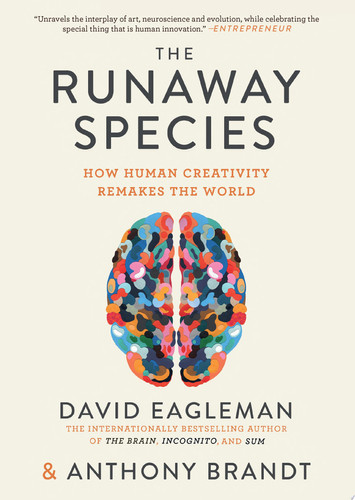
The Runaway Species How Human Creativity Remakes the World

David Eagleman,Anthony Brandt
This enlightening examination of creativity looks “at art and science together to examine how innovations . . . build on what already exists and rely on three brain operations: bending, breaking and blending” ( The Wall Street Journal ) The Runaway Species is a deep dive into the creative mind, a celebration of the human spirit, and a vision of how we can improve our future by understanding and embracing our ability to innovate. David Eagleman and Anthony Brandt seek to answer the question: what lies at the heart of humanity’s ability—and drive—to create? Our ability to remake our world is unique among all living things. But where does our creativity come from, how does it work, and how can we harness it to improve our lives, schools, businesses, and institutions? Eagleman and Brandt examine hundreds of examples of human creativity through dramatic storytelling and stunning images in this beautiful, full–color volume. By drawing out what creative acts have in common and viewing them through the lens of cutting–edge neuroscience, they uncover the essential elements of this critical human ability, and encourage a more creative future for all of us. “ The Runaway Species approach[es] creativity scientifically but sensitively, feeling its roots without pulling them out.” — The Economist
Catapult 2018-06-19 304 pages

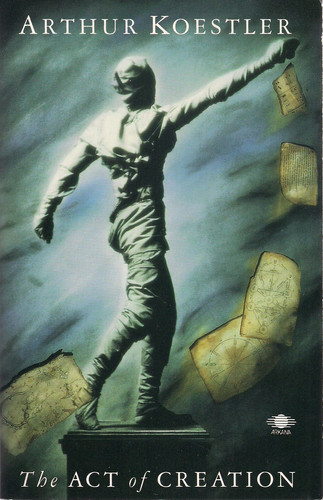
The act of creation

Koestler, Arthur
Astudy of the processes of discovery, invention, imagination and creativity in humor, science, and the arts. It lays out Koestler's attempt to develop an elaborate general theory of human creativity. From describing and comparing many different examples of invention and discovery, Koestler concludes that they all share a common pattern which he terms "bisociation"--A blending of elements drawn from of two previously unrelated matrices of thought into a new matrix of meaning by way of a process involving comparison, abstraction and categorization, analogies and metaphors. He regards many different mental phenomena based on comparison (such as analogies, metaphors, parables, allegories, jokes, identification, role-playing, acting, personification, anthropomorphism etc.), as special cases of "bisociation".
Arkana 1989 751 pages

The Creative Mind

Henri. Bergson
The Creative Mind is a philosophical work written by the French philosopher Henri Bergson. Originally published in 1934, the book explores the nature of creativity and the creative process. Bergson argues that creativity is not simply a matter of individual genius, but is a fundamental aspect of life itself. He suggests that creativity arises from a tension between the past and the present, and that it is the result of a continual process of invention and adaptation.Bergson draws on a wide range of examples, from the arts to the sciences, to illustrate his ideas about creativity. He discusses the role of intuition and imagination in the creative process, and explores the relationship between creativity and the unconscious mind. He also considers the social and cultural factors that can either encourage or inhibit creativity.Throughout the book, Bergson emphasizes the importance of living in the present moment, and of being open to new experiences and ideas. He argues that creativity is not something that can be taught or learned, but is instead a natural expression of the human spirit.Overall, The Creative Mind is a thought-provoking and insightful exploration of one of the most fundamental aspects of human experience. It is a must-read for anyone interested in the nature of creativity, and in the ways in which we can cultivate it in ourselves and others.This is a new release of the original 1946 edition.This scarce antiquarian book is a facsimile reprint of the old original and may contain some imperfections such as library marks and notations. Because we believe this work is culturally important, we have made it available as part of our commitment for protecting, preserving, and promoting the world's literature in affordable, high quality, modern editions, that are true to their original work.
Literary Licensing, LLC 2013-10 306 pages

Culture crash: the killing of the creative class

Timberg, Scott
"Change is no stranger to us in the twenty-first century. All of us must constantly adjust to an evolving world, to transformation and innovation. But for many thousands of creative artists, a torrent of recent changes has made it all but impossible to earn a living. A persistent economic recession, social shifts, and technological change have combined to put our artists-from graphic designers to indie-rock musicians, from architects to booksellers-out of work. This important book looks deeply and broadly into the roots of the crisis of the creative class in America and tells us why it matters. Scott Timberg considers the human cost as well as the unintended consequences of shuttered record stores, decimated newspapers, music piracy, and a general attitude of indifference. He identifies social tensions and contradictions-most concerning the artist's place in society-that have plunged the creative class into a fight for survival. Timberg shows how America's now-collapsing middlebrow culture-a culture once derided by intellectuals like Dwight Macdonald-appears, from today's vantage point, to have been at least a Silver Age. Timberg's reporting is essential reading for anyone who works in the world of culture, knows someone who does, or cares about the work creative artists produce"--
Yale University Press 2015-01-01 310 pages

Wisdom, intelligence, and creativity synthesized

Sternberg, Robert J.
For thirty years, Robert J. Sternberg has been among the most vocal critics of narrow conceptions of intelligence. In Wisdom, Intelligence, and Creativity Synthesized Sternberg critically reviews and summarizes the best research available on human intelligence. He argues that any serious understanding of intelligence must go beyond the standard paper and pencil tests currently in use. In addition to analytical and quantitative abilities, a theory of intelligence must take account of peoples' creative abilities - their ability to go beyond given information and imagine new and exciting ways of reformulating old problems. It must also take into account peoples' ability to weigh options carefully and act prudently. Understanding one's own intellectual shortcomings and learning how to overcome, Sternberg argues, is just as important as developing one's strengths. As he weaves his way through decades of important research on these questions, Sternberg develops a vision of human intelligence that is far more nuanced and accurate than anything previously offered. Wisdom, Intelligence, and Creativity Synthesized is essential reading for psychologists, cognitive scientists, educators, and organizational researchers. Robert J. Sternberg is Dean of the School of Arts and Sciences and Professor of Psychology at Tufts University. Prior to being at Tufts, he was IBM Professor of Psychology and Education, Professor of Management in the School of Management, and Director of the Center for the Psychology of Abilities, Competencies, and Expertise at Yale University. This center, now relocated to Tufts, is dedicated to the advancement of theory, research, practice, and policy advancing the notion of intelligence as developing expertise, as a construct that is modifiable and capable, to some extent, of development throughout the lifespan. Author of over 1,100 articles, chapters, and books, Sternberg's research focuses on intelligence, creativity, and wisdom, and he has studied love and close relationships as well as hate.
Cambridge University Press 2003 227 pages

The creativity conundrum: a propulsion model of kinds of creative contributions

Sternberg, Robert J.
People tend to think of creativity as a trait-a single attribute with which we are born that is relatively fixed in quantity. Many people also think of creativity as something that only very gifted people possess. This book challenges all of these notions. The basic idea is that there are multiple kinds of creativity, and that everyone can develop at least some of these kinds of creativity. The book considers the various kinds of creativity as they apply in domains such as science, literature, the arts, government, business, and sports. The most common kind of creativity may be conceptual replication, whereby someone produces a minor variant of work that has been produced before. This kind of creativity represents a "limiting case" of creative thought. Most successful inventions and scientific discoveries represent "forward incrementations," which basically take existing ideas and move them to the next step in the direction the field is already going. Often more radical are redirections, which take a field in a new direction, and reinitiations, which represent essentially a "starting over" of how people think about a given problem. The book discusses 8 kinds of creativity, and how they are similar to and different from each other. It is illustrated with many examples, and describes why it is necessary to distinguish among the kinds of creativity. --From publisher's description.
Psychology Press 2002 141 pages

Let the elephants run: unlock your creativity and change everything

David Usher
"Award-winning musician and founder of CloudID Creativity Lab David Usher believes we just need the right tools to help us reconnect with our imaginations in our day-to-day lives whether in the head office, the home office, or the artist's studio. Usher empowers readers to achieve more 'aha' moments through two cornerstone principles of creativity: freedom and structure. Using a mix of personal anecdotes and professional examples from the worlds of industry, technology, science, music, and art, he shows us that creativity is not magic; it is a learnable skill that any person or business can master. The dynamic full-colour design includes photographs, artwork and illustrations, as well as action pages to help readers start cultivating the habit of documenting their ideas for future execution."--Provided by publisher.
Anansi 2016 227 pages

Creativity/Anthropology

Smadar Lavie,Kirin Narayan,Renato Rosaldo
Creativity and play erupt in the most solemn of everyday worlds as individuals reshape traditional forms in the light of changing historical circumstances. In this lively volume, fourteen distinguished anthropologists explore the life of creativity in social life across the globe and within the study of ethnography itself. Contributors include Barbara A. Babcock, Edward M. Bruner, James W. Fernandez, Don Handelman, Smadar Lavie, José E. Limon, Barbara Myerhoff, Kirin Narayan, Renato Rosaldo, Richard Schechner, Edward L. Schieffelin, Marjorie Shostak, Anna Lowenhaupt Tsing, and Edith Turner.
Cornell University Press 2018-08-15 368 pages