28 results for "Science"

Beyond the Melting Pot The Negroes, Puerto Ricans, Jews, Italians, and Irish of New York City

Nathan Glazer,Daniel Patrick Moynihan
About the Book Books about Ethnic Studies consider issues relating to the history of race and ethnicity within broader "mainstream" populations. Titles include: Anglo-Israel; Or, The British Nation the Lost Tribes of Israel, Irish Emigration to the United States: What It Has Been, and What It Is, Les Français au Canada. La jeunesse de Bougainville et la guerre de sept ans, Scotch-Irish in New England, The Czecho-Slovaks in America, The Greeks in America, The Polish Peasant in Europe and America; Monograph of an Immigrant Group, The Russian immigrant, and Wilson's Naturalization Laws of the United States, Showing how to Become an American Citizen. About us Trieste Publishing's aim is to provide readers with the highest quality reproductions of fiction and non-fiction literature that has stood the test of time. Our titles are produced from scans of the original books and as a result may sometimes have imperfections. To ensure a high-quality product we have: thoroughly reviewed every page of all the books in the catalog repaired some of the text in some cases, and rejected titles that are not of the highest quality. You can look up "Trieste Publishing" in categories that interest you to find other titles in our large collection. Come home to the books that made a difference!
Trieste Publishing Pty Limited 2017-09-27 378 pages

The jazzmen: how Duke Ellington, Louis Armstrong, and Count Basie transformed America

Tye, Larry
"This is the story of three revolutionary American musicians, the maestro jazzmen who orchestrated the chords that throb at the soul of twentieth-century America. Duke Ellington [...], Louis Daniel Armstrong [...], William James Basie [...]. What is far less known about these groundbreakers is that they were bound not just by their music or even the discrimination that they, like nearly all Black performers of their day, routinely encountered. Each defied and ultimately overcame racial boundaries by opening America's eyes and souls to the magnificence of their music. In the process they wrote the soundtrack for the civil rights movement. Based on more than 250 interviews, this exhaustively researched book brings alive the history of Black America in the early- to mid-1900s through the singular lens of the country's most gifted, engaging, and enduring African American musicians." -Från bokens baksida.
Mariner Books 2025-05-13 393 pages

Stone age economics

Sahlins, Marshall David
Stone Age Economics is a classic study of anthropological economics, first published in 1974. As Marshall Sahlins stated in the first edition, "It has been inspired by the possibility of 'anthropological economics,' a perspective indebted rather to the nature of the primitive economies than to the categories of a bourgeois science." Ambitiously tackling the nature of economic life and how to study it comparatively, the book includes six studies which reflect the author's ideas on revising traditional views of the hunter-gatherer and so-called primitive societies, revealing them to be the original affluent society. The book examines notions of production, distribution and exchange in early communities and examines the link between economics and cultural and social factors. It consists of a set of detailed and closely related studies of tribal economies, of domestic production for livelihood, and of the submission of domestic production to the material and political demands of society at large. Marshall Sahlins is one of the most prominent American anthropologists of our time. He holds the title of Charles F. Grey Distinguished Service Professor of Anthropology at the University of Chicago. His most recent book is How Natives Think: About Captain Cook, for Example.
Transaction Publishers 2011 348 pages

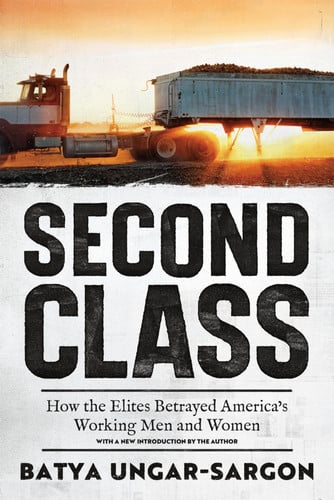
Second class: how the elite betrayed America's working men and women

Ungar-Sargon, Batya
A personal, journalistic ethnography of the modern American working class, based on the travels and interactions of the author through the American heartland. " Second Class is the most important book you will read all year. A political realignment is coming, and it's my hope that the end result will work in favor of our all-too-neglected American working class. When that realignment comes, Batya and her book will help lead the way." --Greg Lukianoff, CEO of the Foundation for Individual Rights in Education, and co-author of The Coddling of the American Mind Who is the American working class? Do they still have a fair shot at the American Dream? What do they think about their chances to secure the hallmarks of a middle-class life? While writing this book, Batya Ungar-Sargon visited states across the nation to speak with members of the American working class who are fighting tooth and nail to survive. In Second Class , working-class Americans of all races, political orientations, and occupations share their stories--cleaning ladies, health care aides, cops, truck drivers, fast food workers, electricians, and more. In their own words, these working-class Americans explain the struggles and triumphs of their increasingly precarious lives--as well as what policies they think would improve them. Second Class combines deep reporting with a look at the data and expert opinions on America's emergent class divide, in which the most basic elements of a secure and stable life are increasingly out of reach for those without a college education. America has broken its contract with its laboring class. So, how do we get back to the American Dream? How do we once again become the land of opportunity, the promised land, where hard work and commitment to family are enough to protect you from poverty? It's not that hard actually. All it would take, as this book illustrates, is for those in power to once again respect the dignity of work--and the American worker.
Encounter Books 2025 248 pages

The Trickster A Study in American Indian Mythology

Paul Radin
2024 Reprint of the 1956 Edition. Full facsimile of the original edition and not reproduced with Optical Recognition Software. The trickster myth, which is the basis of this scientific study, is one of the most imaginative narratives known to man. It concerns the exploits of a grotesque individual whose main physical features are enormous digestive and sexual organs and who unites in himself some of the traits of a god, an animal, and a human being. Primarily his activities, over which he has no conscious control, represent attempts to dupe others, yet actually always recoil upon himself. He is cruel, obscene and possessed of a voracious appetite which he is never permitted to satisfy. Creator and destroyer, affirmer and negator at one and the same time, his activities finally result in the transformation of himself into a being approximating to that of man. The figure of Trickster is of tremendous historical and psychological importance for an understanding of ourselves. As Dr Jung suggests in his Foreword, Trickster is the symbol of the unconscious and undifferentiated in man. That is why he is represented as being everything to every man-god, animal, human being, hero, buffoon, he who antedates all values, good and evil.
Martino Fine Books 2024-06-26 224 pages

An Apache Life-way; the Economic, Social, and Religious Institutions of the Chiricahua Indians

Morris Edward 1907-1996 Opler
In this groundbreaking work of ethnography, Opler provides a detailed and comprehensive account of the culture and society of the Chiricahua Apache people. Drawing on years of fieldwork, Opler offers a unique perspective on the spiritual, economic, and social structures that shaped the Chiricahua way of life. This work has been selected by scholars as being culturally important, and is part of the knowledge base of civilization as we know it. This work is in the "public domain in the United States of America, and possibly other nations. Within the United States, you may freely copy and distribute this work, as no entity (individual or corporate) has a copyright on the body of the work. Scholars believe, and we concur, that this work is important enough to be preserved, reproduced, and made generally available to the public. We appreciate your support of the preservation process, and thank you for being an important part of keeping this knowledge alive and relevant.
Creative Media Partners, LLC 2023-07-22 536 pages

Communities of violence: persecution of minorities in the middle ages

Nirenberg, David
In the wake of modern genocide, we tend to think of violence against minorities as a sign of intolerance or, even worse, a prelude to extermination. In Communities of Violence, David Nirenberg argues that violence in the Middle Ages functioned differently. In this provocative book, he focuses on specific attacks against minorities in fourteenth-century France and the Crown of Aragon. He argues that these attacks were often perpetrated not by irrational masses laboring under inherited ideologies and prejudices, but by groups that manipulated and reshaped the available discourses on minorities. Nirenberg shows that their use of violence expressed complex beliefs about topics as diverse as divine history, kinship, sex, money, and disease, and that their actions were frequently contested by competing groups within their own society. -- from back cover.
Princeton University Press 2015-05-26 301 pages

A little love in big Manhattan

Wisse, Ruth R.
In the early decades of this century, the wave of immigration that brought nearly two million Jews from the Pale of Settlement to the United States included an extraordinary group of gifted Yiddish poets and writers, who came to be called Di Yunge (The Young). A Little Love in Big Manhattan tells the story of two of the Young’s most prominent figures―Mani Leib, a lyric poet intent on refining the hard facts of his life into works of enduring beauty, and Moishe Leib Halpern, for whom poetry had to be the expression of coarse and shattering reality. Through a dual biography of these opposing personalities, Ruth Wisse describes the rich and vital cultural movement that embraced them both. She tells of the burst of creative energy exhibited by the young poets and intellectuals who, after a long day of manual labor, would congregate in the cafes of the Lower East Side for badinage, debate, and literary talk. They started literary journals and compiled anthologies of their writings, which found their way overseas and had a rejuvenating influence on Yiddish poetry abroad. Ironically, their achievement coincided with the decline of the language in which they wrote, so that Yiddish poetry came into its own in America at a time when the next generation could scarcely read it; there were no literary heirs. Ruth Wisse presents modern Jews with a part of their lost inheritance, and also claims for the Yiddish poets a place in the American canon. The first book to present these poets as part of the history of immigrant Jews in America, A Little Love in Big Manhattan (the title is from a poem of Halpern’s) will appeal to readers of poetry and to people interested in facets of the intellectual and artistic atmosphere of the interwar period.
Harvard University Press 1988-07-27 279 pages

For all the world to see: visual culture and the struggle for civil rights

Berger, Maurice
In 1955, shortly after Emmett Till was murdered by white supremacists in Mississippi, his grieving mother distributed to the press a gruesome photograph of his mutilated corpse. Asked why she would do this, she explained that by witnessing with their own eyes the brutality of segregation and racism, Americans would be more likely to support the cause of racial justice. "Let the world see what I've seen," was her reply. The publication of the photograph inspired a generation of activists to join the civil rights movement. Despite this extraordinary episode, the story of visual culture's role in the modern civil rights movement is rarely included in its history. This is the first comprehensive examination of the ways images mattered in the struggle, and it investigates a broad range of media including photography, television, film, magazines, newspapers, and advertising. These images were ever present and diverse: the startling footage of southern white aggression and black suffering that appeared night after night on television news programs; the photographs of black achievers and martyrs in Negro periodicals; the humble snapshot, no less powerful in its ability to edify and motivate. In each case, the war against racism was waged through pictures, millions of points of light, millions of potent weapons that forever changed a nation. This book allows us to see and understand the crucial role that visual culture played in forever changing a nation.
Yale University Press 2010-04-20 207 pages

Enemies, a love story: Mizrahi-Arab-Ashkenazi relations since the dawn of Zionism

Cohen, Hillel
Originally published in Hebrew in 2021, Hillel Cohen's Enemies, a Love Story argues that to understand the ongoing conflict in Palestine/Israel we need to examine the interactions among three identity groups: Mizrahim, Ashkenazim, and Arabs. Refusing to treat Jewish society as a monolith, Cohen shows how the ethnic divide between Ashkenazim (Jews of European descent) and Mizrahim (Jews of Middle Eastern origin) can inform and complicate how we view the wider picture of nationalism, religiosity, and oppression in this part of the world. Cohen considers how and why Ashkenazi-Arab and Mizrahi-Arab relations have metamorphosed over time, from the final decades of the Ottoman Empire into the Mandate period, from the Nakba and its aftermath to the Six Day War of 1967, and from the political upheaval of the 1970s to the rise of the right-wing Likud party and the assassination of Prime Minister Yitzhak Rabin in 1995. The author challenges widespread beliefs that "Mizrahi" is synonymous with rigid nationalism and "Ashkenazi" with progressivism and support for reconciliation, showing how religiosity and socioeconomic status have shaped Israeli attitudes toward Palestinians. Readers interested in Israel, Palestine, and the Middle East should find tremendous value in this timely book on a sensitive issue.
The Pennsylvania State University Press 2025-11-18 401 pages

The black diaspora

Segal, Ronald
The Black Diaspora tells the enthralling story of African-descended people outside Africa, spanning more than five centuries and a dozen countries of settlement, from Britain, Canada, and the United States to Haiti, Guyana, and Brazil. Ronald Segal's account begins in Africa itself, with the cultures and societies flourishing there before the arrival of the Atlantic slave trade, which transported over ten million people to the Americas, after killing at least as many in their procurement and passage. He examines the extent of the profits made through the trade by merchants, manufacturers, investors, and planters, along with the racist ideology that developed as whites strove to rationalize an enormous economic dependence. Segal describes the various ways in which the system of slavery developed and provides the most comprehensive account to date of the resistance by the slaves themselves, from escape and arson to guerrilla warfare and revolution. When emancipation finally came, the former slaves were left in the fetters of poverty and discrimination. Segal details the course of the struggle against colonial rule and the racial oppressions of self-styled democracies. In recounting his own travels through the Diaspora, he shows the continuing plight of peoples confined by the consequences of the past and the prejudices of the present: racked by violence, as in Jamaica and the ghettos of America; denied the right to assert their sense of identity, as in Cuba; acknowledged only to be repudiated, as in Brazil. Yet this is also, Segal reveals, a Diaspora of wondrous achievement. It has immeasurably enriched world culture in music, language and literature, painting, sculpture and architecture; has done much to make sports a form of art; and has invested Western culture with the ecological reverence derived from its African source. Segal argues that the black Diaspora has a unique destiny, infused by the love of freedom that is its creative impulse.
Farrar, Straus and Giroux 1995-08-31 477 pages

The olive and the tree: the secret strength of the Druze

Westheimer, Ruth
All religious groups have codes to guide the lives of adherents, but the Druze, Dr. Ruth tells us, are especially interesting. She has observed the Druze's special art of adjustment in all walks of life, whether religious or secular, and for all people, young and old. Their key is an ancient custom called a-takiyya. During times of communal stress, the Druze refrain from accentuating their religious identity, thus reducing the possibilities of conflict with neighboring groups and allowing them to concentrate on internal community building. According to Druze custom, they predate the Hebrew people in the area surrounding Palestine--particularly in Syria, Lebanon, and Israel. Thus, like many "native" peoples, they do not feel bound by the customs and religions brought into the area by later settlers. This, of course, has led to a long history of strife with their neighbors. Consequently, the Druze people have had to build an inner strength of individuals and community in order to survive as an identifiable ethnic group. Through stories, personal encounters, and historical context, Dr. Ruth Westheimer describes with great warmth the roots of that strength, how the story of the Druze has played out over the millennia, how they influence today's situation in the Middle East, and what Westerners can learn from them and their way of life.
Lantern Books 2007 137 pages

From ghetto to emancipation: historical and contemporary reconsiderations of the Jewish community

David N. Myers,William Rowe
The central addressed the conference question by reported on in this book was posed by Salo Wittmayer Baron, then a young Jewish historian, in his 1928 essay "Ghetto and Emancipation". In it he challenged what he called "the lachrymose conception" of Jewish history in which the Jewish Middle Ages were all evil and Jewish post-Emancipation was all good. In asserting that medieval Jews possessed "more rights than the great bulk of the population...and enjoyed full internal autonomy" in the corporatist order of medieval civilization, he also found much to criticize in the loss of communal autonomy and the recasting of Judaism into a narrow confessional mold in the wake of the Enlightenment. In other words, how can a group seeking to preserve a measure of collective identity survive within a liberal society that values individual rights and obligations above all else? This became the basis for a conference in 1995 at the University of Scranton attended by a distinguished roster of scholars on various fields of Jewish studies from across the United States.
University of Scranton Press 1997 159 pages

The Myth of the Jewish Menace in World Affairs

Lucien Wolf
The Myth of the Jewish Menace in World Affairs-or, The truth about the forged protocols of the elders of Zion is a classic Jewish studies text by Lucien Wolf. The substance of the following three political essays was originally contributed, in the form of independent articles to the Manchester Guardian, the Spectator, and the Daily Telegraph respectively. They have been carefully revised, much amplified, and largely rewritten in order to make a connected argument and avoid repetition. Footnotes of authorities have been added. My grateful acknowledgments are due to the Editors of the Manchester Guardian, the Spectator, and the Daily Telegraph for their kindness in permitting this republication.
CreateSpace Independent Publishing Platform 2015-03 44 pages

Israeli identity in transition

Shapira, Anita
The last 15 years have witnessed deep changes in Israeli society. The naive solidarity of the early years of statehood has given way to more sophisticated approaches, and the atmosphere of the 1990s was conducive towards critique and open discussion. It was the age of the Oslo Accords, of the large wave of immigrants from the Former Soviet Union, economic growth and prosperity, and a concurrent feeling of security and well-being. Israel was fast becoming a postcapitalist society, a junior member of the global village. This newly acquired self-assurance led to openness towards unorthodox views on basic questions of Israeli identity. This book attempts to come to grips with these themes. The complex texture of Israeli society is drawn here by a number of hands, presenting up-to-date approaches, as viewed by experts.
Praeger Publishers 2004-10-30 268 pages