8 results for "Science"

Focus: The Hidden Driver of Excellence

Goleman, Daniel
In Focus, psychologist and journalist Daniel Goleman delves into the science of attention in all its varieties, presenting a long-overdue discussion of this little-noticed and underrated mental asset that matters enormously for how we navigate life. Attention works much like a muscle: use it poorly and it can wither; work it well and it grows. In an era of unstoppable distractions, Goleman persuasively argues that now more than ever we must learn to sharpen focus if we are to contend with, let alone thrive in, a complex world. Goleman analyzes attention research as a threesome: inner, other, and outer focus. He shows why high-performers need all three kinds of focus, as demonstrated by rich case studies from fields as diverse as competitive sports, education, the arts, and business. Those who excel rely on what Goleman calls smart practice that helps them improve habits, add new skills, and sustain excellence. Combining cutting-edge research with practical findings, Focus reveals what distinguishes experts from amateurs and stars from average performers.
HARPER PAPERBACKS 2015-05-05 320 pages

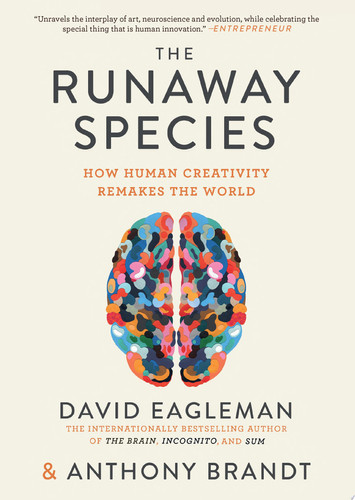
The Runaway Species How Human Creativity Remakes the World

David Eagleman,Anthony Brandt
This enlightening examination of creativity looks “at art and science together to examine how innovations . . . build on what already exists and rely on three brain operations: bending, breaking and blending” ( The Wall Street Journal ) The Runaway Species is a deep dive into the creative mind, a celebration of the human spirit, and a vision of how we can improve our future by understanding and embracing our ability to innovate. David Eagleman and Anthony Brandt seek to answer the question: what lies at the heart of humanity’s ability—and drive—to create? Our ability to remake our world is unique among all living things. But where does our creativity come from, how does it work, and how can we harness it to improve our lives, schools, businesses, and institutions? Eagleman and Brandt examine hundreds of examples of human creativity through dramatic storytelling and stunning images in this beautiful, full–color volume. By drawing out what creative acts have in common and viewing them through the lens of cutting–edge neuroscience, they uncover the essential elements of this critical human ability, and encourage a more creative future for all of us. “ The Runaway Species approach[es] creativity scientifically but sensitively, feeling its roots without pulling them out.” — The Economist
Catapult 2018-06-19 304 pages

Data Science and Digital Business

Fausto Pedro García Márquez,Benjamin Lev
This book combines the analytic principles of digital business and data science with business practice and big data. The interdisciplinary, contributed volume provides an interface between the main disciplines of engineering and technology and business administration. Written for managers, engineers and researchers who want to understand big data and develop new skills that are necessary in the digital business, it not only discusses the latest research, but also presents case studies demonstrating the successful application of data in the digital business.
Springer International Publishing 2019-01-16 316 pages

Minds wide shut: how the new fundamentalisms divide us

Morson, Gary Saul,Schapiro, Morton Owen
A timely exploration of intellectual dogmatism in politics, economics, religion, and literature—and what can be done to fight it Polarization may be pushing democracy to the breaking point. But few have explored the larger, interconnected forces that have set the stage for this crisis: namely, a rise in styles of thought, across a range of fields, that literary scholar Gary Saul Morson and economist Morton Schapiro call “fundamentalist.” In Minds Wide Shut , Morson and Schapiro examine how rigid adherence to ideological thinking has altered politics, economics, religion, and literature in ways that are mutually reinforcing and antithetical to the open-mindedness and readiness to compromise that animate democracy. In response, they propose alternatives that would again make serious dialogue possible. Fundamentalist thinking, Morson and Schapiro argue, is not limited to any one camp. It flourishes across the political spectrum, giving rise to dueling monologues of shouting and abuse between those who are certain that they can’t be wrong, that truth and justice are all on their side, and that there is nothing to learn from their opponents, who must be evil or deluded. But things don’t have to be this way. Drawing on thinkers and writers from across the humanities and social sciences, Morson and Schapiro show how we might begin to return to meaningful dialogue through case-based reasoning, objective analyses, lessons drawn from literature, and more. The result is a powerful invitation to leave behind simplification, rigidity, and extremism—and to move toward a future of greater open-mindedness, moderation, and, perhaps, even wisdom.
Princeton University Press 2023-01-31 307 pages

Internet of things: cases and studies

Fausto Pedro García Márquez,Benjamin Lev
This book provides relevant theoretical frameworks and the latest empirical research findings of Operations Research/Management Science applied to Internet of Things. This book identifies and describes ways in which OR and MS have been applied and influenced the development of IoT. Examples are from smart industry; city; transportation; home and smart devices. It discusses future applications, trends, and potential benefits of this new discipline. It is written for professionals who want to improve their understanding of the strategic role of IoT at various levels of the organization, that is, IoT at the global economy level, at networks and organizations level, at teams and work groups, at information systems and, finally, IoT at the level of individuals, as players in the networked environments.
Springer 2021-07-14 304 pages

Shared prosperity in a fractured world: a new economics for the middle class, the global poor, and our climate

Rodrik, Dani
"Fighting climate change, saving democracy, and eradicating poverty are urgent global challenges, yet the world's leaders continue to pursue outdated policies that focus on one while worsening the tradeoffs between each of them. Shared Prosperity in a Fractured World shows how the nations of the world can achieve all three objectives. Dani Rodrik provides a bold new vision of globalization, one in which we accelerate the green transition to achieve a sustainable planet, shore up the middle class to restore democracy's foundations, and hasten economic revitalization in the developing world to put an end to poverty. The rising tide of authoritarianism has demonstrated our inability to alleviate economic anxieties. Economic nationalism has raised the specter of increased protectionism and deteriorating prospects for economic growth. And automation and other new technologies have undercut the advantages of low-cost, unskilled labor in manufacturing and export-oriented industrialization. Rodrik reveals how we can restore prosperity through new forms of collaborative public-private action-to promote renewables and green industries, middle-class jobs, and enhanced productivity in labor-absorbing services-even in the absence of global cooperation. He explains why this new kind of globalization must also recognize the legitimate desire of governments to pursue their economic, social, and security interests autonomously. Turning conventional economic wisdom on its head, Shared Prosperity in a Fractured World builds on practices that work while radically transforming those that don't, presenting a grounded, clear-eyed approach to tackling the problems that affect us all, at home and around the world"--
Princeton University Press 2025-11-04 269 pages

How to Reason + Reasoning in the Sciences

Richard L. Epstein
Too often we’re guided by what we last heard, by our friends’ approval, by impulse—our desires, our fears. Without reflection. Without even stopping to think. ** In this book you’ll learn how to reason and find your way better in life. You’ll learn to see the consequences of what you and others say and do. You’ll learn to see the assumptions that you and others make. You’ll learn how to judge what you should believe. These are the skills we all need to make good decisions. ** Claims. Arguments. Fallacies. Analogies. Generalizing. Cause and Effect. Explanations. These are clearly set out with hundreds of examples from daily life showing how to use them. Illustrations using a cast of cartoon characters make the concepts memorable. And many exercises will help you to check your understanding. ** Truly a book for all—from high school to graduate school, from auto repair to managing a company. How to Reason will help you find a way in life that is clearer and not buffetted by the winds of nonsense and fear. ******* In Reasoning in the Sciences, you’ll learn how to use your reasoning skills to understand how scientists make definitions, what an experiment is, what can go wrong with an experiment, how scientists reason with models and theories, what counts as a good explanation in science, and how to distinguish science from magic, religion, and fraud. No background in science is needed, just a healthy appetitite for learning.
Advanced Reasoning Forum 2019-01 246 pages