11 results for "Science"

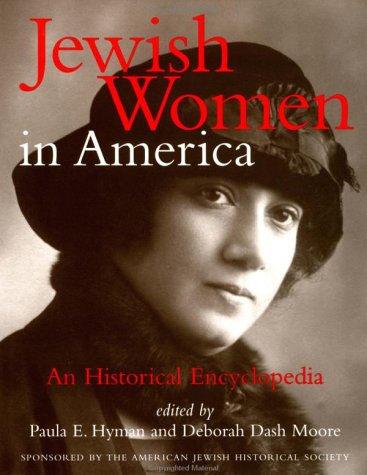
Jewish women in America: an historical encyclopedia

Paula Hyman,Deborah Dash Moore,Phyllis Holman Weisbard,American Jewish Historical Society
This encyclopedia provides the first standard reference work on the lives, history and activities of Jewish women in the United States. Covering a period which extends from the arrival of the first Jewish women in North America in 1654 to the present, this two-volume set presents the most comprehensive and detailed portrait of American Jewish women ever published, and brings together for the first time the wealth of recent scholarship on this subject. Includes: * Biographical entries on over 800 individual women. * 128 topical articles on organizations such as Hadassah, the National Council of Jewish Women, Mizrachi, and the Ladies' Garment Workers' Union. * Major essays on Jewish women's participation in the movement for women's suffrage, social reform, civil rights, and the recent women's movement. * The activities of Jewish women in politics, business, education, the arts, and religion. * A readable, inviting format with over 500 large photographs. * Bibliographies at the end of each entry which include overviews of major scholarship in the field, complete citations of more general works and citations of additional bibliographical and reference sources. * The comprehensive index includes citations to every substantive discussion in the entries as well as all proper names appearing in the text, such as organizations, book, song and film titles, schools, and individuals. The "Encyclopedia" provides information on American Jewish women in all fields of endeavor, and pays special attention to the work of women in the arts, academics, law, the labor movement, education, science, medicine, journalism and publishing, and on the lives of ordinary Jewish women during all time periods and in all regions of the United States.
Routledge 1997 1770 pages

An encyclopedic dictionary of language and languages

Crystal, David
The aim of this book is to provide a succinct, accessible and comprehensive guide to linguistic concepts and names. 'Linguistic' here does not mean the technical terminology of linguistic sciences, but language in a more everyday sense. Terms are drawn from the various applied areas of language study, such as language teaching, speech pathology, stylistics, typography, and lexicography, as well as from core topics such as grammar, figures of speech, and basic phonetics. The dictionary sets out to answer questions people are likely to ask about language, such as 'Which language(s) do they speak in such-a-country' (all the countries of the world are included), and 'How many people speak X?' (several hundred languages are included). There are entries on 'knowledge about language', and 'LINC', and the ongoing developments in corpus compilation (COBUILD, British National Corpus). A great deal of background is given to the language profiles (e.g. early literary history). Pronunciations of language names (and of several other terms) are given. A small number of entries deal with linguistics, in particular the main schools of thought and basic concepts (e. g. competence, morphology). Abbreviations are included. In all, there are almost 2750 entries and there are c. 5000 cross-references, to give readers a wide range of access points to the information. Carefully chosen illustrations show things that cannot easily be expressed in text, such as alphabets. A selection of cartoons reinforces the author's conviction that language study can be fun.
Blackwell 1992 428 pages

Words of science and the history behind them

Asimov, Isaac
What’s in a word? Did you know that a lens is named for the lentil seed it resembles? That a straight line actually comes from the words stretched linen? or that a hippopotamus is literally a “river horse”? That oxygen means “giving birth to sharpness” because Lavoisier, who named it, mistakenly thought it was in all acids? (And acid, by the way, comes from the Latin word for vinegar). That alcohol is the word for an ancient Arabic cosmetic? That petroleum in Latin is “olive oil from a rock”? That a nucleus is a "little nut” or that deoxyribonucleic acid simply means . . . ? Well, read the book and see. The vocabulary of Science has always been a forbidding one, bristling with many-syllabled words and odd, unfamiliar terms. Now Professor Asimov has opened up this language to the ordinary reader by conducting an informal exploration into the roots and histories of hundreds of scientific terms. The result is a really fascinating book that combines a vast quantity of scientific information with an equal amount of language history. Even the longest tongue-twisters have simple origins if you go back far enough; and Professor Asimov makes each discovery of the origins of a word a sort of detective story that can’t fail to stimulate the reader’s interest. This is a perfect book to dip into again and again. Not only is it entertaining in its own right, but it is also a wonderful introduction to what should become the popular indoor sport of word-chasing. A complete index to the more than 1500 terms covered makes it a unique reference book as well.
Harrap 1974 416 pages

The Dog's Children Anishinaabe Texts Told by Angeline Williams

Leonard Bloomfield,John D. Nichols
These are a collection of 20 stories, dictated in 1941 to Bloomfield's linguistics class, edited from manuscripts now in the National Anthropological Archives at the Smithsonian Institution, and published for the first time. In Ojibwe, with English translations by Bloomfield. Ojibwe-English glossary and other linguistic study aids.
University of Manitoba Press 2017-12-15 268 pages

The New First Dictionary of Cultural Literacy What Your Child Needs to Know

William G. Rowland,E. D. Hirsch, Jr.,Michael Stanford
Fully updated for the twenty-first century, The New First Dictionary of Cultural Literacy gathers together all of the essential facts that youngsters should have at their fingertips for school success. The child education expert E. D. Hirsch, Jr., cuts through the wealth of information available today to highlight those terms that a child should be familiar with by the end of sixth grade. With nearly 3,000 concise definitions, including 250 new entries (Harry Potter, centaurs, northern lights, and World Series, to name a few), this popular sourcebook makes finding information easy. Here is everything your child needs to know to be culturally literate in 21 different subject areas, from mythology to literature to U.S. history to science and technology, and much more.
Turtleback 2004-10 306 pages

The Century Dictionary And Cyclopedia The Century Dictionary ... Prepared Under The Superintendence Of William Dwight Whitney ... Rev. & Enl. Under The Superintendence Of Benjamin E. Smith

William Dwight Whitney,Benjamin Eli Smith
This extensive dictionary and encyclopedia was overseen by two highly respected scholars of the late 19th century. Its entries cover a wide range of topics, from English language usage and etymology to science, literature, and history. A valuable resource for anyone seeking a comprehensive understanding of the era. This work has been selected by scholars as being culturally important, and is part of the knowledge base of civilization as we know it. This work is in the "public domain in the United States of America, and possibly other nations. Within the United States, you may freely copy and distribute this work, as no entity (individual or corporate) has a copyright on the body of the work. Scholars believe, and we concur, that this work is important enough to be preserved, reproduced, and made generally available to the public. We appreciate your support of the preservation process, and thank you for being an important part of keeping this knowledge alive and relevant.
Creative Media Partners, LLC 2023-07-18 834 pages

The Cambridge biographical dictionary

Crystal, David
The Cambridge Biographical Dictionary is the outstanding paperback reference guide to the world's noted personalities, living and dead. From Aeschylus and Alexander the Great to Franco Zeffirelli and Louis Zukovsky, from Chinua Achebe and Larry Adler to Zhuangzi and Zoroasta, this alphabetical book provides the essential details on more than 14,000 people from the past and present - some generally famous, others recognised within specialised fields throughout the arts, sciences and sport. By offering year of birth and (where appropriate) death, place of birth, profession, a succinct description of achievement, and in many cases pronunciations and cross-references to other personalities, the entries in this book amount to the most accurate and up-to-date compendium of world biography available in paperback.
Cambridge University Press 1996-06-13 495 pages