4 results for "Science"

The light of Christ: an introduction to Catholicism

White, Thomas Joseph
The Light of Christ provides an accessible presentation of Catholicism that is grounded in traditional theology, but engaged with a host of contemporary questions or objections. Inspired by the theologies of Iranaeus, Thomas Aquinas and John Henry Newman, and rooted in a post-Vatican II context, Fr. Thomas Joseph White presents major doctrines of the Christian religion in a way that is comprehensible for non-specialists: knowledge of God, the mystery of the Trinity, the Incarnation and the atonement, the sacraments and the moral life, eschatology and prayer. At the same time, The Light of Christ also addresses topics such as evolution, the modern historical study of Jesus and the Bible, and objections to Catholic moral teaching. Touching on the concerns of contemporary readers, Fr. White examines questions such as whether Christianity is compatible with the findings of the modern sciences, do historical Jesus studies disrupt or confirm the teaching of the faith, and does history confirm the antiquity of Catholic claims. This book serves as an excellent introduction for young professionals with no specialized background in theology who are interested in learning more about Catholicism, or as an introduction to Catholic theology. It will also serve as a helpful text for theology courses in a university context. As Fr. White states in the book’s introduction: “This is a book that offers itself as a companion. I do not presume to argue the reader into the truths of the Catholic faith, though I will make arguments. My goal is to make explicit in a few broad strokes the shape of Catholicism. I hope to outline its inherent intelligibility or form as a mystery that is at once visible and invisible, ancient and contemporary, mystical and reasonable.”
The Catholic University of America Press 2017-09-15 316 pages

Idolatry and representation: the philosophy of Franz Rosenzweig reconsidered

Batnitzky, Leora
Although Franz Rosenzweig is arguably the most important Jewish philosopher of the twentieth century, his thought remains little understood. Here, Leora Batnitzky argues that Rosenzweig's redirection of German-Jewish ethical monotheism anticipates and challenges contemporary trends in religious studies, ethics, philosophy, anthropology, theology, and biblical studies. This text, which captures the hermeneutical movement of Rosenzweig's corpus, is the first to consider the full import of the cultural criticism articulated in his writings on the modern meanings of art, language, ethics, and national identity. In the process, the book solves significant conundrums about Rosenzweig's relation to German idealism, to other major Jewish thinkers, to Jewish political life, and to Christianity, and brings Rosenzweig into conversation with key contemporary thinkers. Drawing on Rosenzweig's view that Judaism's ban on idolatry is the crucial intellectual and spiritual resource available to respond to the social implications of human finitude, Batnitzky interrogates idolatry as a modern possibility. Her analysis speaks not only to the question of Judaism's relationship to modernity (and vice versa), but also to the generic question of the present's relationship to the past--a subject of great importance to anyone contemplating the modern statuses of religious tradition, reason, science, and historical inquiry. By way of Rosenzweig, Batnitzky argues that contemporary philosophers and ethicists must relearn their approaches to religious traditions and texts to address today's central ethical problems.
Princeton University Press 2009-07-26 281 pages

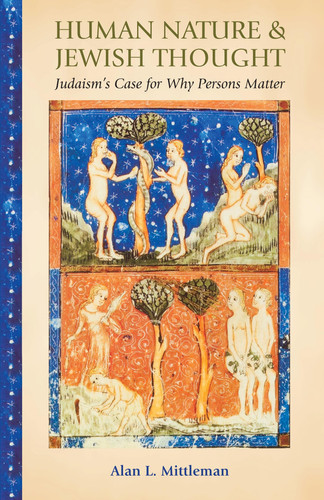
Human nature & Jewish thought: Judaism's case for why persons matter

Mittleman, Alan
This book explores one of the great questions of our time: How can we preserve our sense of what it means to be a person while at the same time accepting what science tells us to be true-namely, that human nature is continuous with the rest of nature? What, in other words, does it mean to be a person in a world of things? Alan Mittleman shows how the Jewish tradition provides rich ways of understanding human nature and personhood that preserve human dignity and distinction in a world of neuroscience, evolutionary biology, biotechnology, and pervasive scientism. These ancient resources can speak to Jewish, non-Jewish, and secular readers alike. Science may tell us what we are, Mittleman says, but it cannot tell us who we are, how we should live, or why we matter. Traditional Jewish thought, in open-minded dialogue with contemporary scientific perspectives, can help us answer these questions. Mittleman shows how, using sources ranging across the Jewish tradition, from the Hebrew Bible and the Talmud to more than a millennium of Jewish philosophy. Among the many subjects the book addresses are sexuality, birth and death, violence and evil, moral agency, and politics and economics. Throughout, Mittleman demonstrates how Jewish tradition brings new perspectives to-and challenges many current assumptions about-these central aspects of human nature. A study of human nature in Jewish thought and an original contribution to Jewish philosophy, this is a book for anyone interested in what it means to be human in a scientific age.
Princeton University Press 2015 215 pages

Contemporary Jewish theology: a reader

Rabbi Elliot N Dorff, PhD
Preface Acknowledgments I. Introduction 1. An Incessantly Gushing Fountain: The Nature of Jewish Theology, Byron Sherwin II. Classical Theologians in the Twentieth Century: Approaches to God 2. Religion of Reason Out of the Sources of Judaism, Hermann Cohen 3. The Star of Redemption, Franz Rosenzweig 4. I and Thou 5. A Thirst for the Living God; and The Pangs of Cleansing, Abraham Isaac Kook 6. God as the Power that Makes for Salvation, Mordecai Kaplan 7. God in Search of Men, Abraham Joshua Heschel III. Contemporary Reflections on Traditional Themes A. God 8. Belief in a Personal God: The Position of Liberal Supernaturalism, Louis Jacobs 9. In Search of God, Elliot N. Dorff 10. From God to Godliness: Proposal for a Predicate Theology, Harold M. Schulweis 11. Toward a Feminist Jewish Reconstruction of Monotheism; and Further Thoughts on Liturgy as an Expression of Theology, Marcia Falk 12. Jewish Feminist Theology, Ellen M. Umansky B. Creation 13. The Wings of the Dove: Jewish Values, Science, and Halachah, David W. Weiss 14. Seek My Face, Speak My Name, Arthur Green C. Revelation 15. Revelation in the Jewish Tradition, Emanuel Levinas 16. Sacred Fragments: Recovering Theology for the Modern Jew, Neil Gillman D. Redemption 17. The Natural and the Supernatural Jew, Arthur A. Cohen 18. On Jewish Eschatology, Steven Schwarzschild E. Covenant/Chosenness 19. Renewing the Covenant, Eugene Borowitz 20. The Election of Israel, David Novak 21. The Body of Faith, Michael Wyschogrod 22. Standing Again at Sinai, Judith Plaskow 23. A Jewish Theology of Jewish Relations to Other Peoples, Elliot N. Dorff F. Law 24. Halakhic Man, Joseph Soloveitchik 25. Some Criteria for Modern Jewish Observance, Jakob J. Petuchowski 26. Dynamics of Judaism, Robert Gordis 27. Engendering Judaism, Rachel Adler IV. Two Pivotal Experiences in the Twentieth Century A. The Holocaust 28. Faith after the Holocaust, Eliezer Berkovits 29. After Auschwitz, Richard Rubenstein 30. The Jewish Return into History; and To Mend the World, Emil Fackenheim 31. Cloud of Smoke, Pillar of Fire: Judaism, Christianity, and Modernity after the Holocaust, Irving Greenberg B. The State of Israel 32. Exile as a Neurotic Solution, A.B. Yehoshua 33. The Third Jewish Commonwealth, David Hartman 34. The Religious and Moral Significance of the Redemption of Israel. Yeshayahu Leibowitz 35. Beyond Innocence and Redemption, Marc Ellis V. Looking Toward the Future of Jewish Thought: A Symposium 36. New Directions in Jewish Theology in America, Arthur Green 37. Another Perspective on Theological Directions for the Jewish Future, Rebecca T. Alpert 38. The Nature and Direction of Modern Jewish Theology: Some Thoughts Occasioned by Arthur Green, David Ellenson 39. B'nei Ezra: An Introduction to Textual Reasoning, Peter Ochs Suggestions for Further Reading Biographical Sketches.
Oxford University Press 1999 522 pages