21 results for "Science"

Trigger warning: short fictions and disturbances

Gaiman, Neil
This third collection of short fiction by Gaiman includes previously published pieces of short fiction--stories, verse, and a Doctor Who story written for the series' fiftieth anniversary (Nothing o'clock). There is also "Black Dog," a new tale that revisits the world of his novel American Gods. The collection explores the masks we all wear and the people we are beneath them to reveal our vulnerabilities and our truest selves. Horror and ghosts stories, science fiction and fairy tales, fabulism and poetry explore the realm of experience and emotion. In "Adventure Story"--a thematic companion to The Ocean at the End of the Lane--Gaiman ponders death and the way people take their stories with them when they die. His social media experience "A Calendar of Tales" are short takes inspired by replies to fan tweets about the months of the year--stories of pirates and the March winds, an igloo made of books, and a Mother's Day card that portends disturbances in the universe. Gaiman offers his own spin on Sherlock Holmes in his award-nominated mystery tale "The Case of Death and Honey". And "Click-Clack the Rattlebag" explains the creaks and clatter we hear when we're all alone in the darkness.
William Morrow, an imprint of HarperCollins Publishers 2015-02-03 310 pages

Emotional

Mlodinow, Leonard
You make hundreds of decisions every day, from what to eat for breakfast to how you should invest, and not one of those decisions would be possible without emotion. It has long been said that thinking and feeling are separate and opposing forces in our behavior. But as Leonard Mlodinow, the best-selling author of Subliminal, tells us, extraordinary advances in psychology and neuroscience have proven that emotions are as critical to our well-being as thinking. How can you connect better with others? How can you make sense of your frustration, fear, and anxiety? What can you do to live a happier life? The answers lie in understanding your emotions. Journeying from the labs of pioneering scientists to real-world scenarios that have flirted with disaster, Mlodinow shows us how our emotions can help, why they sometimes hurt, and what we can learn in both instances. Using deep insights into our evolution and biology, Mlodinow gives us the tools to understand our emotions better and to maximize their benefits. Told with his characteristic clarity and fascinating stories, Emotional explores the new science of feelings and offers us an essential guide to making the most of one of nature's greatest gifts.[Bokinfo]
Random House US 2023-02-14 272 pages

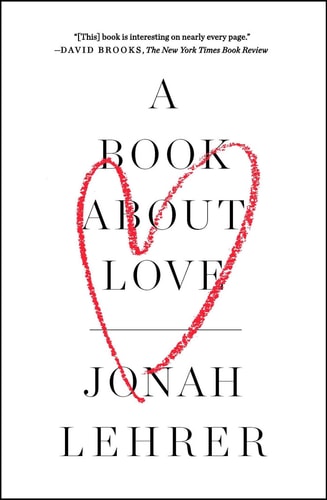
A Book About Love

Jonah Lehrer
Number one bestselling science writer Jonah Lehrer explores the “only happiness that lasts”—love—in a book that “is interesting on nearly every page” (David Brooks, The New York Times Book Review ). Weaving together scientific studies from clinical psychologists, longitudinal studies of health and happiness, historical accounts and literary depictions, child-rearing manuals, and the language of online dating sites, Jonah Lehrer’s A Book About Love plumbs the most mysterious, most formative, most important impulse governing our lives. Love confuses and compels us—and it can destroy and define us. It has inspired our greatest poetry, defined our societies and our beliefs, and governs our biology. From the way infants attach to their parents, to the way we fall in love with another person, to the way some find a love for God or their pets, to the way we remember and mourn love after it expires, this book focuses on research that attempts, even in glancing ways, to deal with the long-term and the everyday. The most dangerous myth of love is that it’s easy, that we fall into the feeling and then the feeling takes care of itself. While we can easily measure the dopamine that causes the initial feelings of “falling” in love, the partnerships and devotions that last decades or longer remain a mystery. “Lehrer uses scores of detailed vignettes to traverse a complicated intellectual landscape, eventually arriving at modern theories of love…He is a talent” ( USA TODAY ), and A Book About Love decodes the set of skills necessary to cultivate a lifetime of love. Love, Lehrer argues, is not built solely on overwhelming passion, but, fascinatingly, on a set of skills to be cultivated over a lifetime.
Simon and Schuster 2017-07-25 304 pages

The Sweet Spot The Pleasures of Suffering and the Search for Meaning

Paul Bloom
"This book will challenge you to rethink your vision of a good life. With sharp insights and lucid prose, Paul Bloom makes a captivating case that pain and suffering are essential to happiness. It's an exhilarating antidote to toxic positivity." --Adam Grant, #1 New York Times bestselling author of Think Again and host of the TED podcast WorkLife One of Behavioral Scientist's "Notable Books of 2021" From the author of Against Empathy, a different kind of happiness book, one that shows us how suffering is an essential source of both pleasure and meaning in our lives Why do we so often seek out physical pain and emotional turmoil? We go to movies that make us cry, or scream, or gag. We poke at sores, eat spicy foods, immerse ourselves in hot baths, run marathons. Some of us even seek out pain and humiliation in sexual role-play. Where do these seemingly perverse appetites come from? Drawing on groundbreaking findings from psychology and brain science, The Sweet Spot shows how the right kind of suffering sets the stage for enhanced pleasure. Pain can distract us from our anxieties and help us transcend the self. Choosing to suffer can serve social goals; it can display how tough we are or, conversely, can function as a cry for help. Feelings of fear and sadness are part of the pleasure of immersing ourselves in play and fantasy and can provide certain moral satisfactions. And effort, struggle, and difficulty can, in the right contexts, lead to the joys of mastery and flow. But suffering plays a deeper role as well. We are not natural hedonists--a good life involves more than pleasure. People seek lives of meaning and significance; we aspire to rich relationships and satisfying pursuits, and this requires some amount of struggle, anxiety, and loss. Brilliantly argued, witty, and humane, Paul Bloom shows how a life without chosen suffering would be empty--and worse than that, boring.
HarperCollins Publishers 2021-11-02 304 pages

The Peace of Mind Prescription An Authoritative Guide to Finding the Most Effective Treatment for Anxiety and Depression

Dennis S. Charney,Charles B. Nemeroff
The Ultimate Guide to Identifying, Treating, and Overcoming Depression and Anxiety Two world-renowned psychiatrists have created a comprehensive and empowering guide to the science and treatment of anxiety and depression. At the heart of their message is the idea that treatment can and must be tailored to the individual and that armed with the right information, patients can get the support they need from their health-care providers. Practical and authoritative, The Peace of Mind Prescription has been unanimously praised as a valuable resource that offers hope to millions of sufferers. Dennis S. Charney, M.D., is the Dean of Research and the Anne and Joel Ehrenkranz Professor in the departments of psychiatry, neuroscience, and pharmacology and biochemistry at the Mount Sinai School of Medicine. Charles B. Nemeroff, M.D., Ph.D., is the Reunette W. Harris Professor and chairman of the department of psychiatry and behavioral sciences at Emory University's School of Medicine.
Houghton Mifflin 2006 259 pages

Me, but better: the science and promise of personality change

Khazan, Olga
"In the vein of 10% Happier and Year of Yes, The Atlantic journalist Olga Khazan embarks on a year-long experimental romp through the riveting, emerging scientific field of personality change. For years, Olga Khazan had been spiraling toward an existential crisis. Though she treasured her loving long-term relationship and her dream job, she often caught herself snatching dissatisfaction from the jaws of happiness. Her anxious and neurotic overachieving had always been a professional asset, but lately, Olga felt that her brittle disposition would shatter at any moment under the weight of just one more thing. She knew something had to give-but was it really possible to do something as radical as change her personality? In The Personality Test, Olga embarks on a year-long experiment to see if it's truly possible to change your personality, sample size: one. Scientifically, personality consists of five sliding-scale traits: extroversion, or how sociable you are; conscientiousness, or how self-disciplined and organized you are; agreeableness, or how warm and empathetic you are; openness, or how receptive you are to new ideas and activities; and neuroticism, or how depressed or anxious you are. But research shows that you can alter these traits by consistently behaving in ways that align with the kind of person you'd like to be. And that, in turn, can actually make you happier, healthier, and more successful. So, for a year, Olga decides to fake it until she makes it. She reluctantly clicks 'yes' on a bucket list of new experiences, from meditation to improv to sailing, that will force her to at least act happy, healthy, and well-adjusted, in the hope she might actually become those things. With a skeptic's eye, Olga brings readers on her personal journey through the science of personality, presenting evidence-backed techniques to change our minds for the better. Deeply reflective and sharply witty, The Personality Test is a probing inquiry into what it means to live a fulfilling life, and how we can keep diving into change, even against our better judgment"-- Provided by publisher.
Simon Element 2025 288 pages

The nature of emotion: fundamental questions

Davidson Ekman,Professor of Psychology Paul Ekman, PH D,Richard Davidson, PhD
The editors of this unique volume have selected 24 leading emotion theorists and asked them to address 12 fundamental questions about the subject of emotion. For example; Are there basic emotions? How do you distinguish emotions from moods, temperament, and emotional traits? Can we control our emotions? Can emotions be non-conscious? What is the relation between emotion and memory? What develops in emotional development? Each chapter addresses a different one of these fundamental questions about emotion, with often divergent answers from 3 to 7 of the following leading researchers: James Averill, Gordon Bower, Linda Camras, Lee Clark, Gerald Clore, Richard Davidson, Judy Dunn, Paul Ekman, Phoebe Ellsworth, Nico Frijda, Hill Goldsmith, Jeffrey Gray, Carroll Izard, Jerome Kaga, Richard Lazarus, Joseph Le Doux, Robert Levenson, Jaak Panksepp, Mary Rothbart, Klaus Shere, Richard Shweder, David Watson, and Robert Zajonc. At the end of each chapter the editors -- Ekman and Davidson -- highlight the areas of agreement and disagreement about each of the 12 questions about emotion. In the final chapter Affective Science: A Research Agenda, the editors describe the research they believe would help answer each of the questions. Not a textbook offering a single viewpoint, The Nature of Emotion, uniquely reveals the central issues in emotion research and theory in the words of many of the leading scientists working in the field today. It is ideal for students, researchers, and clinicians interested in emotion.
Oxford University Press 1994-12-22 496 pages

Compassion and Self Hate An Alternative to Despair

Theodore I. Rubin
Free yourself from destructive behavior and learn how to break your patterns of self-hate and achieve personal fulfillment with this sympathetic and practical guide from the author of The Angry Book . Many of us know that self-destructive patterns are rooted in self-dislike, but few of us understand how to break them. In this wise and compassionate book, bestselling author and eminent psychiatrist Theodore Rubin shows us realistic ways to break these negative mental and emotional attitudes and build a strong sense of well-being and self-understanding. Dr. Rubin looks of how self-hate begins, is sustained, and eventually leads to destructive and defeating behavior—from alcoholism and drug dependency to perfectionism and fear of failure (or success). Offering practical and reassuring advice, he shows that the key to freeing yourself from these restricting emotions and habits is to find and examine the self-hate that generates them, and then to release your innate and powerful capacity for compassion. This warm, sympathetic, and ultimately practical guide to personal growth and fulfillment is timelier and more helpful than ever.
Simon and Schuster 1998-04-28 288 pages

The Emotional Revolution Harnessing the Power of Your Emotions for a More Positive Life

Norman E. Rosenthal
Feel Better. . .Live Better Scientific discoveries are unlocking the mysteries of our emotional lives. Every week brings us new information on the environmental, hormonal, genetic, and chemical factors that affect our feelings, and an ever-expanding repertoire of methods to manage specific emotional conditions. But how can we apply this cutting-edge research to our own lives? In The Emotional Revolution, Norman E. Rosenthal, psychiatrist, researcher, and specialist in the fields of psychopharmacology and psychobiology, offers a comprehensive guide to these exciting breakthroughs. He explores the latest findings about the body mechanisms that create emotions--and why our feelings can sometimes go out of control. He also offers simple self-help strategies and evaluates dozens of the newest treatments--both traditional and alternative--that can help with everything from depression and addiction to anxiety and excessive anger. Here is fascinating, up-to-the-minute information you won't find in any other single resource, including: * Clues to the biological basis of monogamy * A new link between depression and heart disease, and what this means for the treatment of both conditions * How simple patterns of eye movements can help alleviate painful memories * How taking a commonly-used blood pressure medication can help you cope with trauma * How lying in the dark releases a hormone that can alleviate anxiety and craving * The surprising health benefits of friendship and religion * The deadly dangers of anger * The health-promoting powers of love The first book to combine scientific research with prescriptive guidelines for the general reader, The Emotional Revolution is your guide to understanding the complexities of human feelings--and improving your life. "A well-researched, clearly-written, and absorbing book. Highly recommended for anyone who's ever seen a psychiatrist--or who hasn't!" --Dean Hamer, Ph.D., author of The Science of Desire Norman E. Rosenthal, M.D., is Clinical Professor of Psychiatry at Georgetown University. A practicing psychiatrist, Dr. Rosenthal has been listed in The Best Doctors in the U.S. For twenty years, he was a senior researcher in psychiatry and psychobiology at the National Institute of Mental Health. He has appeared on 20/20, CNN, National Public Radio, The Today Show, CBS Morning News, and Good Morning, America . Dr. Rosenthal lives and practices in Rockville, Maryland. Visit his Web site at www.normanrosenthal.com.
Citadel Press 2003 491 pages

Destructive emotions and how we can overcome them: a dialogue with the Dalai Lama

Goleman, Daniel
Can the worlds of science and philosophy work together to recognise our destructive emotions such as hatred, craving, and delusion? Bringing together ancient Buddhist wisdom and recent breakthroughs in a variety of fields from neuroscience to child development, Daniel Goleman's extraordinary book offers fresh insights into how we can recognise and transform our destructive emotions. Out of a week-long discussion between the Dalai Lama and small group of eminent psychologists, neuroscientists, and philosophers, Goleman weaves together a compelling narrative account. Where do these destructive emotions (craving, anger and delusion, known in Buddhism as the three poisons) come from? And how can we transform them to prevent them from threatening humanity's collective safety and its future?
Bloomsbury 2004 404 pages

Six Impossible Things Before Breakfast The Evolutionary Origins of Belief

Lewis Wolpert
Why do 70 percent of Americans believe in angels, while others are convinced that they were abducted by aliens? What makes people believe in improbable things when all the evidence points to the contrary? And don't almost all of us, at some time or another, engage in magical thinking? In Six Impossible Things Before Breakfast, evolutionary biologist Lewis Wolpert delves into the important and timely debate over the nature of belief, looking at its psychological foundations to discover just what evolutionary purpose it could serve. Wolpert takes us through all that science can tell us about the beliefs we feel are instinctive. He deftly explores different types of belief those of children, of the religious, and of those suffering from psychiatric disorders and he asks whether it is possible to live without belief, or whether it is a necessary component of a functioning society."
W.W. Norton & Company 2007 243 pages

The evolution of the emotion-processing mind: with an introduction to mental Darwinism

Langs, Robert
In this ground breaking work, Langs turns to evolutionary biology, the fundamental theory of biological sciences, to derive a set of principles that deeply reform psychoanalytic theory and practice. In doing so he makes a profound announcement of the new field of Evolutionary Psychoanalysis and continues his long-standing project of expanding classical psychoanalysis by forging connections with other biological sciences.
International Universities Press 1996 223 pages

On kissing, tickling, and being bored: psychanalytic essays on the examined life

Phillips, Adam
In a style that is writerly and audacious, Adam Phillips takes up a variety of seemingly ordinary subjects underinvestigated by psychoanalysis--kissing, worrying, risk, solitude, composure, even farting as it relates to worrying. He argues that psychoanalysis began as a virtuoso improvisation within the science of medicine, but that virtuosity has given way to the dream of science that only the examined life is worth living. Phillips goes on to show how the drive to omniscience has been unfortunate both for psychoanalysis and for life. He reveals how much one's psychic health depends on establishing a realm of life that successfully resists examination.
Harvard university press 1998-07-15 138 pages

Humanity on a Tightrope Thoughts on Empathy, Family, and Big Changes for a Viable Future

Paul R. Ehrlich,Robert E. Ornstein
When we think of family, we most often think of our sisters and brothers, our cousins and grandparents, rather than our world family or even our community connections. We still identify with our differences more than our similarities, unless it's convenient to do otherwise. Here, two seasoned authors tackle the question of family and what it means to us now and how it might change to help us address the problems that affect us all. Using specific examples throughout the work, they present a unique approach to what it means to belong to one human family. Beginning with a consideration of how the family unit has begun to be defined by allegiances, by common ties and empathy, the authors then discuss the evolution of the family unit and how the "us" vs. "them" mentality gave way to a way of life that separated peoples rather than brought them together. They consider family values, how they arose, developed, were perverted or perfected to suit the family unit's needs, and the confusion that followed. Humanity on a Tightrope focuses on what families and family values are, and how they often create an "us versus them" mentality that is at the root of many of today's most crucial problems from terrorism, racism, and war to the failure of humanity to come to grips with potentially lethal global environmental problems. The book underlines a basic element for solving the human predicament - quickly spreading the domain of empathy. It takes a close look at how we can do that, building on the findings of both social and natural science and using tools ranging from brain imaging to the internet. It explains how civilization is unlikely to persist unless many more people learn to put themselves in the shoes of others to keep society balancing on the tightrope to sustainability - a tightrope suspended over the collapse of civilization.
Bloomsbury Academic 2012-03-16 210 pages

Handbook of emotion regulation

James J. Gross
"Reviewing the state of the science in a dynamic, thriving field, this influential handbook integrates knowledge from multiple psychological subdisciplines. Foremost experts address the neurobiological and cognitive bases of emotion regulation and examine how individuals develop and use regulatory strategies across the lifespan. The social context of emotion regulation is explored, as are personality processes and individual differences. Critical implications are discussed for psychopathology, psychosocial interventions, and health. Including helpful cross-referencing among chapters, the volume describes cutting-edge methods and identifies promising directions for future investigation. New to This Edition *Incorporates significant scientific advances and many new topics. *Greatly expanded coverage of clinical issues and applications. *Chapters on neural systems, delay of gratification, decision making, and health. *Chapters on adolescence, social baseline theory, and desire regulation, plus more"--
The Guilford Press 2015-02-19 669 pages

Freud and modern psychology

Lewis, Helen Block
The tension between Freud's clinical discoveries about the power of human emotions and the theoretical framework in which he embedded these discoveries has been most eloquently detailed by Freud himself. His agoniz ing reappraisal. in 1926, of the libido theory of anxiety is just one example. But, as is usually the case, theoretical difficulties point to gaps in existing knowledge. At the time when Freud made his fundamental discovery that hysterical symptoms (and dreams) were understandable as reflections of for bidden ("strangulated") affect, anthropology was essentially nonexistent as a science. The cultural nature of human beings (our species' unique adaptation to life) could only be adumbrated by Freud (for example, in the myth of Totem and Taboo). As a consequence, the primacy of human attachment emotions in the acculturation process could not be postulated as a theoretical base. What Freud adopted as his base of theorizing was the most forward looking materialist concept of his the Darwinian concept of individual instincts as the driving force in life. Freud assumed that the vicissitudes of in stincts determine the fate of "ideas" in consciousness. Freud's theoretical base thus impelled him to speculate about the origin and fate of ideas instead of about the origin and fate of human emotional connectedness. This book is a small step along the road which should ultimately bring Freud's discoveries into a modem theoretical framework in psychology."
Plenum Press 1981 247 pages

Explaining emotions

Amélie Rorty
The challenge of explaining the emotions has engaged the attention of the best minds in philosophy and science throughout history. Part of the fascination has been that the emotions resist classification. As adequate account therefore requires receptivity to knowledge from a variety of sources. The philosopher must inform himself of the relevant empirical investigation to arrive at a definition, and the scientist cannot afford to be naive about the assumptions built into his conceptual apparatus. The contributors to this volume have approached the problem of characterizing and classifying emotions from the perspectives of neurophysiology, psychology, and social psychology as well as that of philosophical psychology. They discuss the difficulties that arise in classifying the emotions, assessing their appropriateness and rationality, and determining their function in motivating moral action.
University of California Press 1980-05-09 543 pages

Happiness - Facts and Myths

MICHAEL W. EYSENCK
First published in 1990, Happiness is based fairly and squarely on scientific evidence and provides realistic insights into the following questions: What is happiness? How can you tell if you are happy? How important are love, sex, money, and family relationships? Can happiness last? Is there a blueprint for happiness? Is unhappiness a terminal illness? Is there a 'happiness gone'? This book will be of interest to students of psychology and other mental health experts.
Taylor & Francis 2026-01-19 144 pages

Research companion to emotion in organizations

Neal M. Ashkanasy,Cary L. Cooper
The study of emotions and their effects in the workplace has become one of the 21st century's most exciting and burgeoning fields of organizational research. This unique work confirms that it has become increasingly clear that emotions are an essential element of our understanding of organizational life.This Companion brings together many leading scholars to address a wide range of topics in 38 chapters, across five levels of organizational analysis - including within-person, between-person (individual differences), relationships, groups, and the organization as a whole. Chapters tackle structure and measurement of emotion, antecedents and consequences of positive and negative emotions, including effects on work satisfaction and performance. The expression, recognition, and regulation of emotion and the propagation of mood and emotion in groups are also dealt with. The Companion explores contemporary issues including leadership, organizational climate and culture, as well as organizational change.With cutting edge research and comprehensive coverage of emotion in organizations this Companion will be of invaluable interest to postgraduate students and scholars in the fields of organizational behavior, organizational science, and industrial and organizational psychology.
Edward Elgar 2010-01-27 641 pages