54 results for "Science"

Iron Curtain The Crushing of Eastern Europe, 1944-1956

Anne Applebaum
At the end of WWII, the Soviet Union, to its surprise and delight, found itself in control of a huge swath of territory in Central Europe. It set out to convert a dozen radically different countries to a completely new political and moral system, Communism. Iron Curtain describes how the communist regimes of Eastern Europe were created, and what daily life was like once they were complete. Applebaum draws on newly opened European archives and personal accounts translated for the first time to portray in devestating detail millions of individuals trying to adjust to a way of life that challenged their every belief, rendered worthless their every qualification, and took everything away they had accumulated. Today the Soviet Block is a lost civilization, once whose cruelty, paranoia, bizarre morality and strange aethestics Applebaum captures in the electrifying pages of this book.
McClelland & Stewart 2012-10-30 608 pages

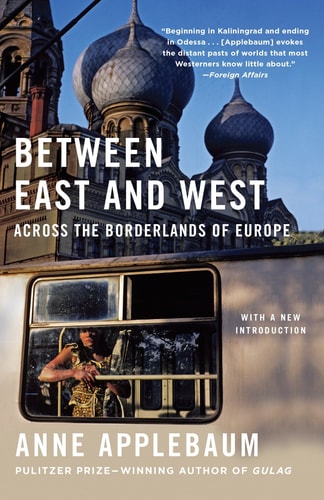
Between East and West Across the Borderlands of Europe

Anne Applebaum
In the summer and fall of 1991, Anne Applebaum, Pulitzer Prize-winning author of Gulag and Iron Curtain , took a three month road trip through the freshly independent borderlands of Eastern Europe. She deftly weaves the harrowing history of the region and captures the effects of political upheaval on a personal level. An extraordinary journey into the past and present of the lands east of Poland and west of Russia—an area defined throughout its history by colliding empires. Traveling from the former Soviet naval center of Kaliningrad on the Baltic to the Black Sea port of Odessa, Anne Applebaum encounters a rich range of competing cultures, religions, and national aspirations. In reasserting their heritage, the inhabitants of the borderlands attempt to build a future grounded in their fractured ancestral legacies. In the process, neighbors unearth old conflicts, devote themselves to recovering lost culture, and piece together competing legends to create a new tradition. Rich in surprising encounters and vivid characters, Between East and West brilliantly illuminates the soul of the borderlands and the shaping power of the past.
National Geographic Books 2017-06-13 336 pages

Highcastle A Remembrance

Stanisław Lem
Stanislaw Lem's Highcastle is at once a remembrance and a meditation. Even as Lem gives an account of his childhood in Lvov in the years between the two world wars, he ponders the nature of memory, innocence, and the imagination. His recollections of growing up the son of a bourgeois doctor at Number 4 Brajerska Street are stunningly evocative, re-creating with acuity a boy's perception of the world around him: his gossipy French tutor; the magical window of Zalewski's Confectionery; his father's anatomy books and carefully hidden French pornography; a trip to Klaften's Toy Shop; an aborted visit to a tattooed lady at the Eastern Fair; the trams, organ grinders, and halvah stands of Lvov.
Harcourt, Brace 1995 146 pages

ESSAYS OF MICHEL DE MONTAIGNE

MONTAIGNE, MICHEL DE
Essays of Michel de Montaigne, Volumes 2 and 3 Translated by Charles Cotton and edited by William Carew Hazlitt, these volumes of Michel de Montaigne's Essays delve into the human condition through a variety of thought-provoking topics. Volume 2 includes essays on subjects such as sorrow, idleness, and the nature of our affections. Volume 3 explores themes including the force of imagination, the punishment of cowardice, and the philosophical inquiry into death. Each essay offers a unique perspective on human nature, often drawing from Montaigne's personal reflections and classical sources.
Independently published 2024-06-16 115 pages

Historic Heston

Blumenthal, Heston
British gastronomy has a grand old tradition that has been lost over time. Now England's most inventive chef is out to reclaim it. Heston Blumenthal, whose name is synonymous with cutting-edge cuisine, nonetheless finds his greatest source of inspiration in the unique and delicious food that the sceptered isle once produced. This has been the secret to his success at world-famous restaurants The Fat Duck and Dinner, where a contrast between old and new, modern and historic, is key. Historic Heston charts a quest for identity through the best of British cooking that stretches from medieval to late-Victorian recipes. Start with thirty historic dishes, take them apart, put them together again, and what have you got? A sublime twenty-firstcentury take on delicacies including meat fruit (1500), quaking pudding (1660), and mockturtle soup (1892). Heston examines the history behind each one's invention and the science that makes it work. He puts these dishes in their social context and follows obscure culinary trails, ferreting out such curious sources as The Queen-like Closet from 1672 (which offers an excellent method for drying goose). What it adds up to is an idiosyncratic culinary history of Britain. This glorious tome also gives a unique insight into the way that Heston works, with signature dishes from both The Fat Duck and Dinner. Illustrated by Dave McKean and with some of the most superb food photography you'll ever see, Historic Heston is a book to treasure. You think you know about British cooking? Think again.
Bloomsbury USA 2014-10-14 432 pages

Jean-Paul Sartre and the Jewish Question Anti-Antisemitism & the Politics of the French Intellectual

Jonathan Judaken
Jean-Paul Sartre and the Jewish Question examines the image of "the Jew" in Sartre's work to rethink not only his oeuvre but also the role of the intellectual in France and the politics and ethics of existentialism. It explores more broadly how French identity is defined through the abstraction and allegorization of "the Jew" and examines the role anti-antisemitic intellectuals play in this process. Jonathan Judaken reconsiders the origins of the intellectual in France in the context of the Dreyfus affair and Sartre's interventions in the parallel Franco-French conflicts in the 1930s and during the Vichy regime. He considers what it was possible to say on behalf of Jews and Judaism during the German occupation, Sartre's contribution after the war to the Vichy syndrome, his positions on the Arab-Israeli conflict, and the ways Sartre's reflections on the Jewish Question served as a template for his shift toward Marxism, his resistance to colonialism, and for the defining of debates about Jews and Judaism in postwar France by both Jewish and non-Jewish intellectuals. Judaken analyzes the texts that Sartre devoted to these issues and argues that "the Jew" constituted a foil Sartre consistently referenced in reflecting on politics in general and on the role of the intellectual in particular.
University of Nebraska Press 2009-04-17 408 pages

Language, Nation and State Identity Politics in a Multilingual Age

T. Judt,D. Lacorne
This edited collection examines the role that language has played in forming modern European nations. With language an omnipresent issue within the European Union, the importance languages have played within the histories and present situations of member nations is a crucial topic. Drawing on an international cast of contributors, the book explores the issues of monolingualism vs. plurilingualism within individual nations, the revival of languages in nations such as former soviet republics, and concludes with a look at language in the electronic age.
Palgrave Macmillan US 2004-12-16 249 pages

Double Agent The Critic and Society

Morris Dickstein
Double Agent is a watershed in the recent revival of interest in the role of the public critic and intellectual who writes about culture, politics, and the arts for an intelligent general audience. Offering acute portraits of critics both famous and neglected, Dickstein traces the evolution of cultural criticism over the last century from Matthew Arnold to New Historicism. He examines the development of practical criticism, the rise and fall of literary journalism, and the growth of American Studies, and rereads the work of critics like Arnold, Walter Pater, I.A. Richards, Roland Barthes, Edmund Wilson, R.P. Blackmur, Lionel Trilling, Alfred Kazin, and George Orwell. In essays and books that are themselves works of literature, these writers made criticism central to the public sphere, balancing social and literary values, politic commitment and aesthetic judgment. Though marginalized or ignored by academic histories of criticism, their example has proved immensely valuable for younger critics eager to find a personal voice and reach a wider public. Dickstein concludes with a lively and provocative dialogue that weighs the claims of recent literary theory and the importance of renewing public culture.
Oxford University Press 1996-07 244 pages

Montesquieu and Rousseau Forerunners of Sociology

Emile. Durkheim
Montesquieu & Rousseau provides, for the first time in English, two essays by Emile Durkheim on his chief eighteenth-century predecessors in the main stream of Western thought.Durkheim recognized that Montesquieu had laid down the principles of sociology long before that young science had a name and that Rousseau, too, spoke as a sociologist in The Social Contract. With his characteristic blend of reason and fervor, he enlarged upon these forerunners to create the fundamental ideas of modern sociology.The essays are valuable for what they tell us of Montesquieu and Rousseau. They are doubly important to readers who are directly concerned with political philosophy and social science. And, as Henri Peyre points out in the Foreword, they are an example of how the best minds of any age can serve each other.
University of Michigan Press 2016-10-30 174 pages

The Rise of European Liberalism An Essay in Interpretation

Harold Joseph Laski
This Book, A Classic By One Of The Outstanding Political Scientists Of The Twentieth Century Seeks To Take Account Of The Factors Through Which Liberalism, The Guiding Doctrine Of Western Civilization Emerged As A New Ideology To Meet The Needs Of A New World In Which Status Was Replaced By Contract As The Judicial Foundation Of Society, Science Began To Replace Religion As The Controlling Factor In Giving Shape To The Ideas Of Humanity.Liberalism Was Synonymous Of Freedom Since It Emerged As The Foe Of Privilege Conferred By Virtue Of Birth Or Creed. However, The Freedom It Sought Had No Universality, Since Its Practice Was Limited To Men Who Had Property To Defend. Liberalism Tried To Discover A System Of Fundamental Rights, Which The State Is Not Entitled To Invade; However, It Turned Out To Be More Urgent And More Ingenious In Exerting Them To Defend The Interests Of Property Than To Protect The Interest Of Propertyless. As Soon As It Sought To Effect Fundamental Transformation Of Institutions Whose Habits It Was Supposed To Inform, It Found That It Was The Prisoner Of The End, It Was Destined To Serve. Soon The Liberal Spirit Was Vandalized And What Ensued Was War And Devastation, Ironically In The Name Of Saving That Very Spirit.Although Written In 1936, This Work Appears Equally Relevant Today As It Helps To Understand The Difficulties Of Our Time.
Aakar Books 2005 234 pages

Simon Wiesenthal

Tom Segev
This first fully documented biography of Simon Wiesenthal, the legendary Nazi hunter, is also a brilliant character study of a man whose life was part invention but wholly dedicated to ensuring both that the Nazis be held responsible for their crimes and that the destruction of European Jewry never be forgotten. Like most Jews in Eastern Europe on the eve of Hitler's invasion of Poland, twenty-four-year-old Simon Wiesenthal did not grasp the nature of the Nazi threat. But six years later, when a skeletal Wiesenthal was liberated from the concentration camp at Mauthausen, he fully fathomed the crimes of the Nazis. Within days he had assembled a list of nearly 150 Nazi war criminals, the first of dozens of such lists he would make over a lifetime as a Nazi hunter. A hero in the eyes of many, Wiesenthal was also attacked for his unrelenting pursuit of the past, when others preferred to forget. For this new biography, rich in newsworthy revelations, historian and journalist Tom Segev has obtained access to Wiesenthal's private papers and to sixteen archives, including records of the U.S., Israeli, Polish, and East German secret services. Segev is able to reveal the intriguing secrets of Wiesenthal's life, including his stunning role in the capture of Adolf Eichmann, his relationship with Israel's Mossad, his controversial investigative techniques, his unlikely friendships with Kurt Waldheim and Albert Speer, and the nature of his rivalry with Elie Wiesel. Segev's challenge in writing this biography was Wiesenthal's own complicated relationship to truth. Wiesenthal told many versions of his life, his suffering in the camps, and his involvement with the arrest of individual Nazis. Segev shows that in order to gain the information he sought and twist the arms of reluctant government figures, Wiesenthal needed to seem more influential than he really was. For two generations of Americans, Simon Wiesenthal was a Jewish superhero--depicted on film by Ben Kingsley and Laurence Olivier--and the muse for a Frederick Forsyth thriller. Now Segev demonstrates that the truth of Wiesenthal's existence is as compelling as the fiction. "Simon Wiesenthal" is an unforgettable life of one of the great men of the twentieth century.
Jonathan Cape Ltd 2010-09 480 pages

Jubilee

Jarman, Derek
Faith in the establishment collapsing everywhere. The far right on the march. Culture wars and random violence – all decked out in red, white and blue. But a spirit of anarchy hangs in the air, the desire to burn it all down and start over. Derek Jarman's iconic film captured punk at its giddy height: a riot of music, DIY fashion, and every kind of sex – with a little pyromania thrown in. Forty years on, this new stage adaptation of Jubilee remixes it for the social and political turmoil of 2017. The cast of the original production at the Royal Exchange Manchester was led by one of the film's original cast members, legendary punk warrior Toyah Willcox. Centred around a marauding girl gang on a killing spree and a time-travelling Queen Elizabeth I, it's a story of what happens when creativity and nihilism collide.
[distributor] Marston Book Services Ltd 2017-11-02 96 pages

Der Wahn und Die Träume in W. Jensens 'Gradiva'

Sigmund Freud
This work has been selected by scholars as being culturally important, and is part of the knowledge base of civilization as we know it. This work is in the "public domain in the United States of America, and possibly other nations. Within the United States, you may freely copy and distribute this work, as no entity (individual or corporate) has a copyright on the body of the work. Scholars believe, and we concur, that this work is important enough to be preserved, reproduced, and made generally available to the public. We appreciate your support of the preservation process, and thank you for being an important part of keeping this knowledge alive and relevant.
Creative Media Partners, LLC 2022-10-27 86 pages

Memoir in Two Voices

François Mitterrand,Elie Wiesel
Near the end of his second term as president of France, Francois Mitterrand decided to talk openly about his life, both personal and political. President for fourteen years, longer than anyone else in the history of the French Republic, Mitterrand was interested not in constructing an elaborate memorial to himself in words but in leaving behind a living testament. He therefore turned to someone whom he knew and trusted, Nobel laureate Elie Wiesel, a close friend of many years, to join him in a vibrant, vigorous exchange. The topics they discuss in these pages are childhood, faith, war, power, writing, and those moments - however and whenever they arrive - that shape and sometimes define us as people. Mitterrand and Wiesel's dialogue is spontaneous, thoughtful, lyrical, blunt, far-reaching, and candid, whether it involves controversial moments in Mitterrand's political career, Wiesel's memories of Auschwitz, the importance of family and religion in their lives, or simply their favorite books and walks. Here is an unobstructed view into the lives and times of two of the greatest figures of conscience of our century, an inspiring memoir in two voices.
Arcade Pub. 1996 177 pages

Creating Social Trust in Post-Socialist Transition

J. Kornai,B. Rothstein,S. Rose-Ackerman
Beneficial social and economic exchange relies on a certain level of trust. But trust is a delicate matter, not least in the former socialist countries where illegitimate behaviour by governments made distrust a habit. The chapters in this volume analyze the causes and the effects of the lack of social trust in post-socialist countries. The contributions originated in the Collegium Budapest project on Honesty and Trust: Theory and Experience in the Light of the Post-Socialist Transition. A second volume entitled, Building a Trustworthy State in Post-Socialist Transition , is being published simultaneously.
Palgrave Macmillan 2015-12-23 252 pages