
5 results for "Science"

The beginning of infinity: explanations that transform the world

Deutsch, David
"A bold and all-embracing exploration of the nature and progress of knowledge from one of today's great thinkers. Throughout history, mankind has struggled to understand life's mysteries, from the mundane to the seemingly miraculous. In this important new book, David Deutsch, an award-winning pioneer in the field of quantum computation, argues that explanations have a fundamental place in the universe. They have unlimited scope and power to cause change, and the quest to improve them is the basic regulating principle not only of science but of all successful human endeavor. This stream of ever improving explanations has infinite reach, according to Deutsch: we are subject only to the laws of physics, and they impose no upper boundary to what we can eventually understand, control, and achieve. In his previous book, The Fabric of Reality, Deutsch describe the four deepest strands of existing knowledge-the theories of evolution, quantum physics, knowledge, and computation-arguing jointly they reveal a unified fabric of reality. In this new book, he applies that worldview to a wide range of issues and unsolved problems, from creativity and free will to the origin and future of the human species. Filled with startling new conclusions about human choice, optimism, scientific explanation, and the evolution of culture, The Beginning of Infinity is a groundbreaking book that will become a classic of its kind"--
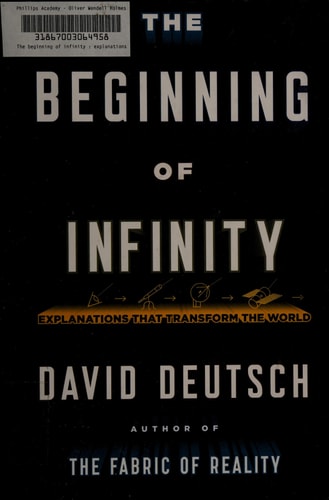
Viking 2011 487 pages

Inference to the best explanation

Lipton, Peter
How do we go about weighing evidence, testing hypotheses, and making inferences? According to the model of Inference to the Best Explanation, we work out what to infer from the evidence by thinking about what would actually explain that evidence, and we take the ability of a hypothesis to explain the evidence as a sign that the hypothesis is correct. In Inference to the Best Explanation, Peter Lipton gives this important and influential idea the development and assessment it deserves. The second edition has been substantially enlarged and reworked, with a new chapter on the relationship between explanation and Bayesianism, and an extension and defence of the account of contrastive explanation. It also includes an expanded defence of the claims that our inferences really are guided by diverse explanatory considerations, and that this pattern of inference can take us towards the truth. This edition of Inference to the Best Explanation has also been updated throughout and includes a new bibliography.
Routledge/Taylor and Francis Group 2004 219 pages

Explaining explanation

Ruben, David-Hillel
In Explaining Explanation, David-Hillel Ruben provides a nontechnical discussion of some of the main historical attempts to explain the concept of explanation, examining the works of Plato, Aristotle, John Stuart Mill, and Carl Hempel. Building on and developing the insights of these historical figures, he concludes with his own original and challenging view of explanation. He relates the concept of explanation to both epistemological and metaphysical issues. Not content to confine the concept to the realm of the philosophy of science, Ruben examines it within a far more broadly conceived theory of knowledge. This second edition of the influential and highly acclaimed book on the philosophy of explanation has been revised and expanded, and the author has made substantial changes in light of the extensive reviews the first edition received. Book jacket.
Paradigm Publishers 2012 246 pages

Explanation

Ruben, David-Hillel
The aim of this series is to bring together important recent writings in major areas of philosophical inquiry, selected from a variety of sources, mostly periodicals, which may not be conveniently available to the university student or the general reader. The editor of each volume contributes an introductory essay on the items chosen and on the questions with which they deal. A selective bibliography is appended as a guide to further reading. This volume presents a selection of the most important recent writings on the nature of explanation. It covers a broad range of topics from the philosophy of science to the central philosophical terrain of the theory of knowledge. The distinguished contributors include Peter Achinstein, Wesley C. Salmon, Carl G. Hempel, Philip Kitcher, Bas C. van Fraassen, Jaegwon Kim, B. Brody, Timothy McCarthy, Peter Railton, David Lewis, Peter Lipton, James Woodward, and Robert J. Matthews.
Oxf. U. P. 1993 363 pages