32 results for "Science"

The Revolution was Televised From Buffy to Breaking Bad - the People and the Shows that Changed TV Drama Forever

Alan Sepinwall
In The Revolution Was Televised, celebrated TV critic Alan Sepinwall chronicles the remarkable transformation of the small screen over the past fifteen years. Focusing on twelve innovative television dramas that changed the medium and the culture at large forever, including The Sopranos, Oz, The Wire, Deadwood, The Shield, Lost, Buffy the Vampire Slayer, 24, Battlestar Galactica, Friday Night Lights, Mad Men, and Breaking Bad, Sepinwall weaves his trademark incisive criticism with highly entertaining reporting about the real-life characters and conflicts behind the scenes. Drawing on interviews with writers David Chase, David Simon, David Milch, Damon Lindelof and Carlton Cuse, and Vince Gilligan, among others, along with the network executives responsible for green-lighting these fresh shows, The Revolution Was Televised is the story of how a new golden age was born, one that's as rich with drama and thrills as the very shows themselves.
Black Incorporated 2013 388 pages

The Panic Virus Fear, Myth and the Vaccination Debate

Seth Mnookin
In 1998 Andrew Wakefield published a paper containing a shocking allegation- the measles-mumps-rubella vaccine might cause autism. Wakefield based his findings on a study of just a dozen children, and his methods and conclusions immediately came under fire. The media, however, seized on the story - and so helped launch one of the most devastating health scares of modern times. Within months, vaccination rates across the West had started to fall, resulting in deaths from diseases previously thought to be disappearing. Wakefield eventually lost his medical licence, yet the myth that vaccines cause developmental disorders lives on. In The Panic Virus Seth Mnookin examines how the anti-immunisation panic spread and looks at a controversial Australian case that exposed the claims and tactics of the movement to new scrutiny. Sorting fact from rumour, he confronts fundamental questions- with more facts at our fingertips than ever, why is our trust in science so fragile? Has the internet made us better informed, or simply enabled panic to spread more quickly? And how might we balance fact and intuition when it comes to decisions about children's health? The Panic Virus is a riveting and sometimes heartbreaking medical detective story, a gripping work of investigative journalism and a cautionary tale for our times.
Black Incorporated 2011 425 pages

The Good Girls Revolt How the Women of Newsweek Sued their Bosses and Changed the Workplace

Lynn Povich
It was the 1960s--a time of economic boom and social strife. Young women poured into the workplace, but the "Help Wanted" ads were segregated by gender and the "Mad Men" office culture was rife with sexual stereotyping and discrimination. Lynn Povich was one of the lucky ones, landing a job at Newsweek , renowned for its cutting-edge coverage of civil rights and the "Swinging Sixties." Nora Ephron, Jane Bryant Quinn, Ellen Goodman, and Susan Brownmiller all started there as well. It was a top-notch job--for a girl--at an exciting place. But it was a dead end. Women researchers sometimes became reporters, rarely writers, and never editors. Any aspiring female journalist was told, "If you want to be a writer, go somewhere else." On March 16, 1970, the day Newsweek published a cover story on the fledgling feminist movement entitled "Women in Revolt," forty-six Newsweek women charged the magazine with discrimination in hiring and promotion. It was the first female class action lawsuit--the first by women journalists--and it inspired other women in the media to quickly follow suit. Lynn Povich was one of the ringleaders. In The Good Girls Revolt , she evocatively tells the story of this dramatic turning point through the lives of several participants. With warmth, humor, and perspective, she shows how personal experiences and cultural shifts led a group of well-mannered, largely apolitical women, raised in the 1940s and 1950s, to challenge their bosses--and what happened after they did. For many, filing the suit was a radicalizing act that empowered them to "find themselves" and fight back. Others lost their way amid opportunities, pressures, discouragements, and hostilities they weren't prepared to navigate. The Good Girls Revolt also explores why changes in the law didn't solve everything. Through the lives of young female journalists at Newsweek today, Lynn Povich shows what has--and hasn't--changed in the workplace.
PublicAffairs 2016-09-27 304 pages

Arrogance Rescuing America from the Media Elite

Bernard Goldberg
In his #1 New York Times bestseller, Bias, Emmy Award-winning journalist Bernard Goldberg created a national firestorm when he exposed the liberal biases of the so-called mainstream media. Now Goldberg takes on Big Journalism and punctures the bubble in which the media elites live and work-a culture of denial where contrary views are not welcome. With blistering wit and passion, Goldberg offers a twelve-step program to help journalists overcome their addiction to slanted news and exposes the main culprits of arrogance in the media. He reveals: How the media's coverage of the Jayson Blair scandal missed far more serious problems at the New York Times, Why the media refuse to shoot straight when the subject turns to guns, Which CBS News icon is "transparently liberal," according to commentator Andy Rooney, Why some think the top journalism school in America is an intellectual gulag, How some journalists, like Bob Costas and Tim Russert, do get it-and how they think American journalism can be made better. Book jacket.
Thorndike Press 2004 496 pages

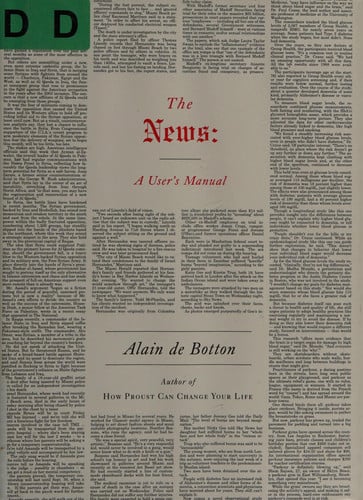
The News A User's Manual

Alain De Botton
From the author of The Architecture of Happiness , a thought-provoking look at the position that news has achieved in our lives. The news is everywhere. We can't stop constantly checking it on our computer screens, but what is this doing to our minds? We are never really taught how to make sense of the torrent of news we face every day, writes Alain de Botton, but this has a huge impact on our sense of what matters and of how we should lead our lives. In his dazzling new book, de Botton takes twenty-five archetypal news stories--including an airplane crash, a murder, a celebrity interview and a political scandal--and submits them to unusually intense analysis with a view to helping us navigate our news-soaked age. He raises such questions as: Why are disaster stories often so uplifting? What makes the love lives of celebrities so interesting? Why do we enjoy watching politicians being brought down? Why are upheavals in far-off lands often so boring? In The News: A User's Manual , de Botton has written the ultimate guide for our frenzied era, certain to bring calm, understanding and a measure of sanity to our daily (perhaps even hourly) interactions with the news machine.
McClelland & Stewart 2014-12-02 272 pages

The Opposite of Hate A Field Guide to Repairing Our Humanity

Sally Kohn
“Brilliantly illustrates the immense and disarming power of changing course and driving not toward division, but toward civility and mutual respect.” -- Ms . magazine As a progressive commentator on Fox News and now CNN, Sally Kohn has made a career out of bridging intractable political differences. In this age of dangerous partisan resentment and rising bigotry, she decided to investigate hate itself--to better consider how we can stop it. With her trademark humor and humanity, Kohn introduces us to leading researchers and scientists who are exploring the evolutionary and cultural roots of hate. She travels to Rwanda, to the Middle East, and across the United States, talking with former terrorists and reformed white supremacists, and even sitting down with some of her own Twitter trolls. What she discovers is surprising: All of us harbor hate but the powerful acknowledgment that we are all in this together can lead us out of the wilderness. The opposite of hate is connection .
Algonquin Books 2019-03-26 272 pages

Microtrends The Small Forces Behind Tomorrow's Big Changes

Mark Penn
The adviser to Senator Hillary Clinton, Bill Gates, and President Bill Clinton proves that small is big by identifying 75 hidden-in-plain-sight trends that are moving America, revealing that the nation is no longer a melting pot but a collection of communities with many individual tastes and lifestyles. "The ideas in his book will help you see the world in a new way." --Bill Clinton "Mark Penn has a keen mind and a fascinating sense of what makes America tick, and you see it on every page of Microtrends ." --Bill Gates In 1982, readers discovered Megatrends . In 2000, The Tipping Point entered the lexicon. Now, in Microtrends , one of the most respected and sought-after analysts in the world articulates a new way of understanding how we live. Mark Penn, the man who identified "Soccer Moms" as a crucial constituency in President Clinton's 1996 reelection campaign, is known for his ability to detect relatively small patterns of behavior in our culture-microtrends that are wielding great influence on business, politics, and our personal lives. Only one percent of the public, or three million people, is enough to launch a business or social movement. Relying on some of the best data available, Penn identifies more than 70 microtrends in religion, leisure, politics, and family life that are changing the way we live. Among them: People are retiring but continuing to work. Teens are turning to knitting. Geeks are becoming the most sociable people around. Women are driving technology. Dads are older than ever and spending more time with their kids than in the past. You have to look at and interpret data to know what's going on, and that conventional wisdom is almost always wrong and outdated. The nation is no longer a melting pot. We are a collection of communities with many individual tastes and lifestyles. Those who recognize these emerging groups will prosper. Penn shows readers how to identify the microtrends that can transform a business enterprise, tip an election, spark a movement, or change your life. In today's world, small groups can have the biggest impact.
Grand Central Publishing 2007-09 448 pages

How to Become a Scandal Adventures in Bad Behavior

Laura Kipnis
A New York Times Book Review Editors' Choice We all relish a good scandal. Why do people feel compelled to act out their tangled psychodramas on the national stage, and why do we so enjoy watching them? The motifs are classic—revenge, betrayal, ambition, madness—though the pitfalls are ones we all negotiate daily. After all, every one of us is a potential scandal in the making: failed self-knowledge and colossal self-deception—the necessary ingredients—are our collective plight. How to Become a Scandal is "an extremely smart, funny, acid, and beautifully written meditation on a scary truth that we all try desperately to ignore" (David Shields, author of Reality Hunger: A Manifesto ).
Picador 2011-08-30 224 pages

The Glass Teat Essays

Harlan Ellison
The classic collection of criticism about television and American culture from the late, multi-award-winning legend. From 1968 through 1972, Harlan Ellison penned a series of weekly columns, sharing his uncompromising thoughts about contemporary television programming for the Los Angeles Free Press , a.k.a. "The Freep," a countercultural, underground newspaper. Sitcoms and variety shows, westerns and cop dramas, newscasts and commercials, Ellison left no pixilated stone unturned, expounding on the insipidness, hypocrisy, and malaise found in the glowing images projected into the faces of American audiences. The Glass Teat: Essays of Opinion on the Subject of Television collects fifty-two of Ellison's columns--including his 2011 introduction "Welcome to the Gulag," his unapologetic commentary about how cellphones and the internet have extended television's reach, eroding intelligence and freedom and creating a legion of bloodshot eyed zombies unable to communicate beyond their screens or think for themselves. Provocative and prescient, irreverent and insightful, Ellison's critical analyses of the glowing box that became the center of American life are even more relevant in the twenty-first century. Also available: The Other Glass Teat: Further Essays of Opinion on the Subject of Television
Open Road Integrated Media, Incorporated 2014-06 276 pages

Gossip The Untrivial Pursuit

Joseph Epstein
Gossip is no trivial matter; despite its reputation, Epstein argues, it is an eternal and necessary human enterprise. Proving that he himself is a master of the art, Epstein serves up delightful mini-biographies of the Great Gossips of the Western World, along with many choice bits from his own experience. He also makes a powerful case that gossip has morphed from its old-fashioned best--clever, mocking, a great private pleasure--to a corrosive new-school version, thanks to the reach of the mass media and the Internet. Written in his trademark erudite and witty style, Gossip captures the complexity of this immensely entertaining subject.
HarperCollins Publishers 2012-11 256 pages

False Alarm The Truth about the Epidemic of Fear

Marc Siegel
More relevant than ever as the Coronavirus, COVID-19 pandemic sweeps the globe, False Alarm (Originally released in 2008) reminds readers to look closely at the facts as the media covers the national pandemic news and spread of the virus, as well as reinforces the notion that we must arm ourselves against fear tactics that inhibit our abilities to properly make decisions in a world of uncertainty. Life today for citizens of the developed world is safer, easier, and healthier than for any other people in history thanks to modern medicine, science, technology, and intelligence. So why is an epidemic of fear sweeping America? The answer, according to nationally renowned health commentator Dr. Marc Siegel, is that we live in an artificially created culture of fear. In False Alarm , Siegel identifies three major catalysts of the culture of fear-government, the media, and big pharma. With fascinating, blow-by-blow analyses of the most sensational false alarms of the past few years, he shows how these fearmongers manipulate our most primitive instincts--often without our even realizing it. False Alarm shows us how to look behind the hype and hysteria, inoculate ourselves against fear tactics, and develop the emotional and intellectual skills needed to take back our lives.
John Wiley & Sons Canada, Limited 2006-09 258 pages

All new people

Braff, Zach
"All New People" is a slick, lively and contemporary comedy written by award-winning screenwriter and well-known actor Zach Braff. The dead of winter, Long Beach Island, New Jersey, Charlie, has hit rock bottom. Away from the rest of the world, this perfect escape is interrupted by a motley parade of misfits who show up and change his plans. A hired beauty, a fireman, and an eccentric British real estate agent desperately trying to stay in the country all suddenly find themselves tangled together in a beach house where the mood is anything but sunny. This pithy piece portrays a scenario of attempted suicide with mordant humour, where a basis of social alienation leads to unexpected connections. The richly-drawn characters are quick-witted and narcissistic yet self-aware and the dialogue is fluid and witty. "All New People" is centred around a clever concept which works as a catalyst for both angst-fuelled scrutiny and morbid humour.
Dramatists Play Service Inc 2012 43 pages

The Hunting of the President The Ten-Year Campaign to Destroy Bill and Hillary Clinton

Joe Conason,Gene Lyons
When Hillary Clinton spoke of "a vast right-wing conspiracy" determined to bring down the president, many people dismissed the idea. Yet if the first lady's accusation was exaggerated, the facts that have since emerged point toward a covert and often concerted effort by Bill Clinton's enemies--abetted by his own reckless behavior--which led inexorably to impeachment. Clinton's foes launched a cascade of well-financed attacks that undermined American democracy and nearly destroyed the Clinton presidency. In vivid prose, Joe Conason and Gene Lyons, two award-winning veteran journalists, identify the antagonists, reveal their tactics, trace the millions of dollars that subsidized them, and examine how and why mainstream news organizations aided those who were determined to bring down Bill Clinton, The Hunting of the President may very well be the All the President's Men of this political regime.
Macmillan 2001-02-03 413 pages

The app generation: how today's youth navigate identity, intimacy, and imagination in a digital world

Gardner, Howard
"No one has failed to notice that the current generation of youth is deeply-some would say totally-involved with digital media. Professors Howard Gardner and Katie Davis name today's young people The App Generation, and in this spellbinding book they explore what it means to be "app-dependent" versus "app-enabled" and how life for this generation differs from life before the digital era. Gardner and Davis are concerned with three vital areas of adolescent life: identity, intimacy, and imagination. Through innovative research, including interviews of young people, focus groups of those who work with them, and a unique comparison of youthful artistic productions before and after the digital revolution, the authors uncover the drawbacks of apps: they may foreclose a sense of identity, encourage superficial relations with others, and stunt creative imagination. On the other hand, the benefits of apps are equally striking: they can promote a strong sense of identity, allow deep relationships, and stimulate creativity. The challenge is to venture beyond the ways that apps are designed to be used, Gardner and Davis conclude, and they suggest how the power of apps can be a springboard to greater creativity and higher aspirations"--
Yale University Press 2013-10-22 244 pages

Philosophical Essays From Ancient Creed to Technological Man

Hans Jonas
Philosophical Essays is a pivotal volume in the collected works of Hans Jonas (1903-1993), one of most important German-American philosophers of the last half of the 20th century. Of the four books published in English during his lifetime, it is the only one to include contributions from his three primary areas of achievement: philosophical reflection on gnosticism, on biology, and on technology - hence the subtitle, "From Ancient Creed to Technological Man." The three sections of the book are, however, given in reverse order with essays on "Science, Technology, and Ethics" preceding papers on "Organism, Mind, and History" and "Religious Thought of the First Christian Centuries." The temporally ultimate project is that which Jonas sees as having philosophical priority. This collection of 18 essays originally published between 1965 and 1974 - that is, after completion of The Phenomenon of Life (1966) but before The Imperative of Responsibility (1984) - manifests the most intensive integration of Jonas's three projects. As such, this volume provides special witness to the inherent unity of what might otherwise be seen as more episodic work. In the Introduction Jonas himself argues for both a biographical and a philosophical unity, the latter of which is emphasized in a new foreword by Carl Mitcham of the European Graduate School.
Atropos Press 2010-12 384 pages

Don't Burn Anyone at the Stake Today

Alderman, Naomi
What’s the most useful thing you could know about your own life? In this era-defining book, developed from her groundbreaking Radio 4 essay series, Naomi Alderman turns her boundless curiosity and incisive thinking to a question that affects us all: how do we understand, and navigate, the epoch we’re living through? She calls this epoch the Information Crisis. The internet has flooded us with more knowledge, opinions, ideas, opportunities, as well as verbal attacks and misinformation, than ever before. It lets us learn more quickly and also spread falsehood more quickly, it brings us together and also divides us in new ways, it is now the lens through which we perceive and understand the world. There is no going back. But we have been here before. In fact, this is humanity’s third information crisis. The first, the invention of writing 5,000 years ago, and the second, the invention of the printing press 600 years ago, drastically reshaped our perceptions, interactions and mental landscapes in ways that feel acutely familiar. Overwhelmed by information, people become afraid and angry, unsettled and distressed, as well as more knowledgeable, educated and curious. By looking at those previous information crises, both the turmoil and the advances, Alderman asks what we can learn from the past to better understand our present, and prepare for our future. Drawing on the work of philosophers and historians, Don’t Burn Anyone at the Stake Today explores how new technology opens up new ways of being and helps us chart a way forward (once again), through the turbulent seas of information overload.[Bokinfo]
Penguin 2026-05-07 224 pages