15 results for "Science"

Uncivil Wars The Controversy Over Reparations for Slavery

David Horowitz
The idea that taxpayers should pay reparations to African Americans for the damages of slavery and segregation is quickly becoming a central demand of some civil rights leaders. It has the backing of important black politicians like Rep. John Conyers (D-Mich), distinguished black intellectuals like Henry Louis Gates and activists like Randall Robinson, who led the successful boycott movement against South Africa a decade ago. The Chicago City Council has overwhelmingly endorsed the concept and municipalities and state governments around the country are considering giving it support. In this well researched and carefully argued book, David Horowitz traces the origins of the reparations movement. He examines the case made by its advocates and concludes that it is "morally questionable and racially incendiary." He notes that only a tiny minority of Americans ever owned slaves; and most Americans living today (white and otherwise) are descended from post-Civil War immigrants who have no lineal connection to slavery at all. More intriguingly, he also points out that the GNP of black America is so large that it makes the African American community the tenth most prosperous "nation" in the world. But this book is more than just an in depth casebook on the hot button issue of reparations. In the hope of initiating a dialogue, Horowitz originally presented a summary of his ideas on this subject in the form of an advertisement that appeared in several college newspapers and was rejected by many more. Editorialists in America's leading papers and several chapters of the American Civil Liberties Union weighed on Horowitz's side. With the assistance of Richard Poe, Horowitz uses the response to the reparations issue to show how the new racial orthodoxy collides with the free speech battle and what its implications are for American education and culture.
Encounter Books 2003-04 139 pages

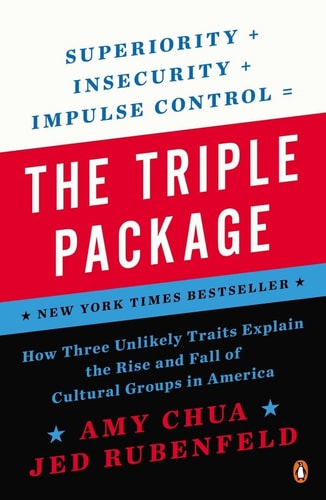
The Triple Package How Three Unlikely Traits Explain the Rise and Fall of Cultural Groups in America

Amy Chua,Jed Rubenfeld
"That certain groups do much better in America than others — as measured by income, occupational status, test scores, and so on — is difficult to talk about. In large part this is because the topic feels racially charged. The irony is that the facts actually debunk racial stereotypes. There are black and Hispanic subgroups in the United States far outperforming many white and Asian subgroups. Moreover, there’s a demonstrable arc to group success — in immigrant groups, it typically dissipates by the third generation — puncturing the notion of innate group differences and undermining the whole concept of 'model minorities.'" Mormons have recently risen to astonishing business success. Cubans in Miami climbed from poverty to prosperity in a generation. Nigerians earn doctorates at stunningly high rates. Indian and Chinese Americans have much higher incomes than other Americans; Jews may have the highest of all. Why do some groups rise? Drawing on groundbreaking original research and startling statistics, The Triple Package uncovers the secret to their success. A superiority complex, insecurity, impulse control—these are the elements of the Triple Package, the rare and potent cultural constellation that drives disproportionate group success. The Triple Package is open to anyone. America itself was once a Triple Package culture. It’s been losing that edge for a long time now. Even as headlines proclaim the death of upward mobility in America, the truth is that the old-fashioned American Dream is very much alive—but some groups have a cultural edge, which enables them to take advantage of opportunity far more than others. • Americans are taught that everyone is equal, that no group is superior to another. But remarkably, all of America’s most successful groups believe (even if they don’t say so aloud) that they’re exceptional, chosen, superior in some way. • Americans are taught that self-esteem—feeling good about yourself—is the key to a successful life. But in all of America’s most successful groups, people tend to feel insecure, inadequate, that they have to prove themselves. • America today spreads a message of immediate gratification, living for the moment. But all of America’s most successful groups cultivate heightened discipline and impulse control. But the Triple Package has a dark underside too. Each of its elements carries distinctive pathologies; when taken to an extreme, they can have truly toxic effects. Should people strive for the Triple Package? Should America? Ultimately, the authors conclude that the Triple Package is a ladder that should be climbed and then kicked away, drawing on its power but breaking free from its constraints. Provocative and profound, The Triple Package will transform the way we think about success and achievement.
Penguin 2015-01-27 352 pages

The American Kaleidoscope Race, Ethnicity, and the Civic Culture

Lawrence H. Fuchs
A leading authority's panoramic history compares the experiences of immigrant-ethnic groups, African-Americans, and Native Americans to each other and in relation to the national political culture. Winner of the John Hope Franklin Prize (1991) Winner of the Theodore Saloutos Award from the Immigration History Society (1993) Do recent changes in American law and politics mean that our national motto — e pluribus unum — is at last becoming a reality? Lawrence H. Fuchs searches for answers to this question by examining the historical patterns of American ethnicity and the ways in which a national political culture has evolved to accommodate ethnic diversity. Fuchs looks first at white European immigrants, showing how most of them and especially their children became part of a unifying political culture. He also describes the ways in which systems of coercive pluralism kept persons of color from fully participating in the civic culture. He documents the dismantling of those systems and the emergence of a more inclusive and stronger civic culture in which voluntary pluralism flourishes. In comparing past patterns of ethnicity in America with those of today, Fuchs finds reasons for optimism. Diversity itself has become a unifying principle, and Americans now celebrate ethnicity. One encouraging result is the acculturation of recent immigrants from Third World countries. But Fuchs also examines the tough issues of racial and ethnic conflict and the problems of the ethno-underclass, the new outsiders. The American Kaleidoscope ends with a searching analysis of public policies that protect individual rights and enable ethnic diversity to prosper. Because of his lifelong involvement with issues of race relations and ethnicity, Lawrence H. Fuchs is singularly qualified to write on a grand scale about the interdependence in the United States of the unum and the pluribus. His book helps to clarify some difficult issues that policymakers will surely face in the future, such as those dealing with immigration, language, and affirmative action.
Wesleyan University Press 1990 618 pages

Las Christmas Favorite Latino Authors Share Their Holiday Memories

Esmeralda Santiago,Joie Davidow
Twenty-five celebrated Latino writers delight and move us with their recollections of Christmas in this splendid holiday extravaganza. From Julia Alvarez's tale of how Santicl� delivered a beloved uncle from political oppression to Junot D�az's story of his own uneasy assimilation on his first Christmas in America, to Sandra Cisneros's poignant memories of her late father's holiday dinners, Las Christmas gives us true stories from writers of many traditions--memories of Christmas and Hanukkah that vividly capture the pride and pain, joy and heartbreak, that so often accompany the holidays in the Americas. Richly illustrated and embellished with songs and poems, along with recipes for an unforgettable Christmas dinner--from traditional sweet tamales to Puerto Rican asopao (stew) and coquito (coconut eggnog)--this is an enduring treasury of Latino writing to read again and again. A heartwarming holiday gift.
Vintage Books 1999 198 pages

Fear in Chile: lives under Pinochet

Politzer Kerekes, Patricia
"Like a García Márquez novel that has suddenly, horrifyingly, come to real life" ( New York Newsday ), Fear in Chile is an extraordinary collection of firstperson accounts of life under dictatorship. In the 1980s, shortly after Chile emerged from one of the century's most notorious reigns of terror, Chilean journalist Patricia Politzer interviewed figures including a revolutionary activist, a military leader loyal to General Augusto Pinochet, a bank clerk concerned with the status quo, the mother of one of the "disappeared," as well as a dozen other men and women from every political position and social stratum of Chilean life. The result is a broad, vivid, yet nonideological view of modern life under military rule, about which Ariel Dorfman writes, "I can think of no better introduction to my country." With the October 1998 arrest of General Pinochet in Great Britain and renewed world awareness of the horrendous crimes committed during his regime, Fear in Chile , updated with a new afterword by the author that considers the recent attempts to prosecute Pinochet for human-rights violations, offers a vivid portrait of Chile's Pinochet era.
New Press 2001 254 pages

The Exile Cuba in the Heart of Miami

David Rieff
This is a fascinating portrait of Miami's Cuban population, the most successful group of immigrants to settle in the United States since the Jews of the nineteenth century. David Rieff has provided an engrossing look at a group exiled from its homeland, showing how America has affected these immigrants, and what it means to become an American in the late twentieth century.
Simon and Schuster 1994-08-31 224 pages

Politics in Black and White Race and Power in Los Angeles

Raphael Sonenshein
This book reaches deep into the past of the city of Los Angeles and carries through to the dramatic events that have recently received global attention--the Rodney King beating and the uprising in South Central L.A. Tracing the evolution of an extraordinary biracial coalition in Los Angeles behind Mayor Tom Bradley, Raphael Sonenshein shows how "crossover" politics and racial violence coexist in urban America. While challenging the prevailing pessimism about biracial coalitions in general, he also compares their relative successes in Los Angeles to their disheartening failures in New York City. What emerges is a probing look at a crucial issue of politics in the United States: can whites and minorities find common ground?
Princeton University Press 1993 301 pages

Of One Blood Abolitionism and the Origins of Racial Equality

Paul Goodman
The abolition movement is perhaps the most salient example of the struggle the United States has faced in its long and complex confrontation with the issue of race. In his final book, historian Paul Goodman, who died in 1995, presents a new and important interpretation of abolitionism. Goodman pays particular attention to the role that blacks played in the movement. In the half-century following the American Revolution, a sizable free black population emerged, the result of state-sponsored emancipation in the North and individual manumission in the slave states. At the same time, a white movement took shape, in the form of the American Colonization Society, that proposed to solve the slavery question by sending the emancipated blacks to Africa and making Liberia an American "colony." The resistance of northern free blacks was instrumental in exposing the racist ideology underlying colonization and inspiring early white abolitionists to attack slavery straight on. In a society suffused with racism, says Goodman, abolitionism stood apart by its embrace of racial equality as a Christian imperative. Goodman demonstrates that the abolitionist movement had a far broader social basis than was previously thought. Drawing on census and town records, his portraits of abolitionists reveal the many contributions of ordinary citizens, especially laborers and women long overshadowed by famous movement leaders. Paul Goodman's humane spirit informs these pages. His book is a scholarly legacy that will enrich the history of antebellum race and reform movements for years to come. "[God] hath made of one blood all nations of men for to dwell on all the face of the earth."—Acts 17:26
University of California Press 2000-11-02 324 pages

Race and other misadventures: essays in honor of Ashley Montagu in his ninetieth year

Larry T. Reynolds,Leonard Lieberman
About the Author Larry T. Reynolds is Professor of Sociology at Central Michigan University and Adjunct Professor at the University of West Florida. He is former Chair of the Marxist Section of the American Sociological Association, recipient of the first annual Charles Horton Cooley Award, and past president of the North Central Sociological Association. A Fellow of the Rockport Institute, he has published in such journals as Sociometry, Sociological Quarterly, Phylon, and Current Anthropology. Among his recent books are Interactionism: Exposition and Critique (1993); A Critique of Contemporary American Sociology (1993); and Symbolic Interactionism (1994). Leonard Liberman is Professor of Anthropology and Sociology at Central Michigan University. His areas of interest are physical anthropology, social psychology, and the sociology of science. He has published in Phylon, Human Organization, Current Anthropology, Anthropology and Education Quarterly, and the American Anthropologist, and he is the author of the forthcoming volume, Outrageous Concepts: Race, Genes, and Sociobiology.
General Hall 1996 424 pages

Jacob's Voices Reflections of a Wandering American Jew

Jerold S. Auerbach
An American professor of history finds his roots in a personal journey through Israel -- and through assimilated America, academia, baseball, and family -- headlong into deep tensions and ambivalence about country, culture, identity and religion. Worried about the commitment of Jews to their heritage, Jerold Auerbach (renowned author of Unequal Justice) shares his story and musings with insight, irony, and intensity. A personal journey, literally and spiritually, to Israel by one of the most recognized legal historians in the United States.
Quid Pro, LLC 2010-07-13 172 pages

Durban. a Study in Racial Ecology

Leo Kuper,Hilstan Watts,Ronald Davies
A study of racial ecology in Durban, South Africa in relation to the proposals of the Group Areas Act during the 1950s and the anti-Indian feelings among the white population. Specifically focuses on the conflicts and co-operation of racial contact, the economic aspects and demographics of the peoples of Durban, residential ecology, segregation, and group areas.
Columbia University Press 1958-03-02 262 pages