14 results for "Science"

Trumped up

Dershowitz, Alan M.
"In our current age of hyper-partisan politics, nearly everyone takes sides. This is especially true with regard to the Trump presidency. It has become difficult to have a reasonable discussion about the most controversial president in our recent history. For Trump zealots, their president has not only committed no crimes, he has done nothing wrong. For anti-Trump zealots, nothing Trump has done--even in foreign policy--is good. Everything he has done is wrong, and since it is wrong, it must necessarily be criminal. This deeply undemocratic fallacy--that political sins must be investigated and prosecuted as criminal--is an exceedingly dangerous trend. Hardening positions on both sides has been manifested by increasing demands to criminalize political differences. Both sides scream "lock 'em up" instead of making substantive criticisms of opposing views ... The vibrant center is weakening, with traditional liberalism and conservatism becoming further apart, not just in approach, but in their respect for Constitutional norms that have served us well for more than two centuries. While Donald Trump is not the only cause of this profound division, his election drew it to the surface and made it the dominant paradigm of political debate. Unless we as a nation begin to focus again on what unites us rather than on what divides us, America might not survive the next decade."--Publisher description.
Bombardier Books, an imprint of Post Hill Press 2017 193 pages

The paranoid style in American politics, and other essays

Hofstadter, Richard
"The distinguishing thing about the paranoid style is not that its exponents see conspiracies or plots here and there in history, but that they regard a vast' or gigantic' conspiracy as the "motive force" in historical events...The paranoid spokesman sees the fate of this conspiracy in apocalyptic terms--he traffics in the birth and death of whole worlds, whole political orders, whole systems of human values. He is always manning the barricades of civilization." --From the book.
Harvard University Press 1996-02-01 330 pages

The Destruction of Hillary Clinton

Bordo, Susan
"If you want to understand not only what happened in 2016, but what's going to happen tomorrow, this book is essential reading. Susan Bordo brings a scholar's rigor and a lioness' heart to this important work." --Paul Begala "Among the best books I've read on the 2016 election . . . the perfect companion to Clinton's What Happened ." --Peter Daou The Destruction of Hillary Clinton is an answer to the question many have been asking: How did an extraordinarily well-qualified, experienced, and admired candidate--whose victory would have been as historic as Barack Obama's--come to be seen as a tool of the establishment, a chronic liar, and a talentless politician? In this masterful narrative of the 2016 campaign year and the events that led up to it, Susan Bordo unpacks the Rights' assault on Clinton and her reputation, the way the left provoked suspicion and indifference among the youth vote, the inescapable presence of James Comey, questions about Russian influence, and the media's malpractice in covering the candidate. Urgent, insightful, and engrossing, The Destruction of Hillary Clinton is an essential guide to understanding the most controversial presidential election in American history.
Melville House 2017 244 pages

The savage wars of peace: small wars and the rise of American power

Boot, Max
"While the major conflicts in American history have become all too familiar, America's "small wars" have played an essential but little-appreciated role in the country's growth as a world power. First published in 2002, The Savage Wars of Peace quickly became a key volume in the case for a new policy of interventionism. Max Boot shows how America's smaller actions--such as the recent conflicts in Bosnia, Somalia, Haiti, Kosovo, and Afghanistan--have made up the vast majority of our military engagements, and yet our armed forces do little to prepare for these "low intensity conflicts." A compellingly readable history of the forgotten wars that helped promote America's rise in the last two centuries, The Savage Wars of Peace is now updated with new material on the repercussions of America's far-flung imperial actions and the impact of these ventures in American international affairs"--Amazon.com, viewed April 3, 2014.
Basic Books 2014 454 pages

"They take our jobs!": and 20 other myths about immigration

Chomsky, Aviva
"Revised and expanded edition of the groundbreaking book which demystifies twenty-one of the most widespread myths and beliefs about immigrants and immigrations. In "They Take Our Jobs!" Aviva Chomsky challenges the underlying assumptions that fuel misinformed claims about immigrants, radically altering our notions of citizenship, discrimination, and U.S. history. Since it was first published, many of the same myths about immigration such as "immigrants take American jobs," " immigrants don't pay taxes," and "immigrants increase crime" continue to be perpetuated and used to promote aggressive anti-immigration policies. In a new introduction, Chomsky reflects on the events of the past ten years. She analyzes declining Mexican immigration patterns, illuminates Mexico's little-known Southern Border Program, and assesses Obama's complicated legacy as "deporter-in-chief" which, Chomsky argues, inadvertently laid the groundwork for Trump's anti-immigrant racism"--
Beacon Press 2018-04-24 243 pages

Safe food: the politics of food safety

Nestle, Marion
Food safety is a matter of intense public concern, and for good reason. Millions of annual cases of food "poisonings" raise alarm not only about the food served in restaurants and fast-food outlets but also about foods bought in supermarkets. The introduction of genetically modified foods—immediately dubbed "Frankenfoods"—only adds to the general sense of unease. Finally, the events of September 11, 2001, heightened fears by exposing the vulnerability of food and water supplies to attacks by bioterrorists. How concerned should we be about such problems? Who is responsible for preventing them? Who benefits from ignoring them? Who decides? Marion Nestle, author of the critically acclaimed Food Politics, argues that ensuring safe food involves more than washing hands or cooking food to higher temperatures. It involves politics. When it comes to food safety, billions of dollars are at stake, and industry, government, and consumers collide over issues of values, economics, and political power—and not always in the public interest. Although the debates may appear to be about science, Nestle maintains that they really are about control: Who decides when a food is safe? She demonstrates how powerful food industries oppose safety regulations, deny accountability, and blame consumers when something goes wrong, and how century-old laws for ensuring food safety no longer protect our food supply. Accessible, informed, and even-handed, Safe Food is for anyone who cares how food is produced and wants to know more about the real issues underlying today's headlines.
University of California Press 2010-06-15 379 pages

The Einstein effect: how the world's favorite genius got into our cars, our bathrooms, and our minds

Cohen, Benyamin
"Albert Einstein's face is still one of the most recognizable in the world and he's widely considered to be the first modern-day celebrity. While many of his discoveries continue to define our daily lives, it's not just his genius that continues to shape our world. Today, more people know Einstein as an icon rather than a theorist-decades after his death, he's a celebrity with a massive online following. The Einstein Effect shows all the ways his influence is still with us today-in our systems and in our culture. Interspersed between chapters on his long-lasting scientific legacy, author Benyamin Cohen (the mind behind Einstein's Twitter account!) also tells the story of how Einstein became an unlikely social media figure and pop culture icon in the modern age"--
Sourcebooks 2023 369 pages

Out of the Frame: The Struggle for Academic Freedom in Israel

Pappé, Ilan
Even before he wrote his bestselling book The Ethnic Cleansing of Palestine , historian Ilan Pappe was a controversial figure in Israel. In Out of the Frame , he gives a full account of his break with conventional Israeli scholarship and its consequences. Growing up in a conventional Israeli community influenced by the utopian visions of Theodor Herzl, Pappe was barely aware of the Nakbah in his high school years. Here, he traces his journey of discovery from the whispers of Palestinian classmates to his realization that the "enemy's" narrative of the events of 1948 was correct. After producing his Ph.D at Oxford University based on recently declassified documents in the early 1980s, he returned to Palestine determined to protect the memory of the Nakbah and struggle for the rectification of its evils. For the first time, he gives the details of the formidable opposition he faced in Israel, including death threats fed by the media, denunciations by the Knesset, and calls for him to be sacked from his post at Haifa University. This revealing work, written with dignity and humor, highlights Israel's difficulty in facing up to its past and forging a peaceful, inclusive future in Palestine.
Pluto Press 2010-11-15 246 pages

Triumph of the image: the media's war in the Persian Gulf : a global perspective

Mowlana, Hamid,Gerbner, George,Schiller, Herbert
The triumph of image over reality and reason is the theme of this book. New communication technologies have made possible the transportation of images and words in real time to hundreds of millions of people around the world. We thought we witnessed the Gulf War as we sat, mesmerized by the imagery. But the studies from the many countries assembled for this book suggest that it was not the war in the Persian Gulf that we witnessed but rather imagery orchestrated to convey a sense of triumph and thus to achieve results that reality and reason could never have achieved.The book offers contributions from thirty-four authors in eighteen countries, including short samplings from the media of several regions. The authors explore the social, economic, and political context of media coverage in their countries, the domination of one image in most of them, and the struggle for alternative perspectives. The authors probe the dynamics of image-making and pose some challenges for the future as well as provide us with a unique glimpse of how the world outside of the United States (as well as many Americans) viewed the war in the Persian Gulf and how the dynamics of image-making and information control operate.Triumph of the Image will be useful to scholars and students in communications and mass media, international relations, political science, cultural studies, propaganda, censorship, and contemporary history as well as to the general public.
Routledge 2019-08-28 269 pages

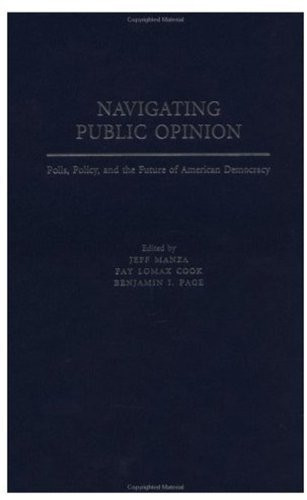
Navigating public opinion: polls, policy, and the future of American democracy

Professor of Sociology Jeff Manza,Jeff Manza,Fay Lomax Cook,Professor of Human Development and Social Policy in the School of Education and Social Policy Fay Lomax Cook,Benjamin I. Page,Gordon Scott Fulcher Professor of Decision Making in the Department of Political Science Benjamin I Page
Do politicians listen to the public? How often and when? Or are the views of the public manipulated or used strategically by political and economic elites? Navigating Public Opinion brings together leading scholars of American politics to assess and debate these questions. It describes how the relationship between opinion and policy has changed over time; how key political actors use public opinion to formulate domestic and foreign policy; and how new measurement techniques might improve our understanding of public opinion in contemporary polling and survey research. The distinguished contributors shed new light on several long-standing controversies over policy responsiveness to public opinion. Featuring a new analysis by Robert Erikson, Michael MacKuen, and James Stimson that builds from their pathbreaking work on how public mood moves policy in a macro-model of policymaking, the volume also includes several critiques of this model by Lawrence Jacobs and Robert Shapiro, another critique by G. William Domhoff, and a rejoinder by Erikson and his coauthors. Other highlights include discussions of how political elites, including state-level policymakers, presidents, and makers of foreign policy, use (or shape) public opinion; and analyses of new methods for measuring public opinion such as survey-based experiments, probabilistic polling methods, non-survey-based measures of public opinion, and the potential and limitations of Internet polls and surveys. Introductory and concluding essays provide useful background context and offer an authoritative summary of what is known about how public opinion influences public policy. A must-have for all students of American politics, public opinion, and polling, this state-of-the-art collection addresses issues that lie at the heart of democratic governance today.
Oxford University Press 2002 376 pages

Locating the proper authorities: the interaction of domestic and international institutions

Daniel W. Drezner
In an era of democratization and globalization, the number of decision makers has multiplied exponentially. Parliamentarians, bureaucrats, international secretariats, regional governors, and nongovernmental organizations have all gained influence at the expense of heads of state. How do these competing layers of authority bargain with each other to govern? International relations theorists have traditionally focused on how leaders' domestic constraints affect their bargaining position internationally. However, there has been much less work on the flip side of this question--how foreign policy leaders can use international institutions as a means of circumventing or co-opting domestic opposition. Locating the Proper Authorities offers some preliminary answers, drawn from a number of theoretical perspectives by the contributors to this volume. Written by some of the most promising theorists in the field of international relations, the essays in Locating the Proper Authorities address a broad array of substantive issue areas, including humanitarian intervention, trade dispute settlement, economic development, democratic transition, and security cooperation. This broad case selection has the virtue of incorporating developing countries, which are too often ignored in international relations, as well as less well-known international organizations. Each chapter examines the mechanisms and strategies through which policy entrepreneurs use international organizations as a means of bypassing or overcoming opposition to policy change. By examining the effects of different institutional design features, Locating the Proper Authorities helps us understand the variety of influence mechanisms through which international institutions shape the interaction of policy initiators and ratifiers. Daniel W. Drezner is Assistant Professor of Political Science, University of Chicago.
The University of Michigan Press 2003 280 pages