24 results for "Science"

The Second Mountain The Quest for a Moral Life

David Brooks
#1 NEW YORK TIMES BESTSELLER - Everybody tells you to live for a cause larger than yourself, but how exactly do you do it? The author of The Road to Character explores what it takes to lead a meaningful life in a self-centered world. "Deeply moving, frequently eloquent and extraordinarily incisive."-- The Washington Post Every so often, you meet people who radiate joy--who seem to know why they were put on this earth, who glow with a kind of inner light. Life, for these people, has often followed what we might think of as a two-mountain shape. They get out of school, they start a career, and they begin climbing the mountain they thought they were meant to climb. Their goals on this first mountain are the ones our culture endorses: to be a success, to make your mark, to experience personal happiness. But when they get to the top of that mountain, something happens. They look around and find the view . . . unsatisfying. They realize: This wasn't my mountain after all. There's another, bigger mountain out there that is actually my mountain. And so they embark on a new journey. On the second mountain, life moves from self-centered to other-centered. They want the things that are truly worth wanting, not the things other people tell them to want. They embrace a life of interdependence, not independence. They surrender to a life of commitment. In The Second Mountain, David Brooks explores the four commitments that define a life of meaning and purpose: to a spouse and family, to a vocation, to a philosophy or faith, and to a community. Our personal fulfillment depends on how well we choose and execute these commitments. Brooks looks at a range of people who have lived joyous, committed lives, and who have embraced the necessity and beauty of dependence. He gathers their wisdom on how to choose a partner, how to pick a vocation, how to live out a philosophy, and how we can begin to integrate our commitments into one overriding purpose. In short, this book is meant to help us all lead more meaningful lives. But it's also a provocative social commentary. We live in a society, Brooks argues, that celebrates freedom, that tells us to be true to ourselves, at the expense of surrendering to a cause, rooting ourselves in a neighborhood, binding ourselves to others by social solidarity and love. We have taken individualism to the extreme--and in the process we have torn the social fabric in a thousand different ways. The path to repair is through making deeper commitments. In The Second Mountain, Brooks shows what can happen when we put commitment-making at the center of our lives.
Random House Large Print 2019 346 pages

Making Sense Conversations on Consciousness, Morality, and the Future of Humanity

Sam Harris
A New York Times New and Noteworthy Book From the bestselling author of Waking Up and The End of Faith, an adaptation of his wildly popular, often controversial podcast "Civilization rests on a series of successful conversations." --Sam Harris Sam Harris--neuroscientist, philosopher, and bestselling author--has been exploring some of the most important questions about the human mind, society, and current events on his podcast, Making Sense. With over one million downloads per episode, these discussions have clearly hit a nerve, frequently walking a tightrope where either host or guest--and sometimes both--lose their footing, but always in search of a greater understanding of the world in which we live. For Harris, honest conversation, no matter how difficult or controversial, represents the only path to moral and intellectual progress. This book includes a dozen of the best conversations from Making Sense, including talks with Daniel Kahneman, Timothy Snyder, Nick Bostrom, and Glenn Loury, on topics that range from the nature of consciousness and free will, to politics and extremism, to living ethically. Together they shine a light on what it means to "make sense" in the modern world.
HarperCollins Publishers 2021-08-17 464 pages

Freedom

Sebastian Junger
A profound rumination on the concept of freedom from the bestselling author of The Perfect Storm 'Sebastian Junger bears witness to a hard-won and an uncertain new world, framed in vital and brilliant prose: a true and honest accounting of everything that underlies the frantic performance of life' Philip Hoare, author of Albert and the Whale Throughout history, humans have been driven by the quest for two cherished ideals: community and freedom. The two don't coexist easily: we value individuality and self-reliance, yet are utterly dependent on community for our most basic needs. In this intricately crafted and thought-provoking book, Sebastian Junger examines this tension that lies at the heart of what it means to be human. For much of a year, Junger and three friends--a conflict photographer and two Afghan war vets--walked the railroad lines of the east coast. It was an experiment in personal autonomy, but also in interdependence. Dodging railroad cops, sleeping under bridges, cooking over fires and drinking from creeks and rivers, the four men forged a unique reliance on one another. In Freedom, Junger weaves his account of this journey together with primatology and boxing strategy, the role of women in resistance movements and apache renegrades, and the brutal reality of life on the Pennsylvania frontier. Written in exquisite, razor-sharp prose, the result is a powerful examination of the primary desire that defines us.
HarperCollins Publishers Limited 2021-05 160 pages

New Power

Jeremy Heimans,Henry Timms
Shortlisted for the Financial Times and McKinsey Business Book of the Year Award 2018"This book will inform and inspire all those wanting to make change . . . and achieve a goal against all odds." Jane Goodall, founder of the Jane Goodall Institute and a UN Messenger of Peace In this indispensable guide to navigating the 21st century, two visionary thinkers reveal the unexpected ways power is changing - and how 'new power' is reshaping politics, business and life. Why do some leap ahead while others fall behind in today's chaotic, connected age? In New Power, Australian Jeremy Heimans and Brit Henry Timms confront the biggest stories of our time - the rise of mega-platforms like Facebook and Uber; the out-of-nowhere victories or Presidents Barack Obama and Donald Trump; the unexpected emergence of movements like #BlackLivesMatter and #MeToo; and the erruption of darker forces such as ISIS. For most of human history, the rules of power were clear: power was something to be seized and jealously guarded. This 'old power' was inaccessible to the vast majority of people. But widespread connectivity has made possible a different kind of power. 'New power' is made by the many rather than the few. It is open, participatory, and peer-driven. It works like a current, not a currency - and like water or electricity, it is most forceful when it surges. In a world increasingly shaped by new power, this revelatory book gives each of us a new way to understand the world and our role in it. SHORTLISTED FOR THE FINANCIAL TIMES & MCKINSEY BOOK OF THE YEAR 2018 PRAISE FOR NEW POWER" If you want to understand how the world is changing, what's really happening and how we can all find our way, this book could not becoming at a better time." Richard Branson"New Power is an essential and extremely insightful guide for anyone who wants to maximize the opportunities for progress and impact in today's new tightly connected world." Reid Hoffman, co-founder of LinkedIn and co-author of the #1 New York Times bestsellers The Alliance and The Startup of You "A must-read, New Power is a gift to our movements. It's not just about going viral-it's about connecting millions of people to roll up our sleeves and create the changes we long for." Alicia Garza, co-founder of Black Lives Matter
Pan Macmillan Australia Pty, Limited 2018-03-27 336 pages

The Sweet Spot The Pleasures of Suffering and the Search for Meaning

Paul Bloom
"This book will challenge you to rethink your vision of a good life. With sharp insights and lucid prose, Paul Bloom makes a captivating case that pain and suffering are essential to happiness. It's an exhilarating antidote to toxic positivity." --Adam Grant, #1 New York Times bestselling author of Think Again and host of the TED podcast WorkLife One of Behavioral Scientist's "Notable Books of 2021" From the author of Against Empathy, a different kind of happiness book, one that shows us how suffering is an essential source of both pleasure and meaning in our lives Why do we so often seek out physical pain and emotional turmoil? We go to movies that make us cry, or scream, or gag. We poke at sores, eat spicy foods, immerse ourselves in hot baths, run marathons. Some of us even seek out pain and humiliation in sexual role-play. Where do these seemingly perverse appetites come from? Drawing on groundbreaking findings from psychology and brain science, The Sweet Spot shows how the right kind of suffering sets the stage for enhanced pleasure. Pain can distract us from our anxieties and help us transcend the self. Choosing to suffer can serve social goals; it can display how tough we are or, conversely, can function as a cry for help. Feelings of fear and sadness are part of the pleasure of immersing ourselves in play and fantasy and can provide certain moral satisfactions. And effort, struggle, and difficulty can, in the right contexts, lead to the joys of mastery and flow. But suffering plays a deeper role as well. We are not natural hedonists--a good life involves more than pleasure. People seek lives of meaning and significance; we aspire to rich relationships and satisfying pursuits, and this requires some amount of struggle, anxiety, and loss. Brilliantly argued, witty, and humane, Paul Bloom shows how a life without chosen suffering would be empty--and worse than that, boring.
HarperCollins Publishers 2021-11-02 304 pages

Supercapitalism The Transformation of Business, Democracy, and Everyday Life

Robert B. Reich
Mid-twentieth-century capitalism has turned into global capitalism, and global capitalism - turbocharged, Web-based, and able to find and make almost anything just about anywhere - has turned into supercapitalism. But as Robert B. Reich makes clear in this eye-opening book, while supercapitalism is working wonderfully well to enlarge the economic pie, democracy - charged with caring for all citizens - is becoming less and less effective under its influence. Reich explains how widening inequalities of income and wealth, heightened job insecurity, and the spreading effects of global warming are the logical outcomes of supercapitalism. He shows us why companies, fighting harder than ever to maintain their competitive positions, have become even more deeply involved in politics; and how average citizens, seeking great deals and invested in the stock market to an unprecedented degree, are increasingly loath to stand by their values if it means biting the hands that feed them. As one of America's most influential voices, Reich sets out a clear course to a vibrant capitalism and a concurrent, equally vibrant democracy.
Scribe Publications 2008 272 pages

Microtrends The Small Forces Behind Tomorrow's Big Changes

Mark Penn
The adviser to Senator Hillary Clinton, Bill Gates, and President Bill Clinton proves that small is big by identifying 75 hidden-in-plain-sight trends that are moving America, revealing that the nation is no longer a melting pot but a collection of communities with many individual tastes and lifestyles. "The ideas in his book will help you see the world in a new way." --Bill Clinton "Mark Penn has a keen mind and a fascinating sense of what makes America tick, and you see it on every page of Microtrends ." --Bill Gates In 1982, readers discovered Megatrends . In 2000, The Tipping Point entered the lexicon. Now, in Microtrends , one of the most respected and sought-after analysts in the world articulates a new way of understanding how we live. Mark Penn, the man who identified "Soccer Moms" as a crucial constituency in President Clinton's 1996 reelection campaign, is known for his ability to detect relatively small patterns of behavior in our culture-microtrends that are wielding great influence on business, politics, and our personal lives. Only one percent of the public, or three million people, is enough to launch a business or social movement. Relying on some of the best data available, Penn identifies more than 70 microtrends in religion, leisure, politics, and family life that are changing the way we live. Among them: People are retiring but continuing to work. Teens are turning to knitting. Geeks are becoming the most sociable people around. Women are driving technology. Dads are older than ever and spending more time with their kids than in the past. You have to look at and interpret data to know what's going on, and that conventional wisdom is almost always wrong and outdated. The nation is no longer a melting pot. We are a collection of communities with many individual tastes and lifestyles. Those who recognize these emerging groups will prosper. Penn shows readers how to identify the microtrends that can transform a business enterprise, tip an election, spark a movement, or change your life. In today's world, small groups can have the biggest impact.
Grand Central Publishing 2007-09 448 pages

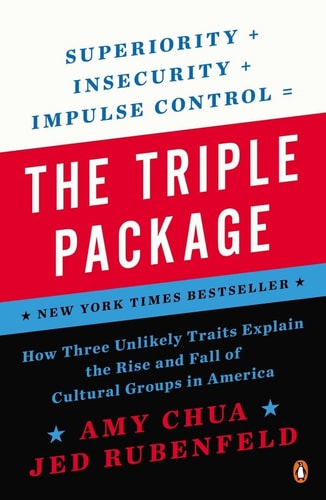
The Triple Package How Three Unlikely Traits Explain the Rise and Fall of Cultural Groups in America

Amy Chua,Jed Rubenfeld
"That certain groups do much better in America than others — as measured by income, occupational status, test scores, and so on — is difficult to talk about. In large part this is because the topic feels racially charged. The irony is that the facts actually debunk racial stereotypes. There are black and Hispanic subgroups in the United States far outperforming many white and Asian subgroups. Moreover, there’s a demonstrable arc to group success — in immigrant groups, it typically dissipates by the third generation — puncturing the notion of innate group differences and undermining the whole concept of 'model minorities.'" Mormons have recently risen to astonishing business success. Cubans in Miami climbed from poverty to prosperity in a generation. Nigerians earn doctorates at stunningly high rates. Indian and Chinese Americans have much higher incomes than other Americans; Jews may have the highest of all. Why do some groups rise? Drawing on groundbreaking original research and startling statistics, The Triple Package uncovers the secret to their success. A superiority complex, insecurity, impulse control—these are the elements of the Triple Package, the rare and potent cultural constellation that drives disproportionate group success. The Triple Package is open to anyone. America itself was once a Triple Package culture. It’s been losing that edge for a long time now. Even as headlines proclaim the death of upward mobility in America, the truth is that the old-fashioned American Dream is very much alive—but some groups have a cultural edge, which enables them to take advantage of opportunity far more than others. • Americans are taught that everyone is equal, that no group is superior to another. But remarkably, all of America’s most successful groups believe (even if they don’t say so aloud) that they’re exceptional, chosen, superior in some way. • Americans are taught that self-esteem—feeling good about yourself—is the key to a successful life. But in all of America’s most successful groups, people tend to feel insecure, inadequate, that they have to prove themselves. • America today spreads a message of immediate gratification, living for the moment. But all of America’s most successful groups cultivate heightened discipline and impulse control. But the Triple Package has a dark underside too. Each of its elements carries distinctive pathologies; when taken to an extreme, they can have truly toxic effects. Should people strive for the Triple Package? Should America? Ultimately, the authors conclude that the Triple Package is a ladder that should be climbed and then kicked away, drawing on its power but breaking free from its constraints. Provocative and profound, The Triple Package will transform the way we think about success and achievement.
Penguin 2015-01-27 352 pages

Inevitable surprises: thinking ahead in a time of turbulence

Peter Schwartz
The world we live in today is more volatile than ever. The security of free nations is threatened by rogue states, the global economy is in flux, and the rapid advance of technology forces constant reevaluation of our society. With so many powerful forces at work and seemingly unpredictable events occurring, to many the future seems dark, and its possibilities frightening. Peter Schwartz disagrees. A world-renowned visionary in the field of scenario planning, Schwartz’s startling—and accurate— predictions have been employed by government agencies and major corporations for more than twenty-five years. He argues that the future is foreseeable, and that by examining the dynamics at work today we can predict the “inevitable surprises” of tomorrow. Timely and thought-provoking, Inevitable Surprises is a book that no one with an interest in business—or the future of our society—can afford to miss.
Gotham Books 2004-05-24 247 pages

Social mobility in industrial society

Lipset, Seymour Martin,Bendix, Reinhard
"Where else but in America," captains of industry are fond of saying, "could a penniless immigrant like Andrew Carnegie achieve so much?" "Any place else that has reached the same stage of industrial development," is the answer implicit in Social Mobility. The authors conclude, somewhat surprisingly, that is not noticeably easier to pull oneself up by the bootstraps in the "Land of Opportunity" than it is in a number of other countries. The very process of industrialization, with its growing demands for skilled management, prevents an elite in any nation form permanently establishing itself in a position of exclusive superiority. Even in states where neither political institutions nor official ideologies favor upward mobility, increasing industrialization requires a growing--and, consequently, a changing--elite class. The authors are concerned primarily with mobility in the total population, with movements into and out of the working class, though they report extensively on the social origins of business leaders in various countries. They deal, too, with the different values of different societies and with the motivation of the socially mobile. Solidly based on examination of studies in more than ten languages and of raw data from unpublished works, this is the first attempt in thirty years to bring together in one volume what is known of social mobility around the world. Here is the first systematic comparison of mobility patterns in such diverse countries as Sweden and Italy, Great Britain and Japan--a comparison backed by statistics and given added meaning by discussions of the causes and consequences of mobility. The authors analyze in detail the political implications of mobility and they explore the relationship between education and mobility. Their discussions of factors making for success or failure in school, of the role of intelligence in mobility, of the effects on children of growing up in various environments, and of the varying personalities of the mobile and non-mobile bring together the work of both psychologists and sociologists. This title is part of UC Press's Voices Revived program, which commemorates University of California Press’s mission to seek out and cultivate the brightest minds and give them voice, reach, and impact. Drawing on a backlist dating to 1893, Voices Revived makes high-quality, peer-reviewed scholarship accessible once again using print-on-demand technology. This title was originally published in 1959.
Univ of California Press 2018-10-23 332 pages

Three pillars of wisdom: the true nature of government, religion, and law

Arnheim, Michael
""Wokeism" and, before it, "Political correctness" are attempts to replace traditional privilege with a new privileged class of special interest groups that have supposedly been discriminated against. In Three Pillars of Wisdom, Dr. Michael Arnheim argues that that there are and always have been only two forms of government: monarchy and oligarchy, regardless of the labels placed on them, and that politics, religion, and law are all fields of contention between "in" and "out" groups"--
Academica Press 2025-07 150 pages

The DIM Hypothesis Why the Lights of the West Are Going Out

Leonard Peikoff
With his groundbreaking and controversial DIM hypothesis, Dr. Leonard Peikoff casts a penetrating new light on the process of human thought, and thereby on Western culture and history. In this far-reaching study, Peikoff identifies the three methods people use to integrate concrete data into a whole, as when connecting diverse experiments by a scientific theory, or separate laws into a Constitution, or single events into a story. The first method, in which data is integrated through rational means, he calls Integration. The second, which employs non-rational means, he calls Misintegration. The third is Disintegration—which is nihilism, the desire to tear things apart. In The DIM Hypothesis Peikoff demonstrates the power of these three methods in shaping the West, by using the categories to examine the culturally representative fields of literature, physics, education, and politics. His analysis illustrates how the historical trends in each field have been dominated by one of these three categories, not only today but during the whole progression of Western culture from its beginning in Ancient Greece. Extrapolating from the historical pattern he identifies, Peikoff concludes by explaining why the lights of the West are going out—and predicts the most likely future for the United States.
Penguin 2013-12-03 400 pages

The new science of the enchanted universe: an anthropology of most of humanity

Sahlins, Marshall
From the perspective of Western modernity, humanity inhabits a disenchanted cosmos. Gods, spirits, and ancestors have left us for a transcendent beyond, no longer living in our midst and being involved in all matters of everyday life from the trivial to the dire. Yet the vast majority of cultures throughout human history treat spirits as very real persons, members of a cosmic society who interact with humans and control their fate. In most cultures, even today, people are but a small part of an enchanted universe misconstrued by the transcendent categories of “religion” and the “supernatural.” The New Science of the Enchanted Universe shows how anthropologists and other social scientists must rethink these cultures of immanence and study them by their own lights. In this, his last, revelatory book, Marshall Sahlins announces a new method and sets an exciting agenda for the field. He takes readers around the world, from Inuit of the Arctic Circle to pastoral Dinka of East Africa, from Araweté swidden gardeners of Amazonia to Trobriand Island horticulturalists. In the process, Sahlins sheds new light on classical and contemporary ethnographies that describe these cultures of immanence and reveals how even the apparently mundane, all-too-human spheres of “economics” and “politics” emerge as people negotiate with, and ultimately usurp, the powers of the gods.
Princeton University Press 2023-12-05 208 pages

How is society possible?

Georg Simmel
Georg Simmel's essay “How Is Society Possible?” is built on the idea that an individual can develop himself or herself fully only by entering into society but nevertheless remains marked with an “in-addition” or “individuality-nucleus” that is never entirely socialized. Georg Simmel, American Journal of Sociology, vol. 16 (1910-11) "Kant could propose and answer the fundamental question of his philosophy, How is nature possible?, only because for him nature was nothing but the representation (Vorstellung) of nature. This does not mean merely that "the world is my representation," that we thus can speak of nature only so far as it is a content of our consciousness, but that what we call nature is a special way in which our intellect assembles, orders, and forms the sense perceptions. These "given" perceptions, of color, taste, tone, temperature, resistance, smell, which in the accidental sequence of subjective experience course through our consciousness, are in and of themselves not yet "nature;" but they become "nature" through the activity of the mind, which combines them into objects and series of objects, into substances and attributes and into causal coherences."
BoD - Books on Demand 2022-12-19 28 pages