457 results for "Science"

Tuesdays with Morrie: an old man, a young man, and life's greatest lesson

Albom, Mitch
Maybe it was a grandparent, or a teacher, or a colleague. Someone older, patient and wise, who understood you when you were young and searching, helped you see the world as a more profound place, gave you sound advice to help you make your way through it. For Mitch Albom, that person was his college professor Morrie Schwartz. Maybe, like Mitch, you lost track of this mentor as you made your way, and the insights faded, and the world seemed colder. Wouldn’t you like to see that person again, ask the bigger questions that still haunt you, receive wisdom for your busy life today the way you once did when you were younger? Mitch Albom had that second chance. He rediscovered Morrie in the last months of the older man’s life. Knowing he was dying, Morrie visited with Mitch in his study every Tuesday, just as they used to back in college. Their rekindled relationship turned into one final "class": lessons in how to live. "The truth is, Mitch," he said, "once you learn how to die, you learn how to live." Tuesdays with Morrie is a magical chronicle of their time together, through which Mitch shares Morrie’s lasting gift with the world.
Doubleday 1997-08-18 192 pages

The Road to Character

David Brooks
#1 NEW YORK TIMES BESTSELLER * NAMED ONE OF THE BEST BOOKS OF THE YEAR BY THE ECONOMIST * "I wrote this book not sure I could follow the road to character, but I wanted at least to know what the road looks like and how other people have trodden it."--David Brooks With the wisdom, humor, curiosity, and sharp insights that have brought millions of readers to his New York Times column and his previous bestsellers, David Brooks has consistently illuminated our daily lives in surprising and original ways. In The Social Animal, he explored the neuroscience of human connection and how we can flourish together. Now, in The Road to Character, he focuses on the deeper values that should inform our lives. Responding to what he calls the culture of the Big Me, which emphasizes external success, Brooks challenges us, and himself, to rebalance the scales between our "résumé virtues"--achieving wealth, fame, and status--and our "eulogy virtues," those that exist at the core of our being: kindness, bravery, honesty, or faithfulness, focusing on what kind of relationships we have formed. Looking to some of the world's greatest thinkers and inspiring leaders, Brooks explores how, through internal struggle and a sense of their own limitations, they have built a strong inner character. Labor activist Frances Perkins understood the need to suppress parts of herself so that she could be an instrument in a larger cause. Dwight Eisenhower organized his life not around impulsive self-expression but considered self-restraint. Dorothy Day, a devout Catholic convert and champion of the poor, learned as a young woman the vocabulary of simplicity and surrender. Civil rights pioneers A. Philip Randolph and Bayard Rustin learned reticence and the logic of self-discipline, the need to distrust oneself even while waging a noble crusade. Blending psychology, politics, spirituality, and confessional, The Road to Character provides an opportunity for us to rethink our priorities, and strive to build rich inner lives marked by humility and moral depth. "Joy," David Brooks writes, "is a byproduct experienced by people who are aiming for something else. But it comes."
Thorndike Press 2016-09-06 624 pages

The Second Mountain The Quest for a Moral Life

David Brooks
#1 NEW YORK TIMES BESTSELLER - Everybody tells you to live for a cause larger than yourself, but how exactly do you do it? The author of The Road to Character explores what it takes to lead a meaningful life in a self-centered world. "Deeply moving, frequently eloquent and extraordinarily incisive."-- The Washington Post Every so often, you meet people who radiate joy--who seem to know why they were put on this earth, who glow with a kind of inner light. Life, for these people, has often followed what we might think of as a two-mountain shape. They get out of school, they start a career, and they begin climbing the mountain they thought they were meant to climb. Their goals on this first mountain are the ones our culture endorses: to be a success, to make your mark, to experience personal happiness. But when they get to the top of that mountain, something happens. They look around and find the view . . . unsatisfying. They realize: This wasn't my mountain after all. There's another, bigger mountain out there that is actually my mountain. And so they embark on a new journey. On the second mountain, life moves from self-centered to other-centered. They want the things that are truly worth wanting, not the things other people tell them to want. They embrace a life of interdependence, not independence. They surrender to a life of commitment. In The Second Mountain, David Brooks explores the four commitments that define a life of meaning and purpose: to a spouse and family, to a vocation, to a philosophy or faith, and to a community. Our personal fulfillment depends on how well we choose and execute these commitments. Brooks looks at a range of people who have lived joyous, committed lives, and who have embraced the necessity and beauty of dependence. He gathers their wisdom on how to choose a partner, how to pick a vocation, how to live out a philosophy, and how we can begin to integrate our commitments into one overriding purpose. In short, this book is meant to help us all lead more meaningful lives. But it's also a provocative social commentary. We live in a society, Brooks argues, that celebrates freedom, that tells us to be true to ourselves, at the expense of surrendering to a cause, rooting ourselves in a neighborhood, binding ourselves to others by social solidarity and love. We have taken individualism to the extreme--and in the process we have torn the social fabric in a thousand different ways. The path to repair is through making deeper commitments. In The Second Mountain, Brooks shows what can happen when we put commitment-making at the center of our lives.
Random House Large Print 2019 346 pages

Iron Curtain The Crushing of Eastern Europe, 1944-1956

Anne Applebaum
At the end of WWII, the Soviet Union, to its surprise and delight, found itself in control of a huge swath of territory in Central Europe. It set out to convert a dozen radically different countries to a completely new political and moral system, Communism. Iron Curtain describes how the communist regimes of Eastern Europe were created, and what daily life was like once they were complete. Applebaum draws on newly opened European archives and personal accounts translated for the first time to portray in devestating detail millions of individuals trying to adjust to a way of life that challenged their every belief, rendered worthless their every qualification, and took everything away they had accumulated. Today the Soviet Block is a lost civilization, once whose cruelty, paranoia, bizarre morality and strange aethestics Applebaum captures in the electrifying pages of this book.
McClelland & Stewart 2012-10-30 608 pages

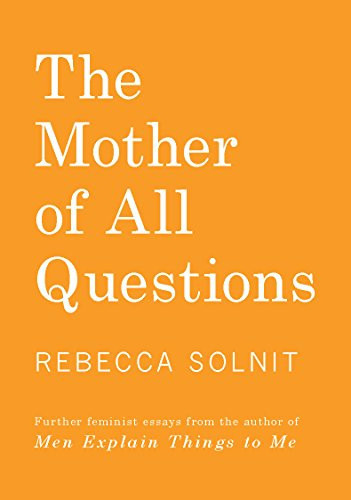
The Mother of All Questions

Rebecca Solnit
In a timely follow-up to her national bestseller Men Explain Things to Me, Rebecca Solnit offers indispensable commentary on women who refuse to be silenced, misogynistic violence, the fragile masculinity of the literary canon, the gender binary, the recent history of rape jokes, and much more. In characteristic style, Solnit mixes humor, keen analysis, and powerful insight in these essays.
Haymarket Books 2019-09-20 192 pages

In the realm of hungry ghosts: close encounters with addiction

Maté, Gabor
"...This insightful book explores the scientific and psychological causes of addiction, as well as the impact on the addicts treated at the Downtown Eastside Vancouver clinic where Mate is a physician. He widens the lens to address the larger societal problem--speaking also to the risks of more "high-status" addictions, such as wealth, power, and sex. He boldly challenges the War on Drugs, proposing a more holistic, constructive set of alternatives. A riveting, debate-provoking book about an illness that reaches all levels of society, In the Realm of Hungry Ghosts provides a much-needed glimpse of hope from an innovator who is taking on addiction with startling clarity, vision, and wisdom."--Cover, p. 4.
North Atlantic Books 2010-01-05 495 pages

Brainwashed How Universities Indoctrinate America's Youth

Ben Shapiro
Brainwashed is the explosive exposé of the leftist agenda at work in today's colleges, revealed by firebrand Ben Shapiro--syndicated columnist, podcaster, radio show host, and one of today's most exciting conservative voices--who's been on the front lines of the battle for America's young minds. This book proves once and for all that so-called higher education continues to sink lower and lower into the depths of liberal madness as close-minded professors turn their students into socialists, atheists, race-baiters, and sex-crazed narcissists. In this book, author Ben Shapiro asks three critical questions: Why are universities so biased? Why do students take their professors at face value? What can we do to stop it? In addition to outlining practical solutions as part of a multi-pronged strategy to deal with this problem, Brainwashed encourages students to consider the motives of their professors; pay attention to how professors use facts and editorialize during lectures; and ask questions, encourage debate, and think before buying into a professor's mindset. Praise for Brainwashed: "Ben Shapiro's writing is smart, informative, and incisive. He is wise beyond his years without losing the refreshing fearlessness of youth." Ann Coulter, bestselling author of High Crimes and Misdemeanors, Slander, and Treason "In Brainwashed, Shapiro tells the truth--that universities are forums of left-liberal indoctrination, where dissent is discouraged and penalized, with more restrictions on free speech rather any other part of American society. Parents who are paying for tuition might want to take note, and see what their hard-earned money is paying for." Michael Barone, U.S. News & World Report and co-author of The Almanac of American Politics "Welcome to P.C. 101. In this trenchant insider's expose, Ben Shapiro bears witness to the modern American campus freak show. You'll get up close and personal with the Marxist loons, moral relativists, multicultural zealots, and American-haters who are corrupting young minds. Brainwashed reveals the ignominious lows to which higher education has sunk. Get deprogrammed. Buy this book!" Michelle Malkin, nationally syndicated columnist and author of Invasion "Sharp thinking, tight writing, crazy-but-true stories: Ben Shapiro sees campus brainwashing and raises a national protest. This is a good book to give both freshmen who need warning and voters/alumni who need to take action." Dr. Marvin Olasky, University of Texas professor and editor-in-chief of World magazine "A worthy successor to God and Man at Yale and Harvard Hates America in exploring the belly of the academic beast." David Horowitz, founder of Students for Academic Freedom and author of Radical Son and Left Illusions "What Animal House did for the toga party, Brainwashed should do for American resistance to campus radicalism." Rusty Humphries, nationally syndicated radio talk show host
Thomas Nelson Incorporated 2010-04 242 pages

Erasing History How Fascists Rewrite the Past to Control the Future

Jason Stanley
From the bestselling author of How Fascism Works , a global call to action that tells us “why the past is a frontline in the struggle for a future free of fascism” (Jeff Sharlet, New York Times bestselling author) as it reveals the far right’s efforts to rewrite history and undo a century of progress on race, gender, sexuality, and class. In the United States, democracy is under attack by an authoritarian movement that has found fertile ground among the country’s conservative politicians and voters, but similar movements have found homes in the hearts and minds of people around the globe. To understand the shape, form, and stakes of this assault, we must go back to extract lessons from our past. In authoritarian countries, critical examination of those nations’ history and traditions is discouraged if not an outright danger to those who do it. And it is no accident that local and global institutions of education have become a battleground, where learning and efforts to upend a hierarchal status quo can be put to end by coercion and threats of violence. Democracies entrust schools and universities to preserve a common memory of positive change, generated by protests, social movements, and rebellions. The authoritarian right must erase this history, and, along with it, the very practice of critical inquiry that has so often been the engine of future progress. In Erasing History , Yale professor of philosophy Jason Stanley exposes the true danger of the authoritarian right’s attacks on education, identifies their key tactics and funders, and traces their intellectual roots. He illustrates how fears of a fascist future have metastasized, from hypothetical threat to present reality. And with his “urgent, piercing, and altogether brilliant” (Johnathan M. Metzl, author of What We’ve Become ) insight, he illustrates that hearts and minds are won in our schools and universities—places that democratic societies across the world are now ill-prepared to defend against the fascist assault currently underway.
Atria/One Signal Publishers 2026-03-17 256 pages

The Bell Curve

Herrnstein, Richard J.
The ability to manipulate information has become the single most important element of success. High intelligence is an increasingly precious raw material. But despite decades of fashionable denial, the overriding and insistent truth about intellectual ability is that it is endowed unequally.In this audio presentation of The Bell Curve , author Charles Murray explores the ways that low intelligence, independent of social, economic, or ethnic background, lies at the root of many of our social problems. He also discusses another taboo that intelligence levels differ among ethnic groups.According to the authors, only by facing up to these differences can we accurately assess the nation's problems and make realistic plans to address them. However, if we accept that there are intelligence differences among groups, we must learn to avoid prejudicial assumptions about any individual of a given group whose intelligence level may be anywhere under the bell curve.
Free Press 1996

Call Them by Their True Names American Crises (and Essays)

Rebecca Solnit
National Book Award Longlist Winner of the Kirkus Prize for Nonfiction Winner of the Foreword INDIE Editor's Choice Prize for Nonfiction "Rebecca Solnit is essential feminist reading." --The New Republic "Solnit's exquisite essays move between the political and the personal, the intellectual and the earthy." --Elle Rebecca Solnit is the author of more than twenty books, including the international bestseller Men Explain Things to Me. Called "the voice of the resistance" by the New York Times, she has emerged as an essential guide to our times, through her incisive commentary on feminism, violence, ecology, hope, and everything in between. In this powerful and wide-ranging collection, Solnit turns her attention to battles over meaning, place, language, and belonging at the heart of the defining crises of our time. She explores the way emotions shape political life, electoral politics, police shootings and gentrification, the life of an extraordinary man on death row, the pipeline protest at Standing Rock, and the existential threat posed by climate change. The work of changing the world sometimes requires changing the story, the names, and inventing or popularizing new names and terms and phrases. Calling things by their true names can also cut through the lies that excuse, disguise, avoid, or encourage inaction, indifference, obliviousness in the face of injustice and violence.
Haymarket Books 2018 188 pages

Making Sense Conversations on Consciousness, Morality, and the Future of Humanity

Sam Harris
A New York Times New and Noteworthy Book From the bestselling author of Waking Up and The End of Faith, an adaptation of his wildly popular, often controversial podcast "Civilization rests on a series of successful conversations." --Sam Harris Sam Harris--neuroscientist, philosopher, and bestselling author--has been exploring some of the most important questions about the human mind, society, and current events on his podcast, Making Sense. With over one million downloads per episode, these discussions have clearly hit a nerve, frequently walking a tightrope where either host or guest--and sometimes both--lose their footing, but always in search of a greater understanding of the world in which we live. For Harris, honest conversation, no matter how difficult or controversial, represents the only path to moral and intellectual progress. This book includes a dozen of the best conversations from Making Sense, including talks with Daniel Kahneman, Timothy Snyder, Nick Bostrom, and Glenn Loury, on topics that range from the nature of consciousness and free will, to politics and extremism, to living ethically. Together they shine a light on what it means to "make sense" in the modern world.
HarperCollins Publishers 2021-08-17 464 pages

Don't Burn this Book Thinking for Yourself in an Age of Unreason

Dave Rubin
From host of The Rubin Report , the most-watched talk show about free speech and big ideas on YouTube right now, a roadmap for free thinking in an increasingly censored world. The left is no longer liberal. Once on the side of free speech and tolerance, progressives now ban speakers from college campuses, "cancel" people who aren't up to date on the latest genders, and force religious people to violate their conscience. They have abandoned the battle of ideas and have begun fighting a battle of feelings. This uncomfortable truth has turned moderates and true liberals into the politically homeless class. Dave Rubin launched his political talk show The Rubin Report in 2015 as a meeting ground for free thinkers who realize that partisan politics is a dead end. He hosts people he both agrees and disagrees with--including those who have been dismissed, deplatformed, and despised--taking on the most controversial issues of our day. As a result, he's become a voice of reason in a time of madness. Now, Rubin gives you the tools you need to think for yourself in an age when tribal outrage is the only available alternative. Based on his own story as well as his experiences from the front lines of the free speech wars, this book will empower you to make up your own mind about what you believe on any issue and teach you the fine art of: Checking your facts, not your privilege , when it comes to today's most pervasive myths, from the wage gap and gun violence to climate change and hate crimes. Standing up to the mob against today's absurd PC culture, when differences of opinion can bring relationships, professional or personal, to a sudden end. Defending classically liberal principles such as individual rights and limited government, because freedom is impossible without them. The Progressive Woke Machine is waging war against the last free thinkers in the world. Don't Burn This Book is the definitive account of our current political upheaval and your guide to surviving it. Dave Rubin is the creator and host of The Rubin Report , the most-watched talk show about free speech and big ideas on YouTube. A former progressive turned classical liberal, he speaks to millions all over the world, including touring with Dr. Jordan Peterson, and performs stand-up comedy in cities around the United States.
Constable 2020 224 pages

In my time of dying: how I came face to face with the idea of an afterlife

Junger, Sebastian
''Mind blowingly brilliant'' PHILIPPA PERRY''Few other writers have such passion for granular detail, intellectual heft and boundless curiosity'' THE TIMES''As suspenseful and pacy as an episode of peak-era ER'' GUARDIANA near-fatal health emergency leads to this powerful reflection on death―and what might follow―by the bestselling author of Tribe and The Perfect Storm.For years as an award-winning war reporter, Sebastian Junger travelled to many front lines and frequently put his life at risk. And yet the closest he ever came to death was the summer of 2020 while spending a quiet afternoon at the New England home he shared with his wife and two young children. Crippled by abdominal pain, Junger was rushed to the hospital by ambulance. Once there, he began slipping away. As blackness encroached, he was visited by his dead father, inviting Junger to join him. “It’s okay,” his father said. “There’s nothing to be scared of. I’ll take care of you.” That was the last thing Junger remembered until he came to the next day when he was told he had suffered a ruptured aneurysm that he should not have survived.This experience spurred Junger―a confirmed atheist raised by his physicist father to respect the empirical―to undertake a scientific, philosophical, and deeply personal examination of mortality and what happens after we die. How do we begin to process the brutal fact that any of us might perish unexpectedly on what begins as an ordinary day? How do we grapple with phenomena that science may be unable to explain? And what happens to a person, emotionally and spiritually, when we are forced to reckon with such existential questions?In My Time of Dying is part medical drama, part searing autobiography, and part rational inquiry into the ultimate unknowable mystery.''Moving, compact, philosophically ambitious … A humbling volume'' OBSERVER‘Stunning … A powerful book that comes as close as anything I’ve read in explaining what it means to be human’ JAMES PATTERSON''An instant classic that filled me with wonder, gratitude and awe'' WILL SCHWALBE''A stunning account I didn’t so much read as inhale, awed and riveted and forever changed'' MICHAEL FINKEL
4th Estate 2025-05-22 176 pages

Encyclopedia of an ordinary life

Rosenthal, Amy Krouse
A memoir in bite-size chunks from the author of the viral Modern Love column “You May Want to Marry My Husband.” “[Rosenthal] shines her generous light of humanity on the seemingly humdrum moments of life and shows how delightfully precious they actually are.” — The Chicago Sun-Times How do you conjure a life? Give the truest account of what you saw, felt, learned, loved, strived for? For Amy Krouse Rosenthal, the surprising answer came in the form of an encyclopedia. In Encyclopedia of an Ordinary Life she has ingeniously adapted this centuries-old format for conveying knowledge into a poignant, wise, often funny, fully realized memoir. Using mostly short entries organized from A to Z, many of which are cross-referenced, Rosenthal captures in wonderful and episodic detail the moments, observations, and emotions that comprise a contemporary life. Start anywhere—preferably at the beginning—and see how one young woman’s alphabetized existence can open up and define the world in new and unexpected ways. An ordinary life, perhaps, but an extraordinary book.
Three Rivers 2006 240 pages

Odd Girl Out

Simmons, Rachel
When boys act out, get into fights, or become physically aggressive, we can't avoid noticing their bad behavior. But it is easy to miss the subtle signs of aggression in girls--the dirty looks, the taunting notes, or the exclusion from the group-that send girls home crying.In Odd Girl Out, Rachel Simmons focuses on these interactions and provides language for the indirect aggression that runs through the lives and friendships of girls. These exchanges take place within intimate circles--the importance of friends and the fear of losing them is key. Without the cultural consent to express their anger or to resolve their conflicts, girls express their aggression in covert but damaging ways. Every generation of women can tell stories of being bullied, but Odd Girl Out explores and explains these experiences for the first time.Journalist Rachel Simmons sheds light on destructive patterns that need our attention. With advice for girls, parents, teachers, and even school administrators, Odd Girl Out is a groundbreaking work that every woman will agree is long overdue.
Psychological Corp 2004

The Fall of Roe

Lerer, Lisa,Dias, Elizabeth
Two New York Times journalists, Lisa Lerer and Elisabeth Dias, have written the definitive book on the end of Roe, revealing how the strategic battle over the most contentious topic in politics helps us understand the battle for control over America. They look at the playbook for how the religious right came to dominate American politics, a strategy that has vaulted anti-abortion activists into central roles in the conservative movement. And unless Democrats shift their strategy, it is those activists who will be the power brokers who determine the future of America. Furthermore, given that these debates and strategies have influence here and throughout the world, 'The Fall of Roe' will be essential not only for understanding America but also informing our own future.
Manilla Press 2024-07 448 pages

Wildland The Making of America's Fury

Evan Osnos
INSTANT NEW YORK TIMES BESTSELLER After a decade abroad, the National Book Award – and Pulitzer Prize – winning writer Evan Osnos returns to three places he has lived in the United States—Greenwich, CT; Clarksburg, WV; and Chicago, IL—to illuminate the origins of America’s political fury. Evan Osnos moved to Washington, D.C., in 2013 after a decade away from the United States, first reporting from the Middle East before becoming the Beijing bureau chief at the Chicago Tribune and then the China correspondent for The New Yorker . While abroad, he often found himself making a case for his home country, urging the citizens of Egypt, Iraq, or China to trust that even though America had made grave mistakes throughout its history, it aspired to some foundational moral commitments: the rule of law, the power of truth, the right of equal opportunity for all. But when he returned to the United States, he found each of these principles under assault. In search of an explanation for the crisis that reached an unsettling crescendo in 2020—a year of pandemic, civil unrest, and political turmoil—he focused on three places he knew firsthand: Greenwich, Connecticut; Clarksburg, West Virginia; and Chicago, Illinois. Reported over the course of six years, Wildland follows ordinary individuals as they navigate the varied landscapes of twenty-first-century America. Through their powerful, often poignant stories, Osnos traces the sources of America’s political dissolution. He finds answers in the rightward shift of the financial elite in Greenwich, in the collapse of social infrastructure and possibility in Clarksburg, and in the compounded effects of segregation and violence in Chicago. The truth about the state of the nation may be found not in the slogans of political leaders but in the intricate details of individual lives, and in the hidden connections between them. As Wildland weaves in and out of these personal stories, events in Washington occasionally intrude, like flames licking up on the horizon. A dramatic, prescient examination of seismic changes in American politics and culture, Wildland is the story of a crucible, a period bounded by two shocks to America’s psyche, two assaults on the country’s sense of itself: the attacks of September 11, 2001, and the storming of the U.S. Capitol on January 6, 2021. Following the lives of everyday Americans in three cities and across two decades, Osnos illuminates the country in a startling light, revealing how we lost the moral confidence to see ourselves as larger than the sum of our parts.
Picador 2022-09-13 496 pages

Family Properties Race, Real Estate, and the Exploitation of Black America (10th Anniversary Edition)

Beryl Satter
“Beryl Satter's Family Properties is really an incredible book. It is, by far, the best book I've ever read on the relationship between blacks and Jews. That's because it hones in on the relationship between one specific black community and one specific Jewish community and thus revels in the particular humanity of all its actors.” —Ta-Nehisi Coates, The Atlantic Part family story and part urban history, a landmark investigation of segregation and urban decay in Chicago -- and cities across the nation The "promised land" for thousands of Southern blacks, postwar Chicago quickly became the most segregated city in the North, the site of the nation's worst ghettos and the target of Martin Luther King Jr.'s first campaign beyond the South. In this powerful book, Beryl Satter identifies the true causes of the city's black slums and the ruin of urban neighborhoods throughout the country: not, as some have argued, black pathology, the culture of poverty, or white flight, but a widespread and institutionalized system of legal and financial exploitation. In Satter's riveting account of a city in crisis, unscrupulous lawyers, slumlords, and speculators are pitched against religious reformers, community organizers, and an impassioned attorney who launched a crusade against the profiteers—the author's father, Mark J. Satter. At the heart of the struggle stand the black migrants who, having left the South with its legacy of sharecropping, suddenly find themselves caught in a new kind of debt peonage. Satter shows the interlocking forces at work in their oppression: the discriminatory practices of the banking industry; the federal policies that created the country's shameful "dual housing market"; the economic anxieties that fueled white violence; and the tempting profits to be made by preying on the city's most vulnerable population. Family Properties: Race, Real Estate, and the Exploitation of Black Urban America is a monumental work of history, this tale of racism and real estate, politics and finance, will forever change our understanding of the forces that transformed urban America. "Gripping . . . This painstaking portrayal of the human costs of financial racism is the most important book yet written on the black freedom struggle in the urban North."—David Garrow, The Washington Post
Picador 2021-04-27 544 pages