
2 results for "Social Media"

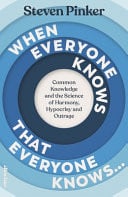
WHEN EVERYONE KNOWS THAT EVERYONE KNOWS... : COMMON KNOWLEDGE AND THE SCIENCE OF HARMONY, HYPOCRISY

PINKER, STEVEN, 1954-
Common knowledge is necessary for coordination, for making arbitrary but complementary choices like driving on the right, using paper currency, and coalescing behind a political leader or movement. It's also necessary for social coordination: everything from rendezvousing at a time and place to speaking the same language to forming enduring relationships of friendship, romance, or authority. Humans have a sixth sense for common knowledge, and we create it with signals like laughter, tears, blushing, eye contact, and blunt speech. But people also go to great lengths to avoid common knowledge -- to ensure that even if everyone knows something, they can't know that everyone else knows they know it. And so we get rituals like benign hypocrisy, veiled bribes and threats, sexual innuendo, and pretending not to see the elephant in the room. Pinker shows how the hidden logic of common knowledge can make sense of many of life's enigmas: financial bubbles and crashes, revolutions that come out of nowhere, the posturing and pretense of diplomacy, the eruption of social media shaming mobs and academic cancel culture, the awkwardness of a first date. Artists and humorists have long mined the intrigues of common knowledge, and Pinker liberally uses their novels, jokes, cartoons, films, and sitcom dialogues to illuminate social life's tragedies and comedies. Along the way he answers questions like: Why do people hoard toilet paper at the first sign of an emergency? Why are Super Bowl ads filled with ads for crypto? Why, in American presidential primary voting, do citizens typically select the candidate they believe is preferred by others rather than their favorite? Why did Russian authorities arrest a protester who carried a blank sign? Why is it so hard for nervous lovers to say goodbye at the end of a phone call? Why does everyone agree that if we were completely honest all the time, life would be unbearable? Consistently riveting in explaining the paradoxes of human behavior, When Everyone Knows That Everyone Knows... invites us to understand the ways we try to get into each other's heads and the harmonies, hypocrisies, and outrages that result. -- Provided by publisher.
ALLEN LANE 2025-09-04 384 pages

The ideas industry

Drezner, Daniel W.
" The public intellectual, as a person and ideal, has a long and storied mythology. Writing in venues like the New Republic and Foreign Affairs, they are expected to opine on a broad array of topics, from foreign policy to literature to economics. Yet in recent years a new kind of thinker has supplanted that archetype: the thought leader. Equipped with one big idea, thought leaders focus their energies on TED talks more than highbrow periodicals. How did this shift happen? In The Ideas Industry, Daniel W. Drezner points to the roles of political polarization, heightened inequality, and eroding trust in authority as ushering in the change. In contrast to public intellectuals, thought leaders gain fame as single-idea merchants. Their ideas are often laudable and highly ambitious: ending global poverty by 2025, for example. But instead of a class composed of university professors and freelance intellectuals debating in highbrow magazines, thought leaders can bypass traditional gatekeepers to directly influence policymakers and the public. They are more immune to criticism--and in this century, the criticism of public intellectuals also counts for less. Three factors have reshaped the world of ideas: waning trust in expertise, increasing political polarization and rising levels of plutocracy. The erosion of trust has lowered the barriers to entry in the marketplace of ideas. Thought leaders don't need doctorates or fellowships to advance their arguments. Polarization is hardly a new phenomenon, but in contrast to their predecessors, today's intellectuals are more likely to enjoy the support of ideologically friendly private funders and be housed in ideologically-driven think tanks. Increasing inequality is a key driver: more than ever before, contemporary plutocrats fund intellectuals and policy shops that generate arguments that align with their own. There are downsides to the contemporary ideas industry, but Drezner argues that it is very good at broadcasting ideas widely and reaching large audiences of people hungry for new thinking. Both fair-minded and trenchant, The Ideas Industry will reshape our understanding of contemporary public intellectual life in America and the West."--
Oxford University Press 2017 344 pages