52 results for "Social Media"

Our revolution: a future to believe in

Sanders, Bernie
"When Bernie Sanders began his race for the presidency, it was considered by the political establishment and the media to be a "fringe" campaign, something not to be taken seriously. After all, he was just an independent senator from a small state with little name recognition. His campaign had no money, no political organization, and it was taking on the entire Democratic Party establishment. By the time Sanders's campaign came to a close, however, it was clear that the pundits had gotten it wrong. Bernie had run one of the most consequential campaigns in the modern history of the country. He had received more than 13 million votes in primaries and caucuses throughout the country, won twenty-two states, and more than 1.4 million people had attended his public meetings. Most important, he showed that the American people were prepared to take on the greed and irresponsibility of corporate America and the 1 percent. In Our Revolution, Sanders shares his personal experiences from the campaign trail, recounting the details of his historic primary fight and the people who made it possible. And for the millions looking to continue the political revolution, he outlines a progressive economic, environmental, racial, and social justice agenda that will create jobs, raise wages, protect the environment, and provide health care for all--and ultimately transform our country and our world for the better. For him, the political revolution has just started. The campaign may be over, but the struggle goes on"--Provided by publisher.
Thomas Dunne Books 2017-08-29 450 pages

The Case Against Impeaching Trump

Alan Dershowitz
The New York Times bestseller! "A brilliant lawyer...A new and very important book. I would encourage all people...to read!"—President Donald J. Trump “Absolutely amazing…. If you care about justice...you’re going to want to read this book.”—Sean Hannity “Maybe the question isn’t what happened to Alan Dershowitz. Maybe it’s what happened to everyone else.”— Politico Alan Dershowitz has been called “one of the most prominent and consistent defenders of civil liberties in America” by Politico and “the nation’s most peripatetic civil liberties lawyer and one of its most distinguished defenders of individual rights” by Newsweek . Yet he has come under partisan fire for applying those same principles to Donald Trump during the course of his many appearances in national media outlets as an expert resource on civil and constitutional law. The Case Against Impeaching Trump seeks to reorient the debate over impeachment to the same standard that Dershowitz has continued to uphold for decades: the law of the United States of America, as established by the Constitution. In the author’s own words: “In the fervor to impeach President Trump, his political enemies have ignored the text of the Constitution. As a civil libertarian who voted against Trump, I remind those who would impeach him not to run roughshod over a document that has protected us all for two and a quarter centuries. In this case against impeachment, I make arguments similar to those I made against the impeachment of President Bill Clinton (and that I would be making had Hillary Clinton been elected and Republicans were seeking to impeach her). Impeachment and removal of a president are not entirely political decisions by Congress. Every member takes an oath to uphold the Constitution of the United States, and the Constitution sets out specific substantive criteria that MUST be met. I am thrilled to contribute to this important debate and especially that my book will be so quickly available to readers so they can make up their own minds.”
Hot Books 2018-07-09 160 pages

Public Opinion by Walter Lippmann

Walter Lippmann
"Public Opinion" is the fascinating study of the role of citizens in a democracy by Walter Lippmann, an American writer, reporter and political commentator. Lippmann's notable career spanned decades and produced some of the most important journalism in American history. He was the first to introduce the concept of the Cold War, received many awards, including two Pulitzer Prizes, and wrote thousands of articles and columns, earning him the title of the "Great Elucidator". "Public Opinion" is Lippmann's assessment of a functional democratic government and the role that citizens play in the democracy. Lippmann examines the dilemmas presented in revolutionary periods of history and raises doubts on the ability of citizens to effectively govern themselves. He draws important attention to the media's role in shaping public perceptions and opinions and presciently warns against the power of propaganda. Lippmann's work exploring modern democracy, how it functions, and what situations most threaten its success have made "Public Opinion" a staple in the field of political science. Lippmann's work was far ahead of its time in understanding the dangers of propaganda and his conclusions remain relevant and thought-provoking nearly a century later.
Editorial Benei Noaj 2010-11 276 pages

Where We Go from Here

Bernie Sanders
BERNIE'S BLUEPRINT FOR 2020. AN INSTANT NATIONAL BESTSELLER. In Where We Go from Here, New York Times bestselling author Bernie Sanders reveals the blueprint for his 2020 presidential run by chronicling the day-by-day struggles that he and his progressive colleagues have waged over the last two years in the fight against Donald Trump's reactionary agenda and for a government that works for all, not just wealthy campaign contributors. At home, Sanders has helped lead the fight for Medicare for all, fought for workers desperate for higher wages, and supported immigrants in the DACA program and children affected by gun violence. He has stood with the people of Puerto Rico devastated by Hurricane Maria, as well as veterans, teachers, the incarcerated, the persecuted, and all those who are too often ignored by Washington. Abroad, his voice has been clear that we need a foreign policy that strives for peace—not war—and international cooperation to address the crisis of climate change. The good news is we're making progress. People all across America are standing up to the most dishonest and reactionary president in our history. They're taking on establishment politicians who've turned a blind eye to the concerns of everyday citizens. They're fighting back against the oligarchs of Wall Street, who would happily see our children do worse than their parents so long as the Dow does better. And the general public continually demonstrates that we are more united than the media would allow us to believe, and what we agree on are largely progressive ideals. Maintaining a vibrant democracy has never been easy, and in these dangerous and unprecedented times, it has been more difficult than ever. Bernie Sanders shows, however, that we can repair the damage Trump has done—and create a nation based on the principles of economic, social, racial, and environmental justice.
St. Martin's Publishing Group 2019-09-03 288 pages

The Terror Dream Myth and Misogyny in an Insecure America

Susan Faludi
It has become clear over the years that the reaction of America's politicians and media to the attacks of 9/11 was bizarrely misdirected and dangerous to our national security. But no one has fully probed its cultural roots. Until now. Pulitzer Prize–winning journalist and bestselling author Susan Faludi brilliantly demonstrates how our culture's seemingly inexplicable response was actually a reflex set centuries deep in the American grain. Her analysis of what went on in the months and years after 9/11 will shock even those who thought they knew the full measure of that tragedy (as her account of the post-9/11 media marketing of flight-suit superheroes, cowering "security moms," Jessica-Lynchesque helpless "girls," and Daniel Boone–wannabe politicians will outrage and amuse). A masterwork of historical interpretation and a Rosetta stone for deciphering the ongoing spectacle of American politics, journalism, and culture, The Terror Dream flushes from hiding a forceful dynamic that disfigures our lives even in times of normalcy, and that, unless it is confronted, will send us reeling in a wrong direction the next time tragedy strikes.
Picador 2008-09-02 480 pages

Among The Truthers North America's Growing Conspiracist Undergro

Jonathan Kay
Millions of people around the world have convinced themselves that the perpetrators of 9/11 were not al-Qaeda terrorists but elements within the U.S. government seeking a pretext to launch wars abroad and enact draconian laws at home. These “9/11 Truthers” are not alone. They are part of a vast conspiracist subculture that is spreading like wildfire on the Internet, is deeply distrustful of mainstream media and is beginning to influence mainstream politics. For two years, Canadian journalist Jonathan Kay has been researching the underground world of conspiracy theorists by attending their conventions, infiltrating their Internet discussion boards and surfing their websites. While many individual conspiracy theories seem harmless, even amusing, the phenomenon is doing real damage to the unity and health of North American society. Since the assassination of JFK, conspiracy thinking has proliferated, and the Internet has fostered the growth of numerous alternate mental worlds in which traditional media and academia have no authority. 9/11 was a death blow to this older consensual view of reality, and as a result, North Americans no longer inhabit one cognitive universe. What this means for the future of politics, and our society at large, is the ultimate subject of this book.
HarperCollins 2012-05-08 368 pages

Myths, Lies, and Downright Stupidity Get Out the Shovel -- Why Everything You Know is Wrong

John Stossel of abc 20/20
Now in paperback: The major national bestseller that the New York Times says "tosses sand on liberal sacred cows"John Stossel -- award-winning journalist, tireless consumer-rights crusader, and anchor of ABC's newsmagazine 20/20 -- has built his reputation on his willingness to debunk conventional wisdom, no matter the source. In his latest New York Times bestseller, which has sold more than 200,000 copies in hardcover, he busts the myths, lies, and downright stupidity clogging media outlets on all sides of the spectrum. Taking a shovel to the heaps of misinterpretations and outright mistakes passing for "fact" these days, Stossel proves:--That contrary to popular belief, Americans have more free time now than ever before; --How DDT could actually save millions of lives annually, if only we hadn't been wrongly convinced it caused cancer; --That Republicans don't shrink government -- they expand it; --Why bottled water is a rip-off (hint: not only doesn't it taste better than tap, it's no healthier either!); --How "defective product" lawsuits end up depriving us of safer products; --Why it's okay to marry your cousin; --And much, much more.Bursting with facts, sharp insights, and plain old common sense, Myths, Lies, and Downright Stupidity is a modern muckraking classic.
Hyperion Books 2007-05-01 320 pages

How Propaganda Works

Jason Stanley
How propaganda undermines democracy and why we need to pay attention Our democracy today is fraught with political campaigns, lobbyists, liberal media, and Fox News commentators, all using language to influence the way we think and reason about public issues. Even so, many of us believe that propaganda and manipulation aren't problems for us--not in the way they were for the totalitarian societies of the mid-twentieth century. In How Propaganda Works , Jason Stanley demonstrates that more attention needs to be paid. He examines how propaganda operates subtly, how it undermines democracy--particularly the ideals of democratic deliberation and equality--and how it has damaged democracies of the past. Focusing on the shortcomings of liberal democratic states, Stanley provides a historically grounded introduction to democratic political theory as a window into the misuse of democratic vocabulary for propaganda's selfish purposes. He lays out historical examples, such as the restructuring of the US public school system at the turn of the twentieth century, to explore how the language of democracy is sometimes used to mask an undemocratic reality. Drawing from a range of sources, including feminist theory, critical race theory, epistemology, formal semantics, educational theory, and social and cognitive psychology, he explains how the manipulative and hypocritical declaration of flawed beliefs and ideologies arises from and perpetuates inequalities in society, such as the racial injustices that commonly occur in the United States. How Propaganda Works shows that an understanding of propaganda and its mechanisms is essential for the preservation and protection of liberal democracies everywhere.
Princeton University Press 2021-02-23 376 pages

How the World Works

Noam Chomsky,David Barsamian
An eye-opening introduction to the timelessly relevant ideas of Noam Chomsky, "arguably the most important intellectual alive" (The New York Times ), this book is a penetrating, illusion-shattering look at how things really work Offering something not found anywhere else, How the World Works is pure Chomsky, but tailored for those who are new to his work. The book is made up of meticulously edited speeches and interviews, and every dazzling idea and penetrating insight is kept intact and delivered in clear, accessible, reader-friendly prose. Originally published as a series of short works— What Uncle Sam Really Wants ; The Prosperous Few and the Restless Many ; Secrets, Lies and Democracy ; and The Common Good —these volumes together sold nearly 600,000 copies. Now collected into one comprehensive anthology, How the World Works reveals how Chomsky’s then-revolutionary ideas have only become more relevant as time has gone by. From the concept that extreme wealth and democracy cannot exist side-by-side; to how the assumptions of mainstream media purposefully limit the spectrum of acceptable opinion; to the decline of unions and workers’ rights thanks to corporations and their unconstrained quest for profit, Chomsky’s prescient theories of the future—not only the future of the United States, but of the world—make it very clear that our society is paying the price now for not heeding him then.
Catapult 2011-09-20 416 pages

Age of Propaganda: The Everyday Use & Abuse of Persuasion

Anthony Pratkanis,Elliott Aronson
Amer. consume 57% of the world's advertising while representing only 6% of the population, & half of our waking hours are spent immersed in the mass media. Drawing on the history of propaganda as well as on contemporary res. in social psychol., this book shows how the tactics used by political campaigners, sales agents, advertisers, televangelists, demagogues, & others often take advantage of our emotions by appealing to our deepest fears & most irrational hopes, creating a distorted vision of the world we live. This updated ed. includes coverage of the Clinton/Lewinsky scandal, recent election campaigns, talk radio, teen suicide, UFO abductions, the Columbine shootings, & novel propaganda tactics based on hypocrisy & false allegations.
Diane Pub Co 2001-01-01 416 pages

The Good Girls Revolt How the Women of Newsweek Sued their Bosses and Changed the Workplace

Lynn Povich
It was the 1960s--a time of economic boom and social strife. Young women poured into the workplace, but the "Help Wanted" ads were segregated by gender and the "Mad Men" office culture was rife with sexual stereotyping and discrimination. Lynn Povich was one of the lucky ones, landing a job at Newsweek , renowned for its cutting-edge coverage of civil rights and the "Swinging Sixties." Nora Ephron, Jane Bryant Quinn, Ellen Goodman, and Susan Brownmiller all started there as well. It was a top-notch job--for a girl--at an exciting place. But it was a dead end. Women researchers sometimes became reporters, rarely writers, and never editors. Any aspiring female journalist was told, "If you want to be a writer, go somewhere else." On March 16, 1970, the day Newsweek published a cover story on the fledgling feminist movement entitled "Women in Revolt," forty-six Newsweek women charged the magazine with discrimination in hiring and promotion. It was the first female class action lawsuit--the first by women journalists--and it inspired other women in the media to quickly follow suit. Lynn Povich was one of the ringleaders. In The Good Girls Revolt , she evocatively tells the story of this dramatic turning point through the lives of several participants. With warmth, humor, and perspective, she shows how personal experiences and cultural shifts led a group of well-mannered, largely apolitical women, raised in the 1940s and 1950s, to challenge their bosses--and what happened after they did. For many, filing the suit was a radicalizing act that empowered them to "find themselves" and fight back. Others lost their way amid opportunities, pressures, discouragements, and hostilities they weren't prepared to navigate. The Good Girls Revolt also explores why changes in the law didn't solve everything. Through the lives of young female journalists at Newsweek today, Lynn Povich shows what has--and hasn't--changed in the workplace.
PublicAffairs 2016-09-27 304 pages

Ideology and Utopia An Introduction to the Sociology of Knowledge

Karl Mannheim
This work has been selected by scholars as being culturally important, and is part of the knowledge base of civilization as we know it. This work is in the "public domain in the United States of America, and possibly other nations. Within the United States, you may freely copy and distribute this work, as no entity (individual or corporate) has a copyright on the body of the work. Scholars believe, and we concur, that this work is important enough to be preserved, reproduced, and made generally available to the public. We appreciate your support of the preservation process, and thank you for being an important part of keeping this knowledge alive and relevant.
Creative Media Partners, LLC 2022-10-26 352 pages

World Without Mind

Franklin Foer
Over the past few decades there has been a revolution in terms of who controls knowledge and information. This rapid change has imperilled the way we think. Without pausing to consider the cost, the world has rushed to embrace the products and services of four titanic corporations. We shop with Amazon; socialise on Facebook; turn to Apple for entertainment; and rely on Google for information. These firms sell their efficiency and purport to make the world a better place, but what they have done instead is to enable an intoxicating level of daily convenience. As these companies have expanded, marketing themselves as champions of individuality and pluralism, their algorithms have pressed us into conformity and laid waste to privacy. They have produced an unstable and narrow culture of misinformation, and put us on a path to a world without private contemplation, autonomous thought, or solitary introspection - a world without mind. In order to restore our inner lives, we must avoid being co-opted by these gigantic companies, and understand the ideas that underpin their success. Elegantly tracing the intellectual history of computer science - from the Descartes and the enlightenment to Alan Turing to Stuart Brand and the hippie origins of today's Silicon Valley - Foer exposes the dark underpinnings of our most idealistic dreams for technology. The corporate ambitions of Google, Facebook, Apple, and Amazon, he argues, are trampling longstanding liberal values, especially intellectual property and privacy. This is a nascent stage in the total automation and homogenization of social, political, and intellectual life. By reclaiming our private authority over how we intellectually engage with the world, we have the power to stem the tide. At stake is nothing less than who we are, and what we will become. There have been monopolists in the past but today's corporate giants have far more nefarious aims. They're monopolists who want access to every facet of our identities and influence over every corner of our decision-making. Until now few have grasped the sheer scale of the threat. Foer explains not just the looming existential crisis but the imperative of resistance.
Jonathan Cape Ltd 2017-09-28 272 pages

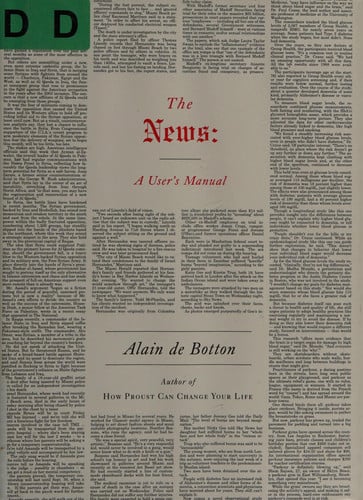
The News A User's Manual

Alain De Botton
From the author of The Architecture of Happiness , a thought-provoking look at the position that news has achieved in our lives. The news is everywhere. We can't stop constantly checking it on our computer screens, but what is this doing to our minds? We are never really taught how to make sense of the torrent of news we face every day, writes Alain de Botton, but this has a huge impact on our sense of what matters and of how we should lead our lives. In his dazzling new book, de Botton takes twenty-five archetypal news stories--including an airplane crash, a murder, a celebrity interview and a political scandal--and submits them to unusually intense analysis with a view to helping us navigate our news-soaked age. He raises such questions as: Why are disaster stories often so uplifting? What makes the love lives of celebrities so interesting? Why do we enjoy watching politicians being brought down? Why are upheavals in far-off lands often so boring? In The News: A User's Manual , de Botton has written the ultimate guide for our frenzied era, certain to bring calm, understanding and a measure of sanity to our daily (perhaps even hourly) interactions with the news machine.
McClelland & Stewart 2014-12-02 272 pages

A Preface to Politics

Walter Lippmann
Walter Lippmann (September 23, 1889 - December 14, 1974) was an American writer, reporter, and political commentator famous for being among the first to introduce the concept of Cold War, coining the term "stereotype" in the modern psychological meaning, and critiquing media and democracy in his newspaper column and several books, most notably his 1922 book Public Opinion.
CreateSpace Independent Publishing Platform 2016-03-07 120 pages

The Opposite of Hate A Field Guide to Repairing Our Humanity

Sally Kohn
“Brilliantly illustrates the immense and disarming power of changing course and driving not toward division, but toward civility and mutual respect.” -- Ms . magazine As a progressive commentator on Fox News and now CNN, Sally Kohn has made a career out of bridging intractable political differences. In this age of dangerous partisan resentment and rising bigotry, she decided to investigate hate itself--to better consider how we can stop it. With her trademark humor and humanity, Kohn introduces us to leading researchers and scientists who are exploring the evolutionary and cultural roots of hate. She travels to Rwanda, to the Middle East, and across the United States, talking with former terrorists and reformed white supremacists, and even sitting down with some of her own Twitter trolls. What she discovers is surprising: All of us harbor hate but the powerful acknowledgment that we are all in this together can lead us out of the wilderness. The opposite of hate is connection .
Algonquin Books 2019-03-26 272 pages

Power and Terror

Noam Chomsky
Immediately after the terrorist attacks of September 11, Noam Chomsky's always tightly scheduled life ratcheted several levels higher in intensity. In the months that followed, he gave a great many public talks and countless interviews, many of them with the foreign media, who turned to him as one of the small handful of American intellectuals who stood opposed to the Bush administration's aggressive military response to the attacks. With unflagging conviction, Chomsky must have repeated a thousand times his argument that we cannot address terrorism of the weak against the powerful without also confronting "the unmentionable but far more extreme terrorism of the powerful against the weak". The argument, supported with an ever-expanding array of historical case studies, documents, and analyses, fell on deaf ears in Washington and in the mainstream American media, but resonated with large audiences in the United states and abroad who turned once agin to Chomsky for the voice of reason and consience that he has provided for decades. Chomsky's voice also reached Japan, where I live, in the form of a translation of his book 9-11 (subtitled in Japanese, "America Is Not Qualified to Retaliate!"), which was rushed into publication at the end of November. Inspired by the book, a producer at an independent Japanese film company and the author began to make plans to produce a documentary about Chomsky and his perspective on terrorism and American power. This book is an outgrowth of that effort
Jacana Media 2003 160 pages

The Good Society

Walter Lippmann
This work has been selected by scholars as being culturally important, and is part of the knowledge base of civilization as we know it. This work was reproduced from the original artifact, and remains as true to the original work as possible. Therefore, you will see the original copyright references, library stamps (as most of these works have been housed in our most important libraries around the world), and other notations in the work. This work is in the public domain in the United States of America, and possibly other nations. Within the United States, you may freely copy and distribute this work, as no entity (individual or corporate) has a copyright on the body of the work. As a reproduction of a historical artifact, this work may contain missing or blurred pages, poor pictures, errant marks, etc. Scholars believe, and we concur, that this work is important enough to be preserved, reproduced, and made generally available to the public. We appreciate your support of the preservation process, and thank you for being an important part of keeping this knowledge alive and relevant.
Creative Media Partners, LLC 2017-08-24 428 pages

How to Read Donald Duck Imperialist Ideology in the Disney Comic

Ariel Dorfman,Armand Mattelart
First published in 1971 in Chile, where the entire third edition was dumped into the ocean by the Chilean Navy and bonfires were held to destroy earlier editions, How to Read Donald Duck reveals the imperialist, capitalist ideology at work in our most beloved cartoons.Focusing on the hapless mice and ducks of Disney-curiously parentless, marginalized, always short of cash-Ariel Dorfman and Armand Mattelart dissect the narratives of dependency and social aspiration that define the Disney corpus. Disney recognized the challenge and, when the book was translated and imported into the United States in 1975, managed to have all 4,000 copies impounded. Ultimately, 1,500 copies of the book were allowed into the country, the rest of the shipment was blocked, and until now no American publisher has re-released the book, which has sold over 1 million copies worldwide. (The original English language edition is now a collector's item, selling for up to $500 on Amazon.)A devastating indictment of a media giant, a document of twentieth-century political upheaval, and a reminder of the dark potential of pop culture, How to Read Donald Duck was published in seventeen languages-and is now available once again, together with a new introduction by Ariel Dorfman.
OR Books, LLC 2018-08-07 192 pages