11 results for "Social Media"

Our revolution: a future to believe in

Sanders, Bernie
"When Bernie Sanders began his race for the presidency, it was considered by the political establishment and the media to be a "fringe" campaign, something not to be taken seriously. After all, he was just an independent senator from a small state with little name recognition. His campaign had no money, no political organization, and it was taking on the entire Democratic Party establishment. By the time Sanders's campaign came to a close, however, it was clear that the pundits had gotten it wrong. Bernie had run one of the most consequential campaigns in the modern history of the country. He had received more than 13 million votes in primaries and caucuses throughout the country, won twenty-two states, and more than 1.4 million people had attended his public meetings. Most important, he showed that the American people were prepared to take on the greed and irresponsibility of corporate America and the 1 percent. In Our Revolution, Sanders shares his personal experiences from the campaign trail, recounting the details of his historic primary fight and the people who made it possible. And for the millions looking to continue the political revolution, he outlines a progressive economic, environmental, racial, and social justice agenda that will create jobs, raise wages, protect the environment, and provide health care for all--and ultimately transform our country and our world for the better. For him, the political revolution has just started. The campaign may be over, but the struggle goes on"--Provided by publisher.
Thomas Dunne Books 2017-08-29 450 pages

The Case Against Impeaching Trump

Alan Dershowitz
The New York Times bestseller! "A brilliant lawyer...A new and very important book. I would encourage all people...to read!"—President Donald J. Trump “Absolutely amazing…. If you care about justice...you’re going to want to read this book.”—Sean Hannity “Maybe the question isn’t what happened to Alan Dershowitz. Maybe it’s what happened to everyone else.”— Politico Alan Dershowitz has been called “one of the most prominent and consistent defenders of civil liberties in America” by Politico and “the nation’s most peripatetic civil liberties lawyer and one of its most distinguished defenders of individual rights” by Newsweek . Yet he has come under partisan fire for applying those same principles to Donald Trump during the course of his many appearances in national media outlets as an expert resource on civil and constitutional law. The Case Against Impeaching Trump seeks to reorient the debate over impeachment to the same standard that Dershowitz has continued to uphold for decades: the law of the United States of America, as established by the Constitution. In the author’s own words: “In the fervor to impeach President Trump, his political enemies have ignored the text of the Constitution. As a civil libertarian who voted against Trump, I remind those who would impeach him not to run roughshod over a document that has protected us all for two and a quarter centuries. In this case against impeachment, I make arguments similar to those I made against the impeachment of President Bill Clinton (and that I would be making had Hillary Clinton been elected and Republicans were seeking to impeach her). Impeachment and removal of a president are not entirely political decisions by Congress. Every member takes an oath to uphold the Constitution of the United States, and the Constitution sets out specific substantive criteria that MUST be met. I am thrilled to contribute to this important debate and especially that my book will be so quickly available to readers so they can make up their own minds.”
Hot Books 2018-07-09 160 pages

Where We Go from Here

Bernie Sanders
BERNIE'S BLUEPRINT FOR 2020. AN INSTANT NATIONAL BESTSELLER. In Where We Go from Here, New York Times bestselling author Bernie Sanders reveals the blueprint for his 2020 presidential run by chronicling the day-by-day struggles that he and his progressive colleagues have waged over the last two years in the fight against Donald Trump's reactionary agenda and for a government that works for all, not just wealthy campaign contributors. At home, Sanders has helped lead the fight for Medicare for all, fought for workers desperate for higher wages, and supported immigrants in the DACA program and children affected by gun violence. He has stood with the people of Puerto Rico devastated by Hurricane Maria, as well as veterans, teachers, the incarcerated, the persecuted, and all those who are too often ignored by Washington. Abroad, his voice has been clear that we need a foreign policy that strives for peace—not war—and international cooperation to address the crisis of climate change. The good news is we're making progress. People all across America are standing up to the most dishonest and reactionary president in our history. They're taking on establishment politicians who've turned a blind eye to the concerns of everyday citizens. They're fighting back against the oligarchs of Wall Street, who would happily see our children do worse than their parents so long as the Dow does better. And the general public continually demonstrates that we are more united than the media would allow us to believe, and what we agree on are largely progressive ideals. Maintaining a vibrant democracy has never been easy, and in these dangerous and unprecedented times, it has been more difficult than ever. Bernie Sanders shows, however, that we can repair the damage Trump has done—and create a nation based on the principles of economic, social, racial, and environmental justice.
St. Martin's Publishing Group 2019-09-03 288 pages

Myths, Lies, and Downright Stupidity Get Out the Shovel -- Why Everything You Know is Wrong

John Stossel of abc 20/20
Now in paperback: The major national bestseller that the New York Times says "tosses sand on liberal sacred cows"John Stossel -- award-winning journalist, tireless consumer-rights crusader, and anchor of ABC's newsmagazine 20/20 -- has built his reputation on his willingness to debunk conventional wisdom, no matter the source. In his latest New York Times bestseller, which has sold more than 200,000 copies in hardcover, he busts the myths, lies, and downright stupidity clogging media outlets on all sides of the spectrum. Taking a shovel to the heaps of misinterpretations and outright mistakes passing for "fact" these days, Stossel proves:--That contrary to popular belief, Americans have more free time now than ever before; --How DDT could actually save millions of lives annually, if only we hadn't been wrongly convinced it caused cancer; --That Republicans don't shrink government -- they expand it; --Why bottled water is a rip-off (hint: not only doesn't it taste better than tap, it's no healthier either!); --How "defective product" lawsuits end up depriving us of safer products; --Why it's okay to marry your cousin; --And much, much more.Bursting with facts, sharp insights, and plain old common sense, Myths, Lies, and Downright Stupidity is a modern muckraking classic.
Hyperion Books 2007-05-01 320 pages

Age of Propaganda: The Everyday Use & Abuse of Persuasion

Anthony Pratkanis,Elliott Aronson
Amer. consume 57% of the world's advertising while representing only 6% of the population, & half of our waking hours are spent immersed in the mass media. Drawing on the history of propaganda as well as on contemporary res. in social psychol., this book shows how the tactics used by political campaigners, sales agents, advertisers, televangelists, demagogues, & others often take advantage of our emotions by appealing to our deepest fears & most irrational hopes, creating a distorted vision of the world we live. This updated ed. includes coverage of the Clinton/Lewinsky scandal, recent election campaigns, talk radio, teen suicide, UFO abductions, the Columbine shootings, & novel propaganda tactics based on hypocrisy & false allegations.
Diane Pub Co 2001-01-01 416 pages

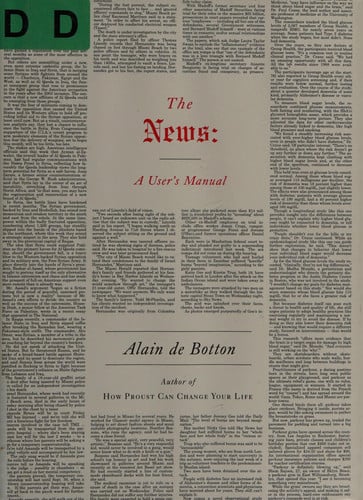
The News A User's Manual

Alain De Botton
From the author of The Architecture of Happiness , a thought-provoking look at the position that news has achieved in our lives. The news is everywhere. We can't stop constantly checking it on our computer screens, but what is this doing to our minds? We are never really taught how to make sense of the torrent of news we face every day, writes Alain de Botton, but this has a huge impact on our sense of what matters and of how we should lead our lives. In his dazzling new book, de Botton takes twenty-five archetypal news stories--including an airplane crash, a murder, a celebrity interview and a political scandal--and submits them to unusually intense analysis with a view to helping us navigate our news-soaked age. He raises such questions as: Why are disaster stories often so uplifting? What makes the love lives of celebrities so interesting? Why do we enjoy watching politicians being brought down? Why are upheavals in far-off lands often so boring? In The News: A User's Manual , de Botton has written the ultimate guide for our frenzied era, certain to bring calm, understanding and a measure of sanity to our daily (perhaps even hourly) interactions with the news machine.
McClelland & Stewart 2014-12-02 272 pages

Vote.com Influence, and the Internet is Giving Power Back to the People

Dick Morris
As the print and broadcast media-commonly referred to as the Fourth Estate-falters and fails, a new social and political force is rising in power. The Fifth Estate, as Morris has dubbed it, is made up of the rapidly growing number of voters who use Internet technology. This army of younger citizens with easy access to information and a direct link to their representatives heralds a new dawning of democracy, putting political power back into the hands of the people.
St. Martin's Press 2000-09-16 256 pages

Inside the Presidential Debates Their Improbable Past and Promising Future

Newton N. Minow,Craig L. LaMay
Newton Minow’s long engagement with the world of television began nearly fifty years ago when President Kennedy appointed him chairman of the Federal Communications Commission. As its head, Minow would famously dub TV a “vast wasteland,” thus inaugurating a career dedicated to reforming television to better serve the public interest. Since then, he has been chairman of PBS and on the board of CBS and elsewhere, but his most lasting contribution remains his leadership on televised presidential debates. He was assistant counsel to Illinois governor Adlai Stevenson when Stevenson first proposed the idea of the debates in 1960; he served as cochair of the presidential debates in 1976 and 1980; and he helped create and is currently vice chairman of the Commission on Presidential Debates, which has organized the debates for the last two decades. Written with longtime collaborator Craig LaMay, this fascinating history offers readers for the first time a genuinely inside look into the origins of the presidential debates and the many battles—both legal and personal—that have determined who has been allowed to debate and under what circumstances. The authors do not dismiss the criticism of the presidential debates in recent years but do come down solidly in favor of them, arguing that they are one of the great accomplishments of modern American electoral politics. As they remind us, the debates were once unique in the democratic world, are now emulated across the globe, and they offer the public the only real chance to see the candidates speak in direct response to one another in a discussion of major social, economic, and foreign policy issues. Looking to the challenges posed by third-party candidates and the emergence of new media such as YouTube, Minow and LaMay ultimately make recommendations for the future, calling for the debates to become less formal, with candidates allowed to question each other and citizens allowed to question candidates directly. They also explore the many ways in which the Internet might serve to broaden the debates’ appeal and informative power. Whether it’s Clinton or Obama vs. McCain, Inside the Presidential Debates will be welcomed in 2008 by anyone interested in where this crucial part of our democracy is headed—and how it got there.
University of Chicago Press 2016-07-28 237 pages

Cultural Forms of Protest in Russia

Birgit Beumers,Alexander Etkind,Olga Gurova,Sanna Turoma
Alongside the Arab Spring, the 'Occupy' anti-capitalist movements in the West, and the events on the Maidan in Kiev, Russia has had its own protest movements, notably the political protests of 2011-12. As elsewhere in the world, these protests had unlikely origins, in Russia's case spearheaded by the 'creative class'. This book examines the protest movements in Russia. It discusses the artistic traditions from which the movements arose; explores the media, including the internet, film, novels, and fashion, through which the protesters have expressed themselves; and considers the outcome of the movements, including the new forms of nationalism, intellectualism, and feminism put forward. Overall, the book shows how the Russian protest movements have suggested new directions for Russian - and global - politics.
Routledge 2019 248 pages

Beyond the Cold War Soviet and American Media Images

Everette E. Dennis,George Gerbner,Yassen N. Zassoursky
Beyond the Cold War represents the first-ever attempt by media scholars and journalists to dissect the Cold War by examining mutual media images in the United States and the former Soviet Union. The result of a bilateral conference in Moscow in 1989, this volume offers an original journalistic assessment of the Cold War and its aftermath as a communications phenomenon. Discussions include the past and present state of Cold War rhetoric, the portrayal of Russians and Americans on television in the two countries, and images of self and other as portrayed by the two media.
Books on Demand 180 pages