
4 results for "Technology"

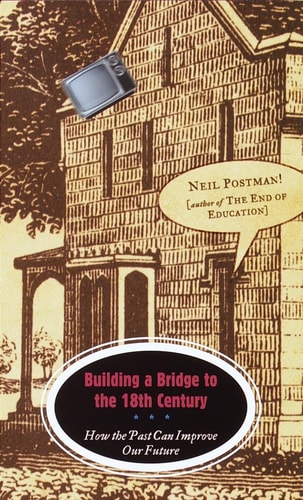
Building a bridge to the 18th century: how the past can improve our future

Postman, Neil
In Building a Bridge to the 18th Century , acclaimed cultural critic Neil Postman offers a cure for the hysteria and hazy values of the postmodern world. Postman shows us how to reclaim that balance between mind and machine in a dazzling celebration of the accomplishments of the Enlightenment-from Jefferson's representative democracy to Locke's deductive reasoning to Rousseau's demand that the care and edification of children be considered an investment in our collective future. Here, too, is the bold assertion that Truth is invulnerable to fashion or the passing of time. Provocative and brilliantly argued, Building a Bridge to the 18th Century illuminates a navigable path through the Information Age-a byway whose signposts, it turns out, were there all along.
Knopf 2000-10-10 213 pages

The enlightened economy: an economic history of Britain, 1700-1850

Mokyr, Joel
"This book focuses on the importance of ideological and institutional factors in the rapid development of the British economy during the years between the Glorious Revolution and the Crystal Palace Exhibition. Joel Mokyr shows that we cannot understand the Industrial Revolution without recognizing the importance of the intellectual sea changes of Britain's Age of Enlightenment. In a vigorous discussion, Mokyr goes beyond the standard explanations that credit geographical factors, the role of markets, politics, and society to show that the beginnings of modern economic growth in Britain depended a great deal on what key players knew and believed, and how those beliefs affected their economic behavior. He argues that Britain led the rest of Europe into the Industrial Revolution because it was there that the optimal intersection of ideas, culture, institutions, and technology existed to make rapid economic growth achievable. His wide-ranging evidence covers sectors of the British economy often neglected, such as the service industries." -- Publisher description.
Yale University Press 2009 564 pages

Changing perspectives in literature and the visual arts, 1650-1820

Roston, Murray
Continuing with the theme of his work Renaissance Perspectives in Literature and the Visual Arts , Murray Roston applies to a later period the same critical principle: that for each generation there exists a central complex of inherited ideas and urgent contemporary concerns to which each creative artist and writer responds in his or her own way. Roston demonstrates that what emerges is not a fixed or monolithic pattern for each generation but a dynamic series of responses to shared challenges. The book relates leading English writers and literary modes to contemporary developments in architecture, painting, and sculpture. "A sumptuous book. . . . Clearly and gracefully written and cogently argued, Roston's admirable achievement is of paramount significance to literary studies, to cultural and art history, and to aesthetics. . . . Outstanding."--Choice Originally published in 1990. The Princeton Legacy Library uses the latest print-on-demand technology to again make available previously out-of-print books from the distinguished backlist of Princeton University Press. These editions preserve the original texts of these important books while presenting them in durable paperback and hardcover editions. The goal of the Princeton Legacy Library is to vastly increase access to the rich scholarly heritage found in the thousands of books published by Princeton University Press since its founding in 1905.
Princeton University Press 2014 454 pages