25 results for "Technology"

21 lessons for the 21st century

Harari, Yuval N.
How do computers and robots change the meaning of being human? How do we deal with the epidemic of fake news? Are nations and religions still relevant? What should we teach our children? As technology advances faster than our understanding of it, hacking becomes a tactic of war, and the world feels more polarized than ever, Yuval Harari addresses the challenge of navigating life in the face of constant and disorienting change and raises the important questions we need to ask ourselves in order to survive. How can we retain freedom of choice when Big Data is watching us? What will the future workforce look like, and how should we ready ourselves for it? How should we deal with the threat of terrorism? Why is liberal democracy in crisis? Harari invites us to consider values, meaning, and personal engagement in a world full of noise and uncertainty. When we are deluged with irrelevant information, clarity is power.
Spiegel & Grau 2018 384 pages

The next 100 years: a forecast for the 21st century

Friedman, George
“Conventional analysis suffers from a profound failure of imagination. It imagines passing clouds to be permanent and is blind to powerful, long-term shifts taking place in full view of the world.” —George Friedman In his long-awaited and provocative new book, George Friedman turns his eye on the future—offering a lucid, highly readable forecast of the changes we can expect around the world during the twenty-first century. He explains where and why future wars will erupt (and how they will be fought), which nations will gain and lose economic and political power, and how new technologies and cultural trends will alter the way we live in the new century. The Next 100 Years draws on a fascinating exploration of history and geopolitical patterns dating back hundreds of years. Friedman shows that we are now, for the first time in half a millennium, at the dawn of a new era—with changes in store, including: • The U.S.-Jihadist war will conclude—replaced by a second full-blown cold war with Russia. • China will undergo a major extended internal crisis, and Mexico will emerge as an important world power. • A new global war will unfold toward the middle of the century between the United States and an unexpected coalition from Eastern Europe, Eurasia, and the Far East; but armies will be much smaller and wars will be less deadly. • Technology will focus on space—both for major military uses and for a dramatic new energy resource that will have radical environmental implications. • The United States will experience a Golden Age in the second half of the century. Written with the keen insight and thoughtful analysis that has made George Friedman a renowned expert in geopolitics and forecasting, The Next 100 Years presents a fascinating picture of what lies ahead. For continual, updated analysis and supplemental material, go to www.Stratfor.com
Doubleday 2009 253 pages

Hog pilots, blue water grunts: the American military in the air, at sea, and on the ground

Kaplan, Robert D.
Foreign affairs journalist Kaplan lets readers experience up close the American military worldwide in the air, at sea, and on the ground: flying in a B-2 bomber, living on a nuclear submarine, and traveling with a Stryker brigade on missions around the world. Provided unprecedented access, Kaplan moves from destroyers off the coast of Indonesia to submarines in the central Pacific, from simulated Iraqi training grounds in Alaska to technology bases in Las Vegas. He goes deep into their highly technical and exotic worlds, and tells this story through the words and perspectives of the enlisted personnel and junior officers themselves--men and women who, as he writes, have "had their national identities as Americans engraved in sharp bas-relief." He not only conveys the vast scope of America's military commitments, but also shows us astonishing and vital operations as they unfold--from the point of view of the troops themselves.--From publisher description
Random House 2007-09-04 428 pages

Merchants of truth: inside the news revolution

Abramson, Jill
The gripping and definitive in-the-room account of the revolution that has swept the news industry over the last decade and reshaped our world. The last decade has seen the News industry face unprecedented change. The sometimes-century old institutions which were once the bastions of truth have had their dominance eroded by vast innovations in viral technology and, as millennial appetites force the industry to choose between principles of objectivity and impartiality, the survivors must confront the horrifying cost of their success- sexual scandal, fake news, the election of President Trump and the shaking of democracy. Taking us behind the scenes at four media titans - BuzzFeed , VICE , The New York Times and The Washington Post - Abramson reveals the human drama behind this shift- one involving deal-making tycoons, thrusting reporters, hard-bitten editors, egomaniacs, bullshitters, provocateurs and bullies, with some surfing and others drowning in the breaking wave of change. 'A cracking, essential read... Abramson knows where most of the bodies are buried and is prepared to draw the reader a detailed map' Guardian
Vintage Books 2020 534 pages

Film after film: or, what became of 21st-century cinema?

Hoberman, J.
In this sly and thought-provoking essay, Village Voice film critic J. Hoberman suggests that it's possible to speak of a distinctive twenty-first century cinema, only a decade into the new millennium. The advent of a new digital technology has led to the displacement of the medium of film - and of the real, as digital image-making ends the necessity of having an actual world, let alone the need for a camera. The future history of motion pictures, Hoberman asserts, will be the history of animation. Meanwhile, the 2000 American presidential election and the trauma of 9/11 have reshaped the movies politically. The two events have combined to create a rupture in film history, perhaps presaging, as Susan Sontag forlornly predicted at the close of the century, the death of cinema, or at least cinephilia. This witty and allusive book, in the style of classic film theorist/critics like Andre Bazin and Siegfried Kracauer, expands on a much-discussed article by Hoberman from Artforum and includes considerations of global cinema's most important figures and films, from Lars von Trier and Zia Jiangke to WALL-E, Avatar, and Inception
Verso 2012 294 pages

Dark mirror: Edward Snowden and the American Surveillance State

Gellman, Barton
"Edward Snowden chose three journalists to tell the stories in his Top Secret trove of NSA documents: Barton Gellman of The Washington Post, Glenn Greenwald of The Guardian and filmmaker Laura Poitras, all of whom would share the Pulitzer Prize for Public Service. Poitras went on to direct the Oscar-winning Citizenfour. Greenwald wrote an instant memoir and cast himself as a pugilist on Snowden's behalf. Gellman took his own path. Snowden and his documents were the beginning, not the end, of a story he had prepared his whole life to tell. More than 20 years as a top investigative journalist armed him with deep sources in national security and high technology. New sources reached out from government and industry, making contact on the same kinds of secret, anonymous channels that Snowden had used. Gellman's reporting unlocked new puzzles in the NSA archive. And as Snowden's revelations faded somewhat from the public consciousness, the machinations he exposed continue still, with many policies unaltered despite societal outrage. Dark Mirror is a true-life spy tale that touches us all, told with authority and an inside view of extraordinary events. Within it is a chilling personal account of the obstacles facing the author, beginning with Gellman's discovery of his own name in Snowden's NSA document trove. Google notifies him that a foreign government is trying to compromise his account. A trusted technical adviser finds anomalies on his laptop. Sophisticated impostors approach Gellman with counterfeit documents, attempting to divert or discredit his work. Throughout Dark Mirror, the author wages an escalating battle against unknown digital adversaries who force him to mimic their tradecraft in self-defense. With the vivid and insightful style that marked Gellman's bestselling Angler, Dark Mirror is an inside account of the surveillance-industrial revolution and its discontents, fighting back against state and corporate intrusions into our most private spheres. Along the way, and with the benefit of hindsight, it tells the full story of a government leak unrivaled in drama since All the President's Men"--
Penguin Press 2020-05-19 426 pages

Postcapitalism: a guide to our future

Mason, Paul
"Over the past two centuries or so, capitalism has undergone profound changes--economic cycles that veer from boom to bust--from which it has always emerged transformed and strengthened. Surveying this turbulent history, Paul Mason's Postcapitalism argues that we are on the brink of a change so big and so profound that this time capitalism itself, the immensely complex system within which entire societies function, will mutate into something wholly new. At the heart of this change is information technology, a revolution that is driven by capitalism but, with its tendency to push the value of much of what we make toward zero, has the potential to destroy an economy based on markets, wages, and private ownership. Almost unnoticed, in the niches and hollows of the market system, swaths of economic life are beginning to move to a different rhythm. Vast numbers of people are changing how they behave and live, in ways contrary to the current system of state-backed corporate capitalism. And as the terrain changes, new paths open. In this bold and prophetic book, Mason shows how, from the ashes of the crisis, we have the chance to create a more socially just and sustainable economy. Although the dangers ahead are profound, he argues that there is cause for hope. This is the first time in human history in which, equipped with an understanding of what is happening around us, we can predict and shape the future"--
Farrar, Straus and Giroux 2016 340 pages

The age of Clinton: America in the 1990s

Troy, Gil
"The 1990s was a decade of extreme change. Shifts in culture, politics, and technology radically altered the way Americans did business, expressed themselves, and thought about their role in the world. At the center of it all was Bill Clinton, the charismatic and flawed baby boomer president, along with his polarizing but increasingly popular wife, Hillary. Although it was in many ways a Democratic Gilded Age, the 1990s was also a time of great anxiety. The Cold War was over. America was stable and prosperous. Yet Americans felt more unmoored and isolated. This was the era of glitz and grunge, when we relished living in the Republic of Everything even as we feared it might degenerate into the Republic of Nothing. Bill Clinton dominated this era, but his complex legacy has yet to be clearly defined. Historian Gil Troy examines Clinton's presidency alongside the decade's cultural changes. Taking the '90s year by year, Troy shows how the culture of the day shaped the Clintons even as the Clintons shaped it, offering answers to two enduring questions about Bill Clinton's legacy: How did such a talented politician leave Americans thinking he accomplished so little when he actually accomplished so much? And to what extent was Clinton responsible for the catastrophes of the following decade, specifically 9/11 and the collapse of the housing market? Even more relevant as we head toward the 2016 election, The Age of Clinton will appeal to readers on both sides of the aisle as it chronicles the wild, transformative decade and the president at its center"--
Thomas Dunne Books/St. Martin's Press 2015-10-06 368 pages

Notes on resistance

Chomsky, Noam
"Noam Chomsky dissects the multiple crises facing humankind and the planet; and provides a road map for resistance. In this completely original set of interviews between the legendary duo of Noam Chomsky and David Barsamian, the two confront topics such as the pandemic, the wealth gap (made worse because of the pandemic), climate destruction, the increasing power of the corporate owned media, systematic racism, Big Tech, and more."--
Haymarket Books 2022 238 pages

I sleep in Hitler's room: an American Jew visits Germany

Tenenbom, Tuvia
But this is just part of the story, a little part of it. For I Sleep in Hitler's Room is also a book about modern anti-Semitism, about hate that refuses to disappear, about a disease that won't get cured and a curse that won't let go. All told in the clearest of style and most amazing of humor. But this is not fiction. From beginning to end "I Sleep in Hitler's Room" is a true tale, a tale about a country that created the Holocaust and a story about a continent that moves in the direction of creating another. The target group, as in the last round, is the same: the "Jews." Why is Europe, the cradle of our civilization, so obsessed with Jews? Read "I Sleep in Hitler's Room" to find the answer. "I Sleep in Hitler's Room" will make you think, make you worry, make you cry, and make you laugh out loud. It is a book you will never forget. Ever. Buy it today. And run to tell all your friends. Traveling across Germany and seeking out that elusive quality that is the German character, playwright and journalist Tuvia Tenenbom wonders whether he has identified it in any one of several striking social phenomena--the proclivity of Germans to join clubs and group activities; how their aptitude for visual design shapes their architecture and their daily life; how their daily life is suffused with soccer and beer, the omnipresent beverage for all occasions; how they proudly self-define themselves by their achievements in precision technology; and, what is most disturbing to this son of Holocaust survivors, how their crushing awareness of their dark history coexists with virulent anti-Semitism and a stubborn obsession with Israel. Tenenbom integrates deep seriousness with the most lighthearted comic touch in this critical but affectionate look at both left and right in contemporary German politics and society. Listen in on his meetings with leaders in German industry and media, including former chancellor Helmut Schmidt, as well as with scores of private citizens whose everyday conversation Tenenbom ponders even as he gently teases them.
Gefen 2016 334 pages

New media art

Tribe, Mark
Art in the age of digital communication Artists have always been early adopters of emerging media technologies, from Albrecht D'rer and his use of the printing press in the 16th century to Nam June Paik's experiments with video in the 1960s. In 1994, the advent of the Internet as a popular medium catalyzed a global art movement that began to explore the cultural, social, and aesthetic possibilities of such new communication technologies as the Web, video surveillance cameras, wireless phones, hand-held computers, and GPS devices. This book addresses New Media art as a specific art historical movement, focusing not only on technologies and forms but also on thematic content and conceptual strategies. New Media art often involves appropriation, collaboration, and the free sharing of ideas and expressions, and frequently addresses the political ramifications of technology around issues of identity, commercialization, privacy, and the public domain. Many New Media artists are profoundly aware of their art historical antecedents, making reference to Dada, Pop Art, Conceptual art, Performance art, and Fluxus. Artists featured: Cory Arcangel, Jonah Brucker-Cohen and Katherine Moriwaki, Young-Hae Chang Heavy Industries, Vuk Cosic, Mary Flanagan, Ken Goldberg, Paul Kaiser and Shelly Eshkar, Jennifer and Kevin McCoy, Mouchette, MTAA, Keith and Mendi Obadike, Radical Software Group, Raqs Media Collective, RTMark, and John F. Simon Jr.
Taschen 2006 95 pages

Too much magic: wishful thinking, technology, and the fate of the nation

Kunstler, James Howard
""Too Much Magic" is what Kunstler sees in the bright visions of a future world dreamed up by optimistic souls who believe technology will solve all our problems. In Too Much Magic, Kunstler articulates a number of issues relating to the unsustainability of our high-energy lifestyle, including: The pernicious cult of "Happy Motoring" and our desire to preserve an ailing and backwards automotive industry at all costs; The upcoming demise of suburbia and the mass migration and demographic shifts that will ensue; The inadequacy of both renewable energy sources and alternative fossil fuels such as biodiesel, tar sands, and shale oil and gas to make up the energy shortfall when our conventional sources of fuel dry; The effect of the continuing increase in global population even after resource shortfalls of oil and fossil fuels become acute; How the diminishing returns of technology collide with hypercomplexity to scuttle our wishes for an easy way out of our epochal predicaments. With vision and clarity of thought, and an antic, comic spirit, Kunstler argues that the time for magical thinking and hoping for miracles is over, and the time to begin preparing for the long emergency has begun."--Jacket.
Atlantic Monthly Press 2012 245 pages

The end of modern history in the Middle East

Lewis, Bernard
The author examines in detail the issues most critical to the region's future. He describes oil as the current, most important export to the outside world from the Middle East but warns that technology will eventually make it obsolete, leaving those who depend solely on oil revenues with a bleak future. The three factors that could most help transform the Middle East, according to Lewis, are Turkey, Israel, and women. He also argues that there is enough in the traditional culture of Islam on the one hand and the modern experience of the Muslim peoples on the other to provide the basis for an advance toward freedom in the true sense of that word and to achieve the social, cultural, and scientific changes necessary to bring the Middle East into line with the developed countries of both West and East.
Hoover Institution Press 2011 188 pages

DNA in Halakhah

Bleich, J. David
"Judaism and Jewish law are eternal and immutable. But the world changes and presents novel challenges. Modern science and developing technology create facts on the ground that raise relevant contemporary questions of which Halakhah must take cognizance. Fingerprint examination, blood typing and DNA matching were all unknown until recent decades. Jewish law posits strict laws of evidence and generally excludes circumstantial evidence for most purposes. Rabbi Bleich's comprehensive work explores the nature of DNA evidence in establishing paternity, the relief of agunot, mamzerut, inheritance, identity as a Jew and as a kohen, the so-called "Jewish" gene and the kohen gene." -- Publisher's description.
Ktav Publishing House 2021 270 pages

Google me: one-click democracy

Cassin, Barbara
"Google is a champion of cultural democracy, but without culture and without democracy." In this witty and polemical critique the philosopher Barbara Cassin takes aim at Google and our culture of big data. While impressed by the search engine's brilliance, Cassin enlists her formidable knowledge of the rhetorical tradition to challenge on the Google myth of a "good" tech company and its "democracy of clicks," laying bare the philosophical poverty and political naiveté ́hat underwrites its founding slogans: "Organize the world's information," and "Don't be evil." For Cassin, this conjunction of globalizing knowledge and moral imperative is frighteningly similar to the way American demagogues justify their own universalizing mission before the world. While sensitive to the possibilities of technology and to Google's playful appeal, Cassin shows what is lost when a narrow worship of information becomes dogma, such that research comes to mean data mining and other languages become provincial "flavors" folded into an impoverished Globish, or global English. As the Internet continues to intensify the neoliberal effacement of difference and corporate reduction of the common, Cassin's refreshing polemic takes technology seriously enough to scrutinize the beliefs upon which it operates.
Fordham University Press 2018 148 pages

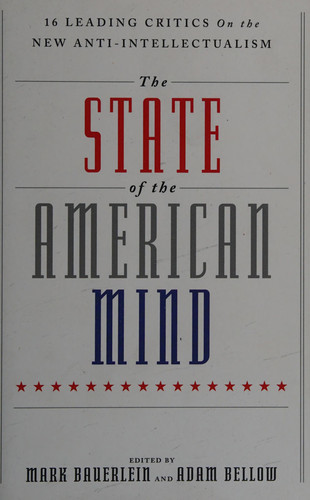
The state of the American mind: 16 leading critics on the new anti-intellectualism

Mark Bauerlein,Adam Bellow
In 1987, Allan Bloom’s The Closing of the American Mind was published; a wildly popular book that drew attention to the shift in American culture away from the tenants that made America—and Americans—unique. Bloom focused on a breakdown in the American curriculum, but many sensed that the issue affected more than education. The very essence of what it meant to be an American was disappearing. That was over twenty years ago. Since then, the United States has experienced unprecedented wealth, more youth enrolling in higher education than ever before, and technology advancements far beyond what many in the 1980s dreamed possible. And yet, the state of the American mind seems to have deteriorated further. Benjamin Franklin’s “self-made man” has become a man dependent on the state. Independence has turned into self-absorption. Liberty has been curtailed in the defense of multiculturalism. In order to fully grasp the underpinnings of this shift away from the self-reliant, well-informed American, editors Mark Bauerlein and Adam Bellow have brought together a group of cultural and educational experts to discuss the root causes of the decline of the American mind. The writers of these fifteen original essays include E. D. Hirsch, Nicholas Eberstadt, and Dennis Prager, as well as Daniel Dreisbach, Gerald Graff, Richard Arum, Robert Whitaker, David T. Z. Mindich, Maggie Jackson, Jean Twenge, Jonathan Kay, Ilya Somin, Steve Wasserman, Greg Lukianoff, and R. R. Reno. Their essays are compiled into three main categories: States of Mind: Indicators of Intellectual and Cognitive Decline These essays broach specific mental deficiencies among the population, including lagging cultural IQ, low Biblical literacy, poor writing skills, and over-medication. Personal and Cognitive Habits/Interests These essays turn to specific mental behaviors and interests, including avoidance of the news, short attention spans, narcissism, and conspiracy obsessions. National Consequences These essays examine broader trends affecting populations and institutions, including rates of entitlement claims, voting habits, and a low-performing higher education system. The State of the American Mind is both an assessment of our current state as well as a warning, foretelling what we may yet become. For anyone interested in the intellectual fate of America, The State of the American Mind offers an accessible and critical look at life in America and how our collective mind is faring.
Templeton Press 2015-06-16 260 pages

The language revolution

Crystal, David
We are living through the consequences of a linguistic revolution. Dramatic linguistic change has left us at the beginning of a new era in the evolution of human language, with repercussions for many individual languages. In this book, David Crystal, one of the world's authorities on language, brings together for the first time the three major trends which he argues have fundamentally altered the world's linguistic ecology: first, the emergence of English as the world's first truly global language; second, the crisis facing huge numbers of languages which are currently endangered or dying; and, third, the radical effect on language of the arrival of Internet technology. Examining the interrelationships between these topics, Crystal encounters a vision of a linguistic future which is radically different from what has existed in the past, and which will make us revise many cherished concepts relating to the way we think about and work with languages. Everyone is affected by this linguistic revolution. The Language Revolution will be essential reading for anyone interested in language and communication in the twenty-first century.
Polity Press 2004-03-12 142 pages

Cultural revolution in Iran: contemporary popular culture in the Islamic Republic

Annabelle Sreberny,Massoumeh Torfeh
The Islamic Republic of Iran has entered its fourth decade, and the values and legacy of the Revolution it was founded upon continue to have profound and contradictory consequences for Iranian life. Despite the repressive power of the current regime the immense creativity of popular cultural practices, that negotiate and resist a repressive system, is a potent and dynamic force. This book draws on the expertise and experience of Iranian and international academics and activists to address diverse areas of social and cultural innovation that are driving change and progress. While religious conservatism remains the creed of the establishment, this volume uncovers an underground world of new technology, media and entertainment that speaks to women seeking a greater public role and a restless younger generation that organises and engages with global trends online.
I.B. Tauris 2016 296 pages

Jordan Wolfson: California

Wolfson, Jordan
Initially conceived to document the artist’s 2014 exhibition at David Zwirner in New York—his first with the gallery, debuting new sculptural work, a critically acclaimed video, and a much-discussed animatronic sculpture—the publication ultimately exists as a hybrid between an exhibition catalogue and a stand-alone expression of Wolfson’s vision. Over the past decade, Jordan Wolfson has become known for his thought-provoking works in a wide range of media, including video, sculpture, installation, photography, and performance. He pulls intuitively from the world of advertising, the Internet, and the technology industries to produce ambitious and enigmatic narratives. However, instead of simply appropriating found material, the artist creates his own unique content, which frequently revolves around a series of invented, animated characters. This artist’s book is the product of close collaboration between Wolfson and the book designer Joseph Logan. Featuring a dynamic layout and large color plates, the book is anchored by extensive photo documentation of Wolfson’s bewitching (Female figure) 2014 , which combines elements of installation and performance in the figure of a curvaceous, scantily clad woman covered in dirt marks and wearing a witch mask. Presented are photographs by Andreas Laszlo Konrath, who documented many aspects of the exhibition, including behind-the-scenes images of its installation. Also included are reproductions of Wolfson’s new series of wall-mounted sculptures comprised of bumper stickers overlaid on inkjet prints, candid photographs of the artist taken by Gaea Woods, and a text by the artist providing context for the visual material.
David Zwirner Books 2015-11-24 135 pages