4 results for "Technology"

The Singularity Is Nearer

Kurzweil, Ray
"This successor volume to The Singularity Is Near explores how technology will refashion the human race in the decades to come. In this entirely new book, Ray Kurzweil brings a fresh perspective to advances in the singularity-assessing the progress of many of his predictions and examining the novel advancements that, in the near future, will bring a revolution in knowledge and an expansion of human potential. Among the topics he discusses are rebuilding the world atom by atom with devices like nanobots; radical life extension beyond the current age limit of 120; reinventing intelligence by expanding biological capacity with nonbiological intelligence in the cloud; how life is improving with declines in poverty and violence; and the growth of technologies that can be applied to everything from clothes to building materials to growing human organs. He also considers the potential perils of biotechnology, nanotechnology, and artificial intelligence, including such topics as how AI will impact unemployment and the safety of autonomous cars, and "After Life" technology, which will reanimate people who have passed away through a combination of data and DNA"--
Penguin USA 2025-06-03 432 pages

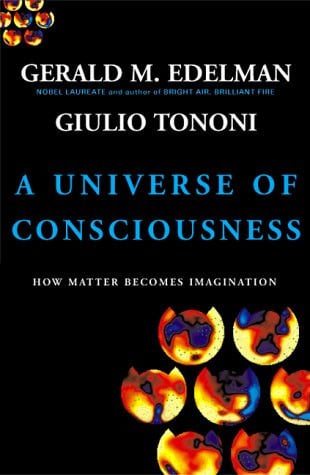
A universe of consciousness: how matter becomes imagination

Edelman, Gerald Maurice
In A Universe of Consciousness, Gerald Edelman builds on the radical ideas he introduced in his monumental trilogy-Neural Darwinism, Topobiology, and The Remembered Present-to present for the first time an empirically supported full-scale theory of consciousness. He and the neurobiolgist Giulio Tononi show how they use ingenious technology to detect the most minute brain currents and to identify the specific brain waves that correlate with particular conscious experiences. The results of this pioneering work challenge the conventional wisdom about consciousness.
Basic Books 2000 274 pages

The human mind: and how to make the most of it

Winston, Robert M. L.
The most mysterious object in the universe is covered in a dull grey membrane and resembles a gigantic fungus. It is, of course, the human brain. Technology has helped us understand how the brain gives rise to the human mind. We can now tell which regions of the brain use energy and which cells generate electricity, as we fall in love, tell a lie or dream of a lottery win. In this accessible and entertaining book, Robert Winston explains how memories are formed or lost, how the ever-changing brain is responsible for toddler tantrums, teenage angst, and the battle of the sexes, and reveals the truth behind extra-sensory perception, deja vu and out-of-body experiences. But paradoxically, science may never quite explain the remarkable mechanism that makes each of us unique.
BBC Large Print 2004-06 512 pages

Mind wars: brain research and national defense

Moreno, Jonathan D.
In his fascinating new book, Jonathan D. Moreno investigates the deeply intertwined worlds of cutting-edge brain science, U.S. defense agencies, and a volatile geopolitical landscape where a nation's weaponry must go far beyond bombs and men. The first-ever exploration of the connections between national security and brain research, Mind Wars: Brain Research and National Defense reveals how many questions crowd this gray intersection of science and government and urges us to begin to answer them. From neuropharmacology to neural imaging to brain-machine interface devices that relay images and sounds between human brains and machines, Moreno shows how national security entities seek to harness the human nervous system in a multitude of ways as a potent weapon against the enemy soldier. Moreno charts such projects as monkeys moving robotic arms with their minds, technology to read the brain’s thought patterns at a distance, the development of "anti-sleep" drugs to enhance soldiers’ battle performance and others to dampen their emotional reactions to the violence, and advances that could open the door to "neuroweapons"—virus-transported molecules to addle the brain. "As new kinds of weapons are added to the arsenal already at the disposal of fallible human leaders," Moreno writes, "we need to find new ways to address the problem"--of the ethical military application of so powerful and intimate a science. This book is the first step in confronting the quandaries inherent in this partnership of government and neuroscience, serves as a compelling wake-up call for scientists and citizens, and suggests that, with imagination, we might meet the needs of both security and civil liberty.
Dana Press 2006-11-17 210 pages