
6 results for "Technology"

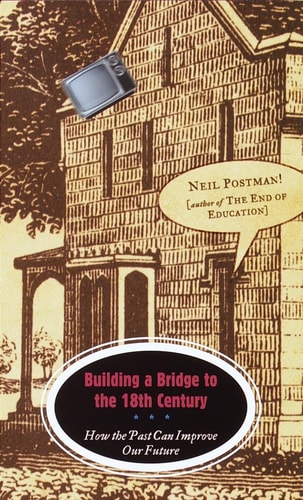
Building a bridge to the 18th century: how the past can improve our future

Postman, Neil
In Building a Bridge to the 18th Century , acclaimed cultural critic Neil Postman offers a cure for the hysteria and hazy values of the postmodern world. Postman shows us how to reclaim that balance between mind and machine in a dazzling celebration of the accomplishments of the Enlightenment-from Jefferson's representative democracy to Locke's deductive reasoning to Rousseau's demand that the care and edification of children be considered an investment in our collective future. Here, too, is the bold assertion that Truth is invulnerable to fashion or the passing of time. Provocative and brilliantly argued, Building a Bridge to the 18th Century illuminates a navigable path through the Information Age-a byway whose signposts, it turns out, were there all along.
Knopf 2000-10-10 213 pages

Republic.com 2.0

Sunstein, Cass R.
What happens to democracy and free speech if people use the Internet to create echo chambers--to listen and speak only to the like-minded? What is the democratic benefit of the Internet's unlimited choices if citizens narrowly limit the information they receive, creating ever-smaller niches and fragmenting the shared public conversation on which democracy depends? Cass Sunstein first asked these questions before 9/11, in Republic.com, and they have become even more urgent in the years since. Now, in Republic.com 2.0, Sunstein thoroughly rethinks the critical relationship between democracy and the Internet in a world where partisan Web logs have emerged as a significant force in politics and where cyber-jihadists have embraced the Internet to thwart democracy and spread violence. Emphasizing the value of unplanned, unchosen encounters, the original Republic.com provoked a strong reaction from cyber-optimists. In Republic.com 2.0 Sunstein answers the critics and expands his argument to take account of new developments, including the blogosphere, and fresh evidence about how people are using the Internet. He demonstrates that the real question is how to avoid "information cocoons" and to ensure that the unrestricted choices made possible by technology do not undermine democracy. Sunstein also proposes new remedies and reforms--focusing far less on what government should do, and much more on what consumers and producers should do--to help democracy avoid the perils, and realize the promise, of the Internet.
Princeton University Press 2007 251 pages

They know everything about you: how data-collecting corporations and snooping government agencies are destroying democracy

Scheer, Robert
They Know Everything About You is a groundbreaking exposé of how government agencies and tech corporations monitor virtually every aspect of our lives, and a fierce defense of privacy and democracy. The revelation that the government has access to a vast trove of personal online data demonstrates that we already live in a surveillance society. But the erosion of privacy rights extends far beyond big government. Intelligence agencies such as the NSA and CIA are using Silicon Valley corporate partners as their data spies. Seemingly progressive tech companies are joining forces with snooping government agencies to create a brave new world of wired tyranny. Life in the digital age poses an unprecedented challenge to our constitutional liberties, which guarantee a wall of privacy between the individual and the government. The basic assumption of democracy requires the ability of the individual to experiment with ideas and associations within a protected zone, as secured by the Constitution. The unobserved moment embodies the most basic of human rights, yet it is being squandered in the name of national security and consumer convenience. Robert Scheer argues that the information revolution, while a source of public enlightenment, contains the seeds of freedom’s destruction in the form of a surveillance state that exceeds the wildest dream of the most ingenious dictator. The technology of surveillance, unless vigorously resisted, represents an existential threat to the liberation of the human spirit.
Nation Books 2015-02-24 256 pages

Electromagnetic Energy Transmission and Radiation

Richard B. Adler,Lan Jen Chu,Robert M. Fano
This book develops a consistent macroscopic theory of electromagnetism and discusses the relation between circuit theory and filed theory. The theory is developed in successive steps from the Lorentz force, the integral form of Maxwell's equations in free space, and suitable macroscopic models of polarized and magnetized matter. It covers the electromagnetism of moving bodies and the process of electromechanical energy conversion; introduces a power-series technique for analyzing quasi-static fields and quasi-stationary systems; it emphasizes the synthesis of fields as opposed to the analysis of fields. Presented in an appendix, the reader will also find, the four-dimensional relativistic formulation of macroscopic electrodynamics.
MIT Press 1968-10 621 pages

Dynamics of the Arab-Israel Conflict Past and Present: Intellectual Odyssey II

Michael Brecher
This book comprises findings from the author's wide-ranging research since 1948 on the unresolved Arab/Israel protracted conflict. Brecher reflects back on his detailed analysis of the UN Commission created in November 1947, and his near-seven decades of research and publications on this complex protracted conflict continued since the first of nine Arab/Israeli wars. The book includes an analysis of the crucial early phase of the unresolved struggle for control of Jerusalem in 1948-49 and beyond, based on extensive interviews with Israel’s leaders and prominent Egyptian senior officials, journalists and academics. It addresses the many diverse attempts at conflict resolution, including a peace plan to resolve the Arab/Israel conflict of the author's own design. It concludes with historical reflections about Israel’s behavior, domestically and externally, in 1948-1949 and 2008 and beyond. No other book on this protracted conflict contains so many important interviews with the first two generations of Israeli leaders and Egyptian officials and academics, and no other author can speak from such a deep and prolonged engagement.
Springer International Publishing 2018-07-13 410 pages

The Preventive State: the Challenge of Preempting Serious Harms While Preserving Essential Liberties

Dershowitz, Alan
"If reliable but uncertain intelligence predicted a mass casualty terrorist attack and indicated likely suspects, what preventive actions would be constitutionally authorized? Detention? Interrogation? Torture? What if the attack involved a weaponized virus? Should the government compel widespread inoculation that might kill hundreds of people while saving millions? What if an article describing how to circumvent the inoculation mandate was about to be published? Should censorship of the article be authorized? These are the sorts of questions Alan Dershowitz has been asking for more than 60 years, in his teaching, writing, and litigation. Now, at age 86, he has written his magnum opus. In it, he suggests an overarching jurisprudential framework that would set limits to the ballooning power of what he calls "the preventive state." This important book offers unprecedented insights into one of the most underexamined developments of our age: the growing magnitude and frequency of cataclysmic threats, coupled with the increasingly effective--but increasingly intrusive--tools intended to predict and prevent them. Dershowitz responds to the urgent need for a jurisprudence that provides balance and accountability as both dangers and preventive capabilities increase, threatening our security and our liberties. This masterful analysis should be read by everyone who cares about security, liberty, and democracy."--
Encounter Books 2025 220 pages