4 results for "Technology"

Reactionary modernism: technology, culture, and politics in Weimar and the Third Reich

Herf, Jeffrey
Explores the paradox inherent in the German fascists' rejection of the rationalism of the Enlightenment while fully embracing modern technology. By associating technology with the Germans rather than the Jews, with beautiful form rather than the formlessness of the market, and with a strong state rather than a predominance of economic values and institutions, right-wing intellectuals reconciled Germany's strength with its romantic soul and national identity. Includes discussion on the transformation of anti-capitalist rhetoric to anti-Jewish rhetoric. See the index for references to antisemitism, and especially ch. 6, "Werner Sombart: Technology and the Jewish Question".
Cambridge University Press 1984 251 pages

Thinking with history: explorations in the passage to modernism

Schorske, Carl E.
In this book, the distinguished historian Carl Schorske--author of the Pulitzer Prize-winning Fin-de-Siécle Vienna --draws together a series of essays that reveal the changing place of history in nineteenth-and twentieth-century cultures. In most intellectual and artistic fields, Schorske argues, twentieth-century Europeans and Americans have come to do their thinking without history. Modern art, modern architecture, modern music, modern science--all have defined themselves not as emerging from or even reacting against the past, but as detached from it in a new, autonomous cultural space. This is in stark contrast to the historicism of the nineteenth century, he argues, when ideas about the past pervaded most fields of thought from philosophy and politics to art, music, and literature. However, Schorske also shows that the nineteenth century's attachment to thinking with history and the modernist way of thinking without history are more than just antitheses. They are different ways of trying to address the problems of modernity, to give shape and meaning to European civilization in the era of industrial capitalism and mass politics. Schorske begins by reflecting on his own vocation as it was shaped by the historical changes he has seen sweep across political and academic culture. Then he offers a European sampler of ways in which nineteenth-century European intellectuals used conceptions of the past to address the problems of their day: the city as community and artifact; the function of art; social dislocation. Narrowing his focus to Fin-de-Siécle Vienna in a second group of essays, he analyzes the emergence of ahistorical modernism in that city. Against the background of Austria's persistent, conflicting Baroque and Enlightenment traditions, Schorske examines three Viennese pioneers of modernism--Adolf Loos, Gustav Mahler, and Sigmund Freud--as they sought new orientation in their fields. In a concluding essay, Schorske turns his attention to thinking about history. In the context of a postmodern culture, when other disciplines that had once abandoned history are discovering new uses for it, he reflects on the nature and limits of history for the study of culture. Originally published in 1998. The Princeton Legacy Library uses the latest print-on-demand technology to again make available previously out-of-print books from the distinguished backlist of Princeton University Press. These editions preserve the original texts of these important books while presenting them in durable paperback and hardcover editions. The goal of the Princeton Legacy Library is to vastly increase access to the rich scholarly heritage found in the thousands of books published by Princeton University Press since its founding in 1905. -- "Kirkus Reviews"
Princeton University Press 1999 240 pages

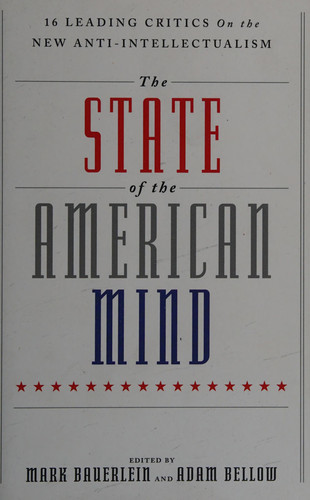
The state of the American mind: 16 leading critics on the new anti-intellectualism

Mark Bauerlein,Adam Bellow
In 1987, Allan Bloom’s The Closing of the American Mind was published; a wildly popular book that drew attention to the shift in American culture away from the tenants that made America—and Americans—unique. Bloom focused on a breakdown in the American curriculum, but many sensed that the issue affected more than education. The very essence of what it meant to be an American was disappearing. That was over twenty years ago. Since then, the United States has experienced unprecedented wealth, more youth enrolling in higher education than ever before, and technology advancements far beyond what many in the 1980s dreamed possible. And yet, the state of the American mind seems to have deteriorated further. Benjamin Franklin’s “self-made man” has become a man dependent on the state. Independence has turned into self-absorption. Liberty has been curtailed in the defense of multiculturalism. In order to fully grasp the underpinnings of this shift away from the self-reliant, well-informed American, editors Mark Bauerlein and Adam Bellow have brought together a group of cultural and educational experts to discuss the root causes of the decline of the American mind. The writers of these fifteen original essays include E. D. Hirsch, Nicholas Eberstadt, and Dennis Prager, as well as Daniel Dreisbach, Gerald Graff, Richard Arum, Robert Whitaker, David T. Z. Mindich, Maggie Jackson, Jean Twenge, Jonathan Kay, Ilya Somin, Steve Wasserman, Greg Lukianoff, and R. R. Reno. Their essays are compiled into three main categories: States of Mind: Indicators of Intellectual and Cognitive Decline These essays broach specific mental deficiencies among the population, including lagging cultural IQ, low Biblical literacy, poor writing skills, and over-medication. Personal and Cognitive Habits/Interests These essays turn to specific mental behaviors and interests, including avoidance of the news, short attention spans, narcissism, and conspiracy obsessions. National Consequences These essays examine broader trends affecting populations and institutions, including rates of entitlement claims, voting habits, and a low-performing higher education system. The State of the American Mind is both an assessment of our current state as well as a warning, foretelling what we may yet become. For anyone interested in the intellectual fate of America, The State of the American Mind offers an accessible and critical look at life in America and how our collective mind is faring.
Templeton Press 2015-06-16 260 pages

A bibliography for After Jews and Arabs

Alcalay, Ammiel
Ammiel Alcalay's groundbreaking work, After Jews and Arabs, published in 1993, redrew the geographic, political, cultural, and emotional map of relations between Jews and Arabs in the Levantine/Mediterranean world over a thousand-year period. Based on over a decade of research and fieldwork in many disciplines-including history and historiography; anthropology, ethnography, and ethnomusicology; political economy and geography; linguistics; philosophy; and the history of science and technology-the book presented a radically different perspective than that presented by received opinion. Given the radical and iconoclastic nature of Alcalay's perspective, After Jews and Arabs met great resistance in attempts to publish it. Though completed and already circulating in 1989, it didn't appear until 1993. In addition, when the book was published, there wasn't enough space to include its original bibliography, a foundational part of the project. A Bibliography for After Jews and Arabs presents the original bibliography, as completed in 1992, without changes, as a glimpse into the historical record of a unique scholarly, political, poetic, and cultural journey. The bibliography itself had roots in research begun in the late 1970s and demonstrates a very wide arc. In addition to the bibliography, we include three accompanying texts here. In "Behind the Scenes: Before After Jews and Arabs, " Alcalay takes us behind the closed doors of the academic process, reprinting the original reader reports and his detailed rebuttals, and in "A Bibliography for After Jews and Arabs A Brief Introduction," Alcalay contextualizes his own path to the work he undertook, in methodological, historical, and political terms. Also included is "A Poetics of Bibliography." Poet, novelist, translator, critic, and scholar Ammiel Alcalay teaches at Queens College and The Graduate Center, CUNY. His books include After Jews and Arabs, Keys to the Garden, Memories of Our Future, Islanders, and neither wit nor gold: from then. A 10th-anniversary edition of from the warring factions, a book-length poem dedicated to Srebrenica, and a book of essays, a little history, came out in 2013. a little history also came out in a Portuguese translation with Editor Lumme, São Paolo in 2019. During the wars in ex-Yugoslavia, he was the primary translator of texts from Bosnia, and translations include Sarajevo Blues and Nine Alexandrias by poet Semezdin Mehmedinovic, as well as works by journalist Zlatko Dizdarevic, and many others. Alcalay is the General Editor of Lost & Found: The CUNY Poetics Document Initiative, a series of student and guest-edited archival texts emerging from New American Poetry, and he was the recipient of a 2017 Before Columbus Foundation American Book Award for this work.
Punctum Books 2021 116 pages