
5 results for "Technology"

The silent world of doctor and patient

Katz, Jay
In this eye-opening look at the doctor-patient decision-making process, physician and law professor Jay Katz examines the time-honored belief in the virtue of silent care and patient compliance. Historically, the doctor-patient relationship has been based on a one-way trust—despite recent judicial attempts to give patients a greater voice through the doctrine of informed consent. Katz criticizes doctors for encouraging patients to relinquish their autonomy, and demonstrates the detrimental effect their silence has on good patient care. Seeing a growing need in this age of medical science and sophisticated technology for more honest and complete communication between physician and patients, he advocates a new, informed dialogue that respects the rights and needs of both sides. In a new foreword to this edition of The Silent World of Doctor and Patient , Alexander Morgan Capron outlines the changes in medical ethics practice that have occurred since the book was first published in 1984, paying particular attention to the hotly debated issues of physician-assisted suicide and informed consent in managed care.
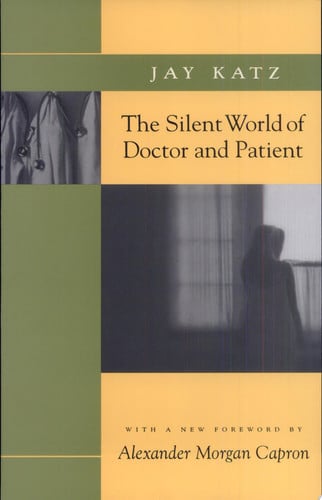
Johns Hopkins University Press 2002-11 263 pages

Who says you're dead? medical & ethical dilemmas for the curious and concerned

Appel, Jacob M.
“An original, compelling, and provocative exploration of ethical issues in our society, with thoughtful and balanced commentary. I have not seen anything like it.” —Alan Lightman, author of Einstein’s Dreams Drawing upon the author’s two decades teaching medical ethics, as well as his work as a practicing psychiatrist, this profound and addictive little book offers up challenging ethical dilemmas and asks readers, What would you do? A daughter gets tested to see if she’s a match to donate a kidney to her father. The test reveals that she is not the man’s biological daughter. Should the doctor tell the father? Or the daughter? A deaf couple prefers a deaf baby. Should they be allowed to use medical technology to ensure they have a child who can’t hear? Who should get custody of an embryo created through IVF when a couple divorces? Or, when you or a loved one is on life support, Who says you’re dead? In short, engaging scenarios, Dr. Appel takes on hot-button issues that many of us will confront: genetic screening, sexuality, privacy, doctor-patient confidentiality. He unpacks each hypothetical with a brief reflection drawing from science, philosophy, and history, explaining how others have approached these controversies in real-world cases. Who Says You’re Dead? is designed to defy easy answers and to stimulate thought and even debate among professionals and armchair ethicists alike.
Algonquin Books of Chapel Hill 2019-10-08 327 pages

Sex in an age of technological reproduction: ICSI and Taboos

Djerassi, Carl
Carl Djerassi is one of "the fathers of the Pill"--he was awarded the National Medal of Science for the first synthesis of a steroid oral contraceptive--and has had a prolific additional career as a writer of fiction, plays, and dialogues about science. In these two plays, ICSI and Taboos , he dramatizes the social transformations and contested viewpoints created by advances in reproductive science and technology. Two of the most startling developments in contemporary science have radically disrupted the historical connection between sex and reproduction: in vitro fertilization and intracytoplasmic sperm injection (ICSI)--an assisted reproductive technique that directly injects a single sperm into an egg. The word play ICSI --designed for classroom readings--presents, in the format of a contentious talk-show dialogue, the science of direct-injection fertilization and the ethical issues connected with it. A DVD included in the book provides video of the ICSI injection process as viewed through a microscope, to be used in performances of the ICSI one-act dialogue. Taboos, a full-length play, turns the screws on characters that reflect a polarized America. Two couples--lesbian partners and a conservative husband and wife struggling with infertility--must make choices in a drama that examines the disjunction of sexual reproduction and the physical act of sex.
University of Wisconsin Press 2008 115 pages

Matters of life and death: a Jewish approach to modern medical ethics

Dorff, Elliot N.
The International Society for Science and Religion has selected Matters of Life and Death as an element of the ISSR Library. The mission of the ISSR Library is "to provide a comprehensive resource for scholars, students, and interested lay readers in the area of science and the human spirit."The incredible medical breakthroughs of today, like genetic engineering, in-vitro fertilizations, and cloning have transformed long-held beliefs on the nature of both life and death, raising difficult moral and religious questions. In Matters of Life and Death Elliot Dorff thoroughly addresses this unavoidable confluence of medical technology and Jewish law and ethics. Elliot N. Dorff, Rabbi (Jewish Theological Seminary), PhD (Columbia University), is rector and Sol and Anne Dorff Distinguished Professor of Philosophy at the American Jewish University (formerly the University of Judaism) in Los Angeles. Among the twelve books he has written are four award-winning books on Jewish ethics and law published by The Jewish Publication Society: Matters of Life and Death (1998) on Jewish medical ethics; To Do the Right and the Good (2002) on Jewish social ethics; Love Your Neighbor and Yourself on Jewish personal ethics; and For the Love of God and People: A Philosophy of Jewish Law (2007). He has also edited 10 books, including Contemporary Jewish Ethics and Morality (Oxford, 1995) and Contemporary Jewish Theology (Oxford, 1999), co-edited by Louis Newman, who also co-edited with Dorff the first three volumes of the Jewish Choices, Jewish Voices series. Since 1984, Rabbi Dorff has served on the Rabbinical Assembly's Committee on Jewish Law and Standards, and has served as its Chair since 2007. He has also served on several federal advisory commissions dealing with the ethics of health care, sexual responsibility, and research on human subjects. He is a member of the State of California's Ethics Committee on embryonic stem cell research. He is married to Marlynn, and they have four children and seven grandchildren.
Jewish Publication Society 1998 456 pages

Diagnosis: Philosophical and Medical Perspectives

N. Laor,Joseph Agassi
1. GENERAL The term "diagnostics" refers to the general theory of diagnosis, not to the study of specific diagnoses but to their general framework. It borrows from different sciences and from different philosophies. Traditionally, the general framework of diagnostics was not distinguished from the framework of medicine. It was not taught in special courses in any systematic way; it was not accorded special attention: students absorbed it intuitively. There is almost no comprehensive study of diagnostics. The instruction in diagnosis provided in medical schools is exclusively specific. Clinical instruction includes (in addition to vital background information, such as anatomy and physiology) specific instruction in nosology, the theory and classification of diseases, and this includes information on diagnoses and prognoses of diverse diseases. What is the cause of the neglect of diagnostics, and of its integrated teaching? The main cause may be the prevalence of the view of diagnostics as part-and parcel of nosology. In this book nosology is taken as a given, autonomous field of study, which invites almost no comments; we shall freely borrow from it a few important general theses and a few examples. We attempt to integrate here three studies: ll of the way nosology is used in the diagnostic process; of the diagnostic process as a branch of applied ethics; ~ of the diagnostic process as a branch of social science and social technology.
Springer Netherlands 2011-10-17 263 pages